

Q 11-06-227JEE MainJEE Main 2019 (11 Jan, Shift 2)Medium
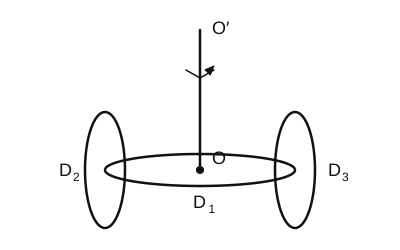
A circular disc $D_1$ of mass $M$ and radius $R$ has two identical discs $D_2$ and $D_3$ of the same mass $M$ and radius $R$ attached rigidly at its opposite ends (see figure). The moment of inertia of the system about the axis OO′, passing through the centre of $D_1$, as shown in the figure, will be
Answer: (B) $3MR^2$
$D_1$ is horizontal and OO′ is perpendicular to it through its centre: $I_1 = \dfrac{MR^2}{2}$.
$D_2$ and $D_3$ are vertical and centred at the ends of a diameter of $D_1$ (distance $R$ from the axis). OO′ is parallel to a diameter of each, so by the parallel axis theorem
$$I_2 = I_3 = \frac{MR^2}{4} + MR^2 = \frac54MR^2$$
$$I = \frac{MR^2}{2} + 2\times\frac54MR^2 = 3MR^2$$
 Solution by Sreeraj P, M.Sc Physics