

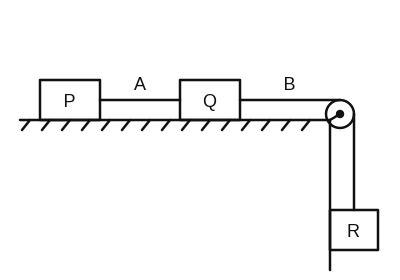
Each of three blocks $P$, $Q$ and $R$ shown in the figure has a mass of $3\ \text{kg}$. Each of the wires $A$ and $B$ has cross-sectional area $0.005\ \text{cm}^2$ and Young's modulus $2\times10^{11}\ \text{N m}^{-2}$. Neglecting friction, the longitudinal strain on wire $B$ is ______ $\times10^{-4}$. (Take $g = 10\ \text{m s}^{-2}$)
Numerical value type. Enter your answer.
Answer: 2
Concept. Find the tension in wire $B$ from Newton's laws, then strain $=\dfrac{T}{AY}$. From the figure, $P$ and $Q$ are on the smooth table (joined by $A$) and $B$ runs from $Q$ over the pulley to the hanging block $R$.
Step 1. Acceleration. Only $R$'s weight drives all three: $a=\dfrac{30}{9}=\dfrac{10}{3}$ m s$^{-2}$.
Step 2. Tension in $B$. It pulls $P$ and $Q$: $T_B=6\times\dfrac{10}{3}=20$ N.
Step 3. Strain. $A=0.005$ cm$^2=5\times10^{-7}$ m$^2$:
$$\varepsilon=\frac{20}{5\times10^{-7}\times2\times10^{11}}=2\times10^{-4}$$
Answer. $2$.
 Solution by Sreeraj P, M.Sc Physics


