The maximum elongation of a steel wire of $1$ m length if the elastic limit of steel and its Young's modulus, respectively, are $8 \times 10^8\ \text{N m}^{-2}$ and $2 \times 10^{11}\ \text{N m}^{-2}$, is :
Concept. The largest stress the wire can take without permanent deformation is the elastic limit; Hooke's law then gives the maximum strain, $\text{strain} = \dfrac{\text{stress}}{Y}$.
Let a wire be suspended from the ceiling (rigid support) and stretched by a weight $W$ attached at its free end. The longitudinal stress at any point of cross-sectional area $A$ of the wire is :
Concept. Longitudinal stress is the internal force per unit cross-sectional area.
Step 1. Force in the wire. The light wire carries the tension $W$ at every point along its length.
Step 2. Stress. $$\text{stress} = \frac{W}{A}$$
Answer. $W/A$ (Option B).
Solution by Sreeraj P, M.Sc Physics
Q 11-08-003NEETNEET 2020Top questionEasy
A wire of length L, area of cross section A is hanging from a fixed support. The length of the wire changes to $L_1$ when mass M is suspended from its free end. The expression for Young's modulus is :
A wire of length $2$ m and cross-sectional area $1\ \text{mm}^2$ is stretched by a force of $100$ N. Young's modulus of the material is $2 \times 10^{11}$ N m$^{-2}$. The extension of the wire is
Two wires P and Q are made of the same material. The length of Q is twice that of P, and the diameter of P is twice that of Q. The same load is hung from each. The ratio of the extension of P to that of Q is
Two rods of equal length and equal cross-section, with Young's moduli $Y_1$ and $Y_2$, are joined end to end. The combination is stretched by a force. The effective Young's modulus of the combined rod is
Concept. Rods joined end to end carry the same force, and their extensions add.
Step 1. Extensions. Each rod has length $L$: $\Delta L_1 = \dfrac{FL}{AY_1}$, $\Delta L_2 = \dfrac{FL}{AY_2}$.
Step 2. Equivalent rod. Length $2L$, same area, same force: $$\frac{F(2L)}{AY} = \frac{FL}{AY_1} + \frac{FL}{AY_2} \;\Rightarrow\; \frac{2}{Y} = \frac{1}{Y_1} + \frac{1}{Y_2}$$
Step 3. Solve. $$Y = \frac{2Y_1Y_2}{Y_1 + Y_2}$$
Answer. $\dfrac{2Y_1Y_2}{Y_1 + Y_2}$ (Option C).
Solution by Sreeraj P, M.Sc Physics
Q 11-08-007JEE MainMedium
A steel wire ($Y = 2 \times 10^{11}$ N m$^{-2}$) is under a tensile stress of $2 \times 10^8$ N m$^{-2}$. Find the elastic energy stored per unit volume of the wire, in kJ m$^{-3}$.
The bulk modulus of water is $2.2 \times 10^9$ N m$^{-2}$. When the pressure on some water is increased by $1.1 \times 10^7$ N m$^{-2}$, its volume decreases by
A metal cube of side $10$ cm has its bottom face fixed. A tangential force of $10^4$ N is applied to its top face. The shear modulus of the metal is $2.5 \times 10^{10}$ N m$^{-2}$. The top face moves sideways by
A steel rod is held tightly between two rigid walls and heated through $50^\circ$C. For steel, $\alpha = 1.2 \times 10^{-5}\ \text{K}^{-1}$ and $Y = 2 \times 10^{11}$ N m$^{-2}$. The stress developed in the rod is
Step 2. Stress. $$\text{stress} = Y\alpha\Delta T = 2 \times 10^{11} \times 6 \times 10^{-4} = 1.2 \times 10^8\ \text{N m}^{-2}$$ It does not depend on the rod's length or area.
Answer. $1.2 \times 10^8$ N m$^{-2}$ (Option C).
Solution by Sreeraj P, M.Sc Physics
Q 11-08-012NEETJEE MainHard
A uniform wire of length $L$, density $\rho$ and Young's modulus $Y$ hangs vertically from a rigid support. The extension of the wire due to its own weight is
Concept. The tension in a hanging wire varies along it: a point at height $x$ above the free end supports only the wire below it. Add the stretches of thin slices.
Step 1. Tension at height $x$. The part below weighs $\rho Axg$, so the tension there is $T(x) = \rho Agx$.
Step 2. Stretch of a slice $dx$. $$d(\Delta L) = \frac{T(x)\,dx}{AY} = \frac{\rho gx}{Y}dx$$
Step 3. Integrate. $$\Delta L = \int_0^L \frac{\rho gx}{Y}dx = \frac{\rho gL^2}{2Y}$$ (The same as the whole weight acting through half the length.)
Answer. $\dfrac{\rho gL^2}{2Y}$ (Option D).
Solution by Sreeraj P, M.Sc Physics
Q 11-08-013NEETJEE MainEasy
A material that undergoes a large plastic deformation between its elastic limit and its fracture point is called
Concept. The gap between the elastic limit and the fracture point on a stress–strain curve measures how much permanent (plastic) deformation a material can take.
Step 1. Classify. A large plastic region means the material can be drawn into wires or beaten into sheets: it is ductile (copper, aluminium). Brittle materials break soon after the elastic limit.
Answer. Ductile (Option A).
Solution by Sreeraj P, M.Sc Physics
Q 11-08-014NEETJEE MainEasy
Steel is said to be more elastic than rubber because
Answer: (B) steel needs a much larger stress for the same strain
Concept. In physics, "more elastic" means a larger modulus of elasticity: more stress is needed for the same strain.
Step 1. Compare. Steel's Young's modulus ($\sim 2 \times 10^{11}$ Pa) is far larger than rubber's ($\sim 10^6$ Pa), so steel needs a much larger stress for the same strain.
Answer. Steel needs a much larger stress for the same strain (Option B).
Solution by Sreeraj P, M.Sc Physics
Q 11-08-015NEETJEE MainMedium
A wire can hold a maximum load of $100$ kg before breaking. Another wire of the same material, twice as long and with twice the radius, can hold a maximum load of
Q 11-08-018JEE MainJEE Main 2026 (6 Apr, Shift 1)Medium
A lift of mass $1600$ kg is supported by thick iron wire. If the maximum stress which the wire can withstand is $4 \times 10^8\ \text{N/m}^2$ and its radius is $4$ mm, then maximum acceleration the lift can take is ______ $\text{m/s}^2$. (take $g = 10\ \text{m/s}^2$ and $\pi = 3.14$)
Concept. The wire breaks if its stress exceeds the maximum stress, so the largest tension it can take is $T_{\max}=\sigma_{\max}A$. When the lift accelerates upward, Newton's law gives $T-mg=ma$, so the tension is largest then.
Step 1. Largest tension. $$T_{\max}=4\times10^8\times\pi(4\times10^{-3})^2=4\times10^8\times3.14\times16\times10^{-6}=20\,096\ \text{N}$$
Step 2. Newton's law for the lift (upward acceleration $a$): $$T_{\max}=m(g+a)\ \Rightarrow\ g+a=\frac{20\,096}{1600}=12.56$$
Step 3. Acceleration. $a=12.56-10=2.56$ m s$^{-2}$.
Answer. Option A.
Solution by Sreeraj P, M.Sc Physics
Q 11-08-019JEE MainJEE Main 2026 (6 Apr, Shift 1)Easy
The two wires $A$ and $B$ of equal cross-section but of different materials are joined together. The ratio of Young's modulus of wire $A$ and wire $B$ is $20/11$. When the joined wire is kept under certain tension the elongations in the wires $A$ and $B$ are equal. If the length of wire $A$ is $2.2$ m, then the length of wire $B$ is ______ m.
Q 11-08-020JEE MainJEE Main 2026 (6 Apr, Shift 2)Medium
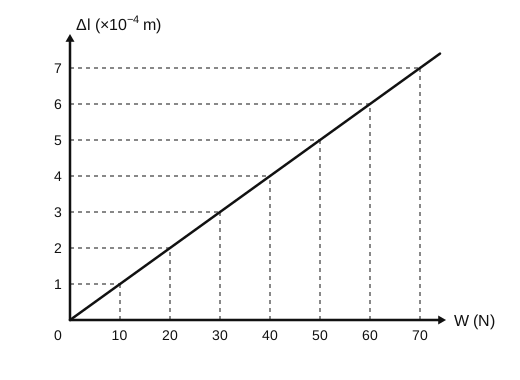
Figure represents the extension ($\Delta l$) of a wire of length $1$ meter, suspended from the ceiling of the room at one end with a load $W$ connected to the other end. If the cross-sectional area of the wire is $10^{-5}\ \text{m}^2$ then the Young's modulus of the wire is ______ $\text{N/m}^2$.
Concept. Young's modulus $Y=\dfrac{\text{stress}}{\text{strain}}$ is a property of the material, like density. Changing the size or shape of a wire changes how much it stretches, but not $Y$.
Answer. $Y$ remains unchanged (Option C). Only temperature and the material change $Y$.
Solution by Sreeraj P, M.Sc Physics
Q 11-08-022JEE MainJEE Main 2026 (5 Apr, Shift 1)Medium
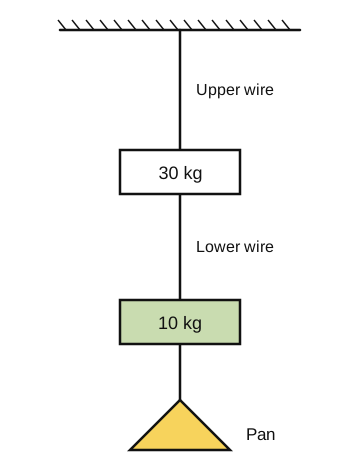
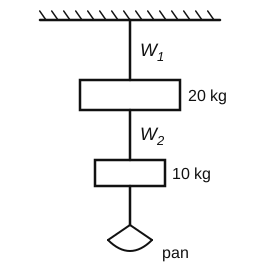
Two wires as shown in the figure below, made of steel and have breaking stress of $12 \times 10^8\ \text{N/m}^2$. Area of cross-section of upper wire is $0.008\ \text{cm}^2$ and of lower wire is $0.004\ \text{cm}^2$. The maximum mass that can be added to pan without breaking any wire is ______ kg.
Concept. Each wire carries everything hanging below it. Find the largest pan load allowed by each wire; the smaller one decides. From the figure: upper wire, $30$ kg block, lower wire, $10$ kg block, then the pan (mass neglected).
Step 1. Breaking loads. Upper: $12\times10^8\times0.008\times10^{-4}=960$ N ($96$ kg). Lower: $12\times10^8\times0.004\times10^{-4}=480$ N ($48$ kg).
Step 2. Upper wire. Carries $30+10+m\le96\Rightarrow m\le56$ kg.
Step 3. Lower wire. Carries $10+m\le48\Rightarrow m\le38$ kg.
Answer. $38$ kg (Option B).
Solution by Sreeraj P, M.Sc Physics
Q 11-08-023JEE MainJEE Main 2026 (5 Apr, Shift 1)Easy
A cube has side length $5$ cm and modulus of rigidity $10^5\ \text{N/m}^2$. The displacement produced by a force of $10$ N in the upper face of cube is ______ mm.
Concept. Shear modulus $\eta=\dfrac{F/A}{\theta}$ with $\theta=\dfrac{\Delta x}{L}$. For a cube, $\Delta x=\dfrac{FL}{\eta A}=\dfrac{F}{\eta L}$.
Step 1. Substitute. $\Delta x=\dfrac{10}{10^5\times0.05}=2\times10^{-3}$ m.
Answer. $2$ mm.
Solution by Sreeraj P, M.Sc Physics
Q 11-08-024JEE MainJEE Main 2026 (5 Apr, Shift 2)Easy
A copper wire of length $3$ m is stretched by $3$ mm by applying an external force. The volume of the wire is $600 \times 10^{-6}\ \text{m}^3$. The elastic potential energy stored in the wire in stretched condition would be ______ J. (Given Young modulus of copper $= 1.1 \times 10^{11}\ \text{N/m}^2$)
Q 11-08-025JEE MainJEE Main 2026 (4 Apr, Shift 2)Medium
A metal string $A$ is suspended from a rigid support and its free end is attached to a block of mass $M$. Second block having mass $2M$ is suspended at the bottom of the first block using a string $B$. The area of cross sections of strings $A$ and $B$ are same. The ratio of lengths of strings of $A$ to $B$ is $2$ and the ratio of their Young's moduli $(Y_A/Y_B)$ is $0.5$. The ratio of elongations in $A$ to $B$ is ______.
Concept. Each string carries the weight of everything below it, then $\Delta l=\dfrac{TL}{AY}$. Take the ratio so that the common quantities cancel.
Step 1. Tensions. String $A$ holds both blocks: $T_A=3Mg$. String $B$ holds only the lower block: $T_B=2Mg$.
Step 2. Ratio (same area): $$\frac{\Delta l_A}{\Delta l_B}=\frac{T_A}{T_B}\cdot\frac{L_A}{L_B}\cdot\frac{Y_B}{Y_A}=\frac32\times2\times\frac1{0.5}=6$$
Answer. Option D.
Solution by Sreeraj P, M.Sc Physics
Q 11-08-026JEE MainJEE Main 2026 (4 Apr, Shift 1)Easy
The increase in the pressure required to decrease the volume ($\Delta V$) of water is $6.3 \times 10^7\ \text{N/m}^2$. The percentage decrease in the volume is ______.
(Bulk modulus of water $= 2.1 \times 10^9\ \text{N/m}^2$.)
Q 11-08-027JEE MainJEE Main 2026 (4 Apr, Shift 1)Medium
A string $A$ of length $0.314$ m and Young's modulus $2 \times 10^{10}\ \text{N/m}^2$ is connected to another string $B$ of length and Young's modulus both twice of those of $A$. This series combination of strings is then suspended from a rigid support and its free end is fixed to a load of mass $0.8$ kg. The net change in length of the combination is ______ mm.
(radius of both the strings is $0.2$ mm and acceleration due to gravity $= 10\ \text{m/s}^2$) (Mass of both strings is to be neglected as compared to the mass of load)
Concept. In series both strings carry the full load; add the two extensions $\dfrac{FL}{AY}$.
Step 1. Area and load. $A=\pi(2\times10^{-4})^2=1.257\times10^{-7}$ m$^2$; $F=8$ N.
Step 2. String A. $\dfrac{8\times0.314}{1.257\times10^{-7}\times2\times10^{10}}=1.0\times10^{-3}$ m.
Step 3. String B. Length and $Y$ both doubled: the same $1.0$ mm.
Step 4. Total. $2$ mm.
Answer. Option B.
Solution by Sreeraj P, M.Sc Physics
Q 11-08-028JEE MainJEE Main 2026 (2 Apr, Shift 1)Easy
A uniform wire of length $l$ of weight $w$ is suspended from the roof with a weight of $W$ at the other end. The stress in the wire at $\dfrac{l}{3}$ distance from the top is $\left(\dfrac{W}{A}+\dfrac{2}{\gamma}\dfrac{w}{A}\right)$, where $A$ is the cross sectional area of the wire. The value of $\gamma$ is ______.
Step 3. Compare with the given form. $\dfrac{2}{\gamma}=\dfrac23\Rightarrow\gamma=3$.
Answer. $3$.
Solution by Sreeraj P, M.Sc Physics
Q 11-08-029JEE MainJEE Main 2026 (28 Jan, Shift 1)Easy
Two wires $A$ and $B$ made of different materials of lengths 6.0 cm and 5.4 cm , respectively and area of cross sections $3.0\times10^{-5}\ \text{m}^2$ and $4.5\times10^{-5}\ \text{m}^2$, respectively are stretched by the same magnitude under a given load. The ratio of the Young's modulus of $A$ to that of $B$ is $x : 3$. The value of $x$ is ______
Q 11-08-030JEE MainJEE Main 2025 (24 Jan, Shift 2)Easy
The increase in pressure required to decrease the volume of a water sample by $0.2\%$ is $P\times10^5\ \text{N m}^{-2}$. Bulk modulus of water is $2.15\times10^9\ \text{N m}^{-2}$. The value of $P$ is ______.
Step 1. Substitute. $2.15\times10^9\times0.002=4.3\times10^6=43\times10^5$ N m$^{-2}$.
Answer. $43$.
Solution by Sreeraj P, M.Sc Physics
Q 11-08-031JEE MainJEE Main 2025 (28 Jan, Shift 2)Easy
The volume contraction of a solid copper cube of edge length $10\ \text{cm}$, when subjected to a hydraulic pressure of $7\times10^6\ \text{Pa}$, would be ______ $\text{mm}^3$. (Given bulk modulus of copper $= 1.4\times10^{11}\ \text{N m}^{-2}$)
Q 11-08-032JEE MainJEE Main 2025 (29 Jan, Shift 1)Easy
The fractional compression $\left(\dfrac{\Delta V}{V}\right)$ of water at a depth of $2.5\ \text{km}$ below sea level is ______ %. Given, the bulk modulus of water $= 2\times10^9\ \text{N m}^{-2}$, density of water $= 10^3\ \text{kg m}^{-3}$, acceleration due to gravity $g = 10\ \text{m s}^{-2}$.
Concept. Interatomic bonds weaken as temperature rises, so the restoring force per unit strain, and $Y$, falls.
Answer. Decreases (Option B).
Solution by Sreeraj P, M.Sc Physics
Q 11-08-034JEE MainJEE Main 2024 (1 Feb, Shift 2)Easy
One end of a metal wire is fixed to a ceiling and a load of $2\ \text{kg}$ hangs from the other end. A similar wire is attached to the bottom of the load and another load of $1\ \text{kg}$ hangs from this lower wire. Then the ratio of the longitudinal strain of the upper wire to that of the lower wire will be ______.
[Area of cross section of wire $= 0.005\ \text{cm}^2$, $Y = 2\times10^{11}\ \text{N m}^{-2}$ and $g = 10\ \text{m s}^{-2}$]
Concept. Identical wires: strain $\propto$ tension, and each wire's tension is the weight below it.
Step 1. Tensions. Upper: $(2+1)g$; lower: $1g$.
Step 2. Ratio. $3$.
Answer. $3$.
Solution by Sreeraj P, M.Sc Physics
Q 11-08-035JEE MainJEE Main 2024 (4 Apr, Shift 1)Medium
An elastic spring under a tension of $3\ \text{N}$ has a length $a$. Its length is $b$ under a tension of $2\ \text{N}$. For its length $(3a - 2b)$, the value of the tension will be ______ N.
Concept. A spring (or wire) obeys $l=L_0+\dfrac Tk$: length is linear in tension, so any linear combination of lengths corresponds to the same combination of tensions.
Step 2. Combine. $3a-2b=L_0+\dfrac{9-4}{k}=L_0+\dfrac5k$: the length under $5$ N.
Answer. $5$.
Solution by Sreeraj P, M.Sc Physics
Q 11-08-036JEE MainJEE Main 2024 (5 Apr, Shift 1)Easy
The density and breaking stress of a wire are $6\times10^4\ \text{kg/m}^3$ and $1.2\times10^8\ \text{N/m}^2$ respectively. The wire is suspended from a rigid support on a planet where the acceleration due to gravity is $\dfrac13$ of the value on the surface of the earth. The maximum length of the wire without breaking is ______ m (take $g = 10\ \text{m/s}^2$).
Concept. A hanging wire holds its own weight. The stress is largest at the top, where the whole wire hangs below: $\sigma=\dfrac{\rho ALg}{A}=\rho gL$. It breaks when this reaches the breaking stress. The area cancels.
Step 1. Gravity on the planet. $g'=\dfrac{10}{3}$ m s$^{-2}$.
Answer. $600$ m. The maximum length does not depend on the thickness of the wire.
Solution by Sreeraj P, M.Sc Physics
Q 11-08-037JEE MainJEE Main 2024 (5 Apr, Shift 2)Medium
Match List-I with List-II:
$$\begin{array}{|l|l|l|l|}\hline & \text{List-I} & & \text{List-II} \\ \hline \text{A.} & \text{A force that restores an elastic body of unit area to its original state} & \text{I.} & \text{Bulk modulus} \\ \hline \text{B.} & \text{Two equal and opposite forces parallel to opposite faces} & \text{II.} & \text{Young's modulus} \\ \hline \text{C.} & \text{Forces perpendicular everywhere to the surface per unit area, same everywhere} & \text{III.} & \text{Stress} \\ \hline \text{D.} & \text{Two equal and opposite forces perpendicular to opposite faces} & \text{IV.} & \text{Shear modulus} \\ \hline \end{array}$$
Choose the correct answer from the options given below:
Concept. Stress is the restoring force per unit area. Each modulus belongs to one kind of stress: normal forces on opposite faces (Young's), tangential forces on opposite faces (shear), equal normal pressure everywhere (bulk).
Q 11-08-038JEE MainJEE Main 2024 (6 Apr, Shift 2)Hard
A wire of cross-sectional area $A$, modulus of elasticity $2\times10^{11}\ \text{N m}^{-2}$ and length $2\ \text{m}$ is stretched between two vertical rigid supports. When a mass of $2\ \text{kg}$ is suspended at the middle, the wire sags lower from its original position, making an angle $\theta = \dfrac{1}{100}$ radian at the points of support. The value of $A$ is ______ $\times10^{-4}\ \text{m}^2$. (Consider the sag $x \ll L$, where $2L$ is the length of the wire; $g = 10\ \text{m/s}^2$)
Concept. The sagging wire stretches a little, and its tension supports the mass through the vertical components. Find $T$ from equilibrium, the strain from the geometry, then $A$ from $T=YA\times\text{strain}$.
Step 1. Tension. At the middle, two tensions at angle $\theta$ below the horizontal hold the weight: $$2T\sin\theta=mg\ \Rightarrow\ T=\frac{20}{2\times0.01}=1000\ \text{N}$$
Step 2. Strain. Each half of length $L$ becomes $\dfrac{L}{\cos\theta}\approx L\left(1+\dfrac{\theta^2}{2}\right)$, so the strain is $$\frac{\theta^2}{2}=\frac{10^{-4}}{2}=5\times10^{-5}$$
Q 11-08-039JEE MainJEE Main 2024 (27 Jan, Shift 1)Easy
If average depth of an ocean is $4000\ \text{m}$ and the bulk modulus of water is $2\times10^9\ \text{N m}^{-2}$, then fractional compression $\dfrac{\Delta V}{V}$ of water at the bottom of ocean is $\alpha\times10^{-2}$. The value of $\alpha$ is ______. (Given, $g = 10\ \text{m s}^{-2}$, $\rho = 1000\ \text{kg m}^{-3}$)
Concept. Bulk modulus $K=\dfrac{\Delta P}{\Delta V/V}$, so the fractional compression is $\dfrac{\Delta V}{V}=\dfrac{\Delta P}{K}$. At depth $h$ the extra pressure is $\rho gh$.
Step 1. Pressure at the bottom. $\Delta P=1000\times10\times4000=4\times10^7$ Pa.
Answer: (C) Both (A) and (R) are true and (R) is the correct explanation of (A)
Concept. Elasticity is the tendency to regain shape; the restoring force comes from the interatomic (and intermolecular) forces in the solid, which is why a body is elastic.
Answer. Both true and R is the correct explanation of A (Option C).
Solution by Sreeraj P, M.Sc Physics
Q 11-08-041JEE MainJEE Main 2024 (29 Jan, Shift 2)Easy
A wire of length $L$ and radius $r$ is clamped at one end. If its other end is pulled by a force $F$, its length increases by $l$. If the radius of the wire and the applied force both are reduced to half of their original values keeping original length constant, the increase in length will become:
Concept. $\Delta L=\dfrac{FL}{\pi r^2Y}\propto\dfrac{F}{r^2}$ at fixed $L$ and material.
Step 1. Scale. $\dfrac{1/2}{1/4}=2$.
Answer. 2 times (Option D).
Solution by Sreeraj P, M.Sc Physics
Q 11-08-042JEE MainJEE Main 2024 (29 Jan, Shift 2)Medium
Two metallic wires $P$ and $Q$ have the same volume and are made up of the same material. If their areas of cross section are in the ratio $4:1$ and force $F_1$ is applied to $P$, an extension of $\Delta l$ is produced. The force which is required to produce the same extension in $Q$ is $F_2$. The value of $\dfrac{F_1}{F_2}$ is ______.
Concept. Same volume means $A_1L_1=A_2L_2$, so a wire with four times the area is a quarter as long. The force for a given extension is $F=\dfrac{YA\,\Delta l}{L}$, so $F\propto\dfrac AL$.
Step 2. Force ratio (same $Y$ and $\Delta l$): $$\frac{F_1}{F_2}=\frac{A_P/L_P}{A_Q/L_Q}=4\times4=16$$
Answer. $16$. Equivalently, at fixed volume $F\propto A^2$.
Solution by Sreeraj P, M.Sc Physics
Q 11-08-043JEE MainJEE Main 2024 (9 Apr, Shift 1)Easy
Two persons pull a wire towards themselves. Each person exerts a force of $200\ \text{N}$ on the wire. Young's modulus of the material of the wire is $1\times10^{11}\ \text{N m}^{-2}$. Original length of the wire is $2\ \text{m}$ and the area of cross section is $2\ \text{cm}^2$. The wire will extend in length by ______ $\mu\text{m}$.
Concept. A wire pulled by $F$ at each end has tension $F$ (not $2F$); the ends are just in equilibrium.
Step 1. Extension. $\Delta L=\dfrac{200\times2}{2\times10^{-4}\times10^{11}}=2\times10^{-5}$ m $=20\ \mu$m.
Answer. $20$.
Solution by Sreeraj P, M.Sc Physics
Q 11-08-044JEE MainJEE Main 2024 (30 Jan, Shift 1)Easy
Young's modulus of the material of a wire of length $L$ and cross-sectional area $A$ is $Y$. If the length of the wire is doubled and the cross-sectional area is halved, then Young's modulus will be:
Concept. Young's modulus is a property of the material, not of the specimen's size or shape.
Step 1. Apply. Changing the length and area of the wire changes its extension under a load, but not $Y$.
Answer. $Y$ (Option C).
Solution by Sreeraj P, M.Sc Physics
Q 11-08-045JEE MainJEE Main 2024 (30 Jan, Shift 1)Medium
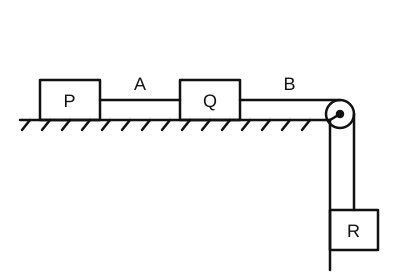
Each of three blocks $P$, $Q$ and $R$ shown in the figure has a mass of $3\ \text{kg}$. Each of the wires $A$ and $B$ has cross-sectional area $0.005\ \text{cm}^2$ and Young's modulus $2\times10^{11}\ \text{N m}^{-2}$. Neglecting friction, the longitudinal strain on wire $B$ is ______ $\times10^{-4}$. (Take $g = 10\ \text{m s}^{-2}$)
Concept. Find the tension in wire $B$ from Newton's laws, then strain $=\dfrac{T}{AY}$. From the figure, $P$ and $Q$ are on the smooth table (joined by $A$) and $B$ runs from $Q$ over the pulley to the hanging block $R$.
Step 1. Acceleration. Only $R$'s weight drives all three: $a=\dfrac{30}{9}=\dfrac{10}{3}$ m s$^{-2}$.
Step 2. Tension in $B$. It pulls $P$ and $Q$: $T_B=6\times\dfrac{10}{3}=20$ N.
Q 11-08-046JEE MainJEE Main 2024 (31 Jan, Shift 1)Medium
The depth below the surface of sea to which a rubber ball must be taken so as to decrease its volume by $0.02\%$ is ______ m. (Take density of sea water $= 10^3\ \text{kg m}^{-3}$, bulk modulus of rubber $= 9\times10^8\ \text{N m}^{-2}$, and $g = 10\ \text{m s}^{-2}$)
Step 2. Depth. $h=\dfrac{1.8\times10^5}{10^3\times10}=18$ m.
Answer. $18$.
Solution by Sreeraj P, M.Sc Physics
Q 11-08-047JEE MainJEE Main 2024 (31 Jan, Shift 2)Medium
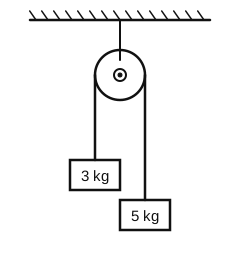
Two blocks of mass $2\ \text{kg}$ and $4\ \text{kg}$ hang from the two ends of a metal wire going over a smooth fixed pulley. The radius of the wire is $4.0\times10^{-5}\ \text{m}$ and Young's modulus of the metal is $2.0\times10^{11}\ \text{N m}^{-2}$. The longitudinal strain developed in the wire is $\dfrac{1}{\alpha\pi}$. The value of $\alpha$ is ______. [Use $g = 10\ \text{m s}^{-2}$]
Q 11-08-049JEE MainJEE Main 2023 (30 Jan, Shift 2)Easy
A force is applied to a steel wire $A$, rigidly clamped at one end. As a result elongation in the wire is $0.2\ \text{mm}$. If same force is applied to another steel wire $B$ of double the length and a diameter $2.4$ times that of the wire $A$, the elongation in the wire $B$ will be (wires having uniform circular cross sections)
Concept. From $Y=\dfrac{FL}{A\,\Delta l}$, the extension is $\Delta l=\dfrac{FL}{AY}$. Same material and same force, so $\Delta l\propto\dfrac{L}{d^2}$.
Step 2. Extension of $B$. $0.347\times0.2=0.0694$ mm $=6.9\times10^{-2}$ mm.
Answer. Option D.
Solution by Sreeraj P, M.Sc Physics
Q 11-08-050JEE MainJEE Main 2023 (31 Jan, Shift 1)Medium
A thin rod having a length of $1\ \text{m}$ and area of cross-section $3\times10^{-6}\ \text{m}^2$ is suspended vertically from one end. The rod is cooled from $210^\circ\text{C}$ to $160^\circ\text{C}$. After cooling, a mass $M$ is attached at the lower end of the rod such that the length of rod again becomes $1\ \text{m}$. Young's modulus and coefficient of linear expansion of the rod are $2\times10^{11}\ \text{N m}^{-2}$ and $2\times10^{-5}\ \text{K}^{-1}$, respectively. The value of $M$ is ______ kg. (Take $g=10\ \text{m s}^{-2}$)
Concept. Cooling shortens the rod by $L\alpha\Delta T$. The hanging mass must stretch it back by the same amount: $\dfrac{MgL}{AY}=L\alpha\Delta T$, so $Mg=YA\alpha\Delta T$.
Step 1. Shortening. $\Delta L=1\times2\times10^{-5}\times50=10^{-3}$ m.
Step 2. Force to stretch it back. $$Mg=\frac{YA\,\Delta L}{L}=\frac{2\times10^{11}\times3\times10^{-6}\times10^{-3}}{1}=600\ \text{N}$$
Step 3. Mass. $M=60$ kg.
Answer. $60$.
Solution by Sreeraj P, M.Sc Physics
Q 11-08-051JEE MainJEE Main 2023 (31 Jan, Shift 2)Easy
Under the same load, wire A having length $5.0\ \text{m}$ and cross section $2.5\times10^{-5}\ \text{m}^2$ stretches uniformly by the same amount as another wire $B$ of length $6.0\ \text{m}$ and a cross section of $3.0\times10^{-5}\ \text{m}^2$. The ratio of the Young's modulus of wire $A$ to that of wire $B$ will be
Q 11-08-052JEE MainJEE Main 2023 (24 Jan, Shift 1)Easy
A $100\ \text{m}$ long wire having cross-sectional area $6.25\times10^{-4}\ \text{m}^2$ and Young's modulus is $10^{10}\ \text{N m}^{-2}$ is subjected to a load of $250\ \text{N}$, then the elongation in the wire will be
Answer: (A) Both A and R are correct and R is the correct explanation of A
Concept. Steel is chosen for structures because it is highly elastic (large $Y$, so small strain under load) and has a high elastic limit, so it returns to shape under large loads.
Answer. Both correct and R is the correct explanation of A (Option A).
Solution by Sreeraj P, M.Sc Physics
Q 11-08-054JEE MainJEE Main 2023 (25 Jan, Shift 1)Medium
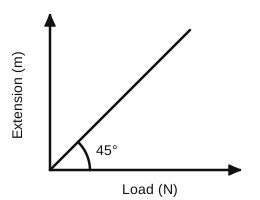
As shown in the figure, in an experiment to determine Young's modulus of a wire, the extension–load curve is plotted. The curve is a straight line passing through the origin and makes an angle of $45^\circ$ with the load axis. The length of wire is $62.8\ \text{cm}$ and its diameter is $4\ \text{mm}$. The Young's modulus is found to be $x\times10^4\ \text{N m}^{-2}$. The value of $x$ is ______.
Concept. $Y=\dfrac{FL}{A\,\Delta l}=\dfrac LA\cdot\dfrac{F}{\Delta l}$. On an extension–load graph the slope is $\dfrac{\Delta l}{F}$, so $Y=\dfrac{L}{A\times\text{slope}}$.
Step 1. Slope. The line makes $45^\circ$ with the load axis: $\dfrac{\Delta l}{F}=\tan45^\circ=1$ m N$^{-1}$.
Q 11-08-055JEE MainJEE Main 2023 (15 Apr, Shift 1)Easy
A wire of length $L$ and radius $r$ is clamped rigidly at one end. When the other end of the wire is pulled by a force $f$, its length increases by $l$. Another wire of same material of length $2L$ and radius $2r$ is pulled by a force $2f$. Then the increase in its length will be
Concept. $\Delta L\propto\dfrac{FL}{r^2}$ for one material.
Step 1. Scale. $\dfrac{2\times2}{4}=1$: the same $l$.
Answer. Option D.
Solution by Sreeraj P, M.Sc Physics
Q 11-08-056JEE MainJEE Main 2023 (10 Apr, Shift 2)Easy
Young's moduli of the material of wires $A$ and $B$ are in the ratio of $1:4$, while its area of cross sections are in the ratio of $1:3$. If the same amount of load is applied to both the wires, the amount of elongation produced in the wires A and B will be in the ratio of [Assume length of wires $A$ and $B$ are same]
Q 11-08-057JEE MainJEE Main 2023 (11 Apr, Shift 1)Easy
The length of a wire becomes $l_1$ and $l_2$ when $100\ \text{N}$ and $120\ \text{N}$ tension are applied respectively. If $10l_2=11l_1$, then the natural length of wire will be $\dfrac1xl_1$. Here the value of $x$ is ______.
Q 11-08-058JEE MainJEE Main 2023 (13 Apr, Shift 1)Easy
Under isothermal condition, the pressure of a gas is given by $P=aV^{-3}$, where $a$ is a constant and $V$ is the volume of the gas. The bulk modulus at constant temperature is equal to
Answer. Option A. (For an ideal gas at constant temperature, $PV=$ constant gives $K=P$; at constant entropy, $K=\gamma P$.)
Solution by Sreeraj P, M.Sc Physics
Q 11-08-059JEE MainJEE Main 2023 (13 Apr, Shift 1)Easy
The elastic potential energy stored in a steel wire of length $20\ \text{m}$ stretched through $2\ \text{cm}$ is $80\ \text{J}$. The cross sectional area of the wire is ______ $\text{mm}^2$. (Given $Y=2.0\times10^{11}\ \text{N m}^{-2}$)
Concept. Elastic energy $U=\dfrac{YA(\Delta L)^2}{2L}$.
Step 1. Solve for $A$. $A=\dfrac{2UL}{Y(\Delta L)^2}=\dfrac{2\times80\times20}{2\times10^{11}\times4\times10^{-4}}=4\times10^{-5}$ m$^2$.
Answer. $40$ mm$^2$.
Solution by Sreeraj P, M.Sc Physics
Q 11-08-060JEE MainJEE Main 2023 (6 Apr, Shift 1)Easy
A steel rod has a radius of $20\ \text{mm}$ and a length of $2.0\ \text{m}$. A force of $62.8\ \text{kN}$ stretches it along its length. Young's modulus of steel is $2.0\times10^{11}\ \text{N m}^{-2}$. The longitudinal strain produced in the wire is ______ $\times10^{-5}$.
Q 11-08-061JEE MainJEE Main 2023 (6 Apr, Shift 2)Easy
A metal block of mass $m$ is suspended from a rigid support through a metal wire of diameter $14\ \text{mm}$. The tensile stress developed in the wire under equilibrium state is $7\times10^5\ \text{N m}^{-2}$. The value of mass $m$ is ______ kg. (Take $g=9.8\ \text{m s}^{-2}$ and $\pi=\frac{22}{7}$)
Concept. Tensile stress is the force per unit cross-sectional area: $\sigma=\dfrac FA$. In equilibrium the wire's tension equals the weight it holds, so $mg=\sigma A$.
Step 1. Area of the wire. Radius $=7$ mm $=7\times10^{-3}$ m: $$A=\pi r^2=\frac{22}{7}\times(7\times10^{-3})^2=154\times10^{-6}\ \text{m}^2$$
Step 2. Tension. $F=\sigma A=7\times10^5\times154\times10^{-6}=107.8$ N.
Step 3. Mass. $m=\dfrac{107.8}{9.8}=11$ kg.
Answer. $11$.
Solution by Sreeraj P, M.Sc Physics
Q 11-08-062JEE MainJEE Main 2023 (8 Apr, Shift 1)Easy
An aluminium rod with Young's modulus $Y=7.0\times10^{10}\ \text{N m}^{-2}$ undergoes elastic strain of $0.04\%$. The energy per unit volume stored in the rod in SI unit is
Concept. Energy per unit volume $u=\tfrac12Y\varepsilon^2$ for strain $\varepsilon$.
Step 1. Strain. $0.04\%=4\times10^{-4}$.
Step 2. Energy density. $$u=\frac12\times7\times10^{10}\times(4\times10^{-4})^2=\frac12\times7\times10^{10}\times1.6\times10^{-7}=5600\ \text{J m}^{-3}$$
Answer. Option C.
Solution by Sreeraj P, M.Sc Physics
Q 11-08-063JEE MainJEE Main 2023 (10 Apr, Shift 1)Medium
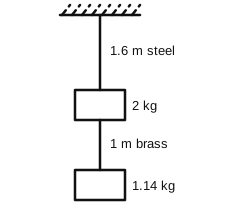
Two wires each of radius $0.2$ cm and negligible mass, one made of steel and the other made of brass are loaded as shown in the figure. The elongation of the steel wire is ______ $\times10^{-6}$ m. [Young's modulus for steel $=2\times10^{11}\ \text{N m}^{-2}$ and $g=10\ \text{m s}^{-2}$]
Q 11-08-064JEE MainJEE Main 2023 (1 Feb, Shift 1)Easy
A certain pressure $P$ is applied to $1$ litre of water and $2$ litre of a liquid separately. Water gets compressed to $0.01\%$ whereas the liquid gets compressed to $0.03\%$. The ratio of bulk modulus of water to that of the liquid is $\dfrac3x$. The value of $x$ is ______.
Q 11-08-065JEE MainJEE Main 2023 (1 Feb, Shift 2)Easy
The Young's modulus of a steel wire of length $6$ m and cross-sectional area $3\ \text{mm}^2$ is $2\times10^{11}\ \text{N m}^{-2}$. The wire is suspended from its support on a given planet. A block of mass $4$ kg is attached to the free end of the wire. The acceleration due to gravity on the planet is $\dfrac14$ of its value on the earth. The elongation of wire is (take $g$ on the earth $=10\ \text{m s}^{-2}$)
Step 1. Substitute. $3\times10^{10}\times0.02=6\times10^8$ N m$^{-2}$.
Answer. Option B.
Solution by Sreeraj P, M.Sc Physics
Q 11-08-067JEE MainJEE Main 2022 (26 Jun, Shift 1)Easy
The elongation of a wire on the surface of the earth is $10^{-4}\ \text{m}$. The same wire of same dimensions is elongated by $6\times10^{-5}\ \text{m}$ on another planet. The acceleration due to gravity on the planet will be ______ $\text{m s}^{-2}$. (Take acceleration due to gravity on the surface of earth $= 10\ \text{m s}^{-2}$)
Q 11-08-068JEE MainJEE Main 2022 (26 Jun, Shift 1)Medium
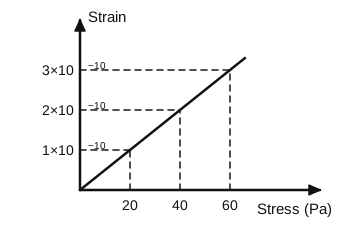
The elastic behaviour of a material for linear stress and linear strain is shown in the figure. The energy density for a linear strain of $5\times10^{-4}$ is ______ $\text{kJ m}^{-3}$. Assume that the material is elastic up to the linear strain of $5\times10^{-4}$.
Concept. Energy density $u=\tfrac12Y\varepsilon^2$. Get $Y$ from the line: here strain is plotted against stress, so $Y=\dfrac{\text{stress}}{\text{strain}}=$ 1/slope.
Step 2. Energy density. $u=\tfrac12(2\times10^{11})(5\times10^{-4})^2=2.5\times10^4$ J m$^{-3}=25$ kJ m$^{-3}$.
Answer. $25$.
Solution by Sreeraj P, M.Sc Physics
Q 11-08-069JEE MainJEE Main 2022 (25 Jul, Shift 1)Easy
A wire of length $L$ and radius $r$ is clamped rigidly at one end. When the other end of the wire is pulled by a force $F$, its length increases by $5\ \text{cm}$. Another wire of the same material of length $4L$ and radius $4r$ is pulled by a force $4F$ under the same conditions. The increase in length of this wire is ______ cm.
Q 11-08-070JEE MainJEE Main 2022 (26 Jul, Shift 1)Medium
In an experiment to determine the Young's modulus of a wire of length exactly $1\ \text{m}$, the extension in the length of the wire is measured as $0.4\ \text{mm}$ with an uncertainty of $\pm0.02\ \text{mm}$ when a load of $1\ \text{kg}$ is applied. The diameter of the wire is measured as $0.4\ \text{mm}$ with an uncertainty of $\pm0.01\ \text{mm}$. The error in the measurement of Young's modulus $(\Delta Y)$ is found to be $x\times10^{10}\ \text{N m}^{-2}$. The value of $x$ is ______.
Concept. $Y=\dfrac{4FL}{\pi d^2\,\Delta l}$. Relative errors add, each multiplied by its power: $\dfrac{\Delta Y}{Y}=2\dfrac{\Delta d}{d}+\dfrac{\Delta(\Delta l)}{\Delta l}$ ($F$ and $L$ are exact).
Step 1. Value of $Y$ ($F=10$ N, $L=1$ m, $d=0.4\times10^{-3}$ m, $\Delta l=0.4\times10^{-3}$ m): $$Y=\frac{4\times10\times1}{\pi(0.4\times10^{-3})^2\times0.4\times10^{-3}}=\frac{40}{2.01\times10^{-10}}=2\times10^{11}\ \text{N m}^{-2}$$
Step 3. Absolute error. $\Delta Y=0.1\times2\times10^{11}=2\times10^{10}$ N m$^{-2}$.
Answer. $x=2$.
Solution by Sreeraj P, M.Sc Physics
Q 11-08-071JEE MainJEE Main 2022 (26 Jul, Shift 2)Easy
The area of cross section of the rope used to lift a load by a crane is $2.5\times10^{-4}\ \text{m}^2$. The maximum lifting capacity of the crane is $10$ metric tons. To increase the lifting capacity of the crane to $25$ metric tons, the required area of cross section of the rope should be (take $g = 10\ \text{m s}^{-2}$)
Q 11-08-072JEE MainJEE Main 2022 (26 Jul, Shift 2)Medium
A uniform heavy rod of mass $20\ \text{kg}$, cross sectional area $0.4\ \text{m}^2$ and length $20\ \text{m}$ is hanging from a fixed support. Neglecting the lateral contraction, the elongation in the rod due to its own weight is $x\times10^{-9}\ \text{m}$. The value of $x$ is ______. (Given Young's modulus $Y = 2\times10^{11}\ \text{N m}^{-2}$ and $g = 10\ \text{m s}^{-2}$)
Concept. In a rod hanging under its own weight the tension falls from $Mg$ at the top to zero at the bottom. Adding the stretch of each small piece gives half of what the full weight would give at the end: $\Delta l=\dfrac{MgL}{2AY}$.
Step 1. Why the factor $\tfrac12$. A piece $dx$ at distance $x$ from the bottom carries the weight $\dfrac{Mg}{L}x$ below it, so it stretches by $\dfrac{Mgx\,dx}{LAY}$. Integrating $x$ from $0$ to $L$ gives $\dfrac{MgL}{2AY}$.
Q 11-08-073JEE MainJEE Main 2022 (27 Jul, Shift 1)Medium
A square aluminium (shear modulus is $25\times10^9\ \text{N m}^{-2}$) slab of side $60$ cm and thickness $15$ cm is subjected to a shearing force (on its narrow face) of $18.0\times10^4$ N. The lower edge is riveted to the floor. The displacement of the upper edge is ______ $\mu$m.
Concept. Shear modulus $\eta=\dfrac{F/A}{\Delta x/h}$, where $A$ is the face the force acts on and $h$ is the height perpendicular to that face. So $\Delta x=\dfrac{Fh}{\eta A}$.
Step 1. Identify the face and the height. The force acts on the narrow face, $60\times15$ cm$^2$: $A=0.6\times0.15=0.09$ m$^2$. The height from the fixed edge to that face is the side, $h=0.6$ m.
Q 11-08-074JEE MainJEE Main 2022 (27 Jul, Shift 2)Medium
A steel wire of length $3.2$ m $(Y_S = 2.0\times10^{11}\ \text{N m}^{-2})$ and a copper wire of length $4.4$ m $(Y_C = 1.1\times10^{11}\ \text{N m}^{-2})$, both of radius $1.4$ mm are connected end to end. When stretched by a load, the net elongation is found to be $1.4$ mm. The load applied, in Newton, will be: (Given $\pi = \dfrac{22}{7}$)
Concept. Wires joined end to end (in series) carry the same tension. The total extension is the sum: $\Delta l=\dfrac FA\left(\dfrac{L_1}{Y_1}+\dfrac{L_2}{Y_2}\right)$.
Q 11-08-075JEE MainJEE Main 2022 (27 Jul, Shift 2)Medium
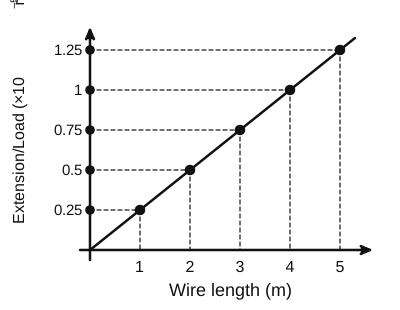
In an experiment to determine the Young's modulus, steel wires of five different lengths ($1$, $2$, $3$, $4$ and $5$ m) but of same cross-section $(2\ \text{mm}^2)$ were taken and curves between extension and load were obtained. The slope (extension/load) of the curves were plotted with the wire length and the following graph is obtained. If the Young's modulus of given steel wires is $x\times10^{11}\ \text{N m}^{-2}$, then the value of $x$ is ______ .
Q 11-08-077JEE MainJEE Main 2021 (27 Jul, Shift 1)Medium
A stone of mass $20$ g is projected from a rubber catapult of length $0.1$ m and area of cross section $10^{-6}\ \text{m}^2$ stretched by an amount $0.04$ m. The velocity of the projected stone is ______ $\text{m s}^{-1}$. (Young's modulus of rubber $= 0.5\times10^9\ \text{N m}^{-2}$)
Concept. The stretched rubber acts as a spring of constant $k=\dfrac{YA}{L}$. Its stored energy $\tfrac12kx^2$ all becomes the stone's kinetic energy.
Step 1. Spring constant. $k=\dfrac{0.5\times10^9\times10^{-6}}{0.1}=5000$ N m$^{-1}$.
Step 2. Stored energy. $U=\tfrac12\times5000\times(0.04)^2=4$ J.
Step 3. Speed. $\tfrac12(0.02)v^2=4\Rightarrow v^2=400\Rightarrow v=20$ m s$^{-1}$.
Answer. $20$.
Solution by Sreeraj P, M.Sc Physics
Q 11-08-078JEE MainJEE Main 2021 (31 Aug, Shift 1)Medium
A uniform heavy rod of weight $10\ \text{kg m s}^{-2}$, cross-sectional area $100\ \text{cm}^2$ and length $20$ cm is hanging from a fixed support. Young's modulus of the material of the rod is $2\times10^{11}\ \text{N m}^{-2}$. Neglecting the lateral contraction, find the elongation of the rod due to its own weight:
Concept. Under its own weight, the tension falls linearly from $W$ at the top to $0$ at the bottom; the average tension $W/2$ gives $\Delta L=\dfrac{WL}{2AY}$.
Step 1. Substitute. $\Delta L=\dfrac{10\times0.2}{2\times10^{-2}\times2\times10^{11}}=5\times10^{-10}$ m.
Answer. Option A.
Solution by Sreeraj P, M.Sc Physics
Q 11-08-079JEE MainJEE Main 2021 (31 Aug, Shift 1)Easy
When a rubber ball is taken to a depth of ______ m in deep sea, its volume decreases by $0.5\%$. (The bulk modulus of rubber $= 9.8\times10^8\ \text{N m}^{-2}$, density of sea water $= 10^3\ \text{kg m}^{-3}$, $g = 9.8\ \text{m s}^{-2}$)
Q 11-08-080JEE MainJEE Main 2021 (31 Aug, Shift 2)Medium
Four identical hollow cylindrical columns of mild steel support a big structure of mass $50\times10^3$ kg. The inner and outer radii of each column are $50$ cm and $100$ cm respectively. Assuming uniform load distribution, calculate the compression strain of each column. [use $Y = 2.0\times10^{11}$ Pa, $g = 9.8\ \text{m s}^{-2}$]
Q 11-08-081JEE MainJEE Main 2021 (24 Feb, Shift 1)Medium
If $Y$, $K$ and $\eta$ are the values of Young's modulus, bulk modulus and modulus of rigidity of any material respectively. Choose the correct relation for these parameters.
Concept. The three moduli are linked through Poisson's ratio $\sigma$: $$Y=2\eta(1+\sigma),\qquad Y=3K(1-2\sigma)$$ Eliminate $\sigma$ to get one relation, then rearrange it for $K$.
Step 1. Express $\sigma$ from each. $1+\sigma=\dfrac{Y}{2\eta}$ and $1-2\sigma=\dfrac{Y}{3K}$.
Step 2. Eliminate $\sigma$. Double the first and add the second: $3=\dfrac{Y}{\eta}+\dfrac{Y}{3K}$, i.e. $$\frac{9}{Y}=\frac{3}{\eta}+\frac1K$$
Step 3. Solve for $K$. $$\frac1K=\frac9Y-\frac3\eta=\frac{9\eta-3Y}{Y\eta}\ \Rightarrow\ K=\frac{Y\eta}{9\eta-3Y}$$
Answer. Option C. Check option A against this: it has the wrong sign; the correct form is $Y=\dfrac{9K\eta}{3K+\eta}$.
Solution by Sreeraj P, M.Sc Physics
Q 11-08-082JEE MainJEE Main 2021 (24 Feb, Shift 2)Easy
A uniform metallic wire is elongated by 0.04 m when subjected to a linear force $F$. The elongation, if its length and diameter is doubled and subjected to the same force will be ______ cm.
Concept. $\Delta L\propto\dfrac{L}{d^2}$ at fixed force and material.
Step 1. Scale. $\dfrac{2}{4}=\dfrac12$: $0.02$ m $=2$ cm.
Answer. $2$.
Solution by Sreeraj P, M.Sc Physics
Q 11-08-083JEE MainJEE Main 2021 (20 Jul, Shift 1)Medium
The value of tension in a long thin metal wire has been changed from $T_1$ to $T_2$. The lengths of the metal wire at two different values of tension $T_1$ and $T_2$ are $\ell_1$ and $\ell_2$, respectively. The actual length of the metal wire is:
Concept. Within Hooke's law the extension is proportional to the tension: $l=L+kT$, where $L$ is the natural length and $k$ a constant of the wire. Two readings give two equations in $L$ and $k$.
Step 1. Two equations. $l_1=L+kT_1$ and $l_2=L+kT_2$.
Step 2. Eliminate $k$. Multiply the first by $T_2$ and the second by $T_1$, then subtract: $$l_1T_2-l_2T_1=L(T_2-T_1)$$
Answer. Option B. Check: $T_1=0$ gives $L=l_1$, as it should.
Solution by Sreeraj P, M.Sc Physics
Q 11-08-085JEE MainJEE Main 2021 (26 Feb, Shift 1)Easy
The normal density of a material is $\rho$ and its bulk modulus of elasticity is $K$. The magnitude of increase in density of material, when a pressure $P$ is applied uniformly on all sides, will be:
Concept. Mass stays the same while volume shrinks, so density rises: $\rho V=$ constant gives $\dfrac{\Delta\rho}{\rho}=-\dfrac{\Delta V}{V}=\dfrac PK$.
Q 11-08-087JEE MainJEE Main 2021 (26 Aug, Shift 2)Medium
Two blocks of masses $3$ kg and $5$ kg are connected by a metal wire going over a smooth pulley. The breaking stress of the metal is $\frac{24}{\pi}\times10^2$ N m$^{-2}$. What is the minimum radius of the wire? (take $g = 10$ m s$^{-2}$)
Concept. First find the tension in the wire from the Atwood machine. The wire must not break, so $\sigma_b\ge\dfrac{T}{\pi r^2}$, which gives the least radius.
Step 1. Tension in an Atwood machine. $$T=\frac{2m_1m_2g}{m_1+m_2}=\frac{2\times3\times5\times10}{8}=37.5\ \text{N}$$
Step 2. Least area. $$\pi r^2=\frac{T}{\sigma_b}=\frac{37.5}{\frac{24}{\pi}\times10^2}=\frac{37.5\pi}{2400}\ \Rightarrow\ r^2=\frac{37.5}{2400}=0.015625$$
Step 3. Radius. $r=0.125$ m $=12.5$ cm.
Answer. Option D. The tension is not $5g$ or $3g$; the blocks accelerate, so use the Atwood formula.
Solution by Sreeraj P, M.Sc Physics
Q 11-08-088JEE MainJEE Main 2021 (27 Aug, Shift 2)Medium
Wires $W_1$ and $W_2$ are made of same material having the breaking stress of $1.25\times10^9$ N m$^{-2}$. $W_1$ and $W_2$ have cross-sectional area of $8\times10^{-7}$ m$^2$ and $4\times10^{-7}$ m$^2$, respectively. Masses of $20$ kg and $10$ kg hang from them as shown in the figure. The maximum mass that can be placed in the pan without breaking the wires is ______ kg (Use $g = 10$ m s$^{-2}$)
Concept. Each wire carries the weight of everything hanging below it. Find the largest load each wire can take ($\sigma_bA$), then find the pan mass that keeps both wires safe. The smaller limit wins.
Step 4. Both must hold. The lower wire limits: $M_{\max}=40$ kg.
Answer. $40$.
Solution by Sreeraj P, M.Sc Physics
Q 11-08-089JEE MainJEE Main 2020 (9 Jan, Shift 1)Easy
A body of mass $m = 10$ kg is attached to one end of a wire of length $0.3$ m. What is the maximum angular speed (in rad s$^{-1}$) with which it can be rotated about its other end in a space station without breaking the wire? [Breaking stress of wire $(\sigma) = 4.8\times10^7$ N m$^{-2}$ and area of cross-section of the wire $= 10^{-2}$ cm$^2$]
Concept. In a space station there is no effective gravity, so the wire's tension alone supplies the centripetal force: $T=m\omega^2l$. The largest allowed tension is $\sigma_bA$.
Step 1. Largest tension. $A=10^{-2}$ cm$^2=10^{-6}$ m$^2$: $$T_{\max}=4.8\times10^7\times10^{-6}=48\ \text{N}$$
Q 11-08-091JEE MainJEE Main 2020 (4 Sep, Shift 2)Medium
A cube of metal is subjected to a hydrostatic pressure of $4\ \text{GPa}$. The percentage change in the length of the side of the cube is close to: (Given bulk modulus of metal, $B = 8\times10^{10}\ \text{Pa}$)
Q 11-08-092JEE MainJEE Main 2019 (10 Apr, Shift 2)Easy
The elastic limit of brass is $379\ \text{MPa}$. The minimum diameter of a brass rod if it is to support a $400\ \text{N}$ load without exceeding its elastic limit will be
Concept. Stress must not exceed the elastic limit: $\dfrac{F}{\pi d^2/4}\le\sigma_e$.
Step 1. Least area. $A=\dfrac{400}{379\times10^6}=1.055\times10^{-6}$ m$^2$.
Step 2. Diameter. $d=\sqrt{\dfrac{4A}{\pi}}=\sqrt{1.344\times10^{-6}}\approx1.16\times10^{-3}$ m.
Answer. $1.16$ mm (Option C).
Solution by Sreeraj P, M.Sc Physics
Q 11-08-093JEE MainJEE Main 2019 (10 Apr, Shift 2)Medium
In an experiment, brass and steel wires of length $1\ \text{m}$ each with areas of cross section $1\ \text{mm}^2$ are used. The wires are connected in series and one end of the combined wire is connected to a rigid support and other end is subjected to elongation. The stress required to produce a net elongation of $0.2\ \text{mm}$ is, [Given, the Young's modulus for steel and brass are, respectively, $120\times10^9\ \text{N/m}^2$ and $60\times10^9\ \text{N/m}^2$]
Concept. Wires in series carry the same tension; with equal areas they have the same stress $\sigma$. Their extensions add.
Step 1. Total extension. $\sigma\left(\dfrac{L}{Y_s}+\dfrac{L}{Y_b}\right)=\sigma\left(\dfrac1{120\times10^9}+\dfrac1{60\times10^9}\right)=\dfrac{\sigma}{40\times10^9}$.
Q 11-08-094JEE MainJEE Main 2019 (9 Jan, Shift 1)Easy
A rod, of length $L$ at room temperature and uniform area of cross section $A$, is made of a metal having coefficient of linear expansion $\alpha/^\circ\text{C}$. It is observed that an external compressive force $F$ is applied on each of its ends, prevents any change in the length of the rod when its temperature rises by $\Delta T$ K. Young's modulus, $Y$ for this metal is
Concept. The compressive force must produce a compression equal to the free thermal expansion: $\dfrac{FL}{AY}=L\alpha\Delta T$.
Step 1. Solve. $Y=\dfrac{F}{A\alpha\Delta T}$. (A temperature change in kelvin equals the change in °C.)
Answer. Option C.
Solution by Sreeraj P, M.Sc Physics
Q 11-08-095JEE MainJEE Main 2019 (8 Apr, Shift 1)Medium
A boy's catapult is made of rubber cord which is $42\ \text{cm}$ long, with $6\ \text{mm}$ diameter of cross-section and of negligible mass. The boy keeps a stone weighing $0.02\ \text{kg}$ on it and stretches the cord by $20\ \text{cm}$ by applying a constant force. When released, the stone flies off with a velocity of $20\ \text{m s}^{-1}$. Neglect the change in the area of cross-section of the cord while stretched. The Young's modulus of rubber is closest to
Step 2. Solve for $Y$. $$Y=\frac{mv^2L}{Ax^2}=\frac{0.02\times400\times0.42}{2.83\times10^{-5}\times0.04}\approx3\times10^6\ \text{N m}^{-2}$$
Step 3. Closest. $10^6$ N m$^{-2}$.
Answer. Option A.
Solution by Sreeraj P, M.Sc Physics
Q 11-08-096JEE MainJEE Main 2019 (8 Apr, Shift 1)Easy
A steel wire having a radius of $2.0\ \text{mm}$, carrying a load of $4\ \text{kg}$, is hanging from a ceiling. Given that $g = 3.1\pi\ \text{m s}^{-2}$, what will be the tensile stress that would be developed in the wire?
Step 2. Stress. $\sigma=\dfrac{4\times3.1\pi}{4\pi\times10^{-6}}=3.1\times10^6$ N m$^{-2}$.
Answer. Option D.
Solution by Sreeraj P, M.Sc Physics
Q 11-08-097JEE MainJEE Main 2019 (8 Apr, Shift 2)Easy
Young's moduli of two wires A and B are in the ratio $7:4$. Wire A is $2\ \text{m}$ long and has radius $R$. Wire B is $1.5\ \text{m}$ long and has radius $2\ \text{mm}$. If the two wires stretch by the same length for a given load, the value of $R$ is close to
Q 11-08-098JEE MainJEE Main 2019 (12 Jan, Shift 2)Easy
A load of mass $M$ kg is suspended from a steel wire of length $2$ m and radius $1.0$ mm in Searle's apparatus experiment. The increase in length produced in the wire is $4.0$ mm. Now the load is fully immersed in a liquid of relative density $2$. The relative density of the material of the load is $8$. The new value of increase in length of the steel wire is:
Concept. Extension is proportional to the tension. Immersing the load reduces the tension by the buoyant force, so the extension falls in the same ratio.
Step 1. Tension in the liquid. Buoyancy $=\dfrac{\rho_{\text{liq}}}{\rho_{\text{load}}}W=\dfrac28W$, so $T=W\left(1-\dfrac14\right)=\dfrac34W$.
Step 2. New extension. $\dfrac34\times4.0=3.0$ mm.
Answer. Option D.
Solution by Sreeraj P, M.Sc Physics
Q 11-08-100JEE MainJEE Main 2019 (12 Apr, Shift 2)Medium
A uniform cylindrical rod of length $L$ and radius $r$, is made from a material whose Young's modulus of elasticity equals $Y$. When this rod is heated by temperature $T$ and simultaneously subjected to a net longitudinal compressional force $F$, its length remains unchanged. The coefficient of volume expansion, of the material of the rod, is (nearly) equal to:
Concept. Length unchanged means the compression undoes the thermal expansion: $\dfrac{F}{AY}=\alpha T$. Then the volume coefficient is $\gamma=3\alpha$.
Step 1. Linear coefficient. $$\frac{F}{\pi r^2Y}=\alpha T\ \Rightarrow\ \alpha=\frac{F}{\pi r^2YT}$$
Q 11-08-101JEE MainJEE Main 2018 (15 Apr, Shift 2)Easy
Forces of $10^5\ \text{N}$ each are applied in opposite directions, on the upper and lower faces of a cube of side $10\ \text{cm}$, shifting the upper face parallel to itself by $0.5\ \text{cm}$. If the side of another cube of the same material is $20\ \text{cm}$ then under similar conditions as above, the displacement will be:
Concept. For a cube of side $L$ in shear: $\eta=\dfrac{F/L^2}{\Delta x/L}$, so $\Delta x=\dfrac{F}{\eta L}$. Same material and same force: $\Delta x\propto\dfrac1L$.
Step 1. Ratio. Side doubles from $10$ cm to $20$ cm, so $\Delta x$ halves.
Step 2. New displacement. $\dfrac{0.5}{2}=0.25$ cm.
Answer. Option B.
Solution by Sreeraj P, M.Sc Physics
Q 11-08-102JEE MainJEE Main 2017 (2 Apr)Easy
A man grows into a giant such that his linear dimensions increase by a factor of $9$. Assuming that his density remains same, the stress in the leg will change by a factor of:
Concept. Stress in the leg is weight divided by the leg's cross-sectional area. Weight scales with volume ($L^3$) at fixed density; area scales with $L^2$.
Step 1. Scaling. Weight $\times9^3$, area $\times9^2$.
Step 2. Stress. $\dfrac{9^3}{9^2}=9$.
Answer. Stress increases by a factor $9$ (Option B). This is why very large animals need disproportionately thick legs.
Solution by Sreeraj P, M.Sc Physics
Q 11-08-103JEE MainJEE Main 2017 (8 Apr)Easy
A compressive force $F$ is applied at the two ends of a long thin steel rod. It is heated, simultaneously, such that its temperature increases by $\Delta T$. The net change in its length is zero. Let $l$ be the length of the rod, $A$ its area of cross-section, $Y$ its Young's modulus, and $\alpha$ its coefficient of linear expansion. Then, $F$ is equal to:
Concept. Zero net change: compression from $F$ cancels thermal expansion, $\dfrac{Fl}{AY}=l\alpha\Delta T$.
Step 1. Solve. $F=AY\alpha\Delta T$, independent of the length.
Answer. Option B.
Solution by Sreeraj P, M.Sc Physics
Q 11-08-104JEE MainJEE Main 2017 (9 Apr)Easy
A steel rail of length $5$ m and area of cross section $40\ \text{cm}^2$ is prevented from expanding along its length while the temperature rises by $10^\circ$C. If coefficient of linear expansion and Young's modulus of steel are $1.2\times10^{-5}\ \text{K}^{-1}$ and $2\times10^{11}\ \text{N m}^{-2}$ respectively, the force developed in the rail is approximately:
Concept. If a rod is stopped from expanding, the walls compress it by exactly the length it wanted to gain. The thermal strain $\alpha\Delta T$ becomes a mechanical strain, so the stress is $Y\alpha\Delta T$ and the force is $YA\alpha\Delta T$, independent of the length.
Answer. About $1\times10^5$ N (Option D). The rail's length ($5$ m) does not enter.
Solution by Sreeraj P, M.Sc Physics
Q 11-08-105JEE MainJEE Main 2018 (8 Apr)Easy
A solid sphere of radius $r$ made of a soft material of bulk modulus $K$ is surrounded by a liquid in a cylindrical container. A massless piston of area $a$ floats on the surface of the liquid, covering entire cross-section of cylindrical container. When a mass $m$ is placed on the surface of the piston to compress the liquid, the fractional decrement in the radius of the sphere $\left(\dfrac{dr}{r}\right)$, is:
Concept. The mass on the piston raises the liquid's pressure by $\dfrac{mg}{a}$ everywhere (Pascal's law), so the sphere is squeezed equally from all sides. Volume strain $=\dfrac{\Delta P}{K}$, and for a sphere $\dfrac{dV}{V}=3\dfrac{dr}{r}$.
Concept. When a coil spring is stretched, its wire hardly changes length; it is twisted.
Step 1. Assertion. Twisting is a shear deformation, so the stretching of the spring is governed by the shear modulus → true.
Step 2. Reason. Steel has much larger elastic moduli and tensile strength than copper, so the steel spring is the stronger one → false.
Answer. (A) is true but (R) is false (Option D).
Solution by Sreeraj P, M.Sc Physics
Q 11-08-107JEE MainJEE Main 2025 (2 Apr, Shift 1)Medium
A steel wire of length $2\ \text{m}$ and Young's modulus $2.0\times10^{11}\ \text{N m}^{-2}$ is stretched by a force. If the Poisson ratio and transverse strain for the wire are $0.2$ and $10^{-3}$ respectively, then the elastic potential energy density of the wire is ______ $\times10^5$ (in SI units).
Concept. Poisson's ratio links the sideways strain to the lengthwise strain: $\sigma=\dfrac{\text{lateral strain}}{\text{longitudinal strain}}$. The stored energy uses the longitudinal strain: $u=\tfrac12Y\varepsilon^2$.
Step 2. Energy density. $$u=\frac12\times2\times10^{11}\times(5\times10^{-3})^2=10^{11}\times2.5\times10^{-5}=25\times10^5\ \text{J m}^{-3}$$
Answer. $25$.
Solution by Sreeraj P, M.Sc Physics
Q 11-08-108JEE MainJEE Main 2025 (2 Apr, Shift 2)Easy
The length of a light string is $1.4\ \text{m}$ when the tension on it is $5\ \text{N}$. If the tension increases to $7\ \text{N}$, the length of the string is $1.56\ \text{m}$. The original length of the string is ______ m.
Q 11-08-109JEE MainJEE Main 2025 (4 Apr, Shift 1)Medium
Two slabs with square cross section of different materials (1, 2) with equal sides ($l$) and thickness $d_1$ and $d_2$ such that $d_2 = 2d_1$ and $l > d_2$. Considering that the lower edges of these slabs are fixed to the floor, we apply equal shearing force on the narrow faces. The angle of deformation is $\theta_2 = 2\theta_1$. If the shear modulus of material 1 is $4\times10^9\ \text{N/m}^2$, then the shear modulus of material 2 is $x\times10^9\ \text{N/m}^2$, where the value of $x$ is ______.
Q 11-08-110JEE MainJEE Main 2025 (4 Apr, Shift 2)Medium
A cylindrical rod of length $1\ \text{m}$ and radius $4\ \text{cm}$ is mounted vertically. It is subjected to a shear force of $10^5\ \text{N}$ at the top. Considering an infinitesimally small displacement of the upper edge, the angular displacement $\theta$ of the rod axis from its original position would be: (shear modulus $G = 10^{10}\ \text{N/m}^2$)
Concept. For a small displacement the angular displacement equals the shear strain: $\theta = \dfrac{F}{AG}$, with the force spread over the top face $A = \pi r^2$.
Q 11-08-111JEE MainJEE Main 2025 (7 Apr, Shift 1)Easy
Two wires A and B are made of the same material, having ratio of lengths $\dfrac{L_A}{L_B} = \dfrac13$ and their diameters ratio $\dfrac{d_A}{d_B} = 2$. If both the wires are stretched using the same force, what would be the ratio of their respective elongations?
Q 11-08-112JEE MainJEE Main 2025 (8 Apr, Shift 2)Easy
A $3\ \text{m}$ long wire of radius $3\ \text{mm}$ shows an extension of $0.1\ \text{mm}$ when loaded vertically by a mass of $50\ \text{kg}$ in an experiment to determine Young's modulus. The value of Young's modulus of the wire as per this experiment is $P\times10^{11}\ \text{N m}^{-2}$, where the value of $P$ is: (Take $g = 3\pi\ \text{m/s}^2$)
Q 11-08-113JEE MainJEE Main 2025 (8 Apr, Shift 2)Easy
A sample of a liquid is kept at $1\ \text{atm}$. It is compressed to $5\ \text{atm}$, which leads to a change of volume of $0.8\ \text{cm}^3$. If the bulk modulus of the liquid is $2\ \text{GPa}$, the initial volume of the liquid was ______ litre. (Take $1\ \text{atm} = 10^5\ \text{Pa}$)
Step 2. Volume. $V=\dfrac{2\times10^9\times0.8\times10^{-6}}{4\times10^5}=4\times10^{-3}$ m$^3=4$ L.
Answer. $4$.
Solution by Sreeraj P, M.Sc Physics
Q 11-08-114JEE MainMedium
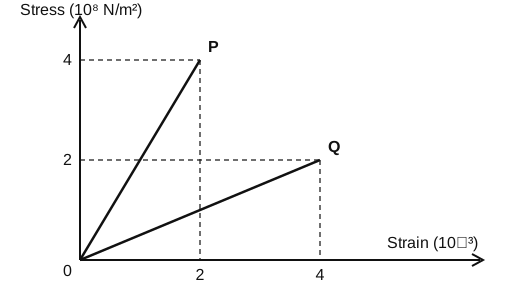
The graph shows the stress–strain lines for two wires $P$ and $Q$ within their elastic limits. The wires have equal lengths and the area of cross-section of $P$ is twice that of $Q$. When the same load is hung from each wire, the ratio of the extension of $P$ to that of $Q$ is
Step 2. Ratio of extensions. Same $F$ and $L$: $$\frac{\Delta L_P}{\Delta L_Q} = \frac{A_QY_Q}{A_PY_P} = \frac{1}{2 \times 4} = \frac18$$
Answer. $1 : 8$ (Option A).
Solution by Sreeraj P, M.Sc Physics
Q 11-08-115JEE MainHard
A uniform wire of mass $m$ and length $L$ hangs vertically from a rigid support, and a block of mass $2m$ is attached to its lower end. The ratio of the extension of the lower half of the wire to that of the upper half is
Concept. The tension varies along the wire because each part also supports the wire below it. The extension of a small element $dx$ is $\dfrac{T\,dx}{AY}$, so the extension of a section is $\dfrac{1}{AY}\int T\,dx$.
Step 1. Tension. At height $x$ above the lower end: $$T(x) = 2mg + \frac{mg}{L}x$$
Answer. $9 : 11$ (Option D). Without the block the ratio would be $1 : 3$; with a block of mass $m$ it would be $5 : 7$.
Solution by Sreeraj P, M.Sc Physics
Q 11-08-116JEE MainMedium
A solid sphere made of a material of bulk modulus $1.5 \times 10^9$ N/m² is lowered into a lake. The depth below the surface at which its radius decreases by $0.02\%$ is ______ m. (Density of water $= 10^3$ kg/m³, $g = 10\ \text{m/s}^2$)
Concept. Bulk modulus $B = \dfrac{\Delta P}{|\Delta V/V|}$. For a sphere $V \propto R^3$, so $\dfrac{\Delta V}{V} = 3\dfrac{\Delta R}{R}$. The extra pressure at depth $h$ is $\rho gh$.

 Solution by Sreeraj P, M.Sc Physics