

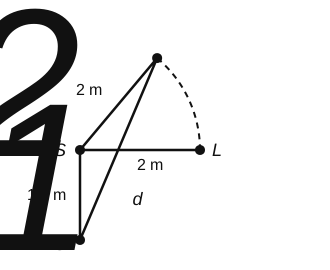
Two coherent sources of sound, $S_1$ and $S_2$, produce sound waves of the same wavelength $\lambda = 1$ m and are in phase. $S_1$ and $S_2$ are placed $1.5$ m apart (see figure). A listener, located at L, directly in front of $S_2$, finds that the intensity is at a minimum when he is $2$ m away from $S_2$. The listener moves away from $S_1$, keeping the distance from $S_2$ fixed. The adjacent maximum of intensity is observed when the listener is at a distance $d$ from $S_1$. Then $d$ is:
Answer: (D) $3$ m
At L: $S_1L = \sqrt{1.5^2 + 2^2} = 2.5$ m and $S_2L = 2$ m, so the path difference is $0.5$ m $= \lambda/2$, a minimum, as stated.
As the listener moves along the circle of radius $2$ m about $S_2$, away from $S_1$, the distance from $S_1$ increases while that from $S_2$ stays $2$ m. The next maximum needs a path difference of $\lambda = 1$ m:
$$d - 2 = 1 \Rightarrow d = 3\ \text{m}$$
 Solution by Sreeraj P, M.Sc Physics