For sound waves, if the number of nodes for the $5^{\text{th}}$ harmonic of an open-ended pipe is $n$ and that for the $9^{\text{th}}$ harmonic of the same pipe with one of its ends closed is $m$, the ratio $\dfrac{n}{m}$ is :
Concept. Count nodes from the standing-wave pattern of each pipe: an open pipe has antinodes at both ends, a closed pipe has a node at the closed end and an antinode at the open end.
Step 1. Open pipe, $5^{\text{th}}$ harmonic. $L = 5\dfrac{\lambda}{2}$: five half-loops, each with one node inside, so $n = 5$.
Step 2. Closed pipe, $9^{\text{th}}$ harmonic. $L = 9\dfrac{\lambda}{4}$, i.e. $(2k - 1) = 9$ with $k = 5$. The pattern has $k = 5$ nodes (counting the closed end), so $m = 5$.
Step 3. Ratio. $\dfrac{n}{m} = \dfrac55 = 1$.
Answer. $1$ (Option C).
Solution by Sreeraj P, M.Sc Physics
Q 11-14-002NEETNEET 2025Top questionEasy
A pipe open at both ends has a fundamental frequency $f$ in air. The pipe is now dipped vertically in a water drum to half of its length. The fundamental frequency of the air column is now equal to :
Concept. Open pipe: $f = \dfrac{v}{2L}$. Dipping it in water closes the lower end and halves the air column, giving a closed pipe: $f' = \dfrac{v}{4L'}$.
Step 1. New air column. $L' = \dfrac{L}{2}$, closed at the water surface.
In a guitar, two strings A and B made of same material are slightly out of tune and produce beats of frequency $6$ Hz. When tension in B is slightly decreased, the beat frequency increases to $7$ Hz. If the frequency of A is $530$ Hz, the original frequency of B will be :
Concept. A closed pipe has only odd harmonics: $f, 3f, 5f, \dots$
Step 1. Second overtone. It is the third allowed mode: $5f = 5 \times 200 = 1000$ Hz.
Answer. $1000$ Hz (Option B).
Solution by Sreeraj P, M.Sc Physics
Q 11-14-019NEETJEE MainMedium
In a resonance tube experiment with a $512$ Hz fork, the first and second resonances occur at air-column lengths of $16$ cm and $49$ cm. The speed of sound in air is
A tuning fork of frequency $256$ Hz produces $4$ beats per second with another fork. When the second fork is loaded with a little wax, the beat frequency decreases. The original frequency of the second fork was
A train sounding a whistle of $600$ Hz approaches and then passes a stationary listener at $30$ m/s. The change in frequency heard by the listener as the train passes is (speed of sound $= 330$ m/s)
Concept. Doppler effect for a moving source: $f\dfrac{v}{v - v_s}$ approaching and $f\dfrac{v}{v + v_s}$ receding.
Step 1. Approaching. $600 \times \dfrac{330}{300} = 660$ Hz.
Step 2. Receding. $600 \times \dfrac{330}{360} = 550$ Hz.
Step 3. Change. $660 - 550 = 110$ Hz.
Answer. $110$ Hz (Option D).
Solution by Sreeraj P, M.Sc Physics
Q 11-14-025NEETJEE MainMedium
A car moving at $20$ m/s towards a wall sounds its horn of frequency $400$ Hz. The frequency of the echo heard by the driver is (speed of sound $= 340$ m/s)
Concept. The wall receives sound from a moving source and re-emits it as a stationary source; the moving driver then hears it as a moving observer: $f'' = f\dfrac{v + u}{v - u}$.
Concept. Change in sound level: $\Delta L = 10\log_{10}\dfrac{I_2}{I_1}$ dB.
Step 1. Substitute. $$\Delta L = 10\log_{10}100 = 20\ \text{dB}$$
Answer. $20$ dB (Option B).
Solution by Sreeraj P, M.Sc Physics
Q 11-14-027NEETJEE MainMedium
In a stationary wave on a string, the distance between two consecutive nodes is $15$ cm. If the frequency is $200$ Hz, the speed of the component travelling waves is
Answer: (D) Two identical waves travelling in opposite directions
Concept. A stationary wave forms when two waves of the same frequency and amplitude travel in opposite directions along the same line.
Step 1. Check the options. Waves of slightly different frequency in the same direction give beats; identical waves in the same direction just add. Only identical waves travelling in opposite directions form a stationary wave.
Answer. Two identical waves travelling in opposite directions (Option D).
Solution by Sreeraj P, M.Sc Physics
Q 11-14-029JEE MainMedium
A wire of length $50$ cm and mass $5$ g is stretched with a tension of $400$ N between two fixed supports. Find its fundamental frequency, in Hz.
An open organ pipe has a fundamental frequency of $300$ Hz. The first overtone of a closed pipe has the same frequency as the first overtone of this open pipe. Find the length of the closed pipe, in cm. (speed of sound $= 330$ m/s)
Q 11-14-031JEE MainJEE Main 2026 (5 Apr, Shift 1)Easy
A transverse wave on a string is described by $y = 3\sin(36t + 0.018x + \pi/4)$, where $x, y$ are in cm and $t$ in seconds. The least distance between the two successive crests in the wave is ______ cm. (Nearest integer) ($\pi = 3.14$)
Concept. Successive crests are one wavelength apart, and $\lambda=\dfrac{2\pi}{k}$.
Step 1. Wave number. $k=0.018$ rad cm$^{-1}$.
Step 2. Wavelength. $\lambda=\dfrac{2\times3.14}{0.018}=348.9\approx349$ cm.
Answer. $349$.
Solution by Sreeraj P, M.Sc Physics
Q 11-14-032JEE MainJEE Main 2026 (2 Apr, Shift 1)Easy
The equation of a plane progressive wave is given by $y=5\cos\pi\left(200t-\dfrac{x}{150}\right)$ where $x$ and $y$ are in cm and $t$ is in second. The velocity of the wave is ______ m/s.
Q 11-14-033JEE MainJEE Main 2026 (28 Jan, Shift 2)Easy
The speed of a longitudinal wave in a metallic bar is 400 m/s. If the density and Young's modulus of the bar material are increased by 0.5% and 1%, respectively then the speed of the wave is changed approximately to ______ m/s.
Concept. Longitudinal waves in a bar: $v=\sqrt{\dfrac Y\rho}$. For small changes, $\dfrac{\Delta v}{v}=\dfrac12\left(\dfrac{\Delta Y}{Y}-\dfrac{\Delta\rho}{\rho}\right)$.
Step 2. New speed. $400\times1.0025=401$ m s$^{-1}$.
Answer. Option C.
Solution by Sreeraj P, M.Sc Physics
Q 11-14-034JEE MainJEE Main 2026 (28 Jan, Shift 2)Easy
Two tuning forks $A$ and $B$ are sounded together giving rise to 8 beats in 2 s. When fork $A$ is loaded with wax, the beat frequency is reduced to 4 beats in 2 s. If the original frequency of tuning fork $B$ is 380 Hz then original frequency of tuning fork $A$ is ______ Hz.
Concept. Wax loading lowers a fork's frequency. Beats per second $=$ beats $\div$ time.
Step 1. Beat frequencies. $\dfrac82=4$ Hz, then $\dfrac42=2$ Hz.
Step 2. Test. $f_A=384$ or $376$. Lowering $f_A$ reduces beats only if $f_A>380$.
Answer. $384$ Hz.
Solution by Sreeraj P, M.Sc Physics
Q 11-14-035JEE MainJEE Main 2026 (24 Jan, Shift 2)Easy
The fifth harmonic of a closed organ pipe is found to be in unison with the first harmonic of an open pipe. The ratio of lengths of closed pipe to that of the open pipe is $5/x$. The value of $x$ is ______
Q 11-14-036JEE MainJEE Main 2025 (22 Jan, Shift 1)Medium
A closed organ pipe and an open organ pipe are filled by two different gases having same bulk modulus but different densities $\rho_1$ and $\rho_2$, respectively. The frequency of the $9^{\text{th}}$ harmonic of the closed tube is identical with the $4^{\text{th}}$ harmonic of the open tube. If the length of the closed tube is $10\ \text{cm}$ and the density ratio of the gases is $\rho_1 : \rho_2 = 1 : 16$, then the length of the open tube is
Concept. Different gases give different speeds: $v=\sqrt{\dfrac B\rho}$, same $B$, so $\dfrac{v_1}{v_2}=\sqrt{\dfrac{\rho_2}{\rho_1}}=4$. Then equate the two harmonics.
Step 2. Solve. $L_2=\dfrac{8L_1v_2}{9v_1}=\dfrac{8\times10}{9\times4}=\dfrac{20}{9}$ cm.
Answer. Option D.
Solution by Sreeraj P, M.Sc Physics
Q 11-14-037JEE MainJEE Main 2025 (23 Jan, Shift 2)Easy
The equation of a transverse wave travelling along a string is $y(x,t) = 4.0\sin\left[20\times10^{-3}x + 600t\right]\ \text{mm}$, where $x$ is in mm and $t$ is in seconds. The velocity of the wave is
Concept. Sound speed is $\sqrt{\text{elastic modulus}/\text{density}}$.
Step 1. Assertion. True: sound is much faster in solids.
Step 2. Reason. False: solids have far larger elastic moduli than gases. That large modulus is what makes solids faster, despite their larger density.
Answer. A is true but R is false (Option B).
Solution by Sreeraj P, M.Sc Physics
Q 11-14-039JEE MainJEE Main 2024 (1 Feb, Shift 1)Medium
A tuning fork resonates with a sonometer wire of length $1\ \text{m}$ stretched with a tension of $6\ \text{N}$. When the tension in the wire is changed to $54\ \text{N}$, the same tuning fork produces $12$ beats per second with it. The frequency of the tuning fork is ______ Hz.
Concept. A string's frequency $\propto\sqrt T$. Tension $\times9$ gives frequency $\times3$.
Step 1. Frequencies. Wire at $6$ N: $f$ (in unison with the fork); at $54$ N: $3f$.
Step 2. Beats. $3f-f=12\Rightarrow f=6$ Hz.
Answer. $6$.
Solution by Sreeraj P, M.Sc Physics
Q 11-14-040JEE MainJEE Main 2024 (5 Apr, Shift 2)Easy
A sonometer wire of resonating length $90\ \text{cm}$ has a fundamental frequency of $400\ \text{Hz}$ when kept under some tension. The resonating length of the wire with a fundamental frequency of $600\ \text{Hz}$ under the same tension is ______ cm.
Concept. At fixed tension and wire, $f=\dfrac1{2L}\sqrt{T/\mu}$ gives $f\propto1/L$.
Step 1. Scale. $L=90\times\dfrac{400}{600}=60$ cm.
Answer. $60$.
Solution by Sreeraj P, M.Sc Physics
Q 11-14-041JEE MainJEE Main 2024 (6 Apr, Shift 2)Medium
Two open organ pipes of lengths $60\ \text{cm}$ and $90\ \text{cm}$ resonate at their $6^{\text{th}}$ and $5^{\text{th}}$ harmonics respectively. The difference of frequencies for the given modes is ______ Hz. (Velocity of sound in air $= 333\ \text{m/s}$)
Concept. An open pipe has all harmonics: $f_n=\dfrac{nv}{2L}$.
Step 1. First pipe. $f=\dfrac{6\times333}{2\times0.60}=1665$ Hz.
Step 2. Second pipe. $f=\dfrac{5\times333}{2\times0.90}=925$ Hz.
Step 3. Difference. $1665-925=740$ Hz.
Answer. $740$.
Solution by Sreeraj P, M.Sc Physics
Q 11-14-042JEE MainJEE Main 2024 (27 Jan, Shift 2)Medium
A closed organ pipe $150\ \text{cm}$ long gives 7 beats per second with an open organ pipe of length $350\ \text{cm}$, both vibrating in fundamental mode. The velocity of sound is ______ $\text{m s}^{-1}$.
Step 2. Beats. $\dfrac v6-\dfrac v7=\dfrac{v}{42}=7\Rightarrow v=294$ m s$^{-1}$.
Answer. $294$.
Solution by Sreeraj P, M.Sc Physics
Q 11-14-043JEE MainJEE Main 2024 (8 Apr, Shift 1)Medium
A closed and an open organ pipe have the same length. If the ratio of frequencies of their seventh overtones is $\left(\dfrac{a-1}{a}\right)$, then the value of $a$ is ______.
Concept. In $y=A\cos2\pi(ft-x/\lambda)$ the coefficient of $t$ inside $2\pi(\ \ )$ is the frequency.
Step 1. Compare. $2\pi(330t-x)$: $f=330$ Hz (and $\lambda=1$ m).
Answer. $330$ Hz (Option A).
Solution by Sreeraj P, M.Sc Physics
Q 11-14-045JEE MainJEE Main 2024 (30 Jan, Shift 1)Medium
In a closed organ pipe, the frequency of the fundamental note is $30\ \text{Hz}$. A certain amount of water is now poured in the organ pipe so that the fundamental frequency is increased to $110\ \text{Hz}$. If the organ pipe has a cross-sectional area of $2\ \text{cm}^2$, the amount of water poured in the organ tube is ______ g. (Take speed of sound in air as $330\ \text{m s}^{-1}$)
Concept. A closed pipe has $f_1=\dfrac v{4L}$, with $L$ the length of the air column. Water shortens the air column.
Step 1. Lengths. $L_1=\dfrac{330}{4\times30}=2.75$ m; $L_2=\dfrac{330}{4\times110}=0.75$ m.
Step 2. Water column. $\Delta L=2.0$ m $=200$ cm; volume $=2\times200=400$ cm$^3$.
Step 3. Mass. $400$ cm$^3$ of water has mass $400$ g.
Answer. $400$.
Solution by Sreeraj P, M.Sc Physics
Q 11-14-046JEE MainJEE Main 2024 (30 Jan, Shift 2)Medium
A point source at the origin is emitting sound waves of intensity $16\times10^{-8}\ \text{W m}^{-2}$. The difference in intensity (magnitude only) at two points located at distances of $2\ \text{m}$ and $4\ \text{m}$ from the origin respectively will be ______ $\times10^{-8}\ \text{W m}^{-2}$.
Q 11-14-047JEE MainJEE Main 2024 (31 Jan, Shift 1)Easy
The fundamental frequency of a closed organ pipe is equal to the first overtone frequency of an open organ pipe. If the length of the open pipe is $60\ \text{cm}$, the length of the closed pipe will be:
Step 2. Choose. The closest option is $310\ \text{m s}^{-1}$.
Answer. $310$ m s$^{-1}$ (Option A).
Solution by Sreeraj P, M.Sc Physics
Q 11-14-049JEE MainJEE Main 2023 (29 Jan, Shift 1)Easy
Two simple harmonic waves having equal amplitudes of $8\ \text{cm}$ and equal frequency of $10\ \text{Hz}$ are moving along the same direction. The resultant amplitude is also $8\ \text{cm}$. The phase difference between the individual waves is ______ degree.
Q 11-14-050JEE MainJEE Main 2023 (29 Jan, Shift 1)Medium
A person observes two moving trains, $A$ reaching the station and $B$ leaving the station with equal speed of $30\ \text{m s}^{-1}$. If both trains emit sounds with frequency $300\ \text{Hz}$ (speed of sound $330\ \text{m s}^{-1}$), the approximate difference of frequencies heard by the person will be
Step 1. Train A (approaching). $300 \times \dfrac{330}{300} = 330$ Hz.
Step 2. Train B (receding). $300 \times \dfrac{330}{360} = 275$ Hz.
Step 3. Difference. $330 - 275 = 55$ Hz.
Answer. $55$ Hz (Option B).
Solution by Sreeraj P, M.Sc Physics
Q 11-14-051JEE MainJEE Main 2023 (31 Jan, Shift 2)Easy
For a solid rod, the Young's modulus of elasticity is $3.2\times10^{11}\ \text{N m}^{-2}$ and density is $8\times10^3\ \text{kg m}^{-3}$. The velocity of longitudinal wave in the rod will be
Concept. Longitudinal waves in a rod: $v=\sqrt{Y/\rho}$.
Step 1. Substitute. $v=\sqrt{\dfrac{3.2\times10^{11}}{8\times10^3}}=\sqrt{4\times10^7}=6.32\times10^3$ m s$^{-1}$.
Answer. Option D.
Solution by Sreeraj P, M.Sc Physics
Q 11-14-052JEE MainJEE Main 2023 (31 Jan, Shift 2)Easy
The displacement equations of two interfering waves are given by $y_1=10\sin\left(\omega t+\dfrac\pi3\right)$ cm, $y_2=5\left[\sin(\omega t)+\sqrt3\cos\omega t\right]$ cm respectively. The amplitude of the resultant wave is ______ cm.
Concept. For $y=A\sin(kx-\omega t)$, $v=\omega/k$.
Step 1. Speed. $k=8$ m$^{-1}$, $\omega=4$ s$^{-1}$: $v=\dfrac48=0.5$ m s$^{-1}$.
Answer. $0.5$ m s$^{-1}$ (Option C).
Solution by Sreeraj P, M.Sc Physics
Q 11-14-054JEE MainJEE Main 2023 (25 Jan, Shift 1)Easy
The distance between two consecutive points with phase difference of $60^\circ$ in a wave of frequency $500\ \text{Hz}$ is $6.0\ \text{m}$. The velocity with which wave is travelling is ______ $\text{km s}^{-1}$.
Concept. A full wavelength corresponds to a phase difference of $360^\circ$, so path difference $=\dfrac{\phi}{2\pi}\lambda$.
Step 1. Wavelength. $60^\circ$ is $\dfrac16$ of a cycle: $\dfrac\lambda6=6$ m, $\lambda=36$ m.
Step 2. Speed. $v=f\lambda=500\times36=18\,000$ m s$^{-1}=18$ km s$^{-1}$.
Answer. $18$.
Solution by Sreeraj P, M.Sc Physics
Q 11-14-055JEE MainJEE Main 2023 (25 Jan, Shift 2)Easy
A train blowing a whistle of frequency $320\ \text{Hz}$ approaches an observer standing on the platform at a speed of $66\ \text{m s}^{-1}$. The frequency observed by the observer will be (given speed of sound $=330\ \text{m s}^{-1}$) ______ Hz.
Concept. Source approaching a stationary observer: $f'=f\dfrac{v}{v-v_s}$ (the waves bunch up ahead of the source).
Step 1. Apply. $320\times\dfrac{330}{264}=400$ Hz.
Answer. $400$.
Solution by Sreeraj P, M.Sc Physics
Q 11-14-056JEE MainJEE Main 2023 (13 Apr, Shift 2)Easy
In an experiment with sonometer when a mass of $180\ \text{g}$ is attached to the string, it vibrates with fundamental frequency of $30\ \text{Hz}$. When a mass $m$ is attached, the string vibrates with fundamental frequency of $50\ \text{Hz}$. The value of $m$ is ______ g.
Q 11-14-057JEE MainJEE Main 2023 (15 Apr, Shift 1)Easy
The fundamental frequency of vibration of a string between two rigid supports is $50\ \text{Hz}$. The mass of the string is $18\ \text{g}$ and its linear mass density is $20\ \text{g m}^{-1}$. The speed of the transverse waves so produced in the string is ______ $\text{m s}^{-1}$.
Concept. For a string fixed at both ends the fundamental has $L=\dfrac\lambda2$, so $v=2Lf_1$. The length comes from mass $\div$ linear density.
Step 1. Length. $\dfrac{18}{20}=0.9$ m.
Step 2. Speed. $2\times0.9\times50=90$ m s$^{-1}$.
Answer. $90$.
Solution by Sreeraj P, M.Sc Physics
Q 11-14-058JEE MainJEE Main 2023 (11 Apr, Shift 1)Easy
The equation of wave is given by $Y=10^{-2}\sin\left[2\pi(160t-0.5x)+\dfrac\pi4\right]$, where $x$ and $Y$ are in m and $t$ in s. The speed of the wave is ______ $\text{km h}^{-1}$.
Concept. In $\sin[2\pi(ft-x/\lambda)]$, $f$ and $1/\lambda$ appear directly; $v=f\lambda$.
Step 1. Read off. $f=160$ Hz; $\dfrac1\lambda=0.5$ m$^{-1}$, so $\lambda=2$ m.
Step 2. Speed. $v=160\times2=320$ m/s $=320\times3.6=1152$ km h$^{-1}$.
Answer. $1152$.
Solution by Sreeraj P, M.Sc Physics
Q 11-14-060JEE MainJEE Main 2023 (11 Apr, Shift 2)Medium
A wire of density $8\times10^3\ \text{kg m}^{-3}$ is stretched between two clamps $0.5\ \text{m}$ apart. The extension developed in the wire is $3.2\times10^{-4}\ \text{m}$. If $Y=8\times10^{10}\ \text{N m}^{-2}$, the fundamental frequency of vibration in the wire will be ______ Hz.
Concept. The tension comes from the stretch: stress $=Y\times$strain. Since $\mu=\rho A$, $v=\sqrt{\dfrac{T}{\mu}}=\sqrt{\dfrac{\text{stress}}{\rho}}$, so the area cancels.
Step 1. Strain and stress. $\dfrac{3.2\times10^{-4}}{0.5}=6.4\times10^{-4}$; stress $=8\times10^{10}\times6.4\times10^{-4}=5.12\times10^7$ Pa.
Step 2. Speed. $\sqrt{\dfrac{5.12\times10^7}{8\times10^3}}=80$ m s$^{-1}$.
Step 3. Fundamental. $\dfrac{80}{2\times0.5}=80$ Hz.
Answer. $80$.
Solution by Sreeraj P, M.Sc Physics
Q 11-14-061JEE MainJEE Main 2023 (12 Apr, Shift 1)Easy
For a certain organ pipe, the first three resonance frequencies are in the ratio of $1:3:5$ respectively. If the frequency of fifth harmonic is $405\ \text{Hz}$ and the speed of sound in air is $324\ \text{m s}^{-1}$, the length of the organ pipe is ______ m.
Concept. Resonances in the ratio $1:3:5$ mean only odd harmonics: a closed pipe, $f_n=\dfrac{nv}{4L}$, $n$ odd.
Step 1. Fundamental. $\dfrac{405}{5}=81$ Hz.
Step 2. Length. $L=\dfrac{v}{4f_1}=\dfrac{324}{324}=1$ m.
Answer. $1$.
Solution by Sreeraj P, M.Sc Physics
Q 11-14-062JEE MainJEE Main 2023 (6 Apr, Shift 1)Medium
A person driving car at a constant speed of $15\ \text{m s}^{-1}$ is approaching a vertical wall. The person notices a change of $40\ \text{Hz}$ in the frequency of his car's horn upon reflection from the wall. The frequency of horn is ______ Hz. (Given: speed of sound $330\ \text{m s}^{-1}$)
Concept. Echo from a wall is two Doppler steps: the wall hears a moving source, then the driver is a moving observer of the wall (a stationary source). Together $f'=f\dfrac{v+u}{v-u}$.
Concept. Speed of sound in a gas $v=\sqrt{\dfrac{\gamma RT}{M}}$. H$_2$ and O$_2$ are both diatomic (same $\gamma$), so at the same $T$, $v\propto\dfrac1{\sqrt M}$.
Step 1. Ratio. $\sqrt{\dfrac{32}{2}}=4$.
Answer. $4:1$ (Option B).
Solution by Sreeraj P, M.Sc Physics
Q 11-14-064JEE MainJEE Main 2023 (8 Apr, Shift 1)Easy
The engine of a train moving with speed $10\ \text{m s}^{-1}$ towards a platform sounds a whistle at frequency $400$ Hz. The frequency heard by a passenger inside the train is (Neglect air speed. Speed of sound in air $=330\ \text{m s}^{-1}$)
Concept. The Doppler effect depends on the relative motion of source and observer.
Step 1. Apply. The passenger and the whistle move together, so there is no relative motion and no shift.
Answer. $400$ Hz (Option A).
Solution by Sreeraj P, M.Sc Physics
Q 11-14-065JEE MainJEE Main 2023 (8 Apr, Shift 1)Easy
An organ pipe $40$ cm long is open at both ends. The speed of sound in air is $360\ \text{m s}^{-1}$. The frequency of the second harmonic is ______ Hz.
Step 1. Second harmonic. $f_2=\dfrac{2\times360}{2\times0.40}=900$ Hz.
Answer. $900$.
Solution by Sreeraj P, M.Sc Physics
Q 11-14-066JEE MainJEE Main 2023 (8 Apr, Shift 2)Easy
A guitar string of length $90$ cm vibrates with a fundamental frequency of $120$ Hz. The length of the string producing a fundamental of $180$ Hz will be ______ cm.
Step 1. Scale. $L=90\times\dfrac{120}{180}=60$ cm.
Answer. $60$.
Solution by Sreeraj P, M.Sc Physics
Q 11-14-067JEE MainJEE Main 2023 (10 Apr, Shift 1)Easy
A transverse harmonic wave on a string is given by $y(x,t)=5\sin(6t+0.003x)$, where $x$ and $y$ are in cm and $t$ in s. The wave velocity is ______ $\text{m s}^{-1}$.
Concept. $v=\omega/k$, keeping track of units: $k$ is in rad cm$^{-1}$.
Step 1. Speed. $v=\dfrac{6}{0.003}=2000$ cm s$^{-1}=20$ m s$^{-1}$.
Answer. $20$.
Solution by Sreeraj P, M.Sc Physics
Q 11-14-068JEE MainJEE Main 2023 (1 Feb, Shift 1)Easy
A steel wire with mass per unit length $7.0\times10^{-3}\ \text{kg m}^{-1}$ is under tension of $70$ N. The speed of transverse waves in the wire will be
Concept. Transverse waves on a string: $v=\sqrt{T/\mu}$.
Step 1. Substitute. $v=\sqrt{\dfrac{70}{7.0\times10^{-3}}}=\sqrt{10^4}=100$ m s$^{-1}$.
Answer. $100$ m s$^{-1}$ (Option B).
Solution by Sreeraj P, M.Sc Physics
Q 11-14-069JEE MainJEE Main 2022 (24 Jun, Shift 1)Easy
The equations of two waves are given by: $$y_1 = 5\sin 2\pi(x - vt)\ \text{cm}$$ $$y_2 = 3\sin 2\pi(x - vt + 1.5)\ \text{cm}$$ These waves are simultaneously passing through a string. The amplitude of the resulting wave is:
Concept. A shift inside the bracket is a phase difference: $2\pi(x-vt+1.5)$ is ahead by $2\pi\times1.5=3\pi$.
Step 1. Phase. $3\pi$ is equivalent to $\pi$: the waves are in opposite phase.
Step 2. Amplitude. $A=5-3=2$ cm.
Answer. $2$ cm (Option A).
Solution by Sreeraj P, M.Sc Physics
Q 11-14-070JEE MainJEE Main 2022 (24 Jun, Shift 2)Easy
Two travelling waves of equal amplitudes and equal frequencies move in opposite directions along a string. They interfere to produce a stationary wave whose equation is given by $y = \left(10\cos\pi x\sin\dfrac{2\pi t}{T}\right)\ \text{cm}$. The amplitude of the particle at $x = \dfrac43\ \text{cm}$ will be ______ cm.
Concept. In $y=10\cos\pi x\sin\dfrac{2\pi t}T$, the amplitude at $x$ is $10|\cos\pi x|$.
Step 1. Substitute. $10\left|\cos\dfrac{4\pi}3\right|=10\times\dfrac12=5$ cm.
Answer. $5$.
Solution by Sreeraj P, M.Sc Physics
Q 11-14-071JEE MainJEE Main 2022 (25 Jun, Shift 1)Easy
The first overtone frequency of an open organ pipe is equal to the fundamental frequency of a closed organ pipe. If the length of the closed organ pipe is $20\ \text{cm}$, the length of the open organ pipe is ______ cm.
Q 11-14-072JEE MainJEE Main 2022 (26 Jun, Shift 2)Easy
A set of $20$ tuning forks is arranged in a series of increasing frequencies. If each fork gives $4$ beats with respect to the preceding fork and the frequency of the last fork is twice the frequency of the first, then the frequency of the last fork is ______ Hz.
Concept. Equal steps of $4$ Hz: an arithmetic sequence. $20$ forks have $19$ gaps.
Step 1. Span. $f_{20}-f_1=19\times4=76$ Hz.
Step 2. Doubling. $f_{20}=2f_1\Rightarrow f_1=76$, $f_{20}=152$ Hz.
Answer. $152$.
Solution by Sreeraj P, M.Sc Physics
Q 11-14-073JEE MainJEE Main 2022 (25 Jul, Shift 1)Medium
An observer is riding on a bicycle and moving towards a hill at $18\ \text{km h}^{-1}$. He hears a sound from a source at some distance behind him directly as well as after its reflection from the hill. If the original frequency of the sound as emitted by the source is $640\ \text{Hz}$ and the velocity of sound in air is $320\ \text{m s}^{-1}$, the beat frequency between the two sounds heard by the observer will be ______ Hz.
Concept. The cyclist (speed $5$ m s$^{-1}$) moves away from the source but towards the hill. The direct sound is lowered, the reflected sound (the hill acts as a stationary source at $f$) is raised.
Step 1. Direct. $f\dfrac{v-5}{v}$.
Step 2. Reflected. $f\dfrac{v+5}{v}$.
Step 3. Beats. $\dfrac{2f\times5}{v}=\dfrac{2\times640\times5}{320}=20$ Hz.
Answer. $20$.
Solution by Sreeraj P, M.Sc Physics
Q 11-14-074JEE MainJEE Main 2022 (25 Jul, Shift 2)Easy
Two waves executing simple harmonic motion travelling in the same direction with the same amplitude and frequency are superimposed. The resultant amplitude is equal to $\sqrt3$ times the amplitude of individual motions. The phase difference between the two motions is ______ (degree).
Q 11-14-075JEE MainJEE Main 2022 (26 Jul, Shift 1)Medium
When a car is approaching the observer, the frequency of its horn is $100\ \text{Hz}$. After passing the observer, it is $50\ \text{Hz}$. If the observer moves with the car, the frequency will be $\dfrac x3\ \text{Hz}$ where $x$ = ______.
Concept. Approaching: $f\dfrac{v}{v-u}$; receding: $f\dfrac{v}{v+u}$. Moving with the car there is no relative motion, so the observer hears $f$ itself.
Step 2. True frequency. $f=100\times\dfrac{v-u}{v}=100\times\dfrac23=\dfrac{200}{3}$ Hz.
Answer. $x=200$.
Solution by Sreeraj P, M.Sc Physics
Q 11-14-076JEE MainJEE Main 2022 (26 Jul, Shift 2)Easy
A transverse wave is represented by $y = 2\sin(\omega t - kx)$ cm. The value of wavelength (in cm) for which the wave velocity becomes equal to the maximum particle velocity will be
Concept. Two different speeds: the wave speed $v=\dfrac\omega k$ (how fast the shape moves) and the maximum particle speed $A\omega$ (how fast a point of the string moves).
Step 2. Wavelength. $\lambda=\dfrac{2\pi}{k}=4\pi$ cm.
Answer. Option A. In general $\lambda=2\pi A$ for this condition.
Solution by Sreeraj P, M.Sc Physics
Q 11-14-077JEE MainJEE Main 2022 (27 Jun, Shift 1)Easy
An observer moves towards a stationary source of sound with a velocity one-fifth of the velocity of sound. The percentage change in the apparent frequency is
Concept. Doppler formula $f'=f\,\dfrac{v\pm v_o}{v\mp v_s}$: take the sign that raises $f$ when the motion is towards. Observer moving towards a stationary source: $f'=f\dfrac{v+v_o}{v}$.
Answer: (C) Wavelength and speed decreases but frequency remains constant.
Concept. The frequency is set by the source and does not change at a boundary. In the denser medium the wave is slower, and $\lambda=v/f$ falls with $v$.
Answer. Wavelength and speed decrease, frequency stays the same (Option C).
Solution by Sreeraj P, M.Sc Physics
Q 11-14-079JEE MainJEE Main 2022 (27 Jul, Shift 2)Easy
A wire of length $30$ cm, stretched between rigid supports, has it's $n^{\text{th}}$ and $(n + 1)^{\text{th}}$ harmonics at $400$ Hz and $450$ Hz, respectively. If tension in the string is $2700$ N, it's linear mass density is ______ $\text{kg m}^{-1}$.
Concept. $y=A\sin\dfrac{2\pi}\lambda(vt-x)$ has the wave speed as the coefficient of $t$.
Step 1. Compare. $\dfrac{2\pi}{\lambda}(400t-x)$: $v=400$ m s$^{-1}$.
Answer. $400$ m s$^{-1}$ (Option C).
Solution by Sreeraj P, M.Sc Physics
Q 11-14-081JEE MainJEE Main 2022 (28 Jul, Shift 1)Medium
The frequency of echo will be ______ Hz if the train blowing a whistle of frequency $320$ Hz is moving with a velocity of $36\ \text{km h}^{-1}$ towards a hill from which an echo is heard by the train driver. Velocity of sound in air is $330\ \text{m s}^{-1}$.
Q 11-14-082JEE MainJEE Main 2021 (31 Aug, Shift 1)Easy
A wire having a linear mass density $9.0\times10^{-4}\ \text{kg m}^{-1}$ is stretched between two rigid supports with a tension of $900$ N. The wire resonates at a frequency of $500$ Hz. The next higher frequency at which the same wire resonates is $550$ Hz. The length of the wire is ______ m.
Concept. A travelling wave keeps its shape and moves: $y=f(x-vt)$ or $f(x+vt)$, one combination of $x$ and $t$.
Step 1. Check. A: $\sin(15x-2t)=\sin15\left(x-\tfrac2{15}t\right)$, travelling at $\tfrac2{15}$ m/s. B: $e^x\cos(\omega t-\theta)$ oscillates in place with a growing amplitude. C: not of the form $f(x\mp vt)$. D: $\sin x\cos\omega t$ is a standing wave.
Answer. Option A.
Solution by Sreeraj P, M.Sc Physics
Q 11-14-084JEE MainJEE Main 2021 (24 Feb, Shift 2)Medium
Two cars are approaching each other at an equal speed of 7.2 km hr$^{-1}$. When they see each other, both blow horns having a frequency of 676 Hz. The beat frequency heard by each driver will be ______ Hz. [Velocity of sound in air is 340 m s$^{-1}$.]
Concept. Each driver hears their own horn unchanged (no relative motion) and the other horn raised by both motions: $f\dfrac{v+u}{v-u}$.
Step 1. Speed. $7.2$ km h$^{-1}=2$ m s$^{-1}$.
Step 2. Other horn. $676\times\dfrac{342}{338}=684$ Hz.
Step 3. Beats. $684-676=8$ Hz.
Answer. $8$.
Solution by Sreeraj P, M.Sc Physics
Q 11-14-085JEE MainJEE Main 2021 (25 Feb, Shift 1)Medium
A student is performing the experiment of the resonance column. The diameter of the column tube is 6 cm. The frequency of the tuning fork is 504 Hz. Speed of the sound at the given temperature is $336\ \text{m s}^{-1}$. The zero of the meter scale coincides with the top end of the resonance column tube. The reading of the water level in the column when the first resonance occurs is:
Concept. The antinode sits a little above the open end (end correction $e\approx0.3d$). First resonance: $l+e=\dfrac\lambda4$.
Step 1. Quarter wavelength. $\dfrac{336}{4\times504}=0.1667$ m $=16.67$ cm.
Step 2. End correction. $0.3\times6=1.8$ cm.
Step 3. Water level. $l=16.67-1.8=14.87$ cm.
Answer. Option A ($14.8$ cm).
Solution by Sreeraj P, M.Sc Physics
Q 11-14-086JEE MainJEE Main 2021 (20 Jul, Shift 1)Easy
The amplitude of wave disturbance propagating in the positive $x$-direction is given by $y = \dfrac{1}{(1+x)^2}$ at time $t = 0$ and $y = \dfrac{1}{1 + (x - 2)^2}$ at $t = 1$ s, where $x$ and $y$ are in metres. The shape of wave does not change during the propagation. The velocity of the wave will be ______ $\text{m s}^{-1}$.
Q 11-14-087JEE MainJEE Main 2021 (20 Jul, Shift 1)Medium
The frequency of a car horn encountered a change from 400 Hz to 500 Hz. When the car approaches a vertical wall. If the speed of sound is $330\ \text{m s}^{-1}$. Then the speed of car is ______ km h$^{-1}$.
Step 3. Convert. $\dfrac{110}{3} \times 3.6 = 132$ km/h.
Answer. $132$.
Solution by Sreeraj P, M.Sc Physics
Q 11-14-089JEE MainJEE Main 2021 (26 Feb, Shift 1)Easy
The mass per unit length of a uniform wire is $0.135$ g cm$^{-1}$. A transverse wave of the form $y = -0.21\sin(x + 30t)$ is produced in it, where $x$ is in meter and $t$ is in second. Then, the expected value of tension in the wire is $x\times10^{-2}$ N. Value of $x$ is ______ (Round-off to the nearest integer)
Step 2. Mass per length. $0.135$ g cm$^{-1}=0.0135$ kg m$^{-1}$.
Step 3. Tension. $T=0.0135\times900=12.15$ N $=1215\times10^{-2}$ N.
Answer. $1215$.
Solution by Sreeraj P, M.Sc Physics
Q 11-14-090JEE MainJEE Main 2021 (26 Feb, Shift 2)Easy
A tuning fork $A$ of unknown frequency produces $5$ beats s$^{-1}$ with a fork of known frequency $340$ Hz. When fork $A$ is filed, the beat frequency decreases to $2$ beats s$^{-1}$. What is the frequency of fork $A$?
Concept. Beat frequency $=|f_A-f_B|$. Filing a fork makes it lighter, so its frequency rises. Use that to pick the sign.
Step 1. Possibilities. $f_A=345$ or $335$ Hz.
Step 2. Test. Filing raises $f_A$. If $345$, beats would increase; if $335$, beats decrease. Beats decreased.
Answer. $335$ Hz (Option A).
Solution by Sreeraj P, M.Sc Physics
Q 11-14-091JEE MainJEE Main 2021 (26 Aug, Shift 1)Easy
Two travelling waves produce a standing wave represented by equation $y = (1.0\ \text{mm})\cos\left[(1.57\ \text{cm}^{-1})x\right]\sin\left[(78.5\ \text{s}^{-1})t\right]$. The node closest to the origin in the region $x > 0$ will be at $x = $ ______ (in cm).
Concept. Nodes are where the $x$-factor vanishes: $\cos kx=0$, first at $kx=\pi/2$ for $x>0$.
Step 1. Solve. $1.57x=\dfrac\pi2=1.57\Rightarrow x=1$ cm.
Answer. $1$.
Solution by Sreeraj P, M.Sc Physics
Q 11-14-092JEE MainJEE Main 2021 (26 Aug, Shift 1)Medium
A source and a detector move away from each other in absence of wind with a speed of $20$ m s$^{-1}$ with respect to the ground. If the detector detects a frequency of $1800$ Hz of the sound coming from the source, then the original frequency of source considering the speed of sound in the air $340$ m s$^{-1}$ will be ______ Hz.
Step 2. Solve. $1800 = \dfrac{8f}{9} \Rightarrow f = 2025$ Hz.
Answer. $2025$.
Solution by Sreeraj P, M.Sc Physics
Q 11-14-093JEE MainJEE Main 2021 (26 Aug, Shift 2)Medium
Two waves are simultaneously passing through a string and their equations are: $y_1 = A_1\sin k(x - vt)$, $y_2 = A_2\sin k(x - vt + x_0)$. Given amplitudes $A_1 = 12$ mm and $A_2 = 5$ mm, $x_0 = 3.5$ cm and wave number $k = 6.28$ cm$^{-1}$. The amplitude of resulting wave will be ______ mm.
Concept. A shift $x_0$ in position gives phase difference $kx_0$. Then the resultant amplitude is $\sqrt{A_1^2+A_2^2+2A_1A_2\cos\delta}$.
Step 1. Phase. $kx_0=6.28\times3.5=2\pi\times3.5=7\pi$, equivalent to $\pi$.
Step 2. Amplitude. Opposite phase: $12-5=7$ mm.
Answer. $7$.
Solution by Sreeraj P, M.Sc Physics
Q 11-14-094JEE MainJEE Main 2021 (27 Aug, Shift 1)Easy
Two cars $X$ and $Y$ are approaching each other with velocities $36$ km h$^{-1}$ and $72$ km h$^{-1}$ respectively. The frequency of a whistle sound as emitted by a passenger in car $X$, heard by the passenger in car $Y$ is $1320$ Hz. If the velocity of sound in air is $340$ m s$^{-1}$, the actual frequency of the whistle sound produced is ______ Hz.
Q 11-14-095JEE MainJEE Main 2021 (27 Aug, Shift 2)Easy
A tuning fork is vibrating at $250$ Hz. The length of the shortest closed organ pipe that will resonate with the tuning fork will be ______ cm. (Take speed of sound in air as $340$ m s$^{-1}$)
Concept. A closed pipe has a node at the closed end and an antinode at the open end, so the shortest resonating length is $\dfrac\lambda4$.
Step 1. Wavelength. $\dfrac{340}{250}=1.36$ m.
Step 2. Length. $\dfrac{1.36}4=0.34$ m.
Answer. $34$ cm.
Solution by Sreeraj P, M.Sc Physics
Q 11-14-096JEE MainJEE Main 2020 (8 Jan, Shift 2)Easy
A transverse wave travels on a taut steel wire with a velocity of $v$ when tension in it is $2.06\times10^4$ N. When the tension is changed to $T$, the velocity changed to $\dfrac{v}{2}$. The value of $T$ is close to:
Concept. $v=\sqrt{T/\mu}$, so $T\propto v^2$ for the same wire.
Step 1. Scale. Halving $v$ quarters $T$: $T=\dfrac{2.06\times10^4}{4}=5.15\times10^3$ N.
Answer. Option B.
Solution by Sreeraj P, M.Sc Physics
Q 11-14-097JEE MainJEE Main 2020 (9 Jan, Shift 2)Easy
A wire of length $L$ and mass per unit length $6.0\times10^{-3}$ kg m$^{-1}$ is put under tension of $540$ N. Two consecutive frequencies that it resonates at are $420$ Hz and $490$ Hz. Then $L$ in meters is:
Step 2. Length. $490-420=70=\dfrac{300}{2L}\Rightarrow L=\dfrac{300}{140}=2.14$ m.
Answer. $2.1$ m (Option A).
Solution by Sreeraj P, M.Sc Physics
Q 11-14-098JEE MainJEE Main 2020 (5 Sep, Shift 2)Medium
A driver in a car, approaching a vertical wall, notices that the frequency of his car horn has changed from $440$ Hz to $480$ Hz when it gets reflected from the wall. If the speed of sound in air is $345\ \text{m s}^{-1}$, then the speed of the car is:
Q 11-14-099JEE MainJEE Main 2020 (5 Sep, Shift 2)Medium
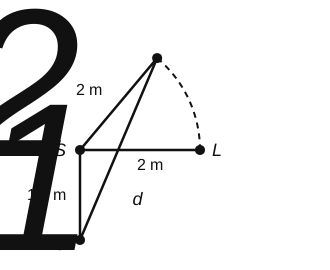
Two coherent sources of sound, $S_1$ and $S_2$, produce sound waves of the same wavelength $\lambda = 1$ m and are in phase. $S_1$ and $S_2$ are placed $1.5$ m apart (see figure). A listener, located at L, directly in front of $S_2$, finds that the intensity is at a minimum when he is $2$ m away from $S_2$. The listener moves away from $S_1$, keeping the distance from $S_2$ fixed. The adjacent maximum of intensity is observed when the listener is at a distance $d$ from $S_1$. Then $d$ is:
Concept. Sources in phase: minimum where the path difference is $(n+\tfrac12)\lambda$, maximum where it is $n\lambda$.
Step 1. At L. $S_1L=\sqrt{1.5^2+2^2}=2.5$ m, $S_2L=2$ m: path difference $0.5$ m $=\lambda/2$, the first minimum.
Step 2. Moving away from $S_1$. $S_2L$ stays $2$ m while $S_1L$ grows, so the path difference grows. The adjacent maximum is at path difference $\lambda=1$ m.
Step 3. Distance. $d-2=1\Rightarrow d=3$ m.
Answer. $3$ m (Option D).
Solution by Sreeraj P, M.Sc Physics
Q 11-14-100JEE MainJEE Main 2020 (6 Sep, Shift 1)Medium
A sound source S is moving along a straight track with speed $v$, and is emitting sound of frequency $f_0$. An observer is standing at a finite distance, at the point O, from the track. The time variation of frequency heard by the observer is best represented by: ($t_0$ represents the instant when the distance between the source and observer is minimum)
Concept. Only the velocity component along the line of sight counts: $f=f_0\dfrac{c}{c-v\cos\theta}$ ($c$: speed of sound, $\theta$: angle between the track and the line of sight).
Step 1. Shape. Far before, $\cos\theta\to1$: $f$ above $f_0$. At closest approach $\cos\theta=0$: $f=f_0$ at $t_0$. Far after, $\cos\theta\to-1$: $f$ below $f_0$. The fall is smooth.
Answer. Option B.
Solution by Sreeraj P, M.Sc Physics
Q 11-14-101JEE MainJEE Main 2020 (7 Jan, Shift 1)Medium
The speed of a transverse wave on a straight wire (mass $6.0$ g, length $60$ cm and area of cross-section $1.0\ \text{mm}^2$) is $90\ \text{m s}^{-1}$. If the Young's modulus of the wire is $16\times10^{11}\ \text{N m}^{-2}$, the extension of the wire over its natural length is:
Concept. The wave speed gives the tension, $T=\mu v^2$; Hooke's law then gives the extension, $\Delta l=\dfrac{Tl}{AY}$.
Step 1. Mass per length. $\mu=\dfrac{6.0\times10^{-3}}{0.60}=0.01$ kg m$^{-1}$.
Step 2. Tension. $T=0.01\times90^2=81$ N.
Step 3. Extension. $\Delta l=\dfrac{81\times0.60}{10^{-6}\times16\times10^{11}}=3.0\times10^{-5}$ m $=0.03$ mm.
Answer. $0.03$ mm (Option A).
Solution by Sreeraj P, M.Sc Physics
Q 11-14-102JEE MainJEE Main 2020 (7 Jan, Shift 2)Medium
A stationary observer receives sound from two identical tuning forks, one of which approaches and the other one recedes with the same speed (much less than the speed of sound). The observer hears $2$ beats/sec. The oscillation frequency of each tuning fork is $f_0 = 1400$ Hz and the velocity of sound in air is $350$ m/s. The speed of each tuning fork is close to:
Concept. One fork approaches and one recedes; for $u \ll v$, $f \approx f_0\left(1 \pm \dfrac{u}{v}\right)$, so the beat frequency is $\dfrac{2f_0u}{v}$.
Q 11-14-103JEE MainJEE Main 2020 (8 Jan, Shift 1)Medium
A one metre long (both ends open) organ pipe is kept in a gas that has double the density of air at STP. Assuming the speed of sound in air at STP is $300$ m/s, the frequency difference between the fundamental and second harmonic of this pipe is ______ Hz.
Concept. At the same pressure and $\gamma$, $v=\sqrt{\gamma P/\rho}\propto1/\sqrt\rho$. In an open pipe the second harmonic minus the fundamental equals the fundamental $v/2L$.
Step 1. Speed in the gas. $v=\dfrac{300}{\sqrt2}=212.1$ m/s.
Step 2. Difference. $f_2-f_1=f_1=\dfrac{212.1}{2\times1}=106$ Hz.
Answer. $106$.
Solution by Sreeraj P, M.Sc Physics
Q 11-14-104JEE MainJEE Main 2020 (2 Sep, Shift 1)Easy
Two identical strings $X$ and $Z$ made of same material have tension $T_X$ and $T_Z$ in them. If their fundamental frequencies are $450\ \text{Hz}$ and $300\ \text{Hz}$, respectively, then the ratio $T_X/T_Z$ is:
Q 11-14-105JEE MainJEE Main 2020 (2 Sep, Shift 2)Medium
A wire of density $9 \times 10^{-3}\ \text{kg cm}^{-3}$ is stretched between two clamps $1\ \text{m}$ apart. The resulting strain in the wire is $4.9 \times 10^{-4}$. The lowest frequency (in Hz) of the transverse vibrations in the wire (Young's modulus of wire $Y = 9 \times 10^{10}\ \text{N m}^{-2}$), to the nearest integer, is ______.
Concept. For a clamped wire $T=YA\times\text{strain}$ and $\mu=\rho A$, so $v=\sqrt{\dfrac{Y\times\text{strain}}{\rho}}$. The lowest frequency is $f_1=\dfrac{v}{2L}$.
Step 1. Density. $9\times10^{-3}$ kg cm$^{-3}=9\times10^3$ kg m$^{-3}$.
Step 3. Frequency. $f_1=\dfrac{70}{2\times1}=35$ Hz.
Answer. $35$.
Solution by Sreeraj P, M.Sc Physics
Q 11-14-106JEE MainJEE Main 2020 (3 Sep, Shift 1)Medium
A uniform thin rope of length $12\ \text{m}$ and mass $6\ \text{kg}$ hangs vertically from a rigid support and a block of mass $2\ \text{kg}$ is attached to its free end. A transverse short wave train of wavelength $6\ \text{cm}$ is produced at the lower end of the rope. What is the wavelength of the wave train (in cm) when it reaches the top of the rope?
Concept. Tension in a hanging rope grows towards the top (it holds more below it). Frequency is fixed by the source, so $\lambda\propto v\propto\sqrt T$.
Step 1. Tensions. Bottom: $2g$; top: $(2+6)g=8g$.
Step 2. Wavelength at top. $6\times\sqrt{\dfrac{8}{2}}=12$ cm.
Answer. Option C.
Solution by Sreeraj P, M.Sc Physics
Q 11-14-107JEE MainJEE Main 2020 (4 Sep, Shift 1)Medium
For a transverse wave travelling along a straight line, the distance between two peaks (crests) is $5\ \text{m}$, while the distance between one crest and one trough is $1.5\ \text{m}$. The possible wavelengths (in m) of the waves are:
Concept. Any two crests are a whole number of wavelengths apart; a crest and a trough are an odd number of half-wavelengths apart. The wavelength must satisfy both.
Step 1. Conditions. $5=n\lambda$ and $1.5=\left(m+\tfrac12\right)\lambda=\dfrac{(2m+1)\lambda}{2}$.
Q 11-14-108JEE MainJEE Main 2020 (4 Sep, Shift 2)Medium
The driver of a bus approaching a big wall notices that the frequency of his bus's horn changes from $420\ \text{Hz}$ to $490\ \text{Hz}$ when he hears it after it gets reflected from the wall. Find the speed of the bus if speed of the sound is $330\ \text{m s}^{-1}$:
Step 3. Convert. $25.4 \times 3.6 \approx 91$ km/h.
Answer. $91$ km h$^{-1}$ (Option A).
Solution by Sreeraj P, M.Sc Physics
Q 11-14-109JEE MainJEE Main 2020 (5 Sep, Shift 1)Medium
In a resonance tube experiment when the tube is filled with water up to a height of $17.0\ \text{cm}$ from bottom, it resonates with a given tuning fork. When the water level is raised the next resonance with the same tuning fork occurs at a height of $24.5\ \text{cm}$. If the velocity of sound in air is $330\ \text{m s}^{-1}$, the tuning fork frequency is:
Concept. Successive resonances of a resonance tube are $\lambda/2$ apart in air-column length. Raising the water by $\Delta h$ shortens the air column by $\Delta h$.
Step 1. Half wavelength. $24.5-17.0=7.5$ cm $=\lambda/2$, so $\lambda=15$ cm.
Step 2. Frequency. $f=\dfrac{330}{0.15}=2200$ Hz.
Answer. $2200$ Hz (Option A).
Solution by Sreeraj P, M.Sc Physics
Q 11-14-110JEE MainJEE Main 2019 (9 Jan, Shift 2)Medium
A musician using an open flute of length $50\ \text{cm}$ produces second harmonic sound waves. A person runs towards the musician from another end of a hall at a speed of $10\ \text{km h}^{-1}$. If the wave speed is $330\ \text{m s}^{-1}$, the frequency heard by the running person shall be close to
Concept. Find the flute's second harmonic ($f_n = \dfrac{nv}{2L}$), then apply the Doppler shift for an observer moving towards the source: $f' = f\dfrac{v + v_o}{v}$.
Q 11-14-111JEE MainJEE Main 2019 (10 Jan, Shift 1)Easy
A train moves towards a stationary observer with speed $34\ \text{m/s}$. The train sounds a whistle and its frequency registered by the observer is $f_1$. If the speed of the train is reduced to $17\ \text{m/s}$, the frequency registered is $f_2$. If speed of sound is $340\ \text{m/s}$, then the ratio $f_1/f_2$ is:
Q 11-14-112JEE MainJEE Main 2019 (10 Jan, Shift 1)Medium
A string of length $1\ \text{m}$ and mass $5\ \text{g}$ is fixed at both ends. The tension in the string is $8.0\ \text{N}$. The string is set into vibration using an external vibrator of frequency $100\ \text{Hz}$. The separation between successive nodes on the string is close to
Concept. The vibrator sets the frequency; the string sets the speed. Successive nodes are $\dfrac\lambda2$ apart.
Step 1. Speed. $\mu=0.005$ kg m$^{-1}$; $v=\sqrt{\dfrac{8}{0.005}}=40$ m s$^{-1}$.
Step 2. Wavelength. $\dfrac{40}{100}=0.4$ m.
Step 3. Node spacing. $20$ cm.
Answer. Option A.
Solution by Sreeraj P, M.Sc Physics
Q 11-14-113JEE MainJEE Main 2019 (10 Jan, Shift 2)Easy
A closed organ pipe has a fundamental frequency of $1.5\ \text{kHz}$. The number of overtones that can be distinctly heard by a person with this organ pipe will be (Assume that the highest frequency a person can hear is $20{,}000\ \text{Hz}$).
Q 11-14-114JEE MainJEE Main 2019 (10 Apr, Shift 1)Easy
A stationary source emits sound waves of frequency $500\ \text{Hz}$. Two observers moving along a line passing through the source detect sound to be of frequencies $480\ \text{Hz}$ and $530\ \text{Hz}$. Their respective speeds are, in $\text{m s}^{-1}$, (Given speed of sound $= 300\ \text{m/s}$)
Q 11-14-115JEE MainJEE Main 2019 (10 Apr, Shift 2)Easy
A source of sound $S$ is moving with a velocity of $50\ \text{m s}^{-1}$ towards a stationary observer. The observer measures the frequency of the source as $1000\ \text{Hz}$. What will be the apparent frequency of the source when it is moving away from the observer after crossing him? (Take velocity of sound in air is $350\ \text{m s}^{-1}$)
Concept. First recover the true frequency from the approaching reading, then apply the receding formula $f\dfrac{v}{v+v_s}$.
Step 1. True frequency. $f=1000\times\dfrac{300}{350}=857$ Hz.
Step 2. Receding. $857\times\dfrac{350}{400}=750$ Hz.
Answer. Option A. Shortcut: $f_{\text{rec}}=f_{\text{app}}\dfrac{v-v_s}{v+v_s}$.
Solution by Sreeraj P, M.Sc Physics
Q 11-14-116JEE MainJEE Main 2019 (10 Apr, Shift 2)Medium
The correct figure that shows, schematically, the wave pattern produced by the superposition of two waves of frequencies $9\ \text{Hz}$ and $11\ \text{Hz}$, is
Concept. Two close frequencies give a fast wave inside an envelope. The loudness peaks $f_1-f_2$ times per second, and the envelope pinches to zero between peaks.
Step 1. Beat frequency. $11-9=2$ Hz: a loudness peak every $0.5$ s.
Step 2. Choose. In 2 s there are 4 beats: the envelope closes to zero at $t=0,\,0.5,\,1,\,1.5,\,2$ s.
Answer. Option A.
Solution by Sreeraj P, M.Sc Physics
Q 11-14-117JEE MainJEE Main 2019 (9 Jan, Shift 1)Medium
A heavy ball of mass $M$ is suspended from the ceiling of a car by a light string of mass $m$ ($m \ll M$). When the car is at rest, the speed of transverse waves in the string is $60\ \text{m s}^{-1}$. When the car has acceleration $a$, the wave-speed increases to $60.5\ \text{m s}^{-1}$. The value of $a$, in terms of gravitational acceleration $g$, is close to
Concept. The string tension is $Mg_{\text{eff}}$, and $v\propto\sqrt{T}$. In a car accelerating horizontally, $g_{\text{eff}}=\sqrt{g^2+a^2}$.
Step 1. Ratio of tensions. $\left(\dfrac{60.5}{60}\right)^2=1.0167$.
Step 2. Solve for $a$. $1+\dfrac{a^2}{g^2}=1.0167^2=1.0337\Rightarrow\dfrac ag=\sqrt{0.0337}=0.18$.
Answer. About $\dfrac g5$ (Option C).
Solution by Sreeraj P, M.Sc Physics
Q 11-14-118JEE MainJEE Main 2019 (8 Apr, Shift 1)Medium
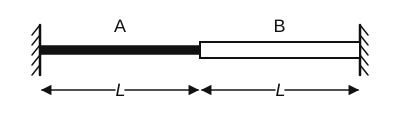
A wire of length $2L$, is made by joining two wires A and B of same length but different radii $r$ and $2r$ and made of the same material. It is vibrating at a frequency such that the joint of the two wires forms a node. If the number of antinodes in wire A is $p$ and that in B is $q$ then ratio $p:q$ is
Concept. Same material and tension; radius doubles, so $\mu$ is $4$ times and $v$ is half in B. Same frequency, so $\lambda_B=\dfrac{\lambda_A}{2}$. Each segment has nodes at both ends, so it holds a whole number of loops: loops $=\dfrac{L}{\lambda/2}$.
Step 1. Loops in A. $p=\dfrac{2L}{\lambda_A}$.
Step 2. Loops in B. $q=\dfrac{2L}{\lambda_B}=\dfrac{4L}{\lambda_A}$.
Step 3. Ratio. $p:q=1:2$.
Answer. Option D. (Antinodes $=$ loops.)
Solution by Sreeraj P, M.Sc Physics
Q 11-14-119JEE MainJEE Main 2019 (9 Apr, Shift 1)Easy
A string is clamped at both the ends and it is vibrating in its $4^{\text{th}}$ harmonic. The equation of the stationary wave is $y = 0.3\sin(0.157x)\cos(200\pi t)$. The length of the string is (All quantities are in SI units.)
Concept. Compare with $y=2A\sin kx\cos\omega t$: $k=\dfrac{2\pi}\lambda$. In the $n$th harmonic the string holds $n$ half-wavelengths: $L=\dfrac{n\lambda}{2}$.
Step 1. Wavelength. $\lambda=\dfrac{2\pi}{0.157}=40$ m.
Step 2. Length. $L=\dfrac{4\times40}{2}=80$ m.
Answer. Option D.
Solution by Sreeraj P, M.Sc Physics
Q 11-14-120JEE MainJEE Main 2019 (9 Apr, Shift 1)Medium
The pressure wave, $P = 0.01\sin(1000t - 3x)\ \text{N m}^{-2}$, corresponds to the sound produced by a vibrating blade on a day when atmospheric temperature is $0^\circ\text{C}$. On some other day when temperature is $T$, the speed of sound produced by the same blade and at the same frequency is found to be $336\ \text{m s}^{-1}$. Approximate value of $T$ is
Concept. From the given pressure wave, $v=\dfrac\omega k$ at $0^\circ$C. Speed of sound in air $\propto\sqrt T$ (kelvin).
Step 1. Speed at $273$ K. $\dfrac{1000}{3}=333.3$ m s$^{-1}$.
Step 2. New temperature. $T=273\left(\dfrac{336}{333.3}\right)^2=273\times1.016=277.4$ K.
Answer. About $4^\circ$C (Option C).
Solution by Sreeraj P, M.Sc Physics
Q 11-14-121JEE MainJEE Main 2019 (9 Apr, Shift 2)Easy
Two cars A and B are moving away from each other in opposite directions. Both the cars are moving with speed of $20\ \text{m s}^{-1}$ with respect to the ground. If an observer in car A detects a frequency $2000\ \text{Hz}$ of the sound coming from car B, what is the natural frequency of the sound source in car B? (speed of sound in air $= 340\ \text{m s}^{-1}$)
Q 11-14-122JEE MainJEE Main 2019 (9 Apr, Shift 2)Easy
A string $2.0\ \text{m}$ long and fixed at its ends is driven by a $240\ \text{Hz}$ vibrator. The string vibrates in its third harmonic mode. The speed of the wave and its fundamental frequency is
Concept. Harmonics of a string are $f_n=nf_1$, and $f_1=\dfrac v{2L}$.
Step 1. Fundamental. $\dfrac{240}{3}=80$ Hz.
Step 2. Speed. $2\times2\times80=320$ m s$^{-1}$.
Answer. Option B.
Solution by Sreeraj P, M.Sc Physics
Q 11-14-123JEE MainJEE Main 2019 (11 Jan, Shift 1)Easy
Equation of travelling wave on a stretched string of linear density $5$ g/m is $y = 0.03\sin(450t - 9x)$ where distance and time are measured in SI units. The tension in the string is:
Concept. Read $v=\dfrac\omega k$ from the equation, then $T=\mu v^2$.
Step 1. Speed. $\dfrac{450}{9}=50$ m s$^{-1}$.
Step 2. Tension. $5\times10^{-3}\times2500=12.5$ N.
Answer. Option C.
Solution by Sreeraj P, M.Sc Physics
Q 11-14-124JEE MainJEE Main 2019 (12 Jan, Shift 1)Easy
A travelling harmonic wave is represented by the equation $y(x, t) = 10^{-3}\sin(50t + 2x)$, where $x$ and $y$ are in meter and $t$ is in seconds. Which of the following is a correct statement about the wave?
Answer: (C) The wave is propagating along the negative $x$-axis with speed $25\ \text{m s}^{-1}$
Concept. In $y=A\sin(\omega t\pm kx)$ the wave speed is $v=\dfrac\omega k$. The sign tells the direction: $\omega t-kx$ moves towards $+x$, $\omega t+kx$ towards $-x$ (the phase stays constant when $x$ decreases as $t$ grows).
Step 1. Speed. $\omega=50$, $k=2$: $v=25$ m s$^{-1}$.
Step 2. Direction. $50t+2x$: negative $x$.
Answer. Option C.
Solution by Sreeraj P, M.Sc Physics
Q 11-14-125JEE MainJEE Main 2019 (12 Jan, Shift 2)Medium
A resonance tube is old and has a jagged end. It is still used in the laboratory to determine the velocity of sound in air. A tuning fork of frequency $512$ Hz produces first resonance when the tube is filled with water to a mark $11$ cm below a reference mark, near the open end of the tube. The experiment is repeated with another fork of frequency $256$ Hz which produces first resonance when water reaches a mark $27$ cm below the reference mark. The velocity of sound in air, obtained in the experiment, is close to
Concept. For the first resonance, (air length) $+$ (end correction) $=\lambda/4$. Lengths are measured from a reference mark, so the jagged end and the unknown offset add the same constant $e$ to both experiments.
Step 1. Two equations. $0.11+e=\dfrac{v}{4\times512}$ and $0.27+e=\dfrac v{4\times256}$.
Step 3. Speed. $v=0.16\times2048=327.7\approx328$ m s$^{-1}$.
Answer. Option D.
Solution by Sreeraj P, M.Sc Physics
Q 11-14-126JEE MainJEE Main 2019 (12 Apr, Shift 1)Medium
A submarine A travelling at $18$ km/hr is being chased along the line of its velocity by another submarine B travelling at $27$ km/hr. B sends a sonar signal of $500$ Hz to detect A and receives a reflected sound of frequency $\nu$. The value of $\nu$ is close to (Speed of sound in water $1500\ \text{m s}^{-1}$)
Concept. Two Doppler steps. A (ahead, $5$ m s$^{-1}$) receives from B ($7.5$ m s$^{-1}$, chasing). Then A reflects as a moving source back to B as a moving observer.
Step 1. A receives. $f_1=500\times\dfrac{1500-5}{1500-7.5}$ (A moves away from the sound; B moves towards A).
Step 2. B receives. $\nu=f_1\times\dfrac{1500+7.5}{1500+5}$.
Step 3. Value. $\nu=500\times\dfrac{1495}{1492.5}\times\dfrac{1507.5}{1505}=501.7$ Hz.
Answer. About $502$ Hz (Option C). B gains on A at $2.5$ m s$^{-1}$, so the echo is slightly higher.
Solution by Sreeraj P, M.Sc Physics
Q 11-14-127JEE MainJEE Main 2019 (12 Apr, Shift 1)Medium
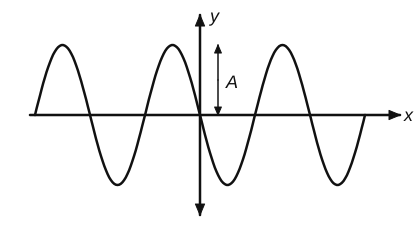
A progressive wave travelling along the positive $x$-direction is represented by $y(x, t) = A\sin(kx - \omega t + \phi)$. Its snapshot at $t = 0$ is given in the figure. For this wave, the phase $\phi$ is:
Concept. At $t=0$ the snapshot is $y(x,0)=A\sin(kx+\phi)$. The figure shows $y=0$ at $x=0$, with $y$ becoming negative just after the origin.
Step 1. Value at the origin. $A\sin\phi=0\Rightarrow\phi=0$ or $\pi$.
Step 2. Slope. $\dfrac{dy}{dx}=kA\cos\phi$ must be negative, so $\cos\phi=-1$: $\phi=\pi$ (the snapshot is $-A\sin kx$).
Answer. $\pi$ (Option C).
Solution by Sreeraj P, M.Sc Physics
Q 11-14-128JEE MainJEE Main 2019 (12 Apr, Shift 2)Easy
A small speaker delivers $2$ W of audio output. At what distance from the speaker will one detect $120$ dB intensity sound? [Given reference intensity of sound as $10^{-12}\ \text{W/m}^2$]
Concept. Sound level $\beta=10\log_{10}\dfrac{I}{I_0}$ dB. A point source spreads its power over a sphere: $I=\dfrac{P}{4\pi r^2}$.
Step 1. Intensity. $120=10\log\dfrac{I}{10^{-12}}\Rightarrow I=1$ W m$^{-2}$.
Step 2. Distance. $r=\sqrt{\dfrac{2}{4\pi\times1}}=0.40$ m.
Answer. $40$ cm (Option A).
Solution by Sreeraj P, M.Sc Physics
Q 11-14-129JEE MainJEE Main 2019 (12 Apr, Shift 2)Medium
Two sources of sound $S_1$ and $S_2$ produce sound waves of same frequency $660$ Hz. A listener is moving from source $S_1$ towards $S_2$ with a constant speed $u_0$ m/s and he hears $10$ beats/s. The velocity of sound is $330$ m/s. Then, $u_0$ equals:
Q 11-14-130JEE MainJEE Main 2019 (12 Apr, Shift 2)Easy
A tuning fork of frequency $480$ Hz is used in an experiment for measuring speed of sound $(v)$ in air by resonance tube method. Resonance is observed to occur at two successive lengths of the air column, $l_1 = 30$ cm and $l_2 = 70$ cm. Then, $v$ is equal to:
Concept. Two successive resonance lengths differ by $\lambda/2$, which removes the end correction.
Step 1. Wavelength. $70-30=40$ cm $=\lambda/2$, so $\lambda=0.80$ m.
Step 2. Speed. $v=480\times0.80=384$ m s$^{-1}$.
Answer. Option A.
Solution by Sreeraj P, M.Sc Physics
Q 11-14-131JEE MainJEE Main 2018 (15 Apr, Shift 1)Medium
A tuning fork vibrates with frequency $256\ \text{Hz}$ and gives one beat per second with the third normal mode of vibration of an open pipe. What is the length of the pipe? (speed of sound in air is $340\ \text{m s}^{-1}$)
Step 2. Length. $L=\dfrac{510}{255}=2.00$ m or $\dfrac{510}{257}=1.98$ m; the option is $200$ cm.
Answer. $200$ cm (Option B).
Solution by Sreeraj P, M.Sc Physics
Q 11-14-132JEE MainJEE Main 2018 (15 Apr, Shift 2)Medium
5 beats/second are heard when a tuning fork is sounded with a sonometer wire under tension, when the length of the sonometer wire is either $0.95\ \text{m}$ or $1\ \text{m}$. The frequency of the fork will be:
Q 11-14-133JEE MainJEE Main 2018 (16 Apr, Shift 1)Easy
The end correction of a resonance column is $1\ \text{cm}$. If the shortest length resonating with the tuning fork is $10\ \text{cm}$, the next resonating length should be
Concept. First resonance: $l_1+e=\dfrac\lambda4$. Next: $l_2+e=\dfrac{3\lambda}4$.
Step 1. Quarter wavelength. $\dfrac\lambda4=10+1=11$ cm.
Step 2. Next length. $l_2=3\times11-1=32$ cm.
Answer. $32$ cm (Option A).
Solution by Sreeraj P, M.Sc Physics
Q 11-14-134JEE MainJEE Main 2018 (16 Apr, Shift 1)Easy
Two sitar strings, $A$ and $B$ playing the note 'Dha' are slightly out of tune and produce beats of frequency $5\ \text{Hz}$. The tension of the string $B$ is slightly increased and the beat frequency is found to decrease by $3\ \text{Hz}$. If the frequency of $A$ is $425\ \text{Hz}$, the original frequency of $B$ is
Concept. $f_B=f_A\pm5$. Raising the tension raises $f_B$; the beats fall (to 2 Hz) only if $f_B$ was below $f_A$.
Step 1. Possibilities. $f_B=420$ Hz or $430$ Hz.
Step 2. Choose. At $430$ Hz a higher tension would increase the beats; at $420$ Hz it brings $f_B$ towards $425$ Hz. So $f_B=420$ Hz.
Answer. $420$ Hz (Option D).
Solution by Sreeraj P, M.Sc Physics
Q 11-14-135JEE MainJEE Main 2017 (8 Apr)Medium
Two wires $W_1$ and $W_2$ have the same radius $r$ and respective densities $\rho_1$ and $\rho_2$, such that $\rho_2 = 4\rho_1$. They are joined together at the point $O$, as shown in the figure. The combination is used as a sonometer wire and kept under tension $T$. The point $O$ is midway between the two bridges. When a stationary wave is set up in the composite wire, the joint is found to be a node. The ratio of the number of antinodes formed in $W_1$ to $W_2$ is:
Concept. Both wires carry the same tension and vibrate at the same frequency. With equal radii, $\mu\propto\rho$, so $v\propto1/\sqrt\rho$ and $\lambda\propto v$. A node at the joint means each half holds a whole number of loops.
Step 1. Wavelengths. $\rho_2=4\rho_1\Rightarrow v_2=v_1/2$, so $\lambda_2=\lambda_1/2$.
Step 3. Antinodes. One antinode per loop: $p:q=1:2$.
Answer. $1:2$ (Option B).
Solution by Sreeraj P, M.Sc Physics
Q 11-14-136JEE MainJEE Main 2017 (9 Apr)Easy
A standing wave is formed by the superposition of two waves travelling in opposite directions. The transverse displacement is given by $y(x, t) = 0.5\sin\left(\dfrac{5\pi}{4}x\right)\cos(200\pi t)$. What is the speed of the travelling wave moving in the positive $x$ direction? ($x$ and $t$ are in meter and second, respectively)
Concept. A standing wave $\sin kx\cos\omega t$ is made of two travelling waves with the same $k$ and $\omega$, each moving at $v=\dfrac\omega k$.
Step 1. Speed. $\dfrac{200\pi}{5\pi/4}=160$ m s$^{-1}$.
Answer. Option C.
Solution by Sreeraj P, M.Sc Physics
Q 11-14-137JEE MainJEE Main 2018 (8 Apr)Medium
A granite rod of $60$ cm length is clamped at its middle point and is set into longitudinal vibrations. The density of granite is $2.7\times10^3\ \text{kg m}^{-3}$ and its Young's modulus is $9.27\times10^{10}$ Pa. What will be the fundamental frequency of the longitudinal vibrations?
Concept. A rod clamped at its middle has a node there and antinodes at both free ends, so in the fundamental $L=\dfrac\lambda2$. Speed of longitudinal waves $v=\sqrt{Y/\rho}$.
Step 1. Speed. $\sqrt{\dfrac{9.27\times10^{10}}{2.7\times10^3}}=\sqrt{3.43\times10^7}=5860$ m s$^{-1}$.
Q 11-14-139JEE MainJEE Main 2025 (2 Apr, Shift 2)Medium
A sinusoidal wave of wavelength $7.5\ \text{cm}$ travels a distance of $1.2\ \text{cm}$ along the $x$-direction in $0.3\ \text{s}$. The crest P is at $x = 0$ at $t = 0$ s and the maximum displacement of the wave is $2\ \text{cm}$. Which equation correctly represents this wave?
Concept. Build the equation from its pieces: $k=\dfrac{2\pi}{\lambda}$, $v=\dfrac{\text{distance}}{\text{time}}$, $\omega=kv$. A crest at $x=0$ at $t=0$ means $y(0,0)=+A$, which needs a cosine with zero phase.
Step 1. $k$. $\dfrac{2\pi}{7.5}=0.838$ cm$^{-1}$.
Step 2. Speed and $\omega$. $v=\dfrac{1.2}{0.3}=4$ cm s$^{-1}$; $\omega=0.838\times4=3.35$ s$^{-1}$.
Step 3. Equation. $y=2\cos(0.83x-3.35t)$ cm, moving towards $+x$.
Answer. Option A.
Solution by Sreeraj P, M.Sc Physics
Q 11-14-140JEE MainJEE Main 2025 (3 Apr, Shift 2)Easy
In the resonance experiment, two air columns (closed at one end) of $100\ \text{cm}$ and $120\ \text{cm}$ length give $15$ beats per second when each one is sounding in its respective fundamental mode. The velocity of sound in the air column is:
Q 11-14-141JEE MainJEE Main 2025 (4 Apr, Shift 1)Easy
In an experiment with a closed organ pipe, it is filled with water up to $\left(\dfrac15\right)$th of its volume. The frequency of the fundamental note will change by:
Concept. Water shortens the air column of a closed pipe; $f_1=\dfrac{v}{4L}\propto\dfrac1L$.
Step 1. New length. $\dfrac45L$.
Step 2. Change. $f'=\dfrac54f$: an increase of $25\%$.
Answer. Option A.
Solution by Sreeraj P, M.Sc Physics
Q 11-14-142JEE MainJEE Main 2025 (4 Apr, Shift 2)Easy
The displacement of a wave is expressed as $x(t) = 5\cos\left(628t + \dfrac\pi2\right)\ \text{m}$. The wavelength of the wave when its velocity is $300\ \text{m/s}$ is:
Concept. The frequency comes from the time part: $f=\omega/2\pi$; then $\lambda=v/f$.
Step 1. Frequency. $f=\dfrac{628}{2\pi}=100$ Hz.
Step 2. Wavelength. $\lambda=\dfrac{300}{100}=3$ m.
Answer. $3$ m (Option B).
Solution by Sreeraj P, M.Sc Physics
Q 11-14-143JEE MainJEE Main 2025 (7 Apr, Shift 1)Medium
Two harmonic waves moving in the same direction superimpose to form a wave $x = a\cos(1.5t)\cos(50.5t)$, where $t$ is in seconds. Find the period with which they beat (close to the nearest integer).
Concept. $2\cos A\cos B=\cos(A-B)+\cos(A+B)$: the product is two waves of angular frequency $52$ and $49$ rad s$^{-1}$. Beat (angular) frequency is their difference.
Step 1. Components. $50.5\pm1.5$: $52$ and $49$ rad s$^{-1}$.
Step 2. Beat period. $\dfrac{2\pi}{3}=2.09$ s.
Answer. About $2$ s (Option D). Trap: the envelope $\cos1.5t$ has period $4.2$ s, but loudness peaks twice per envelope period.
Solution by Sreeraj P, M.Sc Physics
Q 11-14-144JEE MainJEE Main 2025 (7 Apr, Shift 2)Medium
The equation of a wave travelling on a string is $y = \sin(20\pi x + 10\pi t)$, where $x$ and $t$ are distance and time in SI units. The minimum distance between two points having the same oscillating speed (at all times) is:
Concept. Points half a wavelength apart move in opposite directions with exactly the same speed at every instant (phase difference $\pi$). That is the smallest such separation.
Step 1. Wavelength. $k=20\pi\Rightarrow\lambda=\dfrac{2\pi}{20\pi}=0.1$ m.
Step 2. Separation. $\dfrac\lambda2=5$ cm.
Answer. Option A.
Solution by Sreeraj P, M.Sc Physics
Q 11-14-145JEE MainJEE Main 2025 (8 Apr, Shift 2)Easy
Two strings with circular cross section and made of the same material are stretched to have the same tension. A transverse wave is then made to pass through both the strings. The velocity of the wave in the first string having radius of cross section $R$ is $v_1$, and that in the other string having radius of cross section $R/2$ is $v_2$. Then $\dfrac{v_2}{v_1}$ is:
Q 11-14-146JEE MainJEE Main 2025 (8 Apr, Shift 2)Medium
The amplitude and phase of a wave that is formed by the superposition of two harmonic travelling waves, $y_1(x, t) = 4\sin(kx - \omega t)$ and $y_2(x, t) = 2\sin\left(kx - \omega t + \dfrac{2\pi}{3}\right)$, are: (Take the angular frequency of the initial waves to be the same, $\omega$.)
Concept. Waves of the same $k$ and $\omega$ add like vectors (phasors): $R^2=A_1^2+A_2^2+2A_1A_2\cos\delta$ and $\tan\phi=\dfrac{A_2\sin\delta}{A_1+A_2\cos\delta}$.


 Solution by Sreeraj P, M.Sc Physics