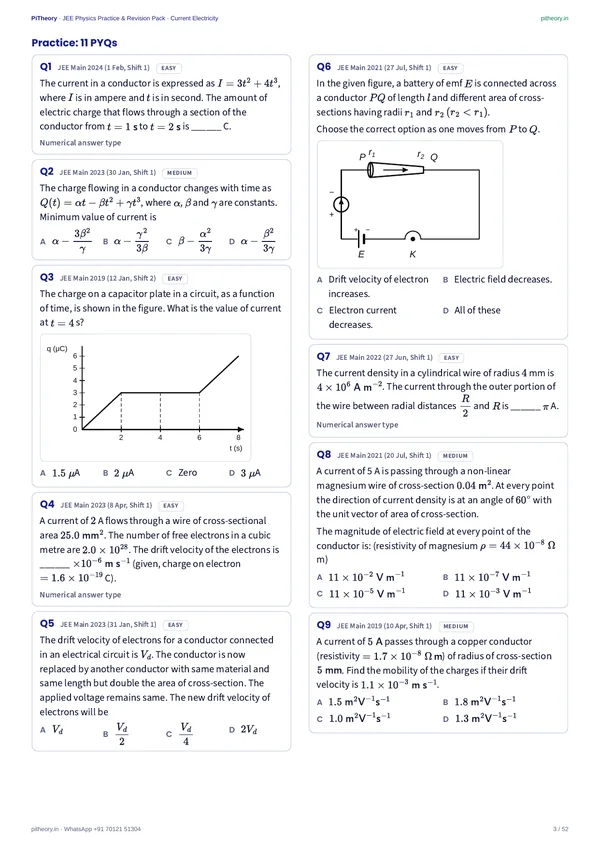

$L, C$ and $R$ represents physical quantities inductance, capacitance and resistance respectively. The dimensional formula $\text{ML}^2\text{T}^{-4}\text{A}^{-2}$ corresponds to ______.
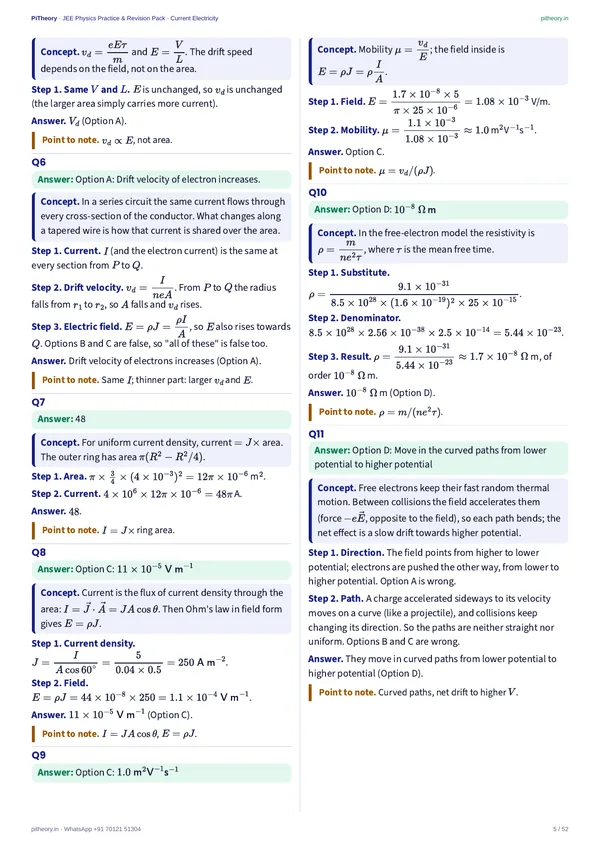
Answer: (A) $\dfrac{R}{\sqrt{LC}}$
Concept. Rather than expanding every symbol, use known combinations: $\sqrt{LC}$ is a time (since $\omega=1/\sqrt{LC}$ in an LC circuit), $L/R$ and $RC$ are times, and $\sqrt{L/C}$ has the dimensions of resistance. Then only $[R]$ needs to be worked out.
Step 1. Dimensions of resistance. $R=\dfrac{V}{I}=\dfrac{P}{I^2}$ and power is $ML^2T^{-3}$:
$$[R]=[ML^2T^{-3}A^{-2}]$$
Step 2. Compare with the target. The target $ML^2T^{-4}A^{-2}$ is $[R]$ with one extra $T^{-1}$. So we need $R$ divided by a time.
Step 3. Check the options.
- (A) $\dfrac{R}{\sqrt{LC}}$: $\sqrt{LC}$ is a time, so this is $[R]\,T^{-1}=ML^2T^{-4}A^{-2}$. Matches.
- (B) $\dfrac{R}{LC}$: $LC$ is time$^2$, giving $[R]\,T^{-2}$. No.
- (D) $\dfrac1R\sqrt{\dfrac LC}$: $\sqrt{L/C}$ is a resistance, so this is dimensionless. No.
- (C) $\dfrac{C}{\sqrt{LR}}$: with $[C]=M^{-1}L^{-2}T^4A^2$ and $[\sqrt{LR}]=ML^2T^{-5/2}A^{-2}$ this is $M^{-2}L^{-4}T^{13/2}A^4$. No.
Answer. Option A, $\dfrac{R}{\sqrt{LC}}$.
 Solution by Sreeraj P, M.Sc Physics