

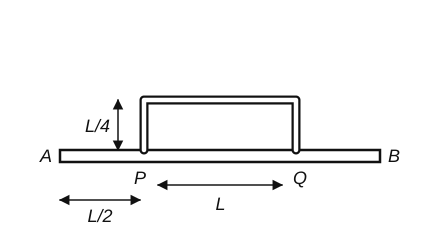
Temperature difference of $120^\circ\text{C}$ is maintained between two ends of a uniform rod $AB$ of length $2L$. Another bent rod $PQ$, of same cross-section as $AB$ and length $\frac{3L}{2}$, is connected across $AB$ (see figure). In steady state, temperature difference between $P$ and $Q$ will be close to
Answer: (A) $45^\circ\text{C}$
Thermal resistance is proportional to length (same material and cross-section). From the figure, $AP = L/2$, $PQ = L$ and $QB = L/2$.
Between $P$ and $Q$ the straight part ($L$) and the bent rod ($3L/2$) are in parallel:
$$R_{PQ} \propto \frac{L\cdot\frac{3L}{2}}{L + \frac{3L}{2}} = \frac{3L}{5}$$
Total resistance $\propto \frac L2 + \frac{3L}{5} + \frac L2 = \frac{8L}{5}$. The temperature drop divides in proportion to resistance:
$$\Delta T_{PQ} = 120 \times \frac{3/5}{8/5} = 45^\circ\text{C}$$
 Solution by Sreeraj P, M.Sc Physics