

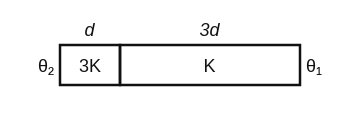
Two materials having coefficients of thermal conductivity $3K$ and $K$ and thickness $d$ and $3d$ respectively, are joined to form a slab as shown in the figure. The temperatures of the outer surfaces are $\theta_2$ and $\theta_1$ respectively, ($\theta_2 > \theta_1$). The temperature at the interface is
Answer: (D) $\dfrac{\theta_1}{10} + \dfrac{9\theta_2}{10}$
Concept. Think of each layer as a thermal resistance $R=\dfrac{d}{KA}$. In series the same heat current flows, so each layer's temperature drop is proportional to its resistance.
Step 1. Resistances. $R_1=\dfrac{d}{3KA}$, $R_2=\dfrac{3d}{KA}=9R_1$.
Step 2. Share of the drop. The $3K$ layer (on the $\theta_2$ side) takes $\dfrac1{10}$ of the total drop.
Step 3. Interface. $\theta=\theta_2-\dfrac{\theta_2-\theta_1}{10}=\dfrac{\theta_1}{10}+\dfrac{9\theta_2}{10}$.
Answer. Option D.
 Solution by Sreeraj P, M.Sc Physics


