The temperature of a metallic sphere of radius $R$ is increased by a small amount $\Delta T$. If the linear coefficient of thermal expansion of the metal is $\alpha$, the approximate increase in the volume of the sphere is :
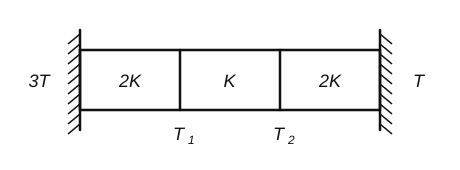
Three identical heat conducting rods are connected in series as shown in the figure. The rods on the sides have thermal conductivity $2K$ while that in the middle has thermal conductivity $K$. The left end of the combination is maintained at temperature $3T$ and the right end at $T$. The rods are thermally insulated from outside. In steady state, temperature at the left junction is $T_1$ and that at the right junction is $T_2$. The ratio $T_1/T_2$ is
Step 3. Junction temperatures. Each outer rod drops $HR = \dfrac{T}{2}$: $$T_1 = 3T - \frac{T}{2} = \frac{5T}{2},\qquad T_2 = T + \frac{T}{2} = \frac{3T}{2}$$
Step 4. Ratio. $\dfrac{T_1}{T_2} = \dfrac53$.
Answer. $\dfrac53$ (Option C).
Solution by Sreeraj P, M.Sc Physics
Q 11-10-003NEETNEET 2024Top questionMedium
A metallic bar of Young's modulus, $0.5 \times 10^{11}\ \text{N m}^{-2}$ and coefficient of linear thermal expansion $10^{-5}\ °\text{C}^{-1}$, length $1$ m and area of cross-section $10^{-3}\ \text{m}^2$ is heated from $0°$C to $100°$C without expansion or bending. The compressive force developed in it is:
Concept. The bar is not allowed to expand, so the thermal strain $\alpha\Delta T$ is cancelled by an equal compressive strain: $F = YA\alpha\Delta T$.
Step 1. Substitute. $$F = 0.5 \times 10^{11} \times 10^{-3} \times 10^{-5} \times 100 = 5 \times 10^4\ \text{N} = 50 \times 10^3\ \text{N}$$ (The length of the bar does not matter.)
Answer. $50 \times 10^3$ N (Option D).
Solution by Sreeraj P, M.Sc Physics
Q 11-10-004NEETNEET 2021Top questionMedium
A cup of coffee cools from $90°$C to $80°$C in t minutes, when the room temperature is $20°$C. The time taken by a similar cup of coffee to cool from $80°$C to $60°$C at a room temperature same at $20°$C is :
The quantities of heat required to raise the temperature of two solid copper spheres of radii $r_1$ and $r_2$ ($r_1 = 1.5r_2$) through $1$ K are in the ratio :
What lengths of brass and iron rods at $0°$C must be used if the difference between their lengths is always $0.2$ m? The coefficients of linear expansion of brass and iron are $18 \times 10^{-6}\ °\text{C}^{-1}$ and $12 \times 10^{-6}\ °\text{C}^{-1}$ respectively.
Concept. The difference in length stays constant only if both rods expand by the same amount: $l_b\alpha_b = l_i\alpha_i$.
Step 1. Ratio of lengths. $$\frac{l_i}{l_b} = \frac{\alpha_b}{\alpha_i} = \frac{18}{12} = \frac32$$ The iron rod is the longer one.
Step 2. Use the difference. $l_i - l_b = 0.2$ m with $l_i = 1.5l_b$ gives $0.5l_b = 0.2$, so $l_b = 0.4$ m and $l_i = 0.6$ m.
Answer. Brass $0.4$ m, iron $0.6$ m (Option A).
Solution by Sreeraj P, M.Sc Physics
Q 11-10-007JEE MainAIEEE 2011Easy
A metal rod of Young's modulus $Y$ and coefficient of linear expansion $\alpha$ is held at its two ends such that its length remains invariant. If its temperature is raised by $t\ °$C, the linear stress developed in it is
Concept. A rod held at fixed length is prevented from expanding by $\alpha t$; that strain becomes a compressive stress $Y\alpha t$.
Answer. Option B.
Solution by Sreeraj P, M.Sc Physics
Q 11-10-008JEE MainAIEEE 2011Easy
An aluminium sphere of $20$ cm diameter is heated from $0°$C to $100°$C. Its volume changes by (coefficient of linear expansion of aluminium $= 23 \times 10^{-6}\ °\text{C}^{-1}$)
A wooden wheel of radius $R$ is made of two semicircular parts. The two parts are held together by a ring made of a metal strip of cross-sectional area $S$ and length $L$, which is slightly less than $2\pi R$. To fit the ring on the wheel, it is heated so that its temperature rises by $\Delta T$ and it just steps over the wheel. As it cools down to the surrounding temperature, it presses the semicircular parts together. If the coefficient of linear expansion of the metal is $\alpha$ and its Young's modulus is $Y$, the force that one part of the wheel applies on the other part is
Concept. After cooling, the ring tries to shrink back by $L\alpha\Delta T$ but the wheel stops it. It stays stretched with strain $\alpha\Delta T$, so its tension is $T=SY\alpha\Delta T$. The force between the two halves of the wheel is then found by looking at one half.
Step 1. Tension in the ring. Strain $=\alpha\Delta T$, stress $=Y\alpha\Delta T$, tension $T=SY\alpha\Delta T$.
Step 2. Forces on one half-wheel with its half-ring. Cut along the joint: the ring pulls the half with tension $T$ at each of the two cut ends, both pulling it towards the other half. Total $2T$.
Step 3. Equilibrium. The other half must push back with $2T$.
A metal rod having a linear coefficient of expansion $2 \times 10^{-5}\ °\text{C}^{-1}$ has a length of $1$ m at $25°$C. The temperature at which it is shortened by $1$ mm is
Concept. $\Delta L = L\alpha\Delta T$; a shortening means a negative $\Delta T$.
Step 1. Temperature change. $$\Delta T = \frac{\Delta L}{L\alpha} = \frac{-10^{-3}}{1 \times 2 \times 10^{-5}} = -50°\text{C}$$
Step 2. New temperature. $25 - 50 = -25°$C.
Answer. $-25°$C (Option C).
Solution by Sreeraj P, M.Sc Physics
Q 11-10-011JEE MainEAMCET 2012 (Engineering)Easy
When the temperature of a body increases from $t$ to $t + \Delta t$, its moment of inertia increases from $I$ to $I + \Delta I$. The coefficient of linear expansion of the body is $\alpha$. The ratio $\dfrac{\Delta I}{I}$ is
A pendulum clock gives correct time at $20°$C at a place where $g = 10\ \text{m/s}^2$. The pendulum consists of a light steel rod connected to a heavy ball. If it is taken to a different place where $g = 10.01\ \text{m/s}^2$, at what temperature will the pendulum give correct time? ($\alpha$ of steel $= 10^{-5}\ °\text{C}^{-1}$)
Two rods of lengths $L_1$ and $L_2$ are welded together to make a composite rod of length $(L_1 + L_2)$. If the coefficients of linear expansion of the materials of the rods are $\alpha_1$ and $\alpha_2$ respectively, the effective coefficient of linear expansion of the composite rod is
An equilateral triangle ABC is formed by joining three rods of equal length, and D is the mid-point of AB. The coefficient of linear expansion for AB is $\alpha_1$ and for AC and BC is $\alpha_2$. The relation between $\alpha_1$ and $\alpha_2$, if the distance DC remains constant for small changes in temperature, is
A long cylindrical metal vessel, of coefficient of linear expansion $\alpha$, is filled with a liquid up to a certain height. On heating, the level of the liquid in the cylinder remains the same. The volume coefficient of expansion of the liquid is
Concept. Liquid volume $=$ base area $\times$ height. If the height stays fixed, the liquid's volume grows only as fast as the vessel's area, whose coefficient is $2\alpha$.
Step 1. Equate. $\gamma_{\text{liquid}}V\Delta T = 2\alpha V\Delta T$, so $\gamma_{\text{liquid}} = 2\alpha$.
Answer. $2\alpha$ (Option A).
Solution by Sreeraj P, M.Sc Physics
Q 11-10-016JEE MainEAMCET 2012 (Medical)Hard
A solid whose volume does not change with temperature floats in a liquid. At temperatures $t_1$ and $t_2$ of the liquid, the fractions of the volume of the solid that remain submerged are $f_1$ and $f_2$ respectively. The coefficient of absolute expansion of the liquid is
Concept. A floating body's weight equals the buoyant force, so (submerged fraction) $\times$ (liquid density) is constant. The density changes as $\rho = \dfrac{\rho_0}{1 + \gamma t}$.
A piece of metal weighs $45$ g in air and $25$ g in a liquid of density $1.5 \times 10^3\ \text{kg m}^{-3}$ kept at $30°$C. When the temperature of the liquid is raised to $40°$C, the metal piece weighs $27$ g. The density of the liquid at $40°$C is $1.25 \times 10^3\ \text{kg m}^{-3}$. The coefficient of linear expansion of the metal is
Concept. The loss of weight equals the mass of liquid displaced, which gives the metal's volume at each temperature; then $\gamma = \dfrac{\Delta V}{V\Delta T}$ and $\alpha = \dfrac{\gamma}{3}$.
Step 1. Volume at $30°$C. $V_{30} = \dfrac{45 - 25}{1.5} = 13.33$ cc.
Step 2. Volume at $40°$C. $V_{40} = \dfrac{45 - 27}{1.25} = 14.4$ cc.
A one litre flask contains some mercury. It is found that at different temperatures the volume of air inside the flask remains the same. The volume of mercury taken in the flask is (coefficient of linear expansion of glass $= 9 \times 10^{-6}\ °\text{C}^{-1}$ and coefficient of volume expansion of Hg $= 1.8 \times 10^{-4}\ °\text{C}^{-1}$)
Concept. The air volume stays constant if the flask and the mercury expand by the same amount: $V_g\gamma_g = V_{Hg}\gamma_{Hg}$, with $\gamma_g = 3\alpha_g$.
When a liquid in a glass vessel is heated, its apparent expansion is $10.30 \times 10^{-4}\ °\text{C}^{-1}$. When the same liquid is heated in a metallic vessel, its apparent expansion is $10.06 \times 10^{-4}\ °\text{C}^{-1}$. The coefficient of linear expansion of the metal is ($\alpha_{glass} = 9 \times 10^{-6}\ °\text{C}^{-1}$)
Concept. Real expansion $=$ apparent expansion $+$ expansion of the vessel ($3\alpha$). The real coefficient of the liquid is the same in both vessels.
The volume of mercury in the bulb of a thermometer is $10^{-6}\ \text{m}^3$. The area of cross-section of the capillary tube is $2 \times 10^{-7}\ \text{m}^2$. If the temperature is raised by $100°$C, the increase in the length of the mercury column is ($\gamma_{Hg} = 18 \times 10^{-5}\ °\text{C}^{-1}$)
A non-conducting body floats in a liquid at $20°$C with $\dfrac{2}{3}$ of its volume immersed in the liquid. When the liquid temperature is increased to $100°$C, $\dfrac{3}{4}$ of the body's volume is immersed. The coefficient of real expansion of the liquid is (neglecting the expansion of the container of the liquid)
A glass flask of volume one litre is filled completely with mercury at $0°$C. The flask is now heated to $100°$C. The coefficient of volume expansion of mercury is $1.82 \times 10^{-4}\ °\text{C}^{-1}$ and the coefficient of linear expansion of glass is $0.1 \times 10^{-4}\ °\text{C}^{-1}$. The amount of mercury which overflows is
The temperatures of the two ends A and B of a rod of length $25$ cm and uniform circular cross-section are $100°$C and $0°$C respectively. In the steady state, the temperature at a point $10$ cm from the end B is (ignore heat loss from the curved surface)
Concept. In the steady state, with no side losses, the temperature falls linearly along a uniform rod.
Step 1. Temperature gradient. $\dfrac{100 - 0}{25} = 4°$C per cm.
Step 2. Temperature at the point. $10$ cm from B (at $0°$C): $0 + 4 \times 10 = 40°$C.
Answer. $40°$C (Option D).
Solution by Sreeraj P, M.Sc Physics
Q 11-10-024JEE MainAIEEE 2008Medium
Two walls of thicknesses $l_1$ and $l_2$ and thermal conductivities $K_1$ and $K_2$ are in contact. In the steady state, if the temperatures at the outer faces are $\theta_1$ and $\theta_2$, the temperature at the common wall is
Three rods AB, BC and BD made of the same material and having the same area of cross-section and the same length are joined at B, as in a T-shape. The ends A, C and D are held at temperatures $20°$C, $80°$C and $80°$C respectively. The temperature at the junction B of the three rods is
Concept. In the steady state the net heat flowing into the junction is zero. Identical rods, so each heat current is proportional to its temperature difference.
Step 1. Balance at B. $$(80 - \theta) + (80 - \theta) = \theta - 20$$
A cylinder of radius $R$ made of a material of thermal conductivity $K_1$ is surrounded by a cylindrical shell of inner radius $R$ and outer radius $2R$ made of a material of thermal conductivity $K_2$. The two ends of the combined system are maintained at two different temperatures. There is no loss of heat across the cylindrical surface and the system is in steady state. The effective thermal conductivity of the system is
Concept. Heat flows along the axis through the core and the shell side by side, so they are in parallel: $K_{\text{eff}}(A_1 + A_2) = K_1A_1 + K_2A_2$.
One end of a cylindrical rod is kept in a steam chamber and the other end in melting ice. $0.5$ g of ice melts in $1$ s. If the rod is replaced by another rod of the same length, half the diameter and double the conductivity of the first rod, the rate of melting of ice will be (in g/s)
Concept. Rate of heat flow $\dfrac{KA\Delta\theta}{l}$, and the rate of melting is proportional to it. Same length and temperatures, so rate $\propto KA$.
Step 1. Factors. Half the diameter gives $\dfrac14$ of the area; double $K$ gives $\times 2$.
Two slabs A and B of equal surface area are placed one over the other such that their surfaces are completely in contact. The thickness and the coefficient of thermal conductivity of slab A are twice those of B. The first surface of slab A is maintained at $100°$C, while the second surface of slab B is maintained at $25°$C. The temperature at the contact of their surfaces is
Three rods of the same dimensions have thermal conductivities $3K$, $2K$ and $K$. They are joined at one common point. The free end of the $3K$ rod is at $100°$C, that of the $2K$ rod at $50°$C and that of the $K$ rod at $0°$C. The temperature of the junction in the steady state is
Concept. In the steady state the net heat flowing into the junction is zero; same dimensions, so each current $\propto K\times$ (temperature difference).
A very small hole in an electric furnace is used for heating metals. The hole nearly acts as a black body. The area of the hole is $200\ \text{mm}^2$. To keep a metal at $727°$C, the heat energy flowing through this hole per second, in joules, is ($\sigma = 5.67 \times 10^{-8}\ \text{W m}^{-2}\text{K}^{-4}$)
A particular star (assuming it to be a black body) has a surface temperature of about $5 \times 10^4$ K. The wavelength in nanometres at which its radiation becomes maximum is ($b = 0.0029$ m K)
The power radiated by a black body is $P$ and it radiates maximum energy around the wavelength $\lambda_0$. If the temperature of the black body is now changed so that it radiates maximum energy around a wavelength $\dfrac{\lambda_0}{2}$, the power radiated becomes
A black body radiates energy at the rate of $E$ watt/m$^2$ at a high temperature $T$ K. When the temperature is reduced to $\dfrac{T}{2}$ K, the radiant energy is
Two liquids at temperatures $60°$C and $20°$C respectively have masses in the ratio $3 : 4$ and their specific heats in the ratio $4 : 5$. If the two liquids are mixed, the resultant temperature is
Equal masses of three liquids A, B and C have temperatures $10°$C, $25°$C and $40°$C respectively. If A and B are mixed, the mixture has a temperature of $15°$C. If B and C are mixed, the mixture has a temperature of $30°$C. If A and C are mixed, the temperature of the mixture is
Concept. Equal masses, so heat balance involves only the specific heats: $s_{\text{hot}}\Delta\theta_{\text{hot}} = s_{\text{cold}}\Delta\theta_{\text{cold}}$.
Step 1. A and B. $s_A(15 - 10) = s_B(25 - 15) \Rightarrow s_A = 2s_B$.
Step 2. B and C. $s_B(30 - 25) = s_C(40 - 30) \Rightarrow s_B = 2s_C$, so $s_A = 4s_C$.
Step 3. A and C. $$4s_C(\theta - 10) = s_C(40 - \theta) \;\Rightarrow\; 5\theta = 80 \;\Rightarrow\; \theta = 16°\text{C}$$
Answer. $16°$C (Option A).
Solution by Sreeraj P, M.Sc Physics
Q 11-10-037NEETJEE MainEasy
At what temperature do the Celsius and Fahrenheit scales give the same reading?
A faulty thermometer reads $2°$ in melting ice and $102°$ in steam at normal pressure. When it reads $52°$, the correct temperature on the Celsius scale is
Concept. Any linear scale gives the same fraction of the way between the fixed points: $\dfrac{C - 0}{100} = \dfrac{x - x_{\text{ice}}}{x_{\text{steam}} - x_{\text{ice}}}$.
A steel scale is correct at $0°$C. A length measured with it at $40°$C reads $50.00$ cm. If $\alpha_{steel} = 1.2 \times 10^{-5}\ °\text{C}^{-1}$, the true length is
How much heat is needed to convert $10$ g of ice at $-10°$C into steam at $100°$C? (specific heat of ice $= 0.5$ cal/g°C, latent heat of fusion $= 80$ cal/g, latent heat of vaporisation $= 540$ cal/g)
Concept. First check whether the water can melt all the ice, then share the leftover heat.
Step 1. Heat available. Water cooling to $0°$C: $40 \times 1 \times 50 = 2000$ cal.
Step 2. Heat to melt all the ice. $20 \times 80 = 1600$ cal. All the ice melts, leaving $400$ cal.
Step 3. Final temperature. The $400$ cal warms $60$ g of water: $$\theta = \frac{400}{60 \times 1} \approx 6.67°\text{C}$$
Answer. $6.67°$C (Option D).
Solution by Sreeraj P, M.Sc Physics
Q 11-10-042NEETJEE MainMedium
$10$ g of ice at $0°$C is mixed with $10$ g of water at $40°$C. The final temperature and the mass of ice left are (latent heat of fusion $= 80$ cal/g)
Step 2. Heat needed. $10 \times 80 = 800$ cal $> 400$ cal, so not all the ice melts and the mixture stays at $0°$C.
Step 3. Ice melted. $\dfrac{400}{80} = 5$ g, so $10 - 5 = 5$ g of ice is left.
Answer. $0°$C and $5$ g (Option A).
Solution by Sreeraj P, M.Sc Physics
Q 11-10-043NEETJEE MainEasy
Two rods of the same material and length have radii in the ratio $1 : 2$. With the same temperature difference across their ends, the ratio of their rates of heat flow is
Step 1. Apply. Doubling $T$ halves $\lambda_m$ (the colour shifts towards blue).
Answer. Is halved (Option C).
Solution by Sreeraj P, M.Sc Physics
Q 11-10-045NEETJEE MainMedium
A body cools from $80°$C to $60°$C in $10$ min in a room at $20°$C. Using the average form of Newton's law of cooling, the time it takes to cool from $60°$C to $40°$C is about
Step 2. Second interval ($60 \to 40$, average $50°$C). $$\frac{20}{t} = 0.04(50 - 20) = 1.2 \;\Rightarrow\; t \approx 16.7\ \text{min}$$ Cooling slows as the body nears room temperature.
Answer. $16.7$ min (Option D).
Solution by Sreeraj P, M.Sc Physics
Q 11-10-046JEE MainMedium
A $50$ cm long steel rod is clamped rigidly at both ends at $20°$C and then heated to $70°$C. Find the thermal stress produced, in units of $10^8$ Pa. ($Y = 2 \times 10^{11}$ Pa, $\alpha = 1.2 \times 10^{-5}\ °\text{C}^{-1}$)
Q 11-10-047JEE MainJEE Main 2026 (5 Apr, Shift 2)Medium
The heat extracted out of $x$ gram of water initially at $50^\circ$C to cool it down to $0^\circ$C is sufficient to evaporate $(1000 - x)$ gram of water also initially at $50^\circ$C. The value of $x$ (closest integer) is ______.
(Take latent heat of water $2256$ kJ/kg.K, specific heat capacity of water $4200$ J/kg.K)
Q 11-10-048JEE MainJEE Main 2026 (4 Apr, Shift 2)Medium
The temperature of a metal strip having coefficient of linear expansion $\alpha$ is increased from $T_1$ to $T_2$ resulting in increase of its length by $\Delta L_1$. The temperature is further increased from $T_2$ to $T_3$ such that the increase in its length is $\Delta L_2$.
Given $T_3 + T_1 = 2T_2$ and $T_2 - T_1 = \Delta T$, the value of $\Delta L_2$ is ______.
Q 11-10-049JEE MainJEE Main 2026 (28 Jan, Shift 1)Easy
Which of the following best represents the temperature versus heat supplied graph for water, in the range of $-20^\circ\text{C}$ to $120^\circ\text{C}$?
Concept. Heating ice from $-20^\circ$C: temperature rises, stays at $0^\circ$C while it melts, rises to $100^\circ$C, stays there while it boils (a much longer flat part: $L_v\approx7L_f$), then steam heats up to $120^\circ$C. Water's specific heat is about twice ice's, so the water section is less steep.
Step 1. Choose. The graph with a short plateau at $0$, a rise to $100$, a long plateau at $100$, then a rise.
Answer. Option C.
Solution by Sreeraj P, M.Sc Physics
Q 11-10-050JEE MainJEE Main 2026 (28 Jan, Shift 1)Medium
10 kg of ice at $-10^\circ\text{C}$ is added to 100 kg of water to lower its temperature from 25 $^\circ\text{C}$. Consider no heat exchange to surroundings. The decrement to the temperature of water is ______ $^\circ\text{C}$.
(specific heat of ice $= 2100\ \text{J/Kg}.^\circ\text{C}$, specific heat of water $= 4200\ \text{J/Kg}.^\circ\text{C}$, latent heat of fusion of ice $= 3.36\times10^5\ \text{J/Kg}$ )
Concept. Check the stages: the ice warms to $0^\circ$C, melts, and the melted water then warms with the rest to a common $T$. Heat lost by the warm water equals all of this.
Step 1. Ice to water at $0^\circ$C. $10\times2100\times10+10\times3.36\times10^5=2.1\times10^5+3.36\times10^6=3.57\times10^6$ J.
Step 2. Balance with final temperature $T$. $$100\times4200(25-T)=3.57\times10^6+10\times4200\,T$$ $$1.05\times10^7-4.2\times10^5T=3.57\times10^6+4.2\times10^4T$$
Answer. The water's temperature falls by $10^\circ$C (Option B).
Solution by Sreeraj P, M.Sc Physics
Q 11-10-051JEE MainJEE Main 2026 (24 Jan, Shift 1)Medium
A brass wire of length 2 m and radius 1 mm at $27^\circ\text{C}$ is held taut between two rigid supports. Initially it was cooled to a temperature of $-43^\circ\text{C}$ creating a tension $T$ in the wire. The temperature to which the wire has to be cooled in order to increase the tension in it to $1.4T$, is ______ $^\circ\text{C}$.
Concept. A wire held between rigid supports is stretched when it is cooled: the thermal strain $\alpha\Delta T$ becomes elastic strain. So the tension is $YA\alpha\Delta T$, directly proportional to how far it has been cooled.
Step 1. First cooling. From $27^\circ$C to $-43^\circ$C: $\Delta T=70$, tension $T$.
Step 2. Tension $1.4T$. Needs $\Delta T=1.4\times70=98$ degrees of cooling.
Step 3. Temperature. $27-98=-71^\circ$C.
Answer. Option A.
Solution by Sreeraj P, M.Sc Physics
Q 11-10-052JEE MainJEE Main 2025 (22 Jan, Shift 1)Easy
An amount of ice of mass $10^{-3}\ \text{kg}$ and temperature $-10^\circ\text{C}$ is transformed to vapour of temperature $110^\circ\text{C}$ by applying heat. The total amount of work required for this conversion is (Take, specific heat of ice $= 2100\ \text{J kg}^{-1}\text{K}^{-1}$, specific heat of water $= 4180\ \text{J kg}^{-1}\text{K}^{-1}$, specific heat of steam $= 1920\ \text{J kg}^{-1}\text{K}^{-1}$, latent heat of ice $= 3.35\times10^{5}\ \text{J kg}^{-1}$ and latent heat of steam $= 2.25\times10^{6}\ \text{J kg}^{-1}$)
Answer. Option A. Boiling takes most of the energy.
Solution by Sreeraj P, M.Sc Physics
Q 11-10-053JEE MainJEE Main 2025 (22 Jan, Shift 1)Easy
Two spherical bodies of same material having radii $0.2\ \text{m}$ and $0.8\ \text{m}$ are placed in same atmosphere. The temperature of the smaller body is $800\ \text{K}$ and temperature of the bigger body is $400\ \text{K}$. If the energy radiated from the smaller body is $E$, the energy radiated from the bigger body is (assume the effect of the surrounding temperature to be negligible)
Q 11-10-054JEE MainJEE Main 2025 (22 Jan, Shift 1)Medium
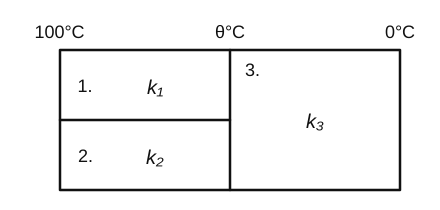
Three conductors of same length having thermal conductivity $k_1$, $k_2$ and $k_3$ are connected as shown in the figure. Area of cross sections of $1^{\text{st}}$ and $2^{\text{nd}}$ conductor are same and for $3^{\text{rd}}$ conductor it is double of the $1^{\text{st}}$ conductor. The temperatures are given in the figure. In steady state condition, the value of $\theta$ is ______ $^\circ\text{C}$. (Given: $k_1 = 60\ \text{J s}^{-1}\text{m}^{-1}\text{K}^{-1}$, $k_2 = 120\ \text{J s}^{-1}\text{m}^{-1}\text{K}^{-1}$, $k_3 = 135\ \text{J s}^{-1}\text{m}^{-1}\text{K}^{-1}$)
Concept. Conductors 1 and 2 sit side by side between $100^\circ$C and $\theta$ (parallel), and together send their heat through conductor 3 to $0^\circ$C (series). Equal lengths, so compare $KA$ values.
Step 1. Heat in (1 and 2, area $A$ each): $(k_1+k_2)A(100-\theta)=180A(100-\theta)$.
Step 2. Heat out (3, area $2A$): $k_3(2A)\theta=270A\,\theta$.
Q 11-10-055JEE MainJEE Main 2025 (23 Jan, Shift 1)Easy
A gun fires a lead bullet of temperature $300\ \text{K}$ into a wooden block. The bullet, having melting temperature of $600\ \text{K}$, penetrates into the block and melts down. If the total heat required for the process is $625\ \text{J}$, then the mass of the bullet is ______ grams. (Latent heat of fusion of lead $= 2.5\times10^4\ \text{J kg}^{-1}$ and specific heat capacity of lead $= 125\ \text{J kg}^{-1}\text{K}^{-1}$)
Concept. $\dfrac C5=\dfrac{F-32}{9}$, i.e. $C=\dfrac59F-\dfrac{160}{9}$: a straight line of positive slope $\tfrac59$ that cuts the $C$-axis below the origin and the $F$-axis at $F=32$.
Step 1. Choose. The graph with a rising line through $(32,0)$ and a negative $C$-intercept.
Answer. Option D.
Solution by Sreeraj P, M.Sc Physics
Q 11-10-057JEE MainJEE Main 2025 (24 Jan, Shift 2)Medium
The temperature of a body in air falls from $40^\circ\text{C}$ to $24^\circ\text{C}$ in 4 minutes. The temperature of the air is $16^\circ\text{C}$. The temperature of the body in the next 4 minutes will be
Answer: (D) low thermal conductivity and high electrical conductivity
Concept. A thermoelectric harvester needs a temperature difference across it (so heat must not leak through easily: low thermal conductivity) and the generated current must flow easily (high electrical conductivity).
Answer. Option D.
Solution by Sreeraj P, M.Sc Physics
Q 11-10-059JEE MainJEE Main 2025 (29 Jan, Shift 2)Medium
A cup of coffee cools from $90^\circ\text{C}$ to $80^\circ\text{C}$ in $t$ minutes when the room temperature is $20^\circ\text{C}$. The time taken by a similar cup of coffee to cool from $80^\circ\text{C}$ to $60^\circ\text{C}$ at the same room temperature is
Concept. Newton's law in the averaged form used in JEE: $\dfrac{\Delta T}{t}=k\left(\bar T-T_0\right)$, where $\bar T$ is the average temperature over the interval.
Step 1. First cooling ($90\to80$, average $85$): $\dfrac{10}{t}=k(85-20)=65k$.
Step 2. Second cooling ($80\to60$, average $70$): $\dfrac{20}{t'}=k(70-20)=50k$.
Concept. A temperature *change* converts with the scale factor only: $100$ Celsius degrees span the same interval as $180$ Fahrenheit degrees, so $\Delta F=\dfrac95\Delta C$. The offset $32$ cancels in a difference.
Step 1. Convert the change. $\Delta F=\dfrac95\times40=72$.
Answer. $72^\circ$F (Option C).
Solution by Sreeraj P, M.Sc Physics
Q 11-10-061JEE MainJEE Main 2024 (30 Jan, Shift 2)Medium
A block of ice at $-10^\circ\text{C}$ is slowly heated and converted to steam at $100^\circ\text{C}$. Which of the following curves represents the phenomenon qualitatively?
Concept. Ice from $-10^\circ$C heated slowly until it is all steam at $100^\circ$C: rise, plateau (melting), rise, plateau (boiling); the process ends on the boiling plateau.
Step 1. Choose. Two flat parts, the second longer, ending without a final rise.
Answer. Option D.
Solution by Sreeraj P, M.Sc Physics
Q 11-10-062JEE MainJEE Main 2023 (29 Jan, Shift 1)Medium
A body cools from $60^\circ\text{C}$ to $40^\circ\text{C}$ in $6$ minutes. If temperature of surroundings is $10^\circ\text{C}$, then after the next $6$ minutes, its temperature will be ______ $^\circ\text{C}$.
Concept. Averaged Newton's law: $\dfrac{\Delta T}{t}=k(\bar T-T_0)$. Find $k$ from the first interval, then use it for the next equal interval with the unknown final temperature.
Step 1. Find $k$. $\dfrac{20}{6}=k(50-10)\Rightarrow k=\dfrac1{12}$ per min.
Step 2. Next $6$ minutes (from $40$ to $T$): $$\frac{40-T}{6}=\frac1{12}\left(\frac{40+T}{2}-10\right)$$
Q 11-10-063JEE MainJEE Main 2023 (29 Jan, Shift 2)Medium
Heat energy of $184\ \text{kJ}$ is given to ice of mass $600\ \text{g}$ at $-12^\circ\text{C}$. Specific heat of ice is $2222.3\ \text{J kg}^{-1}\,{}^\circ\text{C}^{-1}$ and latent heat of ice is $336\ \text{kJ kg}^{-1}$.
(A) Final temperature of system will be $0^\circ\text{C}$.
(B) Final temperature of the system will be greater than $0^\circ\text{C}$.
(C) The final system will have a mixture of ice and water in the ratio of $5:1$.
(D) The final system will have a mixture of ice and water in the ratio of $1:5$.
(E) The final system will have water only.
Choose the correct answer from the options given below:
Concept. Use the heat in stages and see where it runs out.
Step 1. Warm the ice to $0^\circ$C. $0.6\times2222.3\times12\approx16$ kJ. Left: $168$ kJ.
Step 2. Melt. $\dfrac{168}{336}=0.5$ kg melts; $0.1$ kg of ice remains.
Step 3. Final state. Ice and water at $0^\circ$C, ice : water $=0.1:0.5=1:5$. A and D are true.
Answer. Option A.
Solution by Sreeraj P, M.Sc Physics
Q 11-10-064JEE MainJEE Main 2023 (30 Jan, Shift 2)Easy
A faulty thermometer reads $5^\circ\text{C}$ in melting ice and $95^\circ\text{C}$ in steam. The correct temperature on absolute scale will be ______ K when the faulty thermometer reads $41^\circ\text{C}$.
Concept. Any linear scale is compared through the fraction of the ice-to-steam interval: $\dfrac{\text{reading}-\text{ice point}}{\text{steam point}-\text{ice point}}$ is the same on every scale.
Step 1. Fraction on the faulty scale. $\dfrac{41-5}{95-5}=\dfrac{36}{90}=0.4$.
Step 2. Celsius value. $0.4\times100=40^\circ$C.
Step 3. Kelvin. $40+273=313$ K.
Answer. $313$.
Solution by Sreeraj P, M.Sc Physics
Q 11-10-065JEE MainJEE Main 2023 (31 Jan, Shift 2)Easy
A water heater of power $2000\ \text{W}$ is used to heat water. The specific heat capacity of water is $4200\ \text{J kg}^{-1}\ \text{K}^{-1}$. The efficiency of heater is $70\%$. Time required to heat $2\ \text{kg}$ of water from $10^\circ\text{C}$ to $60^\circ\text{C}$ is ______ s. (Assume that the specific heat capacity of water remains constant over the temperature range of the water.)
Concept. Only the useful part of the heater's power heats the water: $\eta Pt=mc\Delta T$.
Step 1. Heat needed. $mc\Delta T=2\times4200\times50=4.2\times10^5$ J.
Step 2. Useful power. $0.7\times2000=1400$ W.
Step 3. Time. $t=\dfrac{4.2\times10^5}{1400}=300$ s.
Answer. $300$.
Solution by Sreeraj P, M.Sc Physics
Q 11-10-066JEE MainJEE Main 2023 (24 Jan, Shift 1)Easy
A hole is drilled in a metal sheet. At $27^\circ\text{C}$, the diameter of hole is $5\ \text{cm}$. When the sheet is heated to $177^\circ\text{C}$, the change in the diameter of hole is $d\times10^{-3}\ \text{cm}$. The value of $d$ will be ______, if coefficient of linear expansion of the metal is $1.6\times10^{-5}/^\circ\text{C}$.
Concept. A hole in a sheet expands exactly as if it were filled with the same metal: every length in the sheet, including the hole's diameter, grows by $\Delta d=d\alpha\Delta T$.
Step 1. Temperature rise. $\Delta T=177-27=150^\circ$C.
Step 2. Change in diameter. $\Delta d=5\times1.6\times10^{-5}\times150=1.2\times10^{-2}$ cm.
Answer. $12\times10^{-3}$ cm, so $d=12$. The hole gets bigger, not smaller.
Solution by Sreeraj P, M.Sc Physics
Q 11-10-067JEE MainJEE Main 2023 (25 Jan, Shift 1)Medium
A bowl filled with very hot soup cools from $98^\circ\text{C}$ to $86^\circ\text{C}$ in $2$ minutes when the room temperature is $22^\circ\text{C}$. How long it will take to cool from $75^\circ\text{C}$ to $69^\circ\text{C}$?
Step 2. Second interval ($75\to69$, average $72$): $\dfrac{6}{t}=\dfrac{6}{70}(72-22)=\dfrac{300}{70}$.
Step 3. Time. $t=\dfrac{6\times70}{300}=1.4$ min.
Answer. Option B.
Solution by Sreeraj P, M.Sc Physics
Q 11-10-068JEE MainJEE Main 2023 (25 Jan, Shift 2)Medium
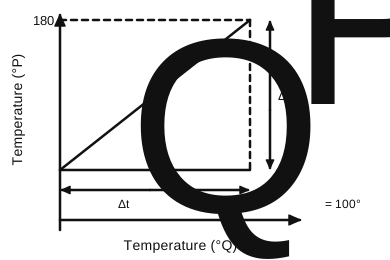
The graph between two temperature scales $P$ and $Q$ is shown in the figure. Between upper fixed point and lower fixed point there are $150$ equal divisions of scale $P$ and $100$ divisions on scale $Q$. The relationship for conversion between the two scales is given by
Concept. Two linear scales are related by matching the same fraction of the fixed-point interval. From the graph, scale $Q$ runs $0$ to $100$ while scale $P$ runs from its lower fixed point up to $180$.
Step 1. Lower fixed point on $P$. There are $150$ divisions ending at $180$, so it starts at $180-150=30$.
Q 11-10-069JEE MainJEE Main 2023 (13 Apr, Shift 2)Easy
Two plates A and B have thermal conductivities $84\ \text{W m}^{-1}\text{K}^{-1}$ and $126\ \text{W m}^{-1}\text{K}^{-1}$ respectively. They have same surface area and same thickness. They are placed in contact along their surfaces. If the temperatures of the outer surfaces of A and B are kept at $100^\circ\text{C}$ and $0^\circ\text{C}$ respectively, then the temperature of the surface of contact in steady state is ______ $^\circ\text{C}$.
Q 11-10-070JEE MainJEE Main 2023 (11 Apr, Shift 1)Easy
On a temperature scale '$X$', the boiling point of water is $65^\circ\text{X}$ and the freezing point is $-15^\circ\text{X}$. Assuming that the $X$ scale is linear, the equivalent temperature corresponding to $-95^\circ\text{X}$ on the Fahrenheit scale would be
Q 11-10-071JEE MainJEE Main 2023 (12 Apr, Shift 1)Medium
A body cools from $80^\circ\text{C}$ to $60^\circ\text{C}$ in $5$ minutes. The temperature of the surrounding is $20^\circ\text{C}$. The time it takes to cool from $60^\circ\text{C}$ to $40^\circ\text{C}$ is
Concept. Newton's law in the average form: $\dfrac{\Delta T}{t}=k(\bar T-T_0)$, with $\bar T$ the mean of the interval. Take the ratio of the two intervals.
Step 1. First interval. $\dfrac{20}{5}=k(70-20)\Rightarrow k=0.08$ min$^{-1}$.
Step 2. Second interval. $\dfrac{20}{t}=0.08(50-20)=2.4\Rightarrow t=\dfrac{25}{3}$ min $=500$ s.
Answer. Option C.
Solution by Sreeraj P, M.Sc Physics
Q 11-10-072JEE MainJEE Main 2023 (6 Apr, Shift 2)Medium
A body cools in $7$ minutes from $60^\circ\text{C}$ to $40^\circ\text{C}$. The temperature of the surrounding is $10^\circ\text{C}$. The temperature of the body after the next $7$ minutes will be
Step 1. First interval. $\dfrac{20}{7}=k(50-10)\Rightarrow k=\dfrac1{14}$ min$^{-1}$.
Step 2. Next 7 minutes. $\dfrac{40-T}{7}=\dfrac1{14}\left(\dfrac{40+T}{2}-10\right)\Rightarrow160-4T=T+20\Rightarrow T=28^\circ$C.
Answer. Option D.
Solution by Sreeraj P, M.Sc Physics
Q 11-10-073JEE MainJEE Main 2023 (8 Apr, Shift 2)Easy
A steel rod of length $1$ m and cross-sectional area $10^{-4}\ \text{m}^2$ is heated from $0^\circ\text{C}$ to $200^\circ\text{C}$ without being allowed to extend or bend. The compressive tension produced in the rod is ______ $\times10^4$ N. (Given Young's modulus of steel $=2\times10^{11}\ \text{N m}^{-2}$, coefficient of linear expansion $=10^{-5}\ \text{K}^{-1}$)
Concept. Thermal force in a clamped rod: $F=YA\alpha\Delta T$.
Step 1. Substitute. $F=2\times10^{11}\times10^{-4}\times10^{-5}\times200=4\times10^4$ N.
Answer. $4$.
Solution by Sreeraj P, M.Sc Physics
Q 11-10-074JEE MainJEE Main 2022 (24 Jun, Shift 1)Medium
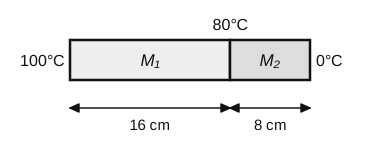
Two metallic blocks $M_1$ and $M_2$ of same area of cross-section are connected to each other (as shown in figure). If the thermal conductivity of $M_2$ is $K$ then the thermal conductivity of $M_1$ will be: [Assume steady state heat conduction]
Concept. Same heat current through both blocks in series: $\dfrac{K_1\Delta T_1}{l_1}=\dfrac{K_2\Delta T_2}{l_2}$ (same area). From the figure: $M_1$ is 16 cm with $100\to80^\circ$C, $M_2$ is 8 cm with $80\to0^\circ$C.
Q 11-10-075JEE MainJEE Main 2022 (24 Jun, Shift 2)Easy
A $100\ \text{g}$ iron nail is hit by a $1.5\ \text{kg}$ hammer striking at a velocity of $60\ \text{m s}^{-1}$. What will be the rise in the temperature of the nail if one fourth of energy of the hammer goes into heating the nail? [Specific heat capacity of iron $= 0.42\ \text{J g}^{-1}\,{}^\circ\text{C}^{-1}$]
Concept. A fraction of the hammer's KE becomes heat in the nail: $f\cdot\tfrac12Mv^2=mc\Delta T$.
Step 1. Heat. $\tfrac14\times\tfrac12\times1.5\times3600=675$ J.
Step 2. Temperature rise. $\Delta T=\dfrac{675}{100\times0.42}=16.07^\circ$C.
Answer. Option A.
Solution by Sreeraj P, M.Sc Physics
Q 11-10-076JEE MainJEE Main 2022 (24 Jun, Shift 2)Medium
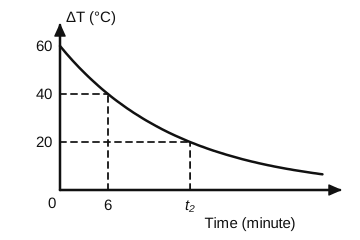
In an experiment to verify Newton's law of cooling, a graph is plotted between the temperature difference $(\Delta T)$ of the water and surroundings and time as shown in figure. The initial temperature of water is taken as $80^\circ\text{C}$. The value of $t_2$ as mentioned in the graph will be ______.
Step 3. Second interval. $$\frac{40 - 20}{t_2 - 6} = \frac{1}{15} \times 30 = 2 \;\Rightarrow\; t_2 - 6 = 10 \;\Rightarrow\; t_2 = 16\ \text{min}$$ (The exact exponential form gives $\approx 16.3$ min, also $16$ to the nearest integer.)
Answer. $16$.
Solution by Sreeraj P, M.Sc Physics
Q 11-10-077JEE MainJEE Main 2022 (25 Jun, Shift 1)Easy
A steam engine intakes $50\ \text{g}$ of steam at $100^\circ\text{C}$ per minute and cools it down to $20^\circ\text{C}$. If latent heat of vaporization of steam is $540\ \text{cal g}^{-1}$, then the heat rejected by the steam engine per minute is ______ $\times10^3\ \text{cal}$. (Given: specific heat capacity of water: $1\ \text{cal g}^{-1}\,{}^\circ\text{C}^{-1}$)
Concept. The steam gives out heat in two stages: condensing at $100^\circ$C (latent heat), then the water cooling from $100$ to $20^\circ$C.
Step 1. Condensing. $50\times540=27\,000$ cal.
Step 2. Cooling the water. $50\times1\times80=4000$ cal.
Step 3. Total per minute. $31\,000$ cal.
Answer. $31\times10^3$ cal.
Solution by Sreeraj P, M.Sc Physics
Q 11-10-078JEE MainJEE Main 2022 (25 Jun, Shift 2)Medium
A solid metallic cube having total surface area $24\ \text{m}^2$ is uniformly heated. If its temperature is increased by $10^\circ\text{C}$, calculate the increase in volume of the cube. (Given $\alpha = 5.0\times10^{-4}\ ^\circ\text{C}^{-1}$)
Q 11-10-079JEE MainJEE Main 2022 (25 Jun, Shift 2)Easy
A copper block of mass $5.0\ \text{kg}$ is heated to a temperature of $500^\circ\text{C}$ and is placed on a large ice block. What is the maximum amount of ice that can melt? [Specific heat of copper: $0.39\ \text{J g}^{-1}\,{}^\circ\text{C}^{-1}$ and latent heat of fusion of water: $335\ \text{J g}^{-1}$]
Concept. The ice block stays at $0^\circ$C, so the copper cools all the way to $0^\circ$C. All the heat it gives out melts ice: $m_cc\Delta T=m_{\text{ice}}L$.
Step 1. Heat from copper. $5000\times0.39\times500=9.75\times10^5$ J.
Step 2. Ice melted. $\dfrac{9.75\times10^5}{335}=2910$ g.
Answer. About $2.9$ kg (Option C).
Solution by Sreeraj P, M.Sc Physics
Q 11-10-080JEE MainJEE Main 2022 (26 Jun, Shift 2)Easy
A geyser heats water flowing at a rate of $2.0\ \text{kg}$ per minute from $30^\circ\text{C}$ to $70^\circ\text{C}$. If the geyser operates on a gas burner, the rate of combustion of fuel will be ______ $\text{g min}^{-1}$. [Heat of combustion $= 8\times10^3\ \text{J g}^{-1}$, specific heat of water $= 4.2\ \text{J g}^{-1}\,{}^\circ\text{C}^{-1}$]
Concept. Heat per minute to warm the water $=mc\Delta T$; fuel burnt per minute $=$ that heat $\div$ heat of combustion.
Step 1. Heat per minute. $2000\times4.2\times40=3.36\times10^5$ J.
Step 2. Fuel. $\dfrac{3.36\times10^5}{8\times10^3}=42$ g min$^{-1}$.
Answer. $42$.
Solution by Sreeraj P, M.Sc Physics
Q 11-10-081JEE MainJEE Main 2022 (25 Jul, Shift 1)Easy
A unit scale is to be prepared whose length does not change with temperature and remains $20\ \text{cm}$, using a bimetallic strip made of brass and iron each of different length. The lengths of both components would change in such a way that the difference between their lengths remains constant. If the length of brass is $40\ \text{cm}$, the length of iron will be ______ cm. ($\alpha_{\text{iron}} = 1.2\times10^{-5}\ \text{K}^{-1}$ and $\alpha_{\text{brass}} = 1.8\times10^{-5}\ \text{K}^{-1}$)
Concept. The difference of the two lengths stays constant if both strips grow by the same amount: $L_b\alpha_b=L_i\alpha_i$. The less-expanding metal must be the longer one.
Step 2. Solve. $L_i=60$ cm, and the difference is $60-40=20$ cm as required.
Answer. $60$.
Solution by Sreeraj P, M.Sc Physics
Q 11-10-082JEE MainJEE Main 2022 (25 Jul, Shift 2)Easy
A block of ice of mass $120\ \text{g}$ at temperature $0^\circ\text{C}$ is put in $300\ \text{g}$ of water at $25^\circ\text{C}$. $x$ g of ice melts as the temperature of the water reaches $0^\circ\text{C}$. The value of $x$ is ______. [Use: specific heat capacity of water $= 4200\ \text{J kg}^{-1}\text{K}^{-1}$, latent heat of ice $= 3.5\times10^5\ \text{J kg}^{-1}$]
Concept. The water cools to $0^\circ$C and its heat melts some ice: $m_wc\Delta T=xL$. If this melts less than the ice available, the mixture stays at $0^\circ$C.
Step 1. Heat from the water. $0.3\times4200\times25=31\,500$ J.
Step 2. Ice melted. $x=\dfrac{31\,500}{3.5\times10^5}=0.09$ kg $=90$ g (less than $120$ g, so consistent).
Answer. $90$.
Solution by Sreeraj P, M.Sc Physics
Q 11-10-083JEE MainJEE Main 2022 (26 Jul, Shift 2)Medium
An ice cube of dimensions $60\ \text{cm}\times50\ \text{cm}\times20\ \text{cm}$ is placed in an insulation box of wall thickness $1\ \text{cm}$. The box keeping the ice cube at $0^\circ\text{C}$ is brought to a room of temperature $40^\circ\text{C}$. The rate of melting of ice is approximately: (Latent heat of fusion of ice is $3.4\times10^5\ \text{J kg}^{-1}$ and thermal conductivity of the insulation wall is $0.05\ \text{W m}^{-1}\,{}^\circ\text{C}^{-1}$)
Concept. Heat leaks in through all six walls: $H=\dfrac{KA\Delta T}{d}$. That heat melts ice at the rate $\dfrac{H}{L}$.
Step 1. Total wall area. $2(0.6\times0.5+0.5\times0.2+0.6\times0.2)=2(0.30+0.10+0.12)=1.04$ m$^2$.
Step 2. Heat current. $H=\dfrac{0.05\times1.04\times40}{0.01}=208$ W.
Step 3. Melting rate. $\dfrac{208}{3.4\times10^5}=6.1\times10^{-4}$ kg s$^{-1}$.
Answer. Option B.
Solution by Sreeraj P, M.Sc Physics
Q 11-10-084JEE MainJEE Main 2022 (27 Jun, Shift 2)Medium
A lead bullet penetrates into a solid object and melts. Assuming that $40\%$ of its kinetic energy is used to heat it, the initial speed of bullet is
(Given, initial temperature of the bullet $= 127^\circ$C, Melting point of the bullet $= 327^\circ$C, Latent heat of fusion of lead $= 2.5\times10^4\ \text{J kg}^{-1}$, Specific heat capacity of lead $= 125\ \text{J kg}^{-1}\text{K}^{-1}$)
Concept. $40\%$ of the KE warms the bullet to its melting point and melts it: $0.4\times\tfrac12v^2=c\Delta T+L$ (per kilogram).
Step 1. Heat per kg. $125\times200+2.5\times10^4=5\times10^4$ J.
Step 2. Speed. $0.2v^2=5\times10^4\Rightarrow v=500$ m s$^{-1}$.
Answer. Option B.
Solution by Sreeraj P, M.Sc Physics
Q 11-10-085JEE MainJEE Main 2022 (27 Jul, Shift 1)Medium
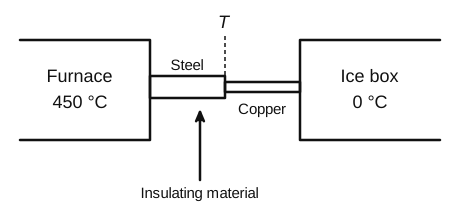
If $K_1$ and $K_2$ are the thermal conductivities, $L_1$ and $L_2$ are the lengths and $A_1$ and $A_2$ are the cross sectional areas of steel and copper rods respectively such that $\dfrac{K_2}{K_1} = 9$, $\dfrac{A_1}{A_2} = 2$, $\dfrac{L_1}{L_2} = 2$. Then, for the arrangement as shown in the figure. The value of temperature $T$ of the steel - copper junction in the steady state will be
Concept. Steel and copper are in series, so each takes a share of the $450^\circ$C drop proportional to its thermal resistance $R=\dfrac{L}{KA}$.
Step 1. Ratio of resistances. $$\frac{R_1}{R_2}=\frac{L_1}{L_2}\cdot\frac{K_2}{K_1}\cdot\frac{A_2}{A_1}=2\times9\times\frac12=9$$
Step 2. Drop across copper. $\dfrac{1}{10}$ of $450$, i.e. $45^\circ$C.
Step 3. Junction. $T=0+45=45^\circ$C.
Answer. Option C.
Solution by Sreeraj P, M.Sc Physics
Q 11-10-086JEE MainJEE Main 2022 (27 Jul, Shift 1)Medium
Read the following statements :
A. When small temperature difference between a liquid and its surrounding is doubled the rate of loss of heat of the liquid becomes twice.
B. Two bodies $P$ and $Q$ having equal surface areas are maintained at temperature $10^\circ$C and $20^\circ$C. The thermal radiation emitted in a given time by $P$ and $Q$ are in the ratio $1 : 1.15$
C. A carnot Engine working between $100$ K and $400$ K has an efficiency of $75\%$
D. When small temperature difference between a liquid and its surrounding is quadrupled, the rate of loss of heat of the liquid becomes twice.
Choose the correct answer from the options given below :
Concept. Check each statement with its law: Newton's cooling (rate $\propto\Delta T$), Stefan's law ($P\propto T^4$ in kelvin), and Carnot efficiency $1-\dfrac{T_C}{T_H}$.
Step 1. A. Rate $\propto\Delta T$: doubling $\Delta T$ doubles it. True.
Step 2. B. $\left(\dfrac{293}{283}\right)^4=1.15$. True.
Step 3. C. $1-\dfrac{100}{400}=75\%$. True.
Step 4. D. Quadrupling $\Delta T$ quadruples the rate, not doubles it. False.
Answer. A, B, C only (Option A).
Solution by Sreeraj P, M.Sc Physics
Q 11-10-087JEE MainJEE Main 2021 (27 Jul, Shift 1)Easy
A body takes $4$ min to cool from $61^\circ\text{C}$ to $59^\circ\text{C}$. If the temperature of the surroundings is $30^\circ\text{C}$, the time taken by the body to cool from $51^\circ\text{C}$ to $49^\circ\text{C}$ is:
Concept. For the same temperature drop, time is inversely proportional to the average excess temperature (Newton's law).
Step 1. Excess temperatures. First interval: average $60$, excess $30$. Second: average $50$, excess $20$.
Step 2. Time. $t=4\times\dfrac{30}{20}=6$ min.
Answer. Option D.
Solution by Sreeraj P, M.Sc Physics
Q 11-10-088JEE MainJEE Main 2021 (31 Aug, Shift 2)Medium
Two thin metallic spherical shells of radii $r_1$ and $r_2$ $(r_1 < r_2)$ are placed with their centres coinciding. A material of thermal conductivity $K$ is filled in the space between the shells. The inner shell is maintained at temperature $\theta_1$ and the outer shell at temperature $\theta_2$ $(\theta_1 < \theta_2)$. The rate at which heat flows radially through the material is:
Q 11-10-089JEE MainJEE Main 2021 (24 Feb, Shift 1)Easy
Each side of a box made of metal sheet in cubic shape is $a$ at room temperature $T$, the coefficient of linear expansion of the metal sheet is $\alpha$. The metal sheet is heated uniformly, by a small temperature $\Delta T$, so that its new temperature is $T + \Delta T$. Calculate the increase in the volume of the metal box.
Answer: (C) Both $A$ and $R$ are true but $R$ is NOT the correct explanation of $A$
Concept. Thermal stress appears only when expansion is prevented. A free rod simply lengthens, so there is no stress.
Step 1. Assertion. True. Reason. True (the rod does lengthen), but lengthening is not why there is no stress; the reason is that nothing stops it.
Answer. Option C.
Solution by Sreeraj P, M.Sc Physics
Q 11-10-091JEE MainJEE Main 2021 (22 Jul, Shift 1)Medium
The area of cross-section of a railway track is $0.01\ \text{m}^2$. The temperature variation is 10 °C. Coefficient of linear expansion of material of track is $10^{-5}\ °\text{C}^{-1}$. The energy stored per meter in the track is ______ $\text{J m}^{-1}$. (Young's modulus of material of track is $10^{11}\ \text{N m}^{-2}$)
Concept. Energy stored per unit volume $=\tfrac12Y\varepsilon^2$ with the prevented strain $\varepsilon=\alpha\Delta T$; per metre of track multiply by the area.
Step 1. Strain. $10^{-5}\times10=10^{-4}$.
Step 2. Energy per metre. $\tfrac12(10^{11})(10^{-8})(0.01)=5$ J m$^{-1}$.
Answer. $5$.
Solution by Sreeraj P, M.Sc Physics
Q 11-10-092JEE MainJEE Main 2021 (22 Jul, Shift 1)Medium
In 5 minutes, a body cools from 75 °C to 65 °C at room temperature of 25 °C. The temperature of body at the end of next 5 minutes is ______ °C.
Step 1. First interval. $\dfrac{10}{5}=k(70-25)\Rightarrow k=\dfrac{2}{45}$ min$^{-1}$.
Step 2. Next 5 minutes. $\dfrac{65-T}{5}=\dfrac2{45}\left(\dfrac{65+T}{2}-25\right)\Rightarrow585-9T=T+15\Rightarrow T=57^\circ$C.
Answer. $57$.
Solution by Sreeraj P, M.Sc Physics
Q 11-10-093JEE MainJEE Main 2021 (26 Feb, Shift 1)Easy
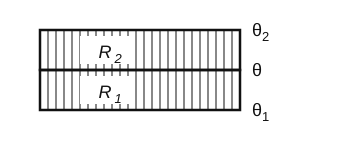
The temperature $\theta$ at the junction of two insulating sheets, having thermal resistances $R_1$ and $R_2$ as well as top and bottom temperatures $\theta_1$ and $\theta_2$ (as shown in figure) is given by:
Q 11-10-094JEE MainJEE Main 2021 (26 Aug, Shift 2)Medium
The temperature of equal masses of three different liquids $x$, $y$ and $z$ are $10^\circ$C, $20^\circ$C and $30^\circ$C respectively. The temperature of mixture when $x$ is mixed with $y$ is $16^\circ$C and that when $y$ is mixed with $z$ is $26^\circ$C. The temperature of mixture when $x$ and $z$ are mixed will be:
Concept. Equal masses, so heat lost $=$ heat gained reduces to $c_1\Delta T_1=c_2\Delta T_2$. Two mixtures give the specific heats in ratio, which then fix the third.
Step 1. $x$ with $y$ (final $16^\circ$C): $c_x(6)=c_y(4)\Rightarrow c_x=\tfrac23c_y$.
Step 2. $y$ with $z$ (final $26^\circ$C): $c_y(6)=c_z(4)\Rightarrow c_z=\tfrac32c_y$.
Step 3. $x$ with $z$. $$\tfrac23(T-10)=\tfrac32(30-T)\ \Rightarrow\ 4(T-10)=9(30-T)\ \Rightarrow\ 13T=310$$
Answer. $T=23.84^\circ$C (Option D).
Solution by Sreeraj P, M.Sc Physics
Q 11-10-095JEE MainJEE Main 2021 (27 Aug, Shift 1)Medium
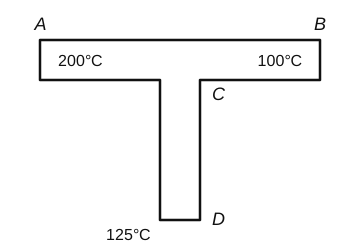
A rod $CD$ of thermal resistance $10.0$ K W$^{-1}$ is joined at the middle of an identical rod $AB$ as shown in figure. The ends $A$, $B$ and $D$ are maintained at $200^\circ$C, $100^\circ$C and $125^\circ$C respectively. The heat current in $CD$ is $P$ W. The value of $P$ is
Concept. Treat it like a circuit: temperatures are potentials, thermal resistances are resistors. At the junction $C$ heat in $=$ heat out. Each half of $AB$ has resistance $5$ K W$^{-1}$; $CD$ has $10$.
Step 1. Junction equation (temperature $T$ at $C$): $$\frac{200-T}{5}=\frac{T-100}{5}+\frac{T-125}{10}$$
Step 3. Current in $CD$. $P=\dfrac{145-125}{10}=2$ W.
Answer. $2$.
Solution by Sreeraj P, M.Sc Physics
Q 11-10-096JEE MainJEE Main 2021 (27 Aug, Shift 2)Easy
The height of victoria's falls is $63$ m. What is the difference in the temperature of water at the top and at the bottom of the fall? [Given $1$ cal $= 4.2$ J and specific heat of water $= 1$ cal g$^{-1}$ $^\circ$C$^{-1}$]
Q 11-10-097JEE MainJEE Main 2020 (8 Jan, Shift 2)Medium
Three containers $C_1$, $C_2$ and $C_3$ have water at different temperatures. The table below shows the final temperature $T$ when different amounts of water (given in litres) are taken from each container and mixed (assume no loss of heat during the process).
$$\begin{array}{|c|c|c|c|}\hline C_1 & C_2 & C_3 & T \\ \hline 1\ l & 2\ l & - & 60^\circ\text{C} \\ \hline - & 1\ l & 2\ l & 30^\circ\text{C} \\ \hline 2\ l & - & 1\ l & 60^\circ\text{C} \\ \hline 1\ l & 1\ l & 1\ l & \theta \\ \hline \end{array}$$
The value of $\theta$ (in $^\circ$C to the nearest integer) is ______.
Q 11-10-098JEE MainJEE Main 2020 (5 Sep, Shift 2)Easy
Two different wires having lengths $L_1$ and $L_2$ and respective temperature coefficients of linear expansion $\alpha_1$ and $\alpha_2$ are joined end-to-end. Then the effective temperature coefficient of linear expansion is:
Q 11-10-099JEE MainJEE Main 2020 (6 Sep, Shift 2)Medium
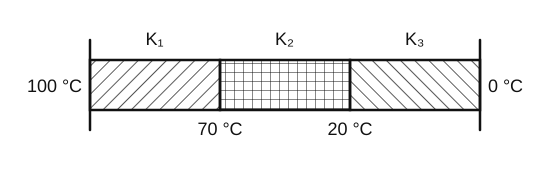
Three rods of identical cross-section and length are made of three different materials of thermal conductivity $K_1$, $K_2$ and $K_3$, respectively. They are joined together at their ends to make a long rod (see figure). One end of the long rod is maintained at $100\ ^\circ\text{C}$ and the other at $0\ ^\circ\text{C}$. If the joints of the rod are at $70\ ^\circ\text{C}$ and $20\ ^\circ\text{C}$ in steady state and there is no loss of energy from the surface of the rod, the correct relationship between $K_1$, $K_2$ and $K_3$ is:
Q 11-10-100JEE MainJEE Main 2020 (7 Jan, Shift 1)Easy
A non-isotropic solid metal cube has coefficients of linear expansion of $5\times10^{-5}\ /^\circ\text{C}$ along the $x$-axis and $5\times10^{-6}\ /^\circ\text{C}$ along the $y$ and $z$-axes. If the coefficient of volume expansion of the solid is $C\times10^{-6}\ /^\circ\text{C}$, then the value of $C$ is ______.
Concept. Volume is the product of three lengths, so for small changes the fractional changes add: $\gamma=\alpha_x+\alpha_y+\alpha_z$. (For an isotropic body this gives $3\alpha$.)
Step 1. Add. $\gamma=50\times10^{-6}+5\times10^{-6}+5\times10^{-6}=60\times10^{-6}$ per $^\circ$C.
Answer. $C=60$.
Solution by Sreeraj P, M.Sc Physics
Q 11-10-101JEE MainJEE Main 2020 (7 Jan, Shift 2)Easy
$M$ grams of steam at $100\ ^\circ\text{C}$ is mixed with $200$ g of ice at its melting point in a thermally insulated container. If it produces liquid water at $40\ ^\circ\text{C}$ [heat of vaporization of water is $540$ cal/g and heat of fusion of ice is $80$ cal/g], the value of $M$ is ______.
Concept. Heat lost by the steam (condensing, then cooling from $100$ to $40^\circ$C) equals heat gained by the ice (melting, then warming from $0$ to $40^\circ$C).
Step 1. Heat lost by steam. $M(540+60)=600M$ cal.
Step 2. Heat gained by ice. $200(80+40)=24\,000$ cal.
Step 3. Equate. $M=40$ g.
Answer. $40$.
Solution by Sreeraj P, M.Sc Physics
Q 11-10-102JEE MainJEE Main 2020 (2 Sep, Shift 2)Easy
When the temperature of a metal wire is increased from $0^\circ\text{C}$ to $10^\circ\text{C}$, its length increases by $0.02\%$. The percentage change in its mass density will be closest to:
Concept. Mass is fixed, so $\rho\propto\dfrac1V$ and $\dfrac{\Delta\rho}{\rho}\approx-\dfrac{\Delta V}{V}=-3\dfrac{\Delta L}{L}$.
Step 1. Change. $3\times0.02\%=0.06\%$ (a decrease).
Answer. Option A.
Solution by Sreeraj P, M.Sc Physics
Q 11-10-103JEE MainJEE Main 2020 (3 Sep, Shift 1)Medium
A bakelite beaker has volume capacity of $500\ \text{cc}$ at $30^\circ\text{C}$. When it is partially filled with $V_m$ volume (at $30^\circ\text{C}$) of mercury, it is found that the unfilled volume of the beaker remains constant as temperature is varied. If $\gamma_{\text{beaker}} = 6\times10^{-6}\ ^\circ\text{C}^{-1}$ and $\gamma_{\text{mercury}} = 1.5\times10^{-4}\ ^\circ\text{C}^{-1}$, where $\gamma$ is the coefficient of volume expansion, then $V_m$ (in cc) is close to ______.
Concept. The empty space stays the same only if the beaker's volume and the mercury's volume grow by the same amount: $V_b\gamma_b\Delta T=V_m\gamma_m\Delta T$.
Step 1. Equate the increases. $500\times6\times10^{-6}=V_m\times1.5\times10^{-4}$.
Step 2. Solve. $V_m=\dfrac{3\times10^{-3}}{1.5\times10^{-4}}=20$ cc.
Answer. $20$.
Solution by Sreeraj P, M.Sc Physics
Q 11-10-104JEE MainJEE Main 2020 (3 Sep, Shift 2)Medium
A metallic sphere cools from $50^\circ\text{C}$ to $40^\circ\text{C}$ in $300\ \text{s}$. If atmospheric temperature around is $20^\circ\text{C}$, then the sphere's temperature after the next $5$ minutes will be close to:
Concept. By Newton's law of cooling, the excess temperature over the surroundings falls by the same factor in equal times.
Step 1. Factor in the first $300$ s. $$\frac{40 - 20}{50 - 20} = \frac23$$
Step 2. Next $300$ s. $$\theta - 20 = \frac23 \times 20 \approx 13.3 \;\Rightarrow\; \theta \approx 33°\text{C}$$ (The average form gives $\theta \approx 33.3°$C as well.)
Answer. $33°$C (Option B).
Solution by Sreeraj P, M.Sc Physics
Q 11-10-105JEE MainJEE Main 2020 (3 Sep, Shift 2)Medium
A calorimeter of water equivalent $20\ \text{g}$ contains $180\ \text{g}$ of water at $25^\circ\text{C}$. $m$ grams of steam at $100^\circ\text{C}$ is mixed in it till the temperature of the mixture is $31^\circ\text{C}$. The value of $m$ is close to (Latent heat of water $= 540\ \text{cal g}^{-1}$, specific heat of water $= 1\ \text{cal g}^{-1}\,{}^\circ\text{C}^{-1}$)
Concept. The calorimeter behaves like $20$ g of extra water (water equivalent). Heat given by the steam (condensing, then cooling to $31^\circ$C) equals heat taken by $200$ g of "water" warming from $25$ to $31^\circ$C.
Step 3. Solve. $m=\dfrac{1200}{609}=1.97\approx2$ g.
Answer. Option A.
Solution by Sreeraj P, M.Sc Physics
Q 11-10-106JEE MainJEE Main 2020 (4 Sep, Shift 1)Medium
The specific heat of water $= 4200\ \text{J kg}^{-1}\text{K}^{-1}$ and the latent heat of ice $= 3.4\times10^{5}\ \text{J kg}^{-1}$. $100$ grams of ice at $0^\circ\text{C}$ is placed in $200\ \text{g}$ of water at $25^\circ\text{C}$. The amount of ice that will melt as the temperature of water reaches $0^\circ\text{C}$ is close to (in grams)
Concept. The heat the water gives up in cooling to $0^\circ$C melts that much ice.
Step 1. Heat available. $0.2\times4200\times25=21\,000$ J.
Step 2. Ice melted. $\dfrac{21\,000}{3.4\times10^5}=0.0618$ kg $\approx61.7$ g.
Answer. Option A.
Solution by Sreeraj P, M.Sc Physics
Q 11-10-107JEE MainJEE Main 2020 (5 Sep, Shift 1)Medium
A bullet of mass $5\ \text{g}$, travelling with a speed of $210\ \text{m s}^{-1}$, strikes a fixed wooden target. One half of its kinetic energy is converted into heat in the bullet. The rise of temperature of the bullet if the specific heat of its material is $0.030\ \text{cal g}^{-1}\,{}^\circ\text{C}^{-1}$ ($1\ \text{calorie} = 4.2\times10^{7}$ ergs) is close to:
Concept. Half the bullet's kinetic energy becomes heat in the bullet: $\tfrac12\cdot\tfrac12mv^2=mc\Delta T$. The mass cancels. Convert the specific heat to J kg$^{-1}$ K$^{-1}$.
Step 1. Specific heat. $0.030$ cal g$^{-1}$ $^\circ$C$^{-1}=0.030\times4.2\times1000=126$ J kg$^{-1}$ K$^{-1}$.
Step 2. Temperature rise. $$\Delta T=\frac{v^2}{4c}=\frac{210^2}{4\times126}=\frac{44\,100}{504}=87.5^\circ\text{C}$$
Answer. Option A.
Solution by Sreeraj P, M.Sc Physics
Q 11-10-108JEE MainJEE Main 2019 (10 Jan, Shift 1)Easy
A heat source at $T = 10^3\ \text{K}$ is connected to another heat reservoir at $T = 10^2\ \text{K}$ by a copper slab which is $1\ \text{m}$ thick. Given that the thermal conductivity of copper is $0.1\ \text{W K}^{-1}\text{m}^{-1}$, the energy flux through it in the steady state is:
Step 1. Substitute. $\dfrac{0.1\times900}{1}=90$ W m$^{-2}$.
Answer. Option C.
Solution by Sreeraj P, M.Sc Physics
Q 11-10-109JEE MainJEE Main 2019 (10 Jan, Shift 2)Medium
An unknown metal of mass $192\ \text{g}$ heated to a temperature of $100^\circ\text{C}$ was immersed into a brass calorimeter of mass $128\ \text{g}$ containing $240\ \text{g}$ of water at a temperature of $8.4^\circ\text{C}$. Calculate the specific heat of the unknown metal if water temperature stabilizes at $21.5^\circ\text{C}$. (Specific heat of brass is $394\ \text{J kg}^{-1}\text{K}^{-1}$)
Concept. Heat lost by the metal $=$ heat gained by the water and the brass calorimeter.
Step 1. Heat gained ($\Delta T=13.1^\circ$C). Water: $0.240\times4200\times13.1=13\,205$ J. Brass: $0.128\times394\times13.1=661$ J. Total $13\,866$ J.
Step 2. Metal ($\Delta T=78.5^\circ$C). $0.192\,c\times78.5=15.07c$.
Step 3. Solve. $c\approx920$ J kg$^{-1}$K$^{-1}$, closest to $916$.
Answer. Option A.
Solution by Sreeraj P, M.Sc Physics
Q 11-10-110JEE MainJEE Main 2019 (9 Jan, Shift 1)Medium
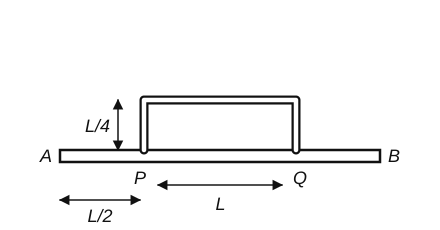
Temperature difference of $120^\circ\text{C}$ is maintained between two ends of a uniform rod $AB$ of length $2L$. Another bent rod $PQ$, of same cross-section as $AB$ and length $\frac{3L}{2}$, is connected across $AB$ (see figure). In steady state, temperature difference between $P$ and $Q$ will be close to
Concept. Treat conduction like resistance ($R\propto$ length for the same rod material and area). The bent rod PQ is in parallel with the straight segment PQ of $AB$.
Step 1. Lengths (from the figure). $AP=\tfrac L2$, straight $PQ=L$, $QB=\tfrac L2$; the bent rod is $\tfrac{3L}{2}$.
Step 3. Share of the 120 °C. Total $0.5L+0.6L+0.5L=1.6L$: $\Delta T_{PQ}=120\times\dfrac{0.6}{1.6}=45^\circ$C.
Answer. Option A.
Solution by Sreeraj P, M.Sc Physics
Q 11-10-111JEE MainJEE Main 2019 (8 Apr, Shift 1)Medium
A thermally insulated vessel contains $150\ \text{g}$ of water at $0^\circ\text{C}$. Then the air from the vessel is pumped out adiabatically. A fraction of water turns into ice and the rest evaporates at $0^\circ\text{C}$ itself. The mass of evaporated water will be closest to (Latent heat of vaporization of water $= 2.10\times10^6\ \text{J kg}^{-1}$ and Latent heat of fusion of water $= 3.36\times10^5\ \text{J kg}^{-1}$)
Concept. Evaporation needs latent heat. In an insulated vessel that heat can only come from water freezing. So the heat taken by the evaporating part equals the heat released by the freezing part: $m_eL_v=m_fL_f$.
Step 1. Two equations. $m_e+m_f=150$ g and $m_e(2.10\times10^6)=m_f(3.36\times10^5)$.
Q 11-10-112JEE MainJEE Main 2019 (8 Apr, Shift 1)Medium
Two identical beakers A and B contain equal volumes of two different liquids at $60^\circ\text{C}$ each and left to cool down. Liquid in A has density of $8\times10^2\ \text{kg m}^{-3}$ and specific heat of $2000\ \text{J kg}^{-1}\text{K}^{-1}$ while the liquid in B has density of $10^3\ \text{kg m}^{-3}$ and specific heat of $4000\ \text{J kg}^{-1}\text{K}^{-1}$. Which of the following best describes their temperature versus time graph schematically? (assume the emissivity of both the beakers to be the same)
Step 2. Choose. Both start at $60^\circ$C and A's curve falls below B's.
Answer. Option B.
Solution by Sreeraj P, M.Sc Physics
Q 11-10-113JEE MainJEE Main 2019 (9 Apr, Shift 2)Easy
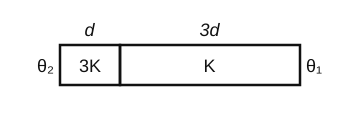
Two materials having coefficients of thermal conductivity $3K$ and $K$ and thickness $d$ and $3d$ respectively, are joined to form a slab as shown in the figure. The temperatures of the outer surfaces are $\theta_2$ and $\theta_1$ respectively, ($\theta_2 > \theta_1$). The temperature at the interface is
Concept. Think of each layer as a thermal resistance $R=\dfrac{d}{KA}$. In series the same heat current flows, so each layer's temperature drop is proportional to its resistance.
Q 11-10-114JEE MainJEE Main 2019 (9 Apr, Shift 2)Easy
A massless spring ($k = 800\ \text{N/m}$), attached with a mass ($500\ \text{g}$) is completely immersed in $1\ \text{kg}$ of water. The spring is stretched by $2\ \text{cm}$ and released so that it starts vibrating. What would be the order of magnitude of the change in the temperature of water when the vibrations stop completely? (Assume that the water container and spring receive negligible heat and specific heat of mass $= 400\ \text{J/kg K}$, specific heat of water $= 4184\ \text{J/kg K}$)
Step 2. Temperature rise. $$\Delta T = \frac{0.16}{1 \times 4184 + 0.5 \times 400} = \frac{0.16}{4384} \approx 3.6 \times 10^{-5}\ \text{K}$$ This is of the order of $10^{-5}$ K.
Answer. $10^{-5}$ K (Option A).
Solution by Sreeraj P, M.Sc Physics
Q 11-10-115JEE MainJEE Main 2019 (11 Jan, Shift 1)Medium
Ice at $-20^\circ$C is added to $50$ g of water at $40^\circ$C. When the temperature of the mixture reaches $0^\circ$C, it is found that $20$ g of ice is still unmelted. The amount of ice added to the water was close to (Specific heat of water $= 4.2\ \text{J/g}^\circ\text{C}$, specific heat of ice $= 2.1\ \text{J/g}^\circ\text{C}$, heat of fusion of water at $0^\circ$C $= 334$ J/g)
Concept. Let $m$ be the ice added. All of it warms from $-20$ to $0^\circ$C, but only $(m-20)$ g melts. The water cooling from $40$ to $0^\circ$C supplies the heat.
Step 1. Heat from the water. $50\times4.2\times40=8400$ J.
Step 2. Heat taken by the ice. $m(2.1)(20)+(m-20)(334)=42m+334m-6680$.
Step 3. Equate and solve. $376m=15\,080\Rightarrow m=40.1$ g.
Answer. About $40$ g (Option D).
Solution by Sreeraj P, M.Sc Physics
Q 11-10-116JEE MainJEE Main 2019 (11 Jan, Shift 2)Easy
Two rods A and B of identical dimensions are at temperature $30^\circ$C. If A is heated up to $180^\circ$C and B up to $T^\circ$C, then the new lengths are the same. If the ratio of the coefficients of linear expansion of A and B is $4 : 3$, then the value of $T$ is
Concept. Equal initial lengths and equal final lengths: the expansions are equal, $\alpha_A\Delta T_A=\alpha_B\Delta T_B$.
Step 1. Solve. $\Delta T_B=\dfrac43\times150=200$, so $T=30+200=230^\circ$C.
Answer. Option A.
Solution by Sreeraj P, M.Sc Physics
Q 11-10-117JEE MainJEE Main 2019 (11 Jan, Shift 2)Easy
A thermometer graduated according to a linear scale reads a value $x_0$ when in contact with boiling water, and $x_0/3$ when in contact with ice. What is the temperature of an object in $^\circ$C, if this thermometer in contact with the object reads $x_0/2$?
Q 11-10-118JEE MainJEE Main 2019 (11 Jan, Shift 2)Medium
When $100$ g of a liquid A at $100^\circ$C is added to $50$ g of a liquid B at temperature $75^\circ$C, the temperature of the mixture becomes $90^\circ$C. The temperature of the mixture, if $100$ g of liquid A at $100^\circ$C is added to $50$ g of liquid B at $50^\circ$C, will be:
Step 2. Second mixing. $100c_A(100-T)=50\cdot\tfrac43c_A(T-50)\Rightarrow300(100-T)=200(T-50)\Rightarrow T=80^\circ$C.
Answer. Option C.
Solution by Sreeraj P, M.Sc Physics
Q 11-10-119JEE MainJEE Main 2019 (11 Jan, Shift 2)Medium
A metal ball of mass $0.1$ kg is heated up to $500^\circ$C and dropped into a vessel of heat capacity $800\ \text{J K}^{-1}$ and containing $0.5$ kg water. The initial temperature of water and vessel is $30^\circ$C. What is the approximate percentage increment in the temperature of the water? [Specific heat capacities of water and metal are, respectively, $4200\ \text{J kg}^{-1}\text{K}^{-1}$ and $400\ \text{J kg}^{-1}\text{K}^{-1}$]
Concept. The ball's heat loss equals the gain of the water and the vessel (heat capacity $800$ J K$^{-1}$), all ending at the same final temperature $T$.
Q 11-10-120JEE MainJEE Main 2019 (12 Jan, Shift 1)Medium
A cylinder of radius $R$ is surrounded by a cylindrical shell of inner radius $R$ and outer radius $2R$. The thermal conductivity of the material of the inner cylinder is $K_1$ and that of the outer cylinder is $K_2$. Assuming no loss of heat, the effective thermal conductivity of the system for heat flowing along the length of the cylinder is:
Concept. Heat flowing along the length goes through the core and the shell side by side (in parallel), so the $KA$ values add: $K_{\text{eff}}A_{\text{total}}=K_1A_1+K_2A_2$.
Q 11-10-121JEE MainJEE Main 2019 (12 Apr, Shift 1)Easy
When $M_1$ gram of ice at $-10^\circ$C (specific heat $= 0.5\ \text{cal g}^{-1}{}^\circ\text{C}^{-1}$) is added to $M_2$ gram of water at $50^\circ$C, finally no ice is left and the water is at $0^\circ$C. The value of latent heat of ice, in cal g$^{-1}$ is:
Q 11-10-122JEE MainJEE Main 2019 (12 Apr, Shift 2)Easy
$1$ kg of water, at $20^\circ$C is heated in an electric kettle whose heating element has a mean (temperature averaged) resistance of $20\ \Omega$. The rms voltage in the mains is $200$ V. Ignoring heat loss from the kettle, time taken for water to evaporate fully is close to [Specific heat of water $= 4200\ \text{J kg}^{-1}{}^\circ\text{C}^{-1}$, latent heat of water $= 2260\ \text{kJ kg}^{-1}$]
Concept. Heat to warm the water to $100^\circ$C plus heat to boil it all away, supplied at $P=\dfrac{V^2}{R}$.
Step 1. Heat. $1\times4200\times80+2.26\times10^6=2.596\times10^6$ J.
Step 2. Power. $\dfrac{200^2}{20}=2000$ W.
Step 3. Time. $\dfrac{2.596\times10^6}{2000}=1298$ s $\approx22$ min.
Answer. Option C.
Solution by Sreeraj P, M.Sc Physics
Q 11-10-123JEE MainJEE Main 2018 (15 Apr, Shift 2)Medium
A body takes 10 minutes to cool from $60^\circ\text{C}$ to $50^\circ\text{C}$. The temperature of surroundings is constant at $25^\circ\text{C}$. Then, the temperature of the body after next 10 minutes will be approximately
A copper ball of mass $100$ g is at a temperature $T$. It is dropped in a copper calorimeter of mass $100$ g, filled with $170$ g of water at room temperature. Subsequently, the temperature of the system is found to be $75^\circ$C. $T$ is given by:
(Given: room temperature $= 30^\circ$C, specific heat of copper $= 0.1\ \text{cal g}^{-1}\,{}^\circ\text{C}^{-1}$)
An external pressure $P$ is applied on a cube at $0^\circ$C so that it is equally compressed from all sides. $K$ is the bulk modulus of the material of the cube and $\alpha$ is its coefficient of linear expansion. Suppose we want to bring the cube to its original size by heating. The temperature should be raised by:
Concept. Pressure shrinks the cube's volume by $\dfrac{\Delta V}{V}=\dfrac PK$. Heating expands it by $\dfrac{\Delta V}{V}=\gamma\Delta T=3\alpha\Delta T$. Restoring the size means these are equal.
Step 1. Equate. $\dfrac PK=3\alpha\Delta T$.
Step 2. Solve. $\Delta T=\dfrac{P}{3\alpha K}$.
Answer. Option B.
Solution by Sreeraj P, M.Sc Physics
Q 11-10-126JEE MainJEE Main 2017 (8 Apr)Easy
In an experiment, a sphere of aluminium of mass $0.20$ kg is heated up to $150^\circ$C. Immediately, it is put into water of volume $150$ cc at $27^\circ$C kept in a calorimeter of water equivalent to $0.025$ kg. The final temperature of the system is $40^\circ$C. The specific heat of aluminium is (take $4.2$ joule $= 1$ calorie):
Concept. Units from the definitions: heat capacity $Q/\Delta T$; specific heat $Q/(m\Delta T)$; latent heat $Q/m$; thermal conductivity from $H=KA\Delta T/l$.
Q 11-10-128JEE MainJEE Main 2025 (4 Apr, Shift 2)Medium
Consider a rectangular sheet of solid material of length $l = 9\ \text{cm}$ and width $d = 4\ \text{cm}$. The coefficient of linear expansion is $\alpha = 3.1\times10^{-5}\ \text{K}^{-1}$ at room temperature and one atmospheric pressure. The mass of the sheet is $m = 0.1\ \text{kg}$ and the specific heat capacity $C_v = 900\ \text{J kg}^{-1}\text{K}^{-1}$. If the amount of heat supplied to the material is $8.1\times10^2\ \text{J}$, then the change in area of the rectangular sheet is:
Concept. The heat supplied gives the temperature rise, $\Delta T=\dfrac{Q}{mc}$; then area expansion $\Delta A=A(2\alpha)\Delta T$.
Step 1. Temperature rise. $\Delta T=\dfrac{810}{0.1\times900}=9$ K.
Step 2. Area change. $\Delta A=36\times10^{-4}\times2\times3.1\times10^{-5}\times9=2.0\times10^{-6}$ m$^2$.
Answer. Option A.
Solution by Sreeraj P, M.Sc Physics
Q 11-10-129JEE MainJEE Main 2025 (7 Apr, Shift 1)Medium
A wire of length $10\ \text{cm}$ and diameter $0.5\ \text{mm}$ is used in a bulb. The temperature of the wire is $1727^\circ\text{C}$ and the power radiated by the wire is $94.2\ \text{W}$. Its emissivity is $\dfrac x8$, where $x$ = ______. (Given $\sigma = 6.0\times10^{-8}\ \text{W m}^{-2}\text{K}^{-4}$, $\pi = 3.14$, and assume that the emissivity of the wire material is the same at all wavelengths.)
Q 11-10-130JEE MainJEE Main 2025 (7 Apr, Shift 2)Medium
Two cylindrical rods A and B made of different materials are joined in a straight line. The ratios of lengths, radii and thermal conductivities of these rods are $\dfrac{L_A}{L_B} = \dfrac12$, $\dfrac{r_A}{r_B} = 2$ and $\dfrac{K_A}{K_B} = \dfrac12$. The free ends of rods A and B are maintained at $400\ \text{K}$ and $200\ \text{K}$ respectively. The temperature of the rods' interface is ______ K, when equilibrium is established.
Concept. Thermal resistance $R=\dfrac{L}{KA}\propto\dfrac{L}{Kr^2}$; in series the temperature drops divide in the ratio of the resistances.
Step 1. Resistances (B as the unit). $R_A=\dfrac{1/2}{(1/2)(4)}=\dfrac14$, $R_B=1$.
Step 2. Drop across A. $200\times\dfrac{1/4}{5/4}=40$ K.
Step 3. Interface. $400-40=360$ K.
Answer. $360$.
Solution by Sreeraj P, M.Sc Physics
Q 11-10-131JEE MainJEE Main 2025 (8 Apr, Shift 2)Easy
Water falls from a height of $200\ \text{m}$ into a pool. Calculate the rise in temperature of the water, assuming no heat dissipation from the water in the pool. (Take $g = 10\ \text{m/s}^2$, specific heat of water = $4200\ \text{J/(kg K)}$)


 Solution by Sreeraj P, M.Sc Physics