

A uniform rod of mass $M$ and length $L$ is free to rotate in a vertical plane about a horizontal axis through a point $O$ at a distance $\dfrac L4$ from one end, as shown. The rod is held horizontal and released. Just after release, the force exerted on the rod by the pivot is
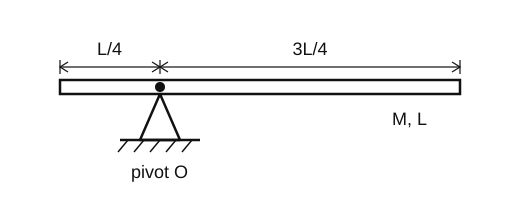
Answer: (D) $\dfrac{4Mg}{7}$
Concept. Just after release $\omega = 0$, so there is no centripetal acceleration and the pivot force is vertical. Find the angular acceleration from torque about $O$, then the acceleration of the centre of mass, then use $Mg - N = Ma_{cm}$.
Step 1. Moment of inertia about $O$. The centre is $\dfrac L4$ from $O$:
$$I_O = \frac{ML^2}{12} + M\left(\frac L4\right)^2 = \frac{7ML^2}{48}$$
Step 2. Angular acceleration. Gravity acts at the centre, arm $\dfrac L4$:
$$\alpha = \frac{Mg\,\frac L4}{\frac{7ML^2}{48}} = \frac{12g}{7L}$$
Step 3. Acceleration of the centre.
$$a_{cm} = \alpha\cdot\frac L4 = \frac{3g}{7}\ \text{(downward)}$$
Step 4. Pivot force.
$$Mg - N = M\cdot\frac{3g}{7} \;\Rightarrow\; N = \frac{4Mg}{7}$$
Answer. $\dfrac{4Mg}{7}$ (Option D).
 Solution by Sreeraj P, M.Sc Physics