

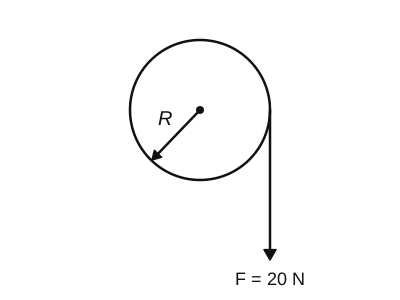
A cord of negligible mass is wound around the rim of a wheel supported by spokes with negligible mass. The mass of the wheel is $10\ \text{kg}$ and radius is $10\ \text{cm}$ and it can freely rotate without any friction. Initially the wheel is at rest. If a steady pull of $20\ \text{N}$ is applied on the cord, the angular velocity of the wheel, after the cord is unwound by $1\ \text{m}$, would be:
Answer: (A) $20\ \text{rad/s}$
The spokes are massless, so all the mass is on the rim: $I = MR^2 = 10 \times (0.1)^2 = 0.1\ \text{kg m}^2$.
Work done by the pull while $1\ \text{m}$ of cord unwinds: $W = 20 \times 1 = 20\ \text{J}$. There is no friction, so all of it becomes rotational kinetic energy:
$$\tfrac12 I\omega^2 = 20 \Rightarrow \tfrac12(0.1)\omega^2 = 20 \Rightarrow \omega^2 = 400 \Rightarrow \omega = 20\ \text{rad/s}$$
 Solution by Sreeraj P, M.Sc Physics