

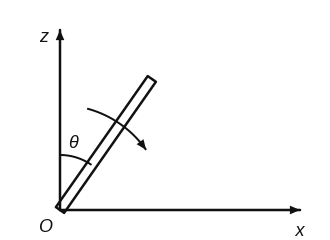
A slender uniform rod of mass $M$ and length $l$ is pivoted at one end so that it can rotate in a vertical plane (see figure). There is negligible friction at the pivot. The free end is held vertically above the pivot and then released. The angular acceleration of the rod when it makes an angle $\theta$ with the vertical is:
Answer: (B) $\dfrac{3g}{2l}\sin\theta$
Concept. For a body rotating about a fixed pivot, $\tau=I\alpha$ about that pivot. Gravity acts at the centre of mass.
Step 1. Torque of gravity. The centre of mass is $\dfrac l2$ from the pivot. With the rod at $\theta$ from the vertical, the lever arm of the weight is $\dfrac l2\sin\theta$:
$$\tau=Mg\frac l2\sin\theta$$
Step 2. Moment of inertia about the end: $I=\dfrac{Ml^2}{3}$.
Step 3. Angular acceleration.
$$\alpha=\frac{\tau}{I}=\frac{Mg\frac l2\sin\theta}{\frac{Ml^2}{3}}=\frac{3g}{2l}\sin\theta$$
Answer. Option B.
 Solution by Sreeraj P, M.Sc Physics


