

Q 11-06-218JEE MainJEE Main 2019 (8 Apr, Shift 2)Easy
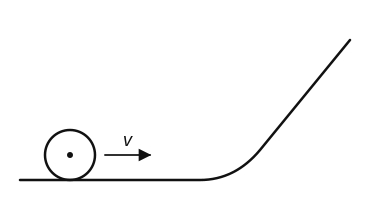
A solid sphere and solid cylinder of identical radii approach an incline with the same linear velocity (see figure). Both roll without slipping all throughout. The two climb maximum heights $h_{sph}$ and $h_{cyl}$ on the incline. The ratio $\dfrac{h_{sph}}{h_{cyl}}$ is given by
Answer: (C) $\dfrac{14}{15}$
Concept. Rolling up all the way, the total kinetic energy $\tfrac12mv^2\left(1+\dfrac{k^2}{R^2}\right)$ turns into $mgh$. So $h=\dfrac{v^2}{2g}\left(1+\dfrac{k^2}{R^2}\right)$: more rotational energy means a higher climb.
Step 1. Values. Sphere: $1+\dfrac25=\dfrac75$. Cylinder: $1+\dfrac12=\dfrac32$.
Step 2. Ratio (same $v$):
$$\frac{h_{sph}}{h_{cyl}}=\frac{7/5}{3/2}=\frac{14}{15}$$
Answer. Option C.
 Solution by Sreeraj P, M.Sc Physics


