

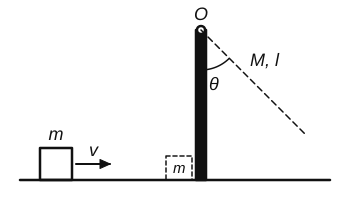
A block of mass $m = 1\ \text{kg}$ slides with velocity $v = 6\ \text{m s}^{-1}$ on a frictionless horizontal surface and collides with a uniform vertical rod and sticks to it as shown. The rod is pivoted about $O$ and swings as a result of the collision making angle $\theta$ before momentarily coming to rest. If the rod has mass $M = 2\ \text{kg}$ and length $l = 1\ \text{m}$, the value of $\theta$ is approximately (take $g = 10\ \text{m s}^{-2}$)
Answer: (A) $63^\circ$
The block hits the lower end of the rod. Angular momentum about $O$ is conserved:
$$mvl = \left(\frac{Ml^{2}}{3} + ml^{2}\right)\omega \Rightarrow 6 = \left(\frac23 + 1\right)\omega \Rightarrow \omega = 3.6\ \text{rad s}^{-1}$$
Energy after the collision is converted into potential energy (rod's centre rises $\tfrac l2(1-\cos\theta)$, block rises $l(1-\cos\theta)$):
$$\frac12\cdot\frac53\cdot(3.6)^{2} = \left(Mg\frac l2 + mgl\right)(1-\cos\theta) \Rightarrow 10.8 = 20(1-\cos\theta)$$
$\cos\theta = 0.46 \Rightarrow \theta \approx 63^\circ$.
 Solution by Sreeraj P, M.Sc Physics