

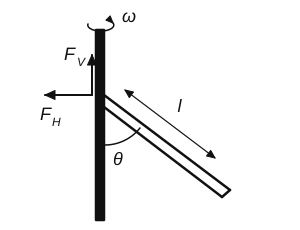
A uniform rod of length $l$ is pivoted at one of its ends on a vertical shaft of negligible radius. When the shaft rotates at angular speed $\omega$ the rod makes an angle $\theta$ with it (see figure). To find $\theta$ equate the rate of change of angular momentum (direction going into the paper) $\dfrac{ml^{2}}{12}\omega^{2}\sin\theta\cos\theta$ about the centre of mass (CM) to the torque provided by the horizontal and vertical forces $F_H$ and $F_V$ about the CM. The value of $\theta$ is then such that:
Answer: (D) $\cos\theta = \dfrac{3g}{2l\omega^{2}}$
The CM moves in a horizontal circle of radius $\tfrac l2\sin\theta$, so $F_H = m\omega^{2}\tfrac l2\sin\theta$, and $F_V = mg$.
Torque of these forces at the pivot about the CM (lever arms $\tfrac l2\cos\theta$ for $F_H$ and $\tfrac l2\sin\theta$ for $F_V$):
$$\tau = mg\frac l2\sin\theta - m\omega^{2}\frac l2\sin\theta\cdot\frac l2\cos\theta$$
Setting $\tau = \dfrac{ml^{2}}{12}\omega^{2}\sin\theta\cos\theta$:
$$\frac{g}{2} = \omega^{2}l\cos\theta\left(\frac14 + \frac1{12}\right) = \frac{\omega^{2}l\cos\theta}{3} \Rightarrow \cos\theta = \frac{3g}{2l\omega^{2}}$$
 Solution by Sreeraj P, M.Sc Physics