

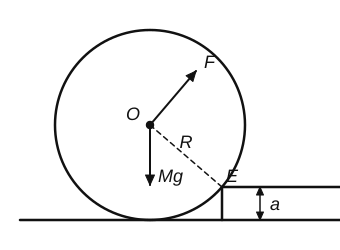
A uniform cylinder of mass $M$ and radius $R$ is to be pulled over a step of height $a$ $(a < R)$ by applying a force $F$ at its centre $O$, perpendicular to the plane through the axis of the cylinder and the edge of the step (see figure). The minimum value of $F$ required is:
Answer: (A) $Mg\sqrt{1-\left(\dfrac{R-a}{R}\right)^{2}}$
Just as the cylinder starts to lift off the floor, the only forces are $Mg$, $F$ and the reaction at the edge of the step. Take torques about the edge $E$.
$F$ acts at $O$ perpendicular to $OE$, so its moment arm is $R$.
The vertical distance of $O$ above $E$ is $R - a$, so the horizontal distance of $O$ from $E$ (moment arm of $Mg$) is $\sqrt{R^{2}-(R-a)^{2}}$.
$$FR = Mg\sqrt{R^{2}-(R-a)^{2}} \;\Rightarrow\; F = Mg\sqrt{1-\left(\frac{R-a}{R}\right)^{2}}$$
 Solution by Sreeraj P, M.Sc Physics