

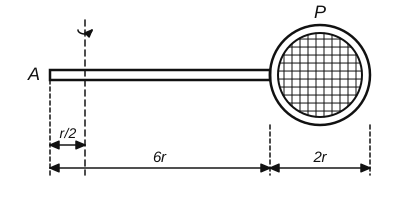
Consider a badminton racket with length scales as shown in the figure. If the mass of the linear and circular portions of the badminton racket are same ($M$) and the mass of the threads are negligible, the moment of inertia of the racket about an axis perpendicular to the handle and in the plane of the ring at, $\frac{r}{2}$ distance from the end $A$ of the handle will be ______ $Mr^2$.
Numerical value type. Enter your answer.
Answer: 52
**Handle** (rod of length $6r$): its centre is $3r - \frac{r}{2} = 2.5r$ from the axis.
$$I_1 = \frac{M(6r)^2}{12} + M(2.5r)^2 = 3Mr^2 + 6.25Mr^2 = 9.25Mr^2$$
**Ring** (radius $r$): the axis is parallel to a diameter, and the ring's centre is at $6r + r - \frac{r}{2} = 6.5r$ from it.
$$I_2 = \frac{Mr^2}{2} + M(6.5r)^2 = 0.5Mr^2 + 42.25Mr^2 = 42.75Mr^2$$
$I = 9.25Mr^2 + 42.75Mr^2 = 52Mr^2$.
 Solution by Sreeraj P, M.Sc Physics