

Q 11-06-078JEE MainJEE Main 2024 (1 Feb, Shift 2)Top questionMedium
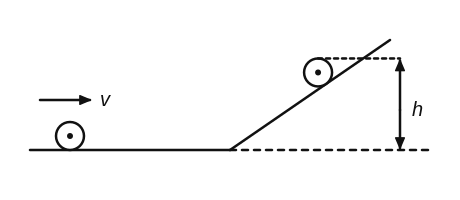
A disc of radius $R$ and mass $M$ is rolling horizontally without slipping with speed $v$. It then moves up an inclined smooth surface as shown in the figure. The maximum height that the disc can go up the incline is
Answer: (C) $\dfrac{1}{2}\dfrac{v^2}{g}$
Concept. On a smooth incline there is no friction, so nothing can change the disc's spin (gravity and the normal force pass through the centre). The rotational energy stays locked in rotation; only the translational energy converts into height.
Step 1. What converts. $\tfrac12Mv^2=Mgh$.
Step 2. Solve. $h=\dfrac{v^2}{2g}$.
Answer. Option C. On a rough incline (rolling up) the disc would rise higher, to $\dfrac{3v^2}{4g}$.
 Solution by Sreeraj P, M.Sc Physics


