
Q 11-13-041JEE MainJEE Main 2026 (4 Apr, Shift 2)Medium
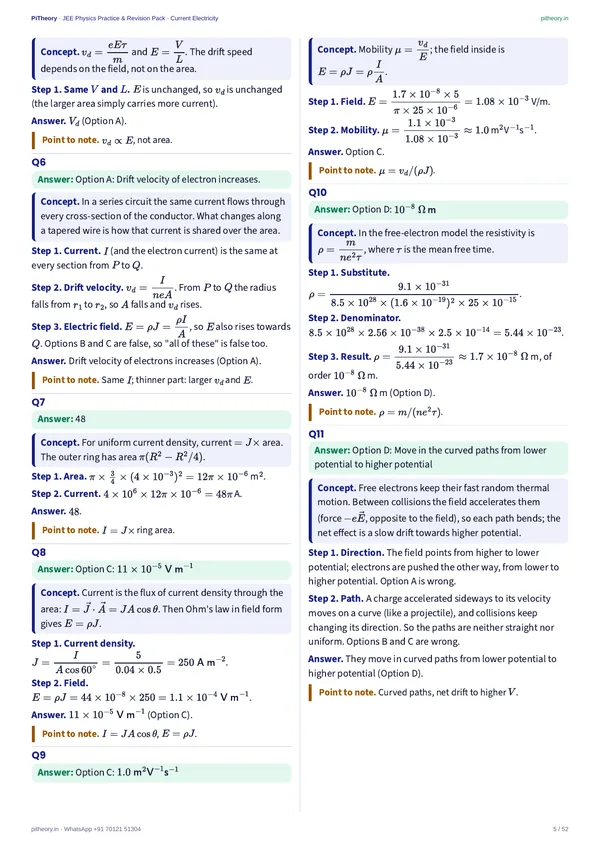
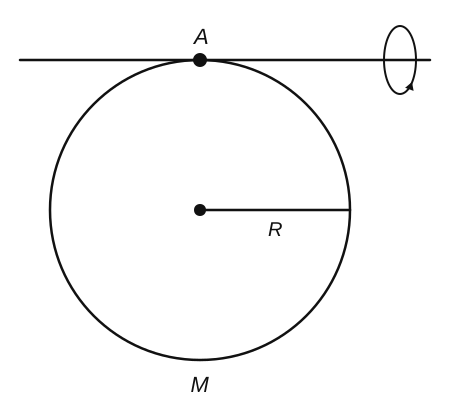
A uniform disc of radius $R$ and mass $M$ is free to oscillate about the axis $A$ as shown in the figure. For small oscillations the time period is ______.
($g$ is acceleration due to gravity)
Answer: (A) $2\pi\sqrt{\dfrac{5R}{4g}}$
Concept. Physical pendulum: $T=2\pi\sqrt{\dfrac{I}{Mgd}}$, with $I$ about the axis and $d$ the distance from the axis to the centre of mass.
Step 1. Moment of inertia. About a diameter $I=\tfrac14MR^2$; the axis $A$ is a tangent parallel to a diameter, at distance $R$: $I=\tfrac14MR^2+MR^2=\tfrac54MR^2$.
Step 2. Period. $d=R$: $T=2\pi\sqrt{\dfrac{5MR^2/4}{MgR}}=2\pi\sqrt{\dfrac{5R}{4g}}$.
Answer. Option A.
 Solution by Sreeraj P, M.Sc Physics