

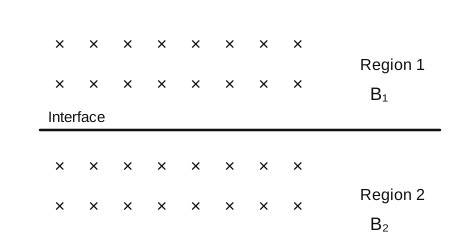
Uniform magnetic fields of different strengths ($B_1$ and $B_2$), both normal to the plane of the paper, exist as shown in the figure. A charged particle of mass $m$ and charge $q$, at the interface at an instant, moves into region 2 with velocity $v$ and returns to the interface. It continues to move into region 1 and finally reaches the interface. What is the displacement of the particle during this movement along the interface? (Consider the velocity of the particle to be normal to the magnetic field and $B_2 > B_1$.)
Answer: (D) $\dfrac{mv}{qB_1}\left(1 - \dfrac{B_1}{B_2}\right)\times2$
In each region the particle moves on a circle of radius $r = \dfrac{mv}{qB}$, and it crosses the interface perpendicularly, so in each region it describes a semicircle.
- In region 2: a semicircle of radius $r_2 = \dfrac{mv}{qB_2}$, shifting it $2r_2$ along the interface.
- In region 1 the velocity is reversed but the field has the same direction, so it curves the other way along the interface: a shift of $2r_1 = \dfrac{2mv}{qB_1}$ in the opposite direction.
Net displacement:
$$2r_1 - 2r_2 = \frac{2mv}{qB_1} - \frac{2mv}{qB_2} = \frac{mv}{qB_1}\left(1 - \frac{B_1}{B_2}\right)\times2$$
 Solution by Sreeraj P, M.Sc Physics