

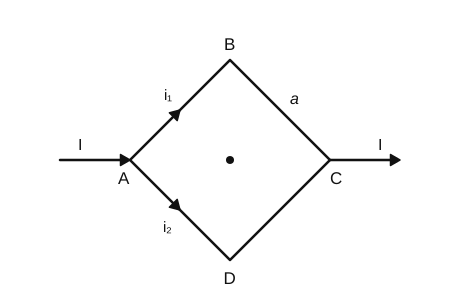
The figure shows a current carrying square loop ABCD of edge length $a$ lying in a plane. Current $I$ enters at A and leaves at C. If the resistance of the ABC part is $r$ and that of the ADC part is $2r$, then the magnitude of the resultant magnetic field at the centre of the square loop is:
Answer: (C) $\dfrac{\sqrt2\mu_0I}{3\pi a}$
The current divides inversely as the resistances: $\dfrac{2I}{3}$ through ABC and $\dfrac I3$ through ADC.
A side carrying current $i$ produces at the centre (distance $a/2$, ends subtending $45^\circ$ on each side):
$$B_{\text{side}} = \frac{\mu_0i}{4\pi(a/2)}(\sin45^\circ + \sin45^\circ) = \frac{\sqrt2\mu_0i}{2\pi a}$$
The currents in ABC and ADC circulate in opposite senses around the centre, so their fields oppose:
$$B = 2\cdot\frac{\sqrt2\mu_0}{2\pi a}\left(\frac{2I}{3} - \frac I3\right) = \frac{\sqrt2\mu_0I}{3\pi a}$$
 Solution by Sreeraj P, M.Sc Physics