A proton moves at $2 \times 10^6\ \text{m/s}$ perpendicular to a uniform magnetic field of $0.1\ \text{T}$. Find the radius of its circular path in cm. (Take $m_p = 1.67\times10^{-27}\ \text{kg}$, $e = 1.6\times10^{-19}\ \text{C}$.)
The magnetic force provides the centripetal force: $qvB = \dfrac{mv^2}{r}$. $$r = \frac{mv}{qB} = \frac{(1.67\times10^{-27})(2\times10^{6})}{(1.6\times10^{-19})(0.1)} \approx 0.209\ \text{m} = 20.9\ \text{cm}$$
Solution by Sreeraj P, M.Sc Physics
Q 12-04-002NEETNEET 2026Top questionMedium
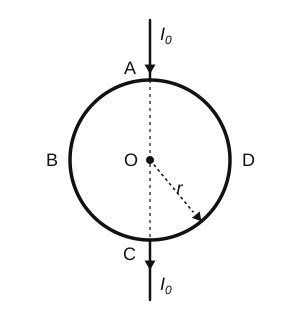
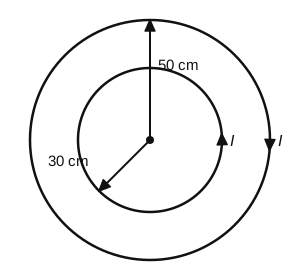
A current $I_0$ flows through a metallic circular loop of radius $r$ as shown in the figure. Resistance of the segment ABC is half that of ADC. Magnitude of magnetic field at the center O of the loop is :
The current enters at A and leaves at C, which are diametrically opposite. The straight lead wires lie along the line through O, so they give no field at O.
The two semicircles ABC and ADC are in parallel. Since $R_{ABC} = \tfrac{1}{2}R_{ADC}$, the current divides as $$I_{ABC} = \frac{2I_0}{3}, \qquad I_{ADC} = \frac{I_0}{3}$$
A semicircle carrying current $I$ gives $B = \dfrac{\mu_0 I}{4r}$ at the centre. The two halves carry current in opposite senses around O, so their fields oppose: $$B = \frac{\mu_0}{4r}\left(\frac{2I_0}{3} - \frac{I_0}{3}\right) = \frac{\mu_0 I_0}{12r}$$
Solution by Sreeraj P, M.Sc Physics
Q 12-04-003NEETNEET 2026Top questionMedium
Two infinitely long parallel conducting wires A and B carry currents $I$ and $2I$, respectively, in the same direction. The wire A has uniform mass per unit length $\lambda$ and lies on an insulated floor. The wire B is kept fixed at a height $h$ above the floor. The minimum magnitude of $h$ so that the wire A does not rise from the floor is :
[$g$ is the acceleration due to gravity and $\mu_0$ is the permeability of free space.]
Currents in the same direction attract, so wire A is pulled upward towards B. Force per unit length on A: $$\frac{F}{l} = \frac{\mu_0 (I)(2I)}{2\pi h} = \frac{\mu_0 I^2}{\pi h}$$
A does not rise as long as this does not exceed its weight per unit length $\lambda g$: $$\frac{\mu_0 I^2}{\pi h} \le \lambda g \;\Rightarrow\; h \ge \frac{\mu_0 I^2}{\pi\lambda g}$$
Minimum $h = \dfrac{\mu_0 I^2}{\pi\lambda g}$.
Solution by Sreeraj P, M.Sc Physics
Q 12-04-004NEETNEET 2025Top questionEasy
An electron (mass $9 \times 10^{-31}$ kg and charge $1.6 \times 10^{-19}$ C) moving with speed $c/100$ ($c$ = speed of light) is injected into a magnetic field $\vec{B}$ of magnitude $9 \times 10^{-4}$ T perpendicular to its direction of motion. We wish to apply an uniform electric field $\vec{E}$ together with the magnetic field so that the electron does not deflect from its path. Then (speed of light $c = 3 \times 10^8\ \text{m s}^{-1}$)
Answer: (B) $\vec{E}$ is perpendicular to $\vec{B}$ and its magnitude is $27 \times 10^2\ \text{V m}^{-1}$
For no deflection, the electric force must cancel the magnetic force: $q\vec{E} = -q\vec{v} \times \vec{B}$. The magnetic force is perpendicular to $\vec{B}$, so $\vec{E}$ must be perpendicular to $\vec{B}$ (and to $\vec{v}$).
A $2$ amp current is flowing through two different small circular copper coils having radii ratio $1:2$. The ratio of their respective magnetic moments will be
Magnetic moment of a coil: $m = NIA = NI\pi r^2$. With the same current (and the same number of turns), $$\frac{m_1}{m_2} = \frac{r_1^2}{r_2^2} = \left(\frac{1}{2}\right)^2 = \frac{1}{4}$$
Solution by Sreeraj P, M.Sc Physics
Q 12-04-006NEETNEET 2025Top questionHard
A model for quantized motion of an electron in a uniform magnetic field $B$ states that the flux passing through the orbit of the electron is $n(h/e)$ where $n$ is an integer, $h$ is Planck's constant and $e$ is the magnitude of electron's charge. According to the model, the magnetic moment of an electron in its lowest energy state will be ($m$ is the mass of the electron)
A tightly wound $100$ turns coil of radius $10$ cm carries a current of $7$ A. The magnitude of the magnetic field at the centre of the coil is (Take permeability of free space as $4\pi \times 10^{-7}$ SI units):
A wire carrying a current $I$ along the positive $x$-axis has length $L$. It is kept in a magnetic field $\vec{B} = (2\hat{i} + 3\hat{j} - 4\hat{k})$ T. The magnitude of the magnetic force acting on the wire is :
(The component of $\vec{B}$ along the wire, $2\hat{i}$, exerts no force.)
Solution by Sreeraj P, M.Sc Physics
Q 12-04-009NEETNEET 2023Top questionHard
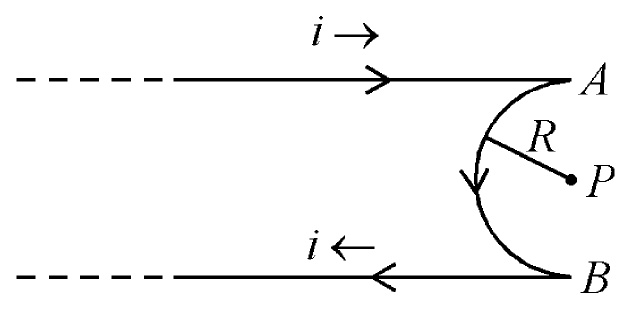
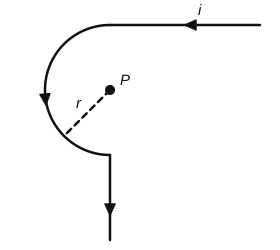
A very long conducting wire is bent in a semi-circular shape from $A$ to $B$ as shown in figure. The magnetic field at point $P$ for steady current configuration is given by :
Answer: (C) $\dfrac{\mu_0 i}{4R}\left[1 - \dfrac{2}{\pi}\right]$ pointed away from page
P is the centre of the semicircle AB of radius $R$. The wire has three parts.
Semicircle: the current goes from A (top) round the left side to B (bottom), which is anticlockwise as seen, so its field at P points out of the page: $$B_1 = \frac{\mu_0 i}{4R}$$
Upper straight wire: semi-infinite, ending at A, directly above P at distance $R$. The current flows to the right and P is below the wire, so the field is into the page: $$B_2 = \frac{\mu_0 i}{4\pi R}$$
Lower straight wire: semi-infinite, ending at B. The current flows to the left and P is above the wire, so the field is also into the page: $$B_3 = \frac{\mu_0 i}{4\pi R}$$
Net field (out of the page positive): $$B = \frac{\mu_0 i}{4R} - \frac{2\mu_0 i}{4\pi R} = \frac{\mu_0 i}{4R}\left[1 - \frac{2}{\pi}\right]$$ pointing away from (out of) the page.
Solution by Sreeraj P, M.Sc Physics
Q 12-04-010NEETNEET 2021Top questionMedium
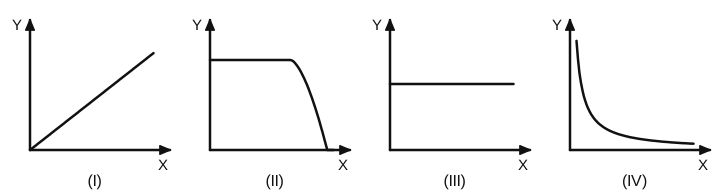
A thick current carrying cable of radius 'R' carries current 'I' uniformly distributed across its cross-section. The variation of magnetic field B(r) due to the cable with the distance 'r' from the axis of the cable is represented by :
Inside ($r < R$), the enclosed current is $I\dfrac{r^2}{R^2}$: $$B \cdot 2\pi r = \mu_0 I\frac{r^2}{R^2} \;\Rightarrow\; B = \frac{\mu_0 I r}{2\pi R^2} \propto r$$
$B$ rises linearly from zero to a maximum at $r = R$, then falls as $1/r$. This is option (4).
Solution by Sreeraj P, M.Sc Physics
Q 12-04-011NEETNEET 2021Top questionMedium
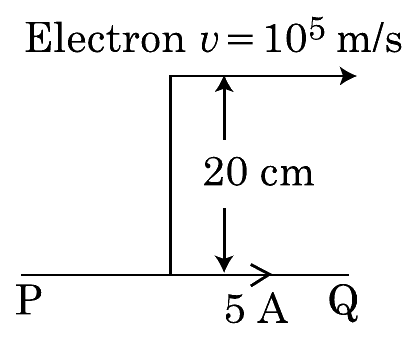
An infinitely long straight conductor carries a current of $5$ A as shown. An electron is moving with a speed of $10^5$ m/s parallel to the conductor. The perpendicular distance between the electron and the conductor is $20$ cm at an instant. Calculate the magnitude of the force experienced by the electron at that instant.
(i) Triangle: perimeter $3a$, so $N = \dfrac{12a}{3a} = 4$ turns, each of area $\dfrac{\sqrt{3}}{4}a^2$: $$m_1 = 4 \times I \times \frac{\sqrt{3}}{4}a^2 = \sqrt{3}Ia^2$$
(ii) Square: perimeter $4a$, so $N = 3$ turns, each of area $a^2$: $$m_2 = 3Ia^2$$
Solution by Sreeraj P, M.Sc Physics
Q 12-04-014NEETNEET 2020Top questionEasy
A long solenoid of $50$ cm length having $100$ turns carries a current of $2.5$ A. The magnetic field at the centre of the solenoid is : ($\mu_0 = 4\pi \times 10^{-7}\ \text{T m A}^{-1}$)
A proton moves with speed $3 \times 10^5$ m/s at $60^\circ$ to a uniform magnetic field of $0.2$ T. The distance it advances along the field in one revolution (the pitch of its helix) is about ($m_p = 1.67 \times 10^{-27}$ kg, $e = 1.6 \times 10^{-19}$ C)
Only the component along $B$ carries the proton forward: $v_\parallel = v\cos 60^\circ = 1.5 \times 10^5$ m/s.
Time for one turn: $T = \dfrac{2\pi m}{eB}$.
Pitch $= v_\parallel T = \dfrac{2\pi m v_\parallel}{eB} = \dfrac{2\pi \times 1.67 \times 10^{-27} \times 1.5 \times 10^5}{1.6 \times 10^{-19} \times 0.2} \approx 0.049$ m $= 4.9$ cm.
Solution by Sreeraj P, M.Sc Physics
Q 12-04-016NEETJEE MainMedium
A proton and an alpha particle have the same kinetic energy and move perpendicular to the same uniform magnetic field. The ratio of the radii of their circular paths, $r_p : r_\alpha$, is
A proton, a deuteron and an alpha particle are each accelerated from rest through the same potential difference and then enter a uniform magnetic field at right angles. The ratio of the radii of their paths is
A cyclotron has a magnetic field of $1$ T and dees of radius $0.5$ m. Find the maximum kinetic energy, in MeV, of the protons it produces. ($m_p = 1.67 \times 10^{-27}$ kg, $e = 1.6 \times 10^{-19}$ C)
In MeV: $\dfrac{1.92 \times 10^{-12}}{1.6 \times 10^{-13}} \approx 12$ MeV.
Solution by Sreeraj P, M.Sc Physics
Q 12-04-019NEETJEE MainEasy
In a region, a uniform electric field of $3 \times 10^4$ V/m and a uniform magnetic field of $0.02$ T are perpendicular to each other. A charged particle moving perpendicular to both fields passes through undeflected. Its speed is
Undeflected means the electric and magnetic forces cancel: $qE = qvB$.
$v = \dfrac{E}{B} = \dfrac{3 \times 10^4}{0.02} = 1.5 \times 10^6$ m/s. The result does not depend on the charge or mass.
Solution by Sreeraj P, M.Sc Physics
Q 12-04-020NEETJEE MainHard
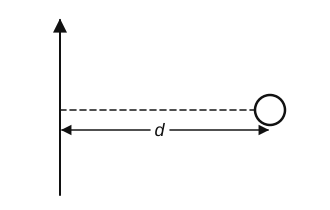
A charged particle enters, at right angles, a region of uniform magnetic field of width $d$ (the field is perpendicular to the plane of motion). In the field its path would have radius $2d$. The angle through which the particle is deviated when it leaves the field region is
Inside the field the particle moves on a circular arc of radius $r$. Crossing a strip of width $d$, the arc turns through angle $\theta$ with $\sin\theta = \dfrac{d}{r} = \dfrac{d}{2d} = \dfrac{1}{2}$.
So $\theta = 30^\circ$.
Solution by Sreeraj P, M.Sc Physics
Q 12-04-021NEETJEE MainMedium
A charged particle enters a region of uniform magnetic field at right angles to the flat boundary of the region and to the field. It moves in a semicircle and leaves the region. If its speed is doubled, the time it spends in the field
The time for a semicircle is half the period: $t = \dfrac{\pi m}{qB}$.
This does not depend on speed. A faster particle moves on a larger semicircle, and the longer path exactly balances its higher speed.
Solution by Sreeraj P, M.Sc Physics
Q 12-04-022NEETJEE MainEasy
Two long straight parallel wires are $5$ cm apart and carry currents of $10$ A and $20$ A in the same direction. The force per metre length between them is
Each side is a finite wire at perpendicular distance $\dfrac{a}{2}$ from the centre, and its ends subtend $45^\circ$ on either side: $$B_1 = \frac{\mu_0 I}{4\pi (a/2)}(\sin 45^\circ + \sin 45^\circ) = \frac{\sqrt{2}\,\mu_0 I}{2\pi a}$$
All four sides give fields in the same direction: $$B = 4B_1 = \frac{2\sqrt{2}\,\mu_0 I}{\pi a}$$
Solution by Sreeraj P, M.Sc Physics
Q 12-04-024NEETJEE MainMedium
A current $I$ flows around a closed loop made of two radii of a circle of radius $R$ joined by the quarter-circle arc between them. The magnetic field at the centre of the circle is
The two straight parts point along radii, so their lines pass through the centre and give no field there.
An arc subtending angle $\theta$ gives $B = \dfrac{\mu_0 I}{4\pi R}\theta$. For a quarter circle, $\theta = \dfrac{\pi}{2}$: $$B = \frac{\mu_0 I}{8R}$$
Solution by Sreeraj P, M.Sc Physics
Q 12-04-025NEETJEE MainMedium
Two concentric circular loops of radii $R$ and $2R$ lie in the same plane and carry equal currents $I$ in opposite directions. The magnetic field at their common centre is
A circular coil of radius $R$ carries a steady current. The ratio of the magnetic field on its axis at a distance $\sqrt{3}R$ from the centre to the field at the centre is
By Ampere's law around the circular core: $B \cdot 2\pi r = \mu_0 N I$. $$B = \frac{\mu_0 N I}{2\pi r} = \frac{2 \times 10^{-7} \times 500 \times 2}{0.1} = 2 \times 10^{-3}\ \text{T}$$
Solution by Sreeraj P, M.Sc Physics
Q 12-04-028NEETJEE MainMedium
A rectangular coil of $50$ turns and area $4 \times 10^{-3}\ \text{m}^2$ carries a current of $2$ A in a uniform magnetic field of $0.5$ T. The plane of the coil makes an angle of $30^\circ$ with the field. The torque on the coil is about
The torque depends on the angle between the field and the coil's normal (its magnetic moment). If the plane is at $30^\circ$ to $B$, the normal is at $60^\circ$.
$\tau = NIAB\sin 60^\circ = 50 \times 2 \times 4 \times 10^{-3} \times 0.5 \times 0.866 \approx 0.17$ N m.
Solution by Sreeraj P, M.Sc Physics
Q 12-04-029NEETJEE MainMedium
A thin ring of radius $R$ carries a charge $q$ spread uniformly over it. It rotates about its axis with angular speed $\omega$. Its magnetic moment is
A current loop of magnetic moment $2\ \text{A m}^2$ is in a uniform magnetic field of $0.3$ T. Find the work (in J) needed to turn it from its stable equilibrium position to its unstable equilibrium position.
A galvanometer of resistance $50\ \Omega$ gives full-scale deflection for $5$ mA. To use it as an ammeter of range $0$–$5$ A, the resistance to connect is about
The shunt must carry the rest of the current, $5 - 0.005 = 4.995$ A, at the same voltage as the galvanometer: $$S = \frac{I_g G}{I - I_g} = \frac{0.005 \times 50}{4.995} \approx 0.05\ \Omega$$
A shunt is connected in parallel.
Solution by Sreeraj P, M.Sc Physics
Q 12-04-032NEETJEE MainEasy
A galvanometer of resistance $100\ \Omega$ gives full-scale deflection for $1$ mA. To convert it into a voltmeter of range $0$–$10$ V, a resistance of
Answer: (D) $9900\ \Omega$ must be connected in series
At full scale the total resistance must be $\dfrac{10}{0.001} = 10\,000\ \Omega$.
The galvanometer supplies $100\ \Omega$, so add $9900\ \Omega$ in series.
Solution by Sreeraj P, M.Sc Physics
Q 12-04-033NEETJEE MainMedium
The number of turns in the coil of a moving-coil galvanometer is doubled, using the same wire so that its resistance also doubles. Its current sensitivity and voltage sensitivity change as follows:
Answer: (A) current sensitivity doubles; voltage sensitivity is unchanged
Current sensitivity $\dfrac{\phi}{I} = \dfrac{NAB}{k}$, so it doubles with $N$.
Voltage sensitivity $\dfrac{\phi}{V} = \dfrac{NAB}{kR}$. Both $N$ and $R$ double, so it is unchanged.
Solution by Sreeraj P, M.Sc Physics
Q 12-04-034NEETJEE MainMedium
A wire bent into a semicircle of radius $R$ carries current $I$. It lies in a plane perpendicular to a uniform magnetic field $B$. The net magnetic force on the wire is
In a uniform field, the force on a curved wire equals the force on the straight wire joining its ends. Here the ends are a diameter, $2R$, apart and the field is perpendicular to it.
$F = BI(2R) = 2BIR$.
Solution by Sreeraj P, M.Sc Physics
Q 12-04-035JEE MainJEE Main 2026 (8 Apr, Shift 2)Medium
A current carrying circular loop of radius $2$ cm with unit normal $\hat{n} = \dfrac{\hat{k} + \hat{i}}{\sqrt{2}}$ is placed in a magnetic field, $\vec{B} = B_0(3\hat{i} + 2\hat{k})$. If $B_0 = 4 \times 10^{-3}$ T and current $I = 100\sqrt{2}$ A, the torque experienced by the loop is ______ Wb.A. ($\pi = 3.14$)
Q 12-04-036JEE MainJEE Main 2026 (8 Apr, Shift 2)Medium
A $5$ mg particle carrying a charge of $5\pi \times 10^{-6}$ C is moving with velocity of $(3\hat{i} + 2\hat{k}) \times 10^{-2}$ m/s in a region having magnetic field $\vec{B} = 0.1\hat{k}\ \text{Wb/m}^2$. It moves a distance of $\alpha$ meter along $\hat{k}$ when it completes $5$ revolutions. The value of $\alpha$ is ______.
Concept. Helix along $\vec B=B\hat k$: the $\hat k$ component of velocity is unchanged, and each turn takes $T=\dfrac{2\pi m}{qB}$.
Step 1. Period. $T=\dfrac{2\pi\times5\times10^{-6}}{5\pi\times10^{-6}\times0.1}=20$ s.
Step 2. Distance. $5T=100$ s; $2\times10^{-2}\times100=2$ m.
Answer. $\alpha=2$.
Solution by Sreeraj P, M.Sc Physics
Q 12-04-037JEE MainJEE Main 2026 (6 Apr, Shift 2)Easy
A current of $30$ A each flows in opposite directions in two conducting wires, placed parallel to each other at a distance of $8$ cm. The magnetic field at the mid point between the two wires is ______ $\mu$T. ($\dfrac{\mu_0}{4\pi} = 10^{-7}\ \text{N/A}^2$)
Concept. Straight wire: $B=\dfrac{\mu_0I}{2\pi r}$. Opposite currents give fields in the same direction between the wires, so they add.
Step 1. Each. $\dfrac{2\times10^{-7}\times30}{0.04}=1.5\times10^{-4}$ T.
Step 2. Total. $3\times10^{-4}$ T $=300\ \mu$T.
Answer. Option B.
Solution by Sreeraj P, M.Sc Physics
Q 12-04-038JEE MainJEE Main 2026 (6 Apr, Shift 2)Medium
A moving coil of galvanometer when shunted with $2\ \Omega$ resistance gives a full scale deflection for a current of $500$ mA. When a resistance of $470\ \Omega$ is connected in series it gives a full scale deflection for $10$ V potential applied on it. The value of resistance of galvanometer coil is ______ $\Omega$.
Q 12-04-039JEE MainJEE Main 2026 (5 Apr, Shift 1)Medium
The charged particle moving in a uniform magnetic field of $(3\hat{i} + 2\hat{j})$ T has an acceleration $\left(4\hat{i} - \dfrac{x}{2}\hat{j}\right)\ \text{m/s}^2$. The value of $x$ is
Q 12-04-040JEE MainJEE Main 2026 (5 Apr, Shift 2)Hard
A particle of charge $q$ and mass $m$ is projected from origin with an initial velocity $\vec{v} = \left(\dfrac{v_0}{\sqrt{2}}\hat{x} + \dfrac{v_0}{\sqrt{2}}\hat{y}\right)$. There exists a uniform magnetic field $\vec{B} = B_0\hat{z}$ and a space varying electric field $\vec{E} = E_0e^{-\lambda x}\hat{x}$ within the region $0 \le x \le L$. After travelling a distance such that $x$-coordinate has changed from $x = 0$ to $x = L$, the change in the kinetic energy is ______.
Concept. The magnetic force does no work, so the change in kinetic energy is the work done by $\vec E$ alone. $\vec E$ is along $x$, so only the change in $x$ matters: $W=\displaystyle\int_0^LqE_0e^{-\lambda x}dx$.
Q 12-04-041JEE MainJEE Main 2026 (4 Apr, Shift 2)Easy
A circular coil of radius $2$ cm and $125$ turns carries a current of $1$ A. The coil is placed in a uniform magnetic field of magnitude $0.4$ T. The axis of the coil makes an angle of $30^\circ$ with the direction of the magnetic field. The torque acting on the coil is $\alpha \times 10^{-4}$ N.m. The value of $\alpha$ is ______. ($\pi = 3.14$)
Concept. Torque on a coil $\tau=NIAB\sin\theta$, $\theta$ between the axis (moment) and $\vec B$.
Step 1. Value. $125\times1\times\pi(0.02)^2\times0.4\times\tfrac12=0.0314$ N m.
Answer. $314$.
Solution by Sreeraj P, M.Sc Physics
Q 12-04-042JEE MainJEE Main 2026 (4 Apr, Shift 1)Easy
A voltmeter with internal resistance of $x\,\Omega$ can be used to measure upto $20$ V. In order to increase its measuring range to $30$ V, the required modification is to ______.
Answer: (A) connect resistor of $\dfrac{x}{2}\,\Omega$, in series with voltmeter.
Concept. A voltmeter's full-scale current is fixed: $I=\dfrac{20}{x}$. For $30$ V the total resistance must be $\dfrac{30}{I}=1.5x$.
Step 1. Extra. $1.5x-x=\dfrac x2$ in series.
Answer. Option A.
Solution by Sreeraj P, M.Sc Physics
Q 12-04-043JEE MainJEE Main 2026 (4 Apr, Shift 1)Hard
An insulated wire is wound so that it forms a flat coil with $N = 200$ turns. The radius of the innermost turn is $r_1 = 3$ cm, and of the outermost turn $r_2 = 6$ cm. If $20$ mA current flows in it then the magnetic moment will be $\alpha \times 10^{-2}\ \text{A.m}^2$. The value of $\alpha$ is ______.
Step 2. Value. $\dfrac{200\times0.02\times\pi\times189\times10^{-6}}{0.09}=2.64\times10^{-2}$ A m$^2$.
Answer. Option B.
Solution by Sreeraj P, M.Sc Physics
Q 12-04-044JEE MainJEE Main 2026 (2 Apr, Shift 1)Hard
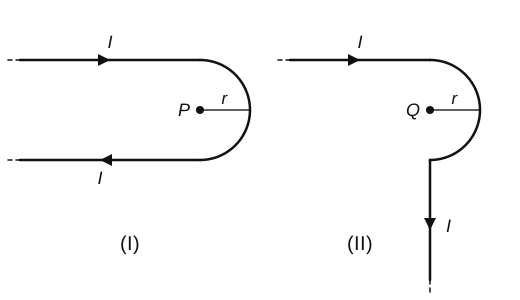
Two identical long current carrying wires are bent into the shapes shown in the following figures. If the magnitude of magnetic fields at the centres P and Q of a semicircular arc are $B_1$ and $B_2$ respectively, then the ratio $\dfrac{B_1}{B_2}$ is ______.
Use: a semi-infinite straight wire ending at the foot of the perpendicular from the point gives $\dfrac{\mu_0I}{4\pi r}$; a semicircle gives $\dfrac{\mu_0I}{4r}$ at its centre; a straight wire whose line passes through the point gives zero.
Figure (I): two semi-infinite wires and the semicircle. All three fields at P point the same way (into or out of the page together):
Figure (II): the horizontal semi-infinite wire and the semicircle contribute; the vertical wire lies along a line through Q, so it contributes nothing:
Q 12-04-045JEE MainJEE Main 2026 (2 Apr, Shift 1)Easy
$1\ \mu$C charge moving with velocity $\vec v=(\hat i-2\hat j+3\hat k)$ m/s in the region of magnetic field $\vec B=(2\hat i+3\hat j-5\hat k)$ T. The magnitude of force acting on it is $\sqrt\alpha\times10^{-6}$ N. The value of $\alpha$ is ______.
Step 2. Magnitude. $|\vec F|=10^{-6}\sqrt{1+121+49}=\sqrt{171}\times10^{-6}$ N.
Answer. $\alpha=171$.
Solution by Sreeraj P, M.Sc Physics
Q 12-04-046JEE MainJEE Main 2026 (2 Apr, Shift 2)Medium
A particle having charge $10^{-9}$ C moving in $x$-$y$ plane in fields of $0.4\hat j$ N/C and $4\times10^{-3}\hat k$ T experiences a force of $(4\hat i+2\hat j)\times10^{-10}$ N. The velocity of the particle at that instant is ______ m/s.
Q 12-04-047JEE MainJEE Main 2026 (28 Jan, Shift 2)Easy
A long cylindrical conductor with large cross section carries an electric current distributed uniformly over its cross-section. Magnetic field due to this current is:
A. maximum at either ends of the conductor and minimum at the midpoint
B. maximum at the axis of the conductor
C. minimum at the surface of the conductor
D. minimum at the axis of the conductor
E. same at all points in the cross-section of the conductor
Choose the correct answer from the options given below:
Concept. Ampere's law with a circle of radius $r$ inside a uniformly carrying wire encloses $I\dfrac{r^2}{a^2}$, so $B=\dfrac{\mu_0Ir}{2\pi a^2}$: zero on the axis, rising linearly to a maximum at the surface.
Step 1. Check each statement. A: the field does not vary along the length of a long wire: false. B: the axis has the minimum (zero), not the maximum: false. C: the surface has the maximum: false. D: minimum (zero) at the axis: true. E: $B$ changes with $r$: false.
Answer. D only (Option D).
Solution by Sreeraj P, M.Sc Physics
Q 12-04-048JEE MainJEE Main 2026 (28 Jan, Shift 1)Easy
The magnetic field at the centre of a current carrying circular loop of radius $R$ is $16\,\mu\text{T}$. The magnetic field at a distance $x = \sqrt3R$ on its axis from the centre is
Concept. On a loop's axis $B=B_0\dfrac{R^3}{(R^2+x^2)^{3/2}}$.
Step 1. At $x=\sqrt3R$. $(4R^2)^{3/2}=8R^3$, so $B=\dfrac{16}{8}=2\ \mu$T.
Answer. Option B.
Solution by Sreeraj P, M.Sc Physics
Q 12-04-049JEE MainJEE Main 2026 (28 Jan, Shift 1)Medium
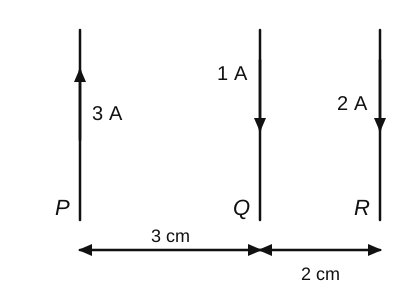
Three long straight wires carrying current are arranged mutually parallel as shown in the figure. The force experienced by 15 cm length of wire $Q$ is ______ .
Concept. Force per length between parallel wires $\dfrac{\mu_0I_1I_2}{2\pi d}$: like currents attract, unlike repel.
Step 1. From P. P (up) and Q (down) are unlike: Q is pushed away from P, towards R. $\dfrac FL=\dfrac{2\times10^{-7}\times3\times1}{0.03}=2\times10^{-5}$ N/m.
Step 2. From R. Q and R both down: Q is pulled towards R. $\dfrac FL=\dfrac{2\times10^{-7}\times2\times1}{0.02}=2\times10^{-5}$ N/m.
Step 3. On 15 cm. $(4\times10^{-5})(0.15)=6\times10^{-6}$ N, towards R.
Answer. Option B.
Solution by Sreeraj P, M.Sc Physics
Q 12-04-050JEE MainJEE Main 2026 (24 Jan, Shift 2)Easy
A moving coil galvanometer of resistance $100\Omega$ shows a full scale deflection for a current of 1 mA . The value of resistance required to convert this galvanometer into an ammeter, showing full scale deflection for a current of 5 mA , is ______ $\Omega$
Q 12-04-051JEE MainJEE Main 2026 (24 Jan, Shift 2)Medium
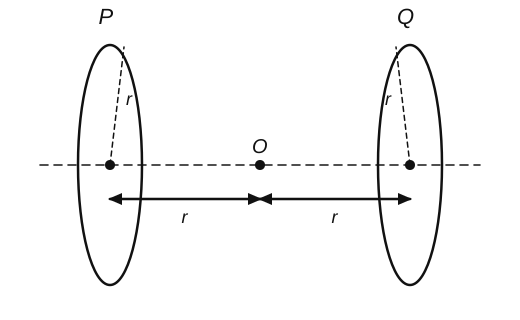
Two identical circular loops $P$ and $Q$ each of radius $r$ are lying in parallel planes such that they have common axis. The current through $P$ and $Q$ are $I$ and $4I$ respectively in clockwise direction as seen from $O$. The net magnetic field at $O$ is :
Answer: (B) $\dfrac{3\mu_oI}{4\sqrt2r}$ towards $Q$
Concept. On the axis of a loop, $B=\dfrac{\mu_0IR^2}{2(R^2+x^2)^{3/2}}$. A current that looks clockwise to an observer gives a field pointing away from that observer.
Step 1. One loop at $x=r$. $B=\dfrac{\mu_0Ir^2}{2(2r^2)^{3/2}}=\dfrac{\mu_0I}{4\sqrt2\,r}$.
Step 2. Directions. Seen from O, both currents are clockwise, so P's field at O points towards P and Q's points towards Q: opposite.
Step 3. Net. $\dfrac{\mu_0(4I-I)}{4\sqrt2\,r}=\dfrac{3\mu_0I}{4\sqrt2\,r}$, towards Q (the larger current).
Answer. Option B.
Solution by Sreeraj P, M.Sc Physics
Q 12-04-052JEE MainJEE Main 2025 (22 Jan, Shift 2)Easy
A proton is moving undeflected in a region of crossed electric and magnetic fields at a constant speed of $2\times10^5\ \text{m s}^{-1}$. When the electric field is switched off, the proton moves along a circular path of radius $2\ \text{cm}$. The magnitude of electric field is $x\times10^4\ \text{N/C}$. The value of $x$ is ______. Take the mass of the proton $= 1.6\times10^{-27}\ \text{kg}$.
Concept. Undeflected in crossed fields: $qE=qvB$, so $E=vB$. With $E$ off, circular motion: $r=\dfrac{mv}{qB}$ gives $B$.
Step 1. Field. $B=\dfrac{mv}{qr}=\dfrac{1.6\times10^{-27}\times2\times10^5}{1.6\times10^{-19}\times0.02}=0.1$ T.
Step 2. Electric field. $E=vB=2\times10^4$ N/C.
Answer. $x=2$.
Solution by Sreeraj P, M.Sc Physics
Q 12-04-053JEE MainJEE Main 2025 (22 Jan, Shift 2)Easy
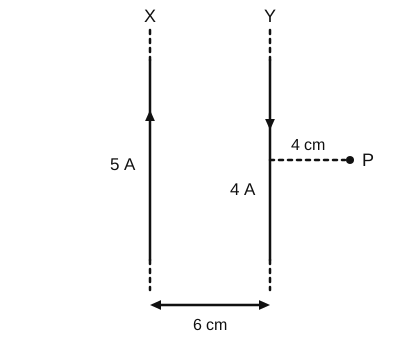
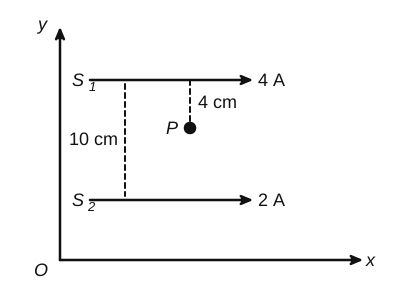
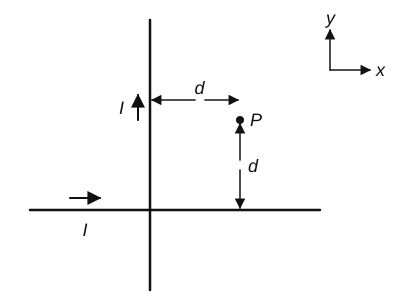
Two long parallel wires $X$ and $Y$, separated by a distance of $6\ \text{cm}$, carry currents of $5\ \text{A}$ and $4\ \text{A}$, respectively, in opposite directions as shown in the figure. Magnitude of the resultant magnetic field at point $P$ at a distance of $4\ \text{cm}$ from wire $Y$ is $x\times10^{-5}\ \text{T}$. The value of $x$ is ______. Take permeability of free space as $\mu_0 = 4\pi\times10^{-7}$ SI units.
Concept. A long wire gives $B=\dfrac{\mu_0I}{2\pi r}$, direction by the right-hand rule. Find each field at P with its direction, then add.
Step 1. Distances. P is $4$ cm from Y and $6+4=10$ cm from X.
Step 2. Sizes. $B_X=\dfrac{2\times10^{-7}\times5}{0.10}=1\times10^{-5}$ T; $B_Y=\dfrac{2\times10^{-7}\times4}{0.04}=2\times10^{-5}$ T.
Step 3. Directions. X carries current up and P is to its right: field into the page. Y carries current down: at P its field is out of the page. They oppose.
Step 4. Net. $2\times10^{-5}-1\times10^{-5}=1\times10^{-5}$ T.
Answer. $x=1$.
Solution by Sreeraj P, M.Sc Physics
Q 12-04-054JEE MainJEE Main 2025 (23 Jan, Shift 1)Medium
Consider a moving coil galvanometer (MCG):
A. The torsional constant in moving coil galvanometer has dimensions $[ML^2T^{-2}]$.
B. Increasing the current sensitivity may not necessarily increase the voltage sensitivity.
C. If we increase number of turns $(N)$ to its double $(2N)$, then the voltage sensitivity doubles.
D. MCG can be converted into an ammeter by introducing a shunt resistance of large value in parallel with galvanometer.
E. Current sensitivity of MCG depends inversely on number of turns of coil.
Choose the correct answer from the options given below:
Concept. $S_I=\dfrac{\theta}{I}=\dfrac{NAB}{k}$ and $S_V=\dfrac{S_I}{R}=\dfrac{NAB}{kR}$. Adding turns of the same wire raises $R$ in proportion to $N$.
Step 1. A. $k$ is torque per radian: $[ML^2T^{-2}]$. True.
Step 2. B. Raising $S_I$ by adding turns raises $R$ too, so $S_V$ need not rise. True.
Step 3. C. Doubling $N$ doubles $S_I$ and $R$: $S_V$ is unchanged. False.
Step 4. D. An ammeter needs a shunt of small resistance. False.
Step 5. E. $S_I\propto N$, not $\dfrac1N$. False.
Answer. A, B only (Option D).
Solution by Sreeraj P, M.Sc Physics
Q 12-04-055JEE MainJEE Main 2025 (23 Jan, Shift 2)Easy
A galvanometer having a coil of resistance $30\ \Omega$ needs $20\ \text{mA}$ of current for full-scale deflection. If a maximum current of $3\ \text{A}$ is to be measured using this galvanometer, the resistance of the shunt to be added to the galvanometer should be $\dfrac{30}{X}\ \Omega$, where $X$ is
Q 12-04-056JEE MainJEE Main 2025 (24 Jan, Shift 1)Easy
A current of $5\ \text{A}$ exists in a square loop of side $\dfrac{1}{\sqrt2}\ \text{m}$. Then the magnitude of the magnetic field $B$ at the centre of the square loop will be $p\times10^{-6}\ \text{T}$, where the value of $p$ is ______. [Take $\mu_0 = 4\pi\times10^{-7}\ \text{T m A}^{-1}$]
Each side is at distance $d = a/2$ from the centre and subtends $45^\circ$ on each side: $$B_{side} = \frac{\mu_0I}{4\pi d}(\sin45^\circ + \sin45^\circ) = \frac{\mu_0I\sqrt2}{4\pi(a/2)}$$
Q 12-04-057JEE MainJEE Main 2025 (24 Jan, Shift 2)Easy
A long straight wire of a circular cross-section with radius $a$ carries a steady current $I$. The current $I$ is uniformly distributed across this cross-section. The plot of magnitude of magnetic field $B$ with distance $r$ from the centre of the wire is given by
Concept. Ampere's law: inside, $B=\dfrac{\mu_0Ir}{2\pi a^2}\propto r$; outside, $B=\dfrac{\mu_0I}{2\pi r}\propto\dfrac1r$. The two meet at $r=a$, so the graph is continuous.
Step 1. Shape. A straight line from the origin up to a peak at $r=a$, then a $1/r$ fall.
Step 2. Reject the others. (A) is flat inside; (B) is zero inside and jumps at $r=a$; (C) is largest on the axis.
Answer. Option D.
Solution by Sreeraj P, M.Sc Physics
Q 12-04-058JEE MainJEE Main 2025 (24 Jan, Shift 2)Hard
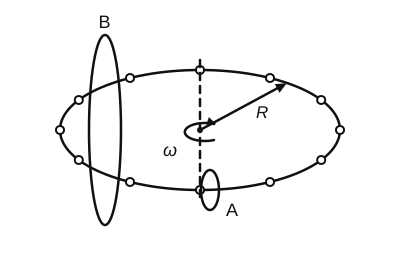
$N$ equally spaced charges, each of value $q$, are placed on a circle of radius $R$. The circle rotates about its axis with an angular velocity $\omega$ as shown in the figure. A bigger Amperian loop B encloses the whole circle whereas a smaller Amperian loop A encloses a small segment. The difference between enclosed currents, $I_A - I_B$, for the given Amperian loops is
Concept. The current through a loop is the charge crossing its surface per second. The rotating ring carries $N$ charges past any point $\dfrac{\omega}{2\pi}$ times a second each.
Step 1. Loop A. A wraps round the ring once, so every charge crosses it once per revolution: $I_A=\dfrac{Nq\omega}{2\pi}$.
Step 2. Loop B. The ring passes through B's surface twice, in opposite directions, so the net charge crossing is zero: $I_B=0$.
Answer: (C) Both (A) and (R) are true and (R) is the correct explanation of (A)
Concept. $\vec F=q\vec v\times\vec B$ is zero when $\vec v\parallel\vec B$.
Step 1. Assertion. An electron moving along the field feels no force, so it can move in a straight line at constant velocity in a uniform field: true.
Step 2. Reason. If the field is along the velocity, $\vec v\times\vec B=0$: true, and this is exactly why the velocity stays constant.
Answer. Both true and R explains A (Option C).
Solution by Sreeraj P, M.Sc Physics
Q 12-04-060JEE MainJEE Main 2025 (24 Jan, Shift 2)Medium
A tightly wound long solenoid carries a current of $1.5\ \text{A}$. An electron is executing uniform circular motion inside the solenoid with a time period of $75\ \text{ns}$. The number of turns per metre in the solenoid is ______. [Take mass of electron $m_e = 9\times10^{-31}\ \text{kg}$, charge of electron $|q_e| = 1.6\times10^{-19}\ \text{C}$, $\mu_0 = 4\pi\times10^{-7}\ \dfrac{\text{N}}{\text{A}^2}$, $1\ \text{ns} = 10^{-9}\ \text{s}$]
Concept. Inside the solenoid $B=\mu_0nI$; the electron circles with $T=\dfrac{2\pi m}{eB}$.
Step 1. Field. $B=\dfrac{2\pi m}{eT}=\dfrac{2\pi\times9\times10^{-31}}{1.6\times10^{-19}\times75\times10^{-9}}=4.71\times10^{-4}$ T.
Step 2. Turns per metre. $n=\dfrac{B}{\mu_0I}=\dfrac{4.71\times10^{-4}}{4\pi\times10^{-7}\times1.5}=250$.
Answer. $250$.
Solution by Sreeraj P, M.Sc Physics
Q 12-04-061JEE MainJEE Main 2025 (28 Jan, Shift 1)Hard
Consider a long thin conducting wire carrying a uniform current $I$. A particle having mass $M$ and charge $q$ is released at a distance $a$ from the wire with a speed $v_0$ along the direction of current in the wire. The particle gets attracted to the wire due to the magnetic force. The particle turns round when it is at distance $x$ from the wire. The value of $x$ is [$\mu_0$ is vacuum permeability]
Concept. The magnetic force does no work, so the speed stays $v_0$. Its component along the wire changes: $m\dfrac{dv_z}{dt}=qB\dfrac{dr}{dt}$ with $B=\dfrac{\mu_0I}{2\pi r}$, so $m\,\Delta v_z=\dfrac{q\mu_0I}{2\pi}\ln\dfrac ra$.
Step 1. Turning point. Radial velocity zero; all of $v_0$ is along the wire, now reversed: $v_z=-v_0$.
Q 12-04-062JEE MainJEE Main 2025 (28 Jan, Shift 2)Medium
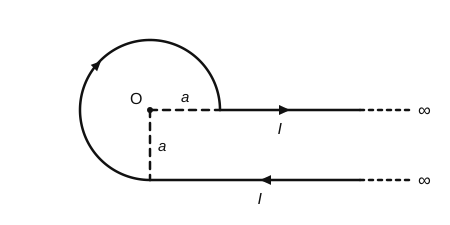
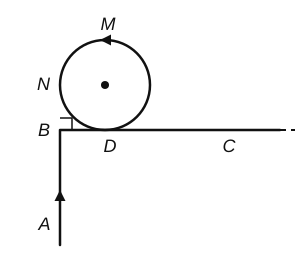
An infinite wire has a circular bend of radius $a$ and carries a current $I$ as shown in the figure. The magnitude of the magnetic field at the origin $O$ of the arc is given by
Concept. Split the wire: the arc gives $\dfrac{\mu_0I\theta}{4\pi a}$; a semi-infinite wire ending at the foot of the perpendicular from O gives $\dfrac{\mu_0I}{4\pi a}$; a wire whose line passes through O gives nothing.
Step 1. Lower straight wire. It comes from infinity along the line $a$ below O and ends directly below O: $\dfrac{\mu_0I}{4\pi a}$. Current to the left, O above it: into the page.
Step 2. Arc. Three-quarters of a circle, $\theta=\dfrac{3\pi}2$, traversed clockwise: $\dfrac{\mu_0I}{4\pi a}\cdot\dfrac{3\pi}2$, into the page.
Step 3. Upper wire. Leaves along the line through O: zero.
Q 12-04-063JEE MainJEE Main 2025 (29 Jan, Shift 1)Medium
Consider a long straight wire of circular cross-section (radius $a$) carrying a steady current $I$. The current is uniformly distributed across this cross-section. The distances from the centre of the wire's cross-section at which the magnetic field [inside the wire, outside the wire] is half of the maximum possible magnetic field anywhere due to the wire will be
Concept. Ampère's law for a uniform wire: inside $B=\dfrac{\mu_0Ir}{2\pi a^2}$ (grows with $r$); outside $B=\dfrac{\mu_0I}{2\pi r}$. The maximum is at the surface.
Step 1. Inside. Half the maximum at $r=\dfrac a2$.
Step 2. Outside. Half the maximum at $r=2a$.
Answer. Option C.
Solution by Sreeraj P, M.Sc Physics
Q 12-04-064JEE MainJEE Main 2025 (29 Jan, Shift 2)Easy
The magnetic field inside a 200-turn solenoid of radius $10\ \text{cm}$ is $2.9\times10^{-4}\ \text{T}$. If the solenoid carries a current of $0.29\ \text{A}$, then the length of the solenoid is ______ $\pi$ cm.
Concept. $B=\mu_0\dfrac NLI\Rightarrow L=\dfrac{\mu_0NI}{B}$. The radius is not needed.
Step 1. Length. $\dfrac{4\pi\times10^{-7}\times200\times0.29}{2.9\times10^{-4}}=0.08\pi$ m.
Answer. $8\pi$ cm.
Solution by Sreeraj P, M.Sc Physics
Q 12-04-065JEE MainJEE Main 2024 (1 Feb, Shift 1)Easy
A galvanometer has a resistance of $50\ \Omega$ and allows a maximum current of $5\ \text{mA}$. It can be converted into a voltmeter to measure up to $100\ \text{V}$ by connecting in series a resistor of resistance
Q 12-04-066JEE MainJEE Main 2024 (1 Feb, Shift 1)Medium
A regular polygon of 6 sides is formed by bending a wire of length $4\pi$ metre. If an electric current of $4\pi\sqrt3\ \text{A}$ flows through the sides of the polygon, the magnetic field at the centre of the polygon would be $x\times10^{-7}\ \text{T}$. The value of $x$ is ______.
Concept. Same finite-wire formula; a hexagon has six sides, each subtending $30^\circ$ on either side of the perpendicular from the centre.
Step 1. Geometry. Side $\dfrac{4\pi}{6}=\dfrac{2\pi}{3}$ m; distance $d=\dfrac{\sqrt3}{2}\times\dfrac{2\pi}{3}=\dfrac{\pi}{\sqrt3}$ m.
Step 2. One side. $10^{-7}\times\dfrac{4\pi\sqrt3}{\pi/\sqrt3}\times(2\sin30^\circ)=12\times10^{-7}$ T.
Step 3. Six sides. $72\times10^{-7}$ T.
Answer. $72$.
Solution by Sreeraj P, M.Sc Physics
Q 12-04-067JEE MainJEE Main 2024 (1 Feb, Shift 2)Easy
In an ammeter, $5\%$ of the main current passes through the galvanometer. If the resistance of the galvanometer is $G$, the resistance of the ammeter will be
Concept. Current divides inversely as resistance: $0.05I$ through $G$, $0.95I$ through $S$, so $S=\dfrac{G}{19}$. The ammeter's resistance is $G\parallel S$.
Q 12-04-068JEE MainJEE Main 2024 (1 Feb, Shift 2)Easy
A moving coil galvanometer has 100 turns and each turn has an area of $2.0\ \text{cm}^2$. The magnetic field produced by the magnet is $0.01\ \text{T}$ and the deflection in the coil is $0.05$ radian when a current of $10\ \text{mA}$ is passed through it. The torsional constant of the suspension wire is $x\times10^{-5}\ \text{N m rad}^{-1}$. The value of $x$ is ______.
Answer: (A) the electron will continue to move with uniform velocity along the axis of the solenoid.
The field inside the solenoid is along its axis, parallel to the electron's velocity. So $\vec F = -e(\vec v\times\vec B) = 0$ and the electron keeps moving with uniform velocity along the axis.
Solution by Sreeraj P, M.Sc Physics
Q 12-04-070JEE MainJEE Main 2024 (4 Apr, Shift 1)Medium
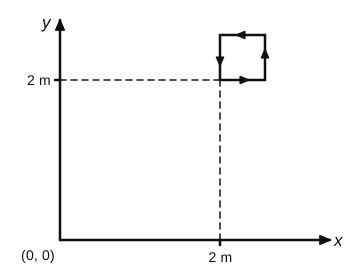
The magnetic field existing in a region is given by $\vec B = 0.2(1 + 2x)\hat k\ \text{T}$. A square loop of edge $50\ \text{cm}$ carrying $0.5\ \text{A}$ current is placed in the $x$-$y$ plane with its edges parallel to the $x$-$y$ axes, as shown in the figure. The magnitude of the net magnetic force experienced by the loop is ______ mN.
Concept. $B$ depends only on $x$. The forces on the two sides parallel to $x$ are equal and opposite. The two sides parallel to $y$ carry opposite currents in different fields, so the net force is $F=IL\,[B(x_2)-B(x_1)]$.
Step 1. Fields. $x_1=2$ m, $x_2=2.5$ m: $B(x_2)-B(x_1)=0.2\times2\times0.5=0.2$ T.
Step 2. Force. $F=0.5\times0.5\times0.2=0.05$ N.
Answer. $50$ mN.
Solution by Sreeraj P, M.Sc Physics
Q 12-04-071JEE MainJEE Main 2024 (4 Apr, Shift 2)Medium
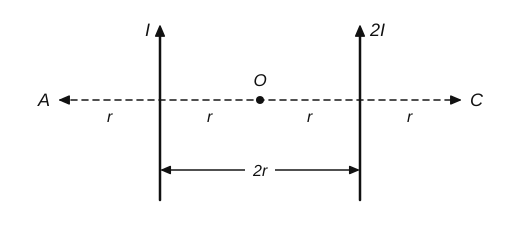
Two parallel long current carrying wires separated by a distance $2r$ are shown in the figure. The ratio of the magnetic field at $A$ to the magnetic field produced at $C$ is $\dfrac{x}{7}$. The value of $x$ is ______.
Concept. Outside both wires, wires with currents in the same direction give fields in the same direction, so the magnitudes add.
Step 1. At A. A is $r$ from the wire with $I$ and $3r$ from the wire with $2I$: $B_A=\dfrac{\mu_0}{2\pi}\left(\dfrac Ir+\dfrac{2I}{3r}\right)=\dfrac{\mu_0I}{2\pi r}\cdot\dfrac53$.
Step 2. At C. C is $r$ from $2I$ and $3r$ from $I$: $B_C=\dfrac{\mu_0}{2\pi}\left(\dfrac{2I}{r}+\dfrac{I}{3r}\right)=\dfrac{\mu_0I}{2\pi r}\cdot\dfrac73$.
Step 3. Ratio. $\dfrac{B_A}{B_C}=\dfrac57$.
Answer. $x=5$.
Solution by Sreeraj P, M.Sc Physics
Q 12-04-072JEE MainJEE Main 2024 (5 Apr, Shift 1)Easy
In a co-axial straight cable, the central conductor and the outer conductor carry equal currents in opposite directions. The magnetic field is zero
Concept. Ampère's law outside the cable: the loop encloses $I-I=0$, so $B=0$ there.
Answer. Outside the cable (Option A).
Solution by Sreeraj P, M.Sc Physics
Q 12-04-073JEE MainJEE Main 2024 (5 Apr, Shift 1)Hard
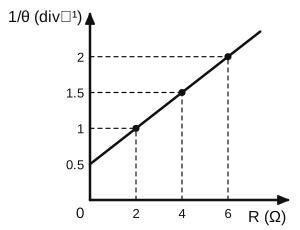
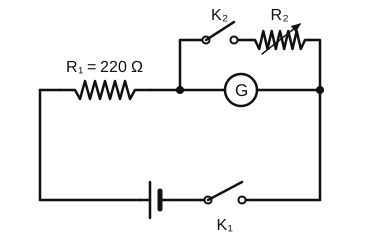
In the experiment to determine the galvanometer resistance by the half-deflection method, the plot of $1/\theta$ vs the resistance ($R$) of the resistance box is shown in the figure. The figure of merit of the galvanometer is ______ $\times10^{-1}\ \text{A/division}$. [The source has emf $2\ \text{V}$]
Concept. With only the resistance box $R$ in series, $I=\dfrac{E}{R+G}$ and $\theta=\dfrac IK$, where $K$ is the figure of merit. So $\dfrac1\theta=\dfrac{K}{E}(R+G)$: a straight line with slope $\dfrac KE$.
Step 1. Slope. From $(2,1)$ to $(6,2)$: $\dfrac{2-1}{6-2}=0.25$ per ohm.
Step 2. Figure of merit. $K=0.25\times E=0.25\times2=0.5$ A/division.
Step 3. Check. The intercept $0.5=\dfrac{KG}{E}$ gives $G=2\ \Omega$, consistent.
Answer. $5$.
Solution by Sreeraj P, M.Sc Physics
Q 12-04-074JEE MainJEE Main 2024 (5 Apr, Shift 1)Medium
A straight metal wire carrying a current of $2\ \text{A}$, having resistance $1\ \Omega$, resistivity $2\times10^{-6}\ \Omega\,\text{m}$, area of cross-section $10\ \text{mm}^2$ and mass $500\ \text{g}$, is suspended horizontally in mid air by applying a uniform magnetic field $\vec B$. The magnitude of $B$ is ______ $\times10^{-1}\ \text{T}$ (given $g = 10\ \text{m/s}^2$).
Concept. The wire floats when $BIL=mg$. Find $L$ from the resistance.
Step 1. Length. $L=\dfrac{RA}{\rho}=\dfrac{1\times10^{-5}}{2\times10^{-6}}=5$ m.
Step 2. Field. $B=\dfrac{0.5\times10}{2\times5}=0.5$ T.
Answer. $5$ ($\times10^{-1}$ T).
Solution by Sreeraj P, M.Sc Physics
Q 12-04-075JEE MainJEE Main 2024 (5 Apr, Shift 2)Medium
A galvanometer of resistance $100\ \Omega$, when connected in series with $400\ \Omega$, measures a voltage of up to $10\ \text{V}$. The value of the resistance required to convert the galvanometer into an ammeter to read up to $10\ \text{A}$ is $x\times10^{-2}\ \Omega$. The value of $x$ is
The Lorentz force is $\vec F = q\vec E + q(\vec v\times\vec B)$: electric part $q\vec E$, magnetic part $q(\vec v\times\vec B)$.
Solution by Sreeraj P, M.Sc Physics
Q 12-04-077JEE MainJEE Main 2024 (5 Apr, Shift 2)Easy
A solenoid of length $0.5\ \text{m}$ has a radius of $1\ \text{cm}$ and is made up of $m$ turns. It carries a current of $5\ \text{A}$. If the magnitude of the magnetic field inside the solenoid is $6.28\times10^{-3}\ \text{T}$, then the value of $m$ is ______.
Q 12-04-078JEE MainJEE Main 2024 (6 Apr, Shift 1)Easy
A current element $\Delta\vec l = \Delta x\,\hat i$ is placed at the origin and carries a large current $I = 10\ \text{A}$. The magnetic field on the $y$-axis at a distance of $0.5\ \text{m}$ from the element, for $\Delta x$ of $1\ \text{cm}$ length, is
Concept. Biot–Savart for a short element: $dB=\dfrac{\mu_0}{4\pi}\dfrac{I\,dl\sin\theta}{r^2}$; on the $y$-axis, $\theta=90^\circ$.
Step 1. Value. $10^{-7}\times\dfrac{10\times0.01}{0.25}=4\times10^{-8}$ T.
Answer. Option A.
Solution by Sreeraj P, M.Sc Physics
Q 12-04-079JEE MainJEE Main 2024 (6 Apr, Shift 1)Easy
A circular coil having 200 turns, $2.5\times10^{-4}\ \text{m}^2$ area and carrying $100\ \mu\text{A}$ current is placed in a uniform magnetic field of $1\ \text{T}$. Initially the magnetic dipole moment $(\vec M)$ was directed along $\vec B$. The amount of work required to rotate the coil through $90^\circ$ from its initial orientation such that $\vec M$ becomes perpendicular to $\vec B$ is ______ $\mu\text{J}$.
Q 12-04-081JEE MainJEE Main 2024 (6 Apr, Shift 2)Easy
An ammeter A consists of a $240\ \Omega$ coil connected in parallel to a $10\ \Omega$ shunt. It is connected in series with a $140.4\ \Omega$ resistor across a $24\ \text{V}$ battery. The reading of the ammeter is ______ mA.
Concept. The ammeter is a $240\ \Omega$ coil in parallel with a $10\ \Omega$ shunt: one resistor of $\dfrac{240\times10}{250}=9.6\ \Omega$ in the circuit. It reads the total current.
Step 1. Circuit. $R=140.4+9.6=150\ \Omega$.
Step 2. Current. $I=\dfrac{24}{150}=0.16$ A.
Answer. $160$ mA.
Solution by Sreeraj P, M.Sc Physics
Q 12-04-082JEE MainJEE Main 2024 (6 Apr, Shift 2)Easy
A coil having 100 turns, area of $5\times10^{-3}\ \text{m}^2$, carrying a current of $1\ \text{mA}$ is placed in a uniform magnetic field of $0.20\ \text{T}$ in such a way that the plane of the coil is perpendicular to the magnetic field. The work done in turning the coil through $90^\circ$ is ______ $\mu\text{J}$.
Concept. Plane perpendicular to $\vec B$ means the moment is along $\vec B$ ($\theta=0$). Turning by $90^\circ$ needs $W=MB$.
Step 1. Value. $100\times10^{-3}\times5\times10^{-3}\times0.2=10^{-4}$ J.
Answer. $100\ \mu$J.
Solution by Sreeraj P, M.Sc Physics
Q 12-04-083JEE MainJEE Main 2024 (27 Jan, Shift 1)Medium
A proton moving with a constant velocity passes through a region of space without any change in its velocity. If $\vec E$ and $\vec B$ represent the electric and magnetic fields respectively, then the region of space may have:
(A) $E = 0,\ B = 0$; (B) $E = 0,\ B \ne 0$; (C) $E \ne 0,\ B = 0$; (D) $E \ne 0,\ B \ne 0$
Choose the most appropriate answer from the options given below:
Concept. The velocity stays the same only if the net force $q(\vec E+\vec v\times\vec B)$ is zero.
Step 1. Each case. (A) No fields: no force. Possible. (B) $E=0$, $B\ne0$: zero force if $\vec v\parallel\vec B$. Possible. (C) $E\ne0$, $B=0$: the force $q\vec E$ cannot be cancelled. Not possible. (D) $E\ne0$, $B\ne0$: crossed fields with $E=vB$ cancel. Possible.
Answer. (A), (B) and (D) only (Option C).
Solution by Sreeraj P, M.Sc Physics
Q 12-04-084JEE MainJEE Main 2024 (27 Jan, Shift 1)Easy
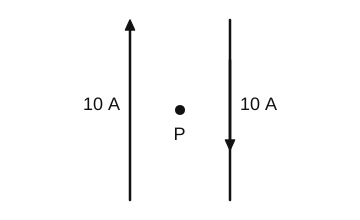
Two long, straight wires carry equal currents in opposite directions as shown in figure. The separation between the wires is $5.0\ \text{cm}$. The magnitude of the magnetic field at a point P midway between the wires is ______ $\mu\text{T}$. (Given: $\mu_0 = 4\pi\times10^{-7}\ \text{T m A}^{-1}$)
Each wire is $2.5\ \text{cm}$ from P. For opposite currents, the fields at a point between the wires point in the same direction, so they add: $$B = 2\times\frac{\mu_0 I}{2\pi d} = 2\times\frac{2\times10^{-7}\times10}{0.025} = 2\times8\times10^{-5} = 1.6\times10^{-4}\ \text{T} = 160\ \mu\text{T}$$
Solution by Sreeraj P, M.Sc Physics
Q 12-04-085JEE MainJEE Main 2024 (27 Jan, Shift 2)Easy
A current of $200\ \mu\text{A}$ deflects the coil of a moving coil galvanometer through $60^\circ$. The current to cause deflection through $\dfrac{\pi}{10}$ radian is:
Q 12-04-086JEE MainJEE Main 2024 (27 Jan, Shift 2)Medium
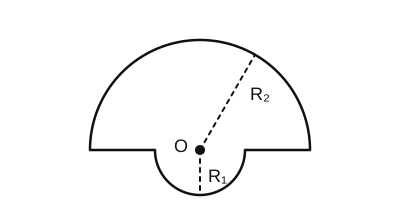
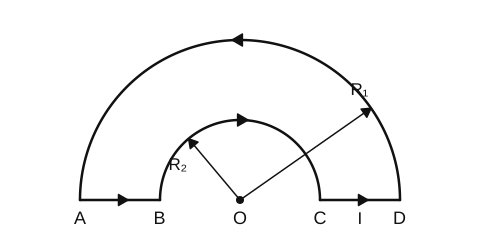
The magnetic field at the centre of a wire loop formed by two semicircular wires of radii $R_1 = 2\pi\ \text{m}$ and $R_2 = 4\pi\ \text{m}$ carrying current $I = 4\ \text{A}$ as per figure given below is $\alpha\times10^{-7}\ \text{T}$. The value of $\alpha$ is ______. (Centre O is common for all segments)
The straight segments lie along lines through O, so they give no field at O. The current goes round the loop in one sense, so the two semicircles give fields in the same direction: $$B = \frac{\mu_0 I}{4R_1} + \frac{\mu_0 I}{4R_2} = \frac{4\pi\times10^{-7}\times4}{4}\left(\frac{1}{2\pi} + \frac{1}{4\pi}\right)$$ $$B = 4\pi\times10^{-7}\times\frac{3}{4\pi} = 3\times10^{-7}\ \text{T} \;\Rightarrow\; \alpha = 3$$
Solution by Sreeraj P, M.Sc Physics
Q 12-04-087JEE MainJEE Main 2024 (29 Jan, Shift 1)Easy
A galvanometer having coil resistance $10\ \Omega$ shows a full scale deflection for a current of $3\ \text{mA}$. For it to measure a current of $8\ \text{A}$, the value of the shunt should be:
Q 12-04-088JEE MainJEE Main 2024 (29 Jan, Shift 1)Medium
The deflection in a moving coil galvanometer falls from 25 divisions to 5 divisions when a shunt of $24\ \Omega$ is applied. The resistance of the galvanometer coil will be:
Q 12-04-089JEE MainJEE Main 2024 (29 Jan, Shift 2)Easy
Two particles $X$ and $Y$ having equal charges are being accelerated through the same potential difference. Thereafter, they enter normally in a region of uniform magnetic field and describe circular paths of radii $R_1$ and $R_2$ respectively. The mass ratio of $X$ and $Y$ is:
Q 12-04-090JEE MainJEE Main 2024 (29 Jan, Shift 2)Easy
A charge of $4.0\ \mu\text{C}$ is moving with a velocity of $4.0\times10^6\ \text{m s}^{-1}$ along the positive $y$-axis under a magnetic field $\vec B$ of strength $(2\hat k)\ \text{T}$. The force acting on the charge is $x\hat i\ \text{N}$. The value of $x$ is ______.
$$\vec F = q\vec v\times\vec B = 4\times10^{-6}\times4\times10^6\,(\hat j\times2\hat k) = 16\times2\,\hat i = 32\,\hat i\ \text{N}$$ So $x = 32$.
Solution by Sreeraj P, M.Sc Physics
Q 12-04-091JEE MainJEE Main 2024 (8 Apr, Shift 1)Easy
An electron with kinetic energy $5\ \text{eV}$ enters a region of uniform magnetic field of $3\ \mu\text{T}$ perpendicular to its direction. An electric field $E$ is applied perpendicular to the direction of velocity and magnetic field. The value of $E$, so that the electron moves along the same path, is ______ $\text{N C}^{-1}$. (Given, mass of electron $= 9\times10^{-31}\ \text{kg}$, electric charge $= 1.6\times10^{-19}\ \text{C}$)
Q 12-04-092JEE MainJEE Main 2024 (8 Apr, Shift 2)Easy
A long straight wire of radius $a$ carries a steady current $I$. The current is uniformly distributed across its cross section. The ratio of the magnetic field at $\dfrac a2$ and $2a$ from the axis of the wire is:
Concept. Same formulas: $B\left(\tfrac a2\right)=\tfrac12B_{\max}$ and $B(2a)=\tfrac12B_{\max}$.
Answer. $1:1$ (Option B).
Solution by Sreeraj P, M.Sc Physics
Q 12-04-093JEE MainJEE Main 2024 (9 Apr, Shift 1)Easy
A galvanometer has a coil of resistance $200\ \Omega$ with a full scale deflection at $20\ \mu\text{A}$. The value of resistance to be added to use it as an ammeter of range $(0 - 20)\ \text{mA}$ is:
Answer: (B) Statement I is true but Statement II is false
Concept. Test each statement against the theory.
Step 1. Statement I. With time-varying currents the forces between two circuits need not be equal and opposite at each instant; momentum is conserved only if the momentum carried by the electromagnetic field is counted. True.
Step 2. Statement II. For steady currents Ampere's circuital law can be derived from the Biot–Savart law; the two are equivalent. So it does depend on it: false.
Answer. Option B.
Solution by Sreeraj P, M.Sc Physics
Q 12-04-095JEE MainJEE Main 2024 (9 Apr, Shift 1)Medium
A square loop of edge length $2\ \text{m}$ carrying a current of $2\ \text{A}$ is placed with its edges parallel to the $x$–$y$ axes. A magnetic field is passing through the $x$–$y$ plane and expressed as $\vec B = B_0(1 + 4x)\hat k$, where $B_0 = 5\ \text{T}$. The net magnetic force experienced by the loop is ______ N.
Concept. In a non-uniform field, forces on opposite sides do not cancel. Sides along $x$ cancel each other; the sides along $y$ at $x_1$ and $x_2$ give a net force $IL[B(x_2)-B(x_1)]$.
Step 1. Field difference. $B_0\times4\times2=40$ T.
Step 2. Force. $2\times2\times40=160$ N.
Answer. $160$.
Solution by Sreeraj P, M.Sc Physics
Q 12-04-096JEE MainJEE Main 2024 (9 Apr, Shift 2)Easy
A proton and a deutron ($q = +e$, $m = 2.0\ \text{u}$) having same kinetic energies enter a region of uniform magnetic field $\vec B$, moving perpendicular to $\vec B$. The ratio of the radius $r_d$ of deutron path to the radius $r_p$ of the proton path is:
$r = \dfrac{\sqrt{2mK}}{qB}$. Same $q$ and $K$, so $r \propto \sqrt m$: $$\frac{r_d}{r_p} = \sqrt{\frac{2}{1}} = \sqrt2 : 1$$
Solution by Sreeraj P, M.Sc Physics
Q 12-04-097JEE MainJEE Main 2024 (30 Jan, Shift 1)Medium
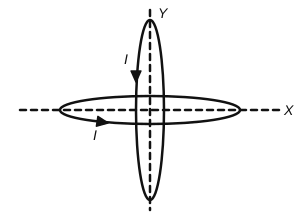
Two insulated circular loops $A$ and $B$, each of radius $a$ and carrying a current $I$ in the anticlockwise direction, are placed with a common centre $O$ in mutually perpendicular planes. The magnitude of the magnetic induction at the centre will be:
Q 12-04-098JEE MainJEE Main 2024 (30 Jan, Shift 1)Medium
The horizontal component of earth's magnetic field at a place is $3.5\times10^{-5}\ \text{T}$. A very long straight conductor carrying a current of $\sqrt2\ \text{A}$ in the direction from South-East to North-West is placed. The force per unit length experienced by the conductor is ______ $\times10^{-6}\ \text{N m}^{-1}$.
Concept. Only the horizontal component (pointing north) acts on a horizontal wire. SE to NW makes $45^\circ$ with north.
Step 1. Force per length. $IB\sin45^\circ=\sqrt2\times3.5\times10^{-5}\times\dfrac1{\sqrt2}=3.5\times10^{-5}$ N/m.
Answer. $35$.
Solution by Sreeraj P, M.Sc Physics
Q 12-04-099JEE MainJEE Main 2024 (30 Jan, Shift 2)Medium
A current of $5\ \text{A}$ flows in a square loop of side $1\ \text{m}$ placed in air. The magnetic field at the centre of the loop is $X\sqrt2\times10^{-7}\ \text{T}$. The value of $X$ is ______.
Concept. Finite wire: $B=\dfrac{\mu_0I}{4\pi d}(\sin\alpha_1+\sin\alpha_2)$. At a square's centre $d=\dfrac a2$ and each angle is $45^\circ$; four sides add.
Step 1. One side. $10^{-7}\times\dfrac{5}{0.5}\times\sqrt2=\sqrt2\times10^{-6}$ T.
Step 2. Four sides. $4\sqrt2\times10^{-6}=40\sqrt2\times10^{-7}$ T.
Answer. $X=40$.
Solution by Sreeraj P, M.Sc Physics
Q 12-04-100JEE MainJEE Main 2024 (31 Jan, Shift 1)Medium
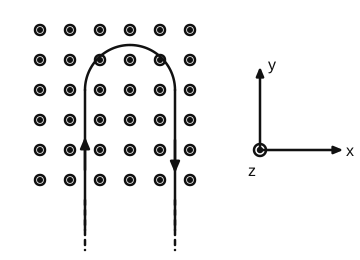
A rigid wire consists of a semicircular portion of radius $R$ and two straight sections. The wire is partially immersed in a uniform magnetic field $\vec B = B_0\hat k$ (out of the page), as shown in the figure. The two straight sections run parallel to the $y$-axis and extend out of the field region at the bottom. If the wire carries a current $i$ (up the left section and down the right section), the magnetic force on the wire is:
Concept. In a uniform field the force on any wire equals the force on the straight line joining its ends. The part in the field runs from the left section's exit point, up and round, to the right section's exit point: its ends are $2R$ apart along $x$.
Step 1. Equivalent wire. Length $2R$, current from left to right: $\vec L=2R\,\hat i$.
Q 12-04-102JEE MainJEE Main 2024 (31 Jan, Shift 2)Medium
A uniform magnetic field of $2\times10^{-3}\ \text{T}$ acts along the positive $Y$-direction. A rectangular loop of sides $20\ \text{cm}$ and $10\ \text{cm}$ with a current of $5\ \text{A}$ is in the $Y$-$Z$ plane. The current is in the anticlockwise sense with reference to the negative $X$ axis. The magnitude and direction of the torque is:
Answer: (B) $2\times10^{-4}\ \text{N m}$ along negative $Z$-direction
Concept. Anticlockwise as seen looking along $-x$ means the moment points along $-x$ (right-hand rule). $\vec\tau=\vec m\times\vec B$.
Step 1. Moment. $5\times0.02=0.1$ A m$^2$ along $-\hat i$.
Step 2. Torque. $0.1\times2\times10^{-3}\,(-\hat i\times\hat j)=-2\times10^{-4}\hat k$ N m.
Answer. Option B.
Solution by Sreeraj P, M.Sc Physics
Q 12-04-103JEE MainJEE Main 2024 (31 Jan, Shift 2)Medium
Two circular coils $P$ and $Q$ of 100 turns each have the same radius of $\pi\ \text{cm}$. The currents in $P$ and $Q$ are $1\ \text{A}$ and $2\ \text{A}$ respectively. $P$ and $Q$ are placed with their planes mutually perpendicular with their centres coinciding. The resultant magnetic field induction at the centre of the coils is $\sqrt x\ \text{mT}$, where $x = $ ______. [Use $\mu_0 = 4\pi\times10^{-7}\ \text{T m A}^{-1}$]
Concept. Coil at its centre: $B=\dfrac{\mu_0NI}{2R}$. Perpendicular coils: add as vectors.
Step 1. Coil P. $\dfrac{4\pi\times10^{-7}\times100\times1}{2\times0.01\pi}=2$ mT. Coil Q. $4$ mT.
Step 2. Resultant. $\sqrt{4+16}=\sqrt{20}$ mT.
Answer. $x=20$.
Solution by Sreeraj P, M.Sc Physics
Q 12-04-104JEE MainJEE Main 2023 (29 Jan, Shift 1)Hard
A single current carrying loop of wire carrying current $I$ flowing in anticlockwise direction seen from the $+z$ direction and lying in the $xy$ plane is shown in figure. The plot of the $\hat{j}$ component of magnetic field ($B_y$) at a distance $a$ (less than radius of the coil) and on the $yz$ plane versus $z$ coordinate looks like
Concept. Use symmetry. Reflecting the loop in its own plane ($z\to-z$) leaves the loop and its current unchanged; under this reflection the field components in the plane ($B_x$, $B_y$) change sign. So $B_y(0,a,-z)=-B_y(0,a,z)$: $B_y$ is an odd function of $z$.
Step 1. In the plane. At $z=0$ the field of the loop is along $z$ (perpendicular to the plane), so $B_y=0$.
Step 2. Far away. $B_y\to0$ as $|z|\to\infty$.
Step 3. Shape. Zero at the centre and at both ends, opposite signs on the two sides, with one hump each side: only graph (C) is odd.
Answer. Option C.
Solution by Sreeraj P, M.Sc Physics
Q 12-04-105JEE MainJEE Main 2023 (29 Jan, Shift 1)Medium
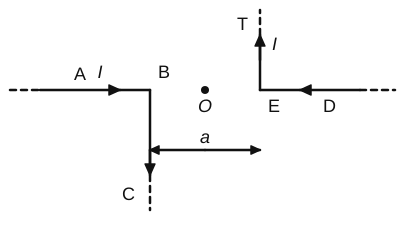
The magnitude of magnetic induction at mid-point $O$ due to current arrangement as shown in figure will be
Concept. O lies on the line of AB and DE, so those parts give nothing. BC and ET are semi-infinite wires starting level with O, each at distance $\dfrac a2$: each gives $\dfrac{\mu_0I}{4\pi(a/2)}=\dfrac{\mu_0I}{2\pi a}$.
Step 1. BC. Current down, O to its right: $(-\hat y)\times\hat x=+\hat z$ (out of the page).
Step 2. ET. Current up, O to its left: $\hat y\times(-\hat x)=+\hat z$ (out of the page).
Q 12-04-106JEE MainJEE Main 2023 (29 Jan, Shift 2)Easy
The electric current in a circular coil of four turns produces a magnetic induction $32\ \text{T}$ at its centre. The coil is unwound and is rewound into a circular coil of single turn, the magnetic induction at the centre of the coil by the same current will be
Concept. Same wire rewound: $N\times2\pi r$ is fixed, so $r\propto\dfrac1N$ and $B=\dfrac{\mu_0NI}{2r}\propto N^2$.
Step 1. Ratio. From $4$ turns to $1$: $\dfrac{1}{16}$.
Step 2. Value. $\dfrac{32}{16}=2$ T.
Answer. Option C.
Solution by Sreeraj P, M.Sc Physics
Q 12-04-107JEE MainJEE Main 2023 (30 Jan, Shift 1)Medium
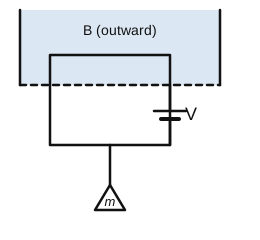
A massless square loop, of wire of resistance $10\ \Omega$, supporting a mass of $1\ \text{g}$, hangs vertically with one of its sides in a uniform magnetic field of $10^3\ \text{G}$, directed outwards in the shaded region. A dc voltage $V$ is applied to the loop. For what value of $V$, the magnetic force will exactly balance the weight of the supporting mass of $1\ \text{g}$? (If sides of the loop $=10\ \text{cm}$, $g=10\ \text{m s}^{-2}$)
Concept. Only the top side and the upper parts of the two vertical sides are in the field. The forces on the vertical parts are equal and opposite, so the net force is $BIL$ on the top side, which must hold up the mass.
Step 1. Current. $B=10^3$ G $=0.1$ T: $I=\dfrac{mg}{BL}=\dfrac{10^{-3}\times10}{0.1\times0.1}=1$ A.
Step 2. Voltage. $V=IR=1\times10=10$ V.
Answer. $10$ V (Option D).
Solution by Sreeraj P, M.Sc Physics
Q 12-04-108JEE MainJEE Main 2023 (30 Jan, Shift 1)Easy
The magnetic moments associated with two closely wound circular coils $A$ and $B$ of radius $r_A=10\ \text{cm}$ and $r_B=20\ \text{cm}$ respectively are equal if (where $N_A$, $I_A$ and $N_B$, $I_B$ are number of turns and current of $A$ and $B$ respectively)
Q 12-04-109JEE MainJEE Main 2023 (30 Jan, Shift 2)Medium
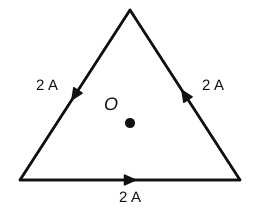
As shown in the figure, a current of $2\ \text{A}$ flowing in an equilateral triangle of side $4\sqrt3\ \text{cm}$. The magnetic field at the centroid $O$ of the triangle is (Neglect the effect of earth's magnetic field)
Concept. Each side of a regular polygon is a finite wire. For an equilateral triangle the centroid is at $d=\dfrac{a}{2\sqrt3}$ from each side, and each end subtends $60^\circ$ with the perpendicular.
Step 1. Distance. $d=\dfrac{4\sqrt3}{2\sqrt3}=2$ cm.
Step 2. One side. $B_1=\dfrac{\mu_0I}{4\pi d}(2\sin60^\circ)=10^{-7}\times\dfrac{2}{0.02}\times\sqrt3=\sqrt3\times10^{-5}$ T.
Step 3. Three sides. All three fields point the same way (the current circulates one way round O): $B=3\sqrt3\times10^{-5}$ T.
Answer. $3\sqrt3\times10^{-5}$ T (Option D).
Solution by Sreeraj P, M.Sc Physics
Q 12-04-110JEE MainJEE Main 2023 (30 Jan, Shift 2)Medium
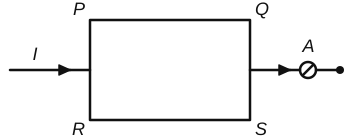
A current carrying rectangular loop $PQRS$ is made of uniform wire. The length $PR=QS=5\ \text{cm}$ and $PQ=RS=100\ \text{cm}$. If ammeter current reading changes from $I$ to $2I$, the ratio of magnetic forces per unit length on the wire $PQ$ due to wire $RS$ in the two cases respectively $\left(f^I_{PQ}:f^{2I}_{PQ}\right)$ is
Concept. The current enters at the middle of PR and leaves at the middle of QS. The two halves of the loop are identical, so PQ and RS each carry half the current, in the same direction: they attract with $\dfrac FL=\dfrac{\mu_0(I/2)^2}{2\pi d}\propto I^2$.
Step 1. Ratio. $I\to2I$ multiplies the force per length by 4.
Answer. $1:4$ (Option B).
Solution by Sreeraj P, M.Sc Physics
Q 12-04-111JEE MainJEE Main 2023 (31 Jan, Shift 2)Medium
The number of turns of the coil of a moving coil galvanometer is increased in order to increase current sensitivity by $50\%$. The percentage change in voltage sensitivity of the galvanometer will be
Concept. Current sensitivity $\dfrac{\theta}{I}=\dfrac{NAB}{k}$; voltage sensitivity $\dfrac{\theta}{V}=\dfrac{NAB}{kR}$. More turns of the same wire raise $R$ in the same ratio.
Step 1. Effect. $N\times1.5$ and $R\times1.5$: voltage sensitivity unchanged.
Answer. $0\%$ (Option D).
Solution by Sreeraj P, M.Sc Physics
Q 12-04-112JEE MainJEE Main 2023 (31 Jan, Shift 2)Medium
A long conducting wire having a current $I$ flowing through it, is bent into a circular coil of $N$ turns. Then it is bent into a circular coil of $n$ turns. The magnetic field is calculated at the centre of coils in both the cases. The ratio of the magnetic field in first case to that of second case is
Concept. Same as above: $B\propto N^2$ for a fixed wire length.
Answer. $N^2:n^2$ (Option C).
Solution by Sreeraj P, M.Sc Physics
Q 12-04-113JEE MainJEE Main 2023 (24 Jan, Shift 1)Easy
Two long straight wires $P$ and $Q$ carrying equal current $10\ \text{A}$ each were kept parallel to each other at $5\ \text{cm}$ distance. Magnitude of magnetic force experienced by $10\ \text{cm}$ length of wire $P$ is $F_1$. If distance between wires is halved and currents on them are doubled, force $F_2$ on $10\ \text{cm}$ length of wire $P$ will be
Q 12-04-114JEE MainJEE Main 2023 (24 Jan, Shift 1)Easy
A circular loop of radius $R$ is carrying current $i$ A. The ratio of magnetic field at the centre of circular loop and at a distance $R$ from the center of the loop on its axis is
$B_{centre}=\dfrac{\mu_0i}{2R}$, $B_{axis}=\dfrac{\mu_0iR^2}{2(R^2+x^2)^{3/2}}$. With $x=R$: $$\frac{B_{centre}}{B_{axis}}=\frac{(2R^2)^{3/2}}{R^3}=2\sqrt2$$
Solution by Sreeraj P, M.Sc Physics
Q 12-04-115JEE MainJEE Main 2023 (24 Jan, Shift 2)Easy
A long solenoid is formed by winding $70$ turns $\text{cm}^{-1}$. If $2.0\ \text{A}$ current flows, then the magnetic field produced inside the solenoid is ______. ($\mu_0=4\pi\times10^{-7}\ \text{T m A}^{-1}$)
Concept. Long solenoid: $B=\mu_0nI$, with $n$ in turns per metre.
Step 1. Turns. $70$ per cm $=7000$ per m.
Step 2. Field. $4\pi\times10^{-7}\times7000\times2=176\times10^{-4}$ T.
Answer. Option B.
Solution by Sreeraj P, M.Sc Physics
Q 12-04-116JEE MainJEE Main 2023 (24 Jan, Shift 2)Medium
A single turn current loop in the shape of a right angle triangle with sides $5\ \text{cm}$, $12\ \text{cm}$, $13\ \text{cm}$ is carrying a current of $2\ \text{A}$. The loop is in a uniform magnetic field of magnitude $0.75\ \text{T}$ whose direction is parallel to the current in the $13\ \text{cm}$ side of the loop. The magnitude of the magnetic force on the $5\ \text{cm}$ side will be $\dfrac{x}{130}$ N. The value of $x$ is ______.
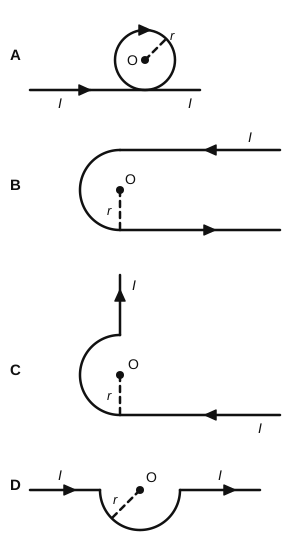
Concept. Add the pieces at O with their signs: circle $\dfrac{\mu_0I}{2r}$, semicircle $\dfrac{\mu_0I}{4r}$, infinite wire at distance $r$: $\dfrac{\mu_0I}{2\pi r}$, semi-infinite wire ending at the foot of the perpendicular: $\dfrac{\mu_0I}{4\pi r}$, a wire on a line through O: 0.
Step 1. A (straight wire with a full loop). The loop circulates against the straight wire's field: $\dfrac{\mu_0I}{2r}-\dfrac{\mu_0I}{2\pi r}=\dfrac{\mu_0I}{2\pi r}[\pi-1]$, which is III.
Step 2. B (hairpin). Two semi-infinite wires and a semicircle, all the same way: $\dfrac{\mu_0I}{4\pi r}\cdot2+\dfrac{\mu_0I}{4r}=\dfrac{\mu_0I}{4\pi r}[\pi+2]$, which is I.
Step 3. C. One semi-infinite wire ending below O, a semicircle, and a wire on a line through O: $\dfrac{\mu_0I}{4\pi r}[\pi+1]$, which is IV.
Step 4. D (semicircular dip). The straight parts lie on the line through O: only the semicircle, $\dfrac{\mu_0I}{4r}$, which is II.
Answer. A-III, B-I, C-IV, D-II (Option C).
Solution by Sreeraj P, M.Sc Physics
Q 12-04-118JEE MainJEE Main 2023 (25 Jan, Shift 2)Medium
For a moving coil galvanometer, the deflection in the coil is $0.05$ rad when a current of $10\ \text{mA}$ is passed through it. If the torsional constant of suspension wire is $4.0\times10^{-5}\ \text{N m rad}^{-1}$, the magnetic field is $0.01\ \text{T}$ and the number of turns in the coil is $200$, the area of each turn (in $\text{cm}^2$) is
Q 12-04-119JEE MainJEE Main 2023 (25 Jan, Shift 2)Medium
Two long parallel wires carrying currents $8\ \text{A}$ and $15\ \text{A}$ in opposite directions are placed at a distance of $7\ \text{cm}$ from each other. A point $P$ is at equidistant from both the wires such that the lines joining the point $P$ to the wires are perpendicular to each other. The magnitude of magnetic field at $P$ is ______ $\times10^{-6}\ \text{T}$. (Given $\sqrt2=1.4$)
Step 3. Statements. B and E are true; A, C and D are false.
Answer. B and E only (Option C).
Solution by Sreeraj P, M.Sc Physics
Q 12-04-121JEE MainJEE Main 2023 (13 Apr, Shift 2)Easy
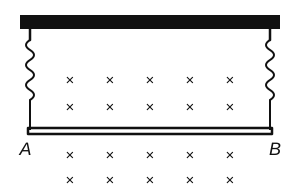
A straight wire AB of mass $40\ \text{g}$ and length $50\ \text{cm}$ is suspended by a pair of flexible leads in uniform magnetic field of magnitude $0.40\ \text{T}$ as shown in the figure. The magnitude of the current required in the wire to remove the tension in the supporting leads is ______ A. (Take $g=10\ \text{m s}^{-2}$)
Concept. The tension in the leads is removed when the magnetic force on AB is upward and equal to the weight: $BIL=mg$.
Step 1. Solve. $I=\dfrac{mg}{BL}=\dfrac{0.04\times10}{0.40\times0.50}=2$ A (flowing so that $I\vec L\times\vec B$ points up).
Answer. $2$.
Solution by Sreeraj P, M.Sc Physics
Q 12-04-122JEE MainJEE Main 2023 (15 Apr, Shift 1)Medium
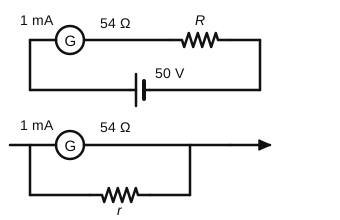
For designing a voltmeter of range $50\ \text{V}$ and an ammeter of range $10\ \text{mA}$ using a galvanometer which has a coil of resistance $54\ \Omega$ showing a full scale deflection for $1\ \text{mA}$ as in figure.
(A) for voltmeter $R\approx50\ \text{k}\Omega$
(B) for ammeter $r\approx0.2\ \Omega$
(C) for ammeter $r\approx6\ \Omega$
(D) for voltmeter $R\approx5\ \text{k}\Omega$
(E) for voltmeter $R\approx500\ \Omega$
Choose the correct answer from the options given below:
Q 12-04-123JEE MainJEE Main 2023 (15 Apr, Shift 1)Medium
An electron in a hydrogen atom revolves around its nucleus with a speed of $6.76\times10^6\ \text{m s}^{-1}$ in an orbit of radius $0.52\ \text{Å}$. The magnetic field produced at the nucleus of the hydrogen atom is ______ T.
Concept. The orbiting electron is a current loop: $I=\dfrac{ev}{2\pi r}$, and $B=\dfrac{\mu_0I}{2r}=\dfrac{\mu_0ev}{4\pi r^2}$.
Step 1. Value. $10^{-7}\times\dfrac{1.6\times10^{-19}\times6.76\times10^6}{(0.52\times10^{-10})^2}=\dfrac{1.08\times10^{-19}}{2.70\times10^{-21}}=40$ T.
Answer. $40$.
Solution by Sreeraj P, M.Sc Physics
Q 12-04-124JEE MainJEE Main 2023 (10 Apr, Shift 2)Easy
A straight wire carrying a current of $14\ \text{A}$ is bent into a semicircular arc of radius $2.2\ \text{cm}$ as shown in the figure. The magnetic field produced by the current at the centre $O$ of the arc is ______ $\times10^{-4}\ \text{T}$.
Concept. The straight parts lie on the line through O, so they give no field there. Only the semicircle counts: $B=\dfrac{\mu_0I}{4R}$.
Step 1. Value. $B=\dfrac{4\pi\times10^{-7}\times14}{4\times0.022}=\dfrac{\pi\times14\times10^{-7}}{0.022}=2.0\times10^{-4}$ T.
Answer. $2$.
Solution by Sreeraj P, M.Sc Physics
Q 12-04-125JEE MainJEE Main 2023 (11 Apr, Shift 1)Medium
The current sensitivity of moving coil galvanometer is increased by $25\%$. This increase is achieved only by changing in the number of turns of coils and area of cross section of the wire while keeping the resistance of galvanometer coil constant. The percentage change in the voltage sensitivity will be
On the axis the field is along the axis, parallel to the velocity, so $\vec F=q\vec v\times\vec B=0$. The electron keeps moving along the axis with the same velocity: B and C.
Solution by Sreeraj P, M.Sc Physics
Q 12-04-127JEE MainJEE Main 2023 (13 Apr, Shift 1)Medium
When a resistance of $5\ \Omega$ is shunted with a moving coil galvanometer, it shows a full scale deflection for a current of $250\ \text{mA}$, however when $1050\ \Omega$ resistance is connected with it in series, it gives full scale deflection for $25$ volt. The resistance of galvanometer is ______ $\Omega$.
Q 12-04-128JEE MainJEE Main 2023 (6 Apr, Shift 1)Easy
A long straight wire of circular cross-section (radius $a$) is carrying steady current $I$. The current $I$ is uniformly distributed across this cross-section. The magnetic field is
Answer: (B) directly proportional to $r$ in the region $r<a$ and inversely proportional to $r$ in the region $r>a$
Ampère's law: inside, the enclosed current is $I\dfrac{r^2}{a^2}$, giving $B=\dfrac{\mu_0Ir}{2\pi a^2}\propto r$. Outside, $B=\dfrac{\mu_0I}{2\pi r}\propto\dfrac1r$.
Solution by Sreeraj P, M.Sc Physics
Q 12-04-129JEE MainJEE Main 2023 (6 Apr, Shift 1)Medium
Two identical circular wires of radius $20\ \text{cm}$ and carrying current $\sqrt2$ A are placed in perpendicular planes as shown in figure. The net magnetic field at the centre of the circular wires is ______ $\times10^{-8}$ T. (Take $\pi=3.14$)
Each loop gives $B=\dfrac{\mu_0I}{2r}=\dfrac{4\pi\times10^{-7}\times\sqrt2}{0.4}=\sqrt2\pi\times10^{-6}\ \text{T}$ at the centre, and the two fields are perpendicular. $$B_{net}=\sqrt2\times\sqrt2\pi\times10^{-6}=2\pi\times10^{-6}=6.28\times10^{-6}\ \text{T}=628\times10^{-8}\ \text{T}$$
Solution by Sreeraj P, M.Sc Physics
Q 12-04-130JEE MainJEE Main 2023 (6 Apr, Shift 2)Medium
A student is provided with a variable voltage source $V$, a test resistor $R_T=10\ \Omega$, two identical galvanometers $G_1$ and $G_2$ and two additional resistors, $R_1=10\ \text{M}\Omega$ and $R_2=0.001\ \Omega$. For conducting an experiment to verify Ohm's law, the most suitable circuit is
Concept. To verify Ohm's law we need an ammeter in series with $R_T$ and a voltmeter across it. A galvanometer with a tiny shunt is an ammeter; one with a huge series resistance is a voltmeter.
Step 1. Voltmeter. $G_1$ in series with $R_1=10$ M$\Omega$, connected across $R_T$.
Step 2. Ammeter. $G_2$ with $R_2=0.001\ \Omega$ in parallel, placed in series with $R_T$.
Step 3. Pick. Circuit (A) has exactly this; the others use the $10$ M$\Omega$ resistor as a shunt or the $0.001\ \Omega$ resistor in series, which spoils one meter or the other.
Answer. Option A.
Solution by Sreeraj P, M.Sc Physics
Q 12-04-131JEE MainJEE Main 2023 (6 Apr, Shift 2)Medium
A proton with a kinetic energy of $2.0\ \text{eV}$ moves into a region of uniform magnetic field of magnitude $\dfrac\pi2\times10^{-3}\ \text{T}$. The angle between the direction of magnetic field and velocity of proton is $60^\circ$. The pitch of the helical path taken by the proton is ______ cm. (Take mass of proton $=1.6\times10^{-27}$ kg and charge on proton $=1.6\times10^{-19}$ C)
Concept. Split the velocity: the perpendicular part gives a circle with period $T=\dfrac{2\pi m}{qB}$; the parallel part carries the particle forward. Pitch $=v_\parallel T$.
Concept. A metallic core moving in the magnet's field has eddy currents induced in it. By Lenz's law they oppose the motion, so they damp the swing of the coil.
Step 1. Effect. The coil comes to rest quickly at its deflection (dead-beat galvanometer). The core does not add torque or make the field radial (the soft-iron core and curved poles do that).
Answer. Option B.
Solution by Sreeraj P, M.Sc Physics
Q 12-04-133JEE MainJEE Main 2023 (8 Apr, Shift 1)Easy
A charged particle moving in magnetic field $B$ has the components of velocity along $B$ as well as perpendicular to $B$. The path of the charged particle will be
Answer: (B) helical path with the axis along magnetic field B
Concept. Split $\vec v$: the part along $\vec B$ feels no force and stays constant; the perpendicular part goes round a circle.
Step 1. Combine. Uniform motion along $\vec B$ plus circular motion in the perpendicular plane is a helix whose axis is along $\vec B$.
Answer. Option B.
Solution by Sreeraj P, M.Sc Physics
Q 12-04-134JEE MainJEE Main 2023 (8 Apr, Shift 2)Easy
The ratio of magnetic field at the centre of a current carrying coil of radius $r$ to the magnetic field at distance $r$ from the centre of coil on its axis is $\sqrt x:1$. The value of $x$ is ______.
$\dfrac{B_c}{B_{axis}}=\dfrac{(r^2+r^2)^{3/2}}{r^3}=2\sqrt2=\sqrt8$, so $x=8$.
Solution by Sreeraj P, M.Sc Physics
Q 12-04-135JEE MainJEE Main 2023 (10 Apr, Shift 1)Easy
Given below are two statements:
Statement I: If the number of turns in the coil of a moving coil galvanometer is doubled then the current sensitivity becomes double.
Statement II: Increasing current sensitivity of a moving coil galvanometer by only increasing the number of turns in the coil will also increase its voltage sensitivity in the same ratio.
In the light of the above statements, choose the correct answer from the options given below.
Concept. Semicircle: $\dfrac{\mu_0i}{4r}$. Semi-infinite wire ending at the foot of the perpendicular: $\dfrac{\mu_0i}{4\pi r}$. A wire along a line through P: zero.
Step 1. Top wire. Comes from the right along the line $r$ above P and ends directly above P. Current to the left with P below: out of the page, $\dfrac{\mu_0i}{4\pi r}$.
Step 2. Semicircle. From the top round the left to the bottom: anticlockwise, out of the page, $\dfrac{\mu_0i}{4r}$.
Step 3. Bottom wire. Runs straight down along the line through P: zero.
Q 12-04-137JEE MainJEE Main 2023 (1 Feb, Shift 1)Medium
A charged particle of $2\ \mu\text{C}$ accelerated by a potential difference of $100$ V enters a region of uniform magnetic field of magnitude $4$ mT at right angle to the direction of field. The charged particle completes a semicircle of radius $3$ cm inside the magnetic field. The mass of the charged particle is ______ $\times10^{-18}$ kg.
Step 1. Substitute. $m=\dfrac{2\times10^{-6}\times9\times10^{-4}\times16\times10^{-6}}{200}=1.44\times10^{-16}$ kg.
Answer. $144$.
Solution by Sreeraj P, M.Sc Physics
Q 12-04-138JEE MainJEE Main 2023 (1 Feb, Shift 2)Easy
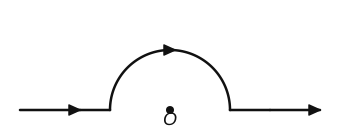
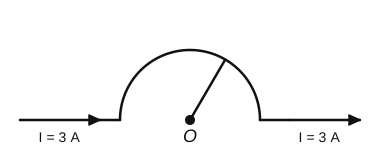
As shown in the figure, a long straight conductor with semicircular arc of radius $\dfrac{\pi}{10}$ m is carrying current $I=3$ A. The magnitude of the magnetic field at the center $O$ of the arc is (The permeability of the vacuum $=4\pi\times10^{-7}\ \text{N A}^{-2}$)
The straight parts lie along the line through $O$ and give no field. The semicircle gives $$B=\frac{\mu_0I}{4r}=\frac{4\pi\times10^{-7}\times3}{4\times\pi/10}=3\times10^{-6}\ \text{T}=3\ \mu\text{T}$$
Solution by Sreeraj P, M.Sc Physics
Q 12-04-139JEE MainJEE Main 2022 (24 Jun, Shift 1)Easy
Given below are two statements: One is labelled as Assertion (A) and the other is labelled as Reason (R).
Assertion (A): In a uniform magnetic field, speed and energy remain the same for a moving charged particle.
Reason (R): A moving charged particle experiences magnetic force perpendicular to its direction of motion.
Answer: (A) Both Assertion and Reason are true and Reason is the correct explanation of Assertion.
Concept. The magnetic force $q\vec v\times\vec B$ is always perpendicular to $\vec v$.
Step 1. Reason. True by the cross product.
Step 2. Assertion. A force perpendicular to the velocity does no work, so the kinetic energy and speed stay the same: true, and it follows from the reason.
Answer. Option A.
Solution by Sreeraj P, M.Sc Physics
Q 12-04-140JEE MainJEE Main 2022 (24 Jun, Shift 1)Easy
The magnetic field at the centre of a circular coil of radius $r$, due to current $I$ flowing through it, is $B$. The magnetic field at a point along the axis at a distance $\dfrac r2$ from the centre is:
$B = \dfrac{\mu_0 I}{2r}$ and on the axis $B_x = \dfrac{\mu_0 I r^2}{2(r^2+x^2)^{3/2}}$, so $$\frac{B_x}{B} = \frac{r^3}{(r^2+x^2)^{3/2}} = \frac{r^3}{\left(\frac54 r^2\right)^{3/2}} = \left(\frac{2}{\sqrt5}\right)^3$$
Solution by Sreeraj P, M.Sc Physics
Q 12-04-141JEE MainJEE Main 2022 (24 Jun, Shift 2)Medium
A proton, a deuteron and an $\alpha$-particle with same kinetic energy enter into a uniform magnetic field at right angle to magnetic field. The ratio of the radii of their respective circular paths is:
Q 12-04-142JEE MainJEE Main 2022 (25 Jun, Shift 1)Medium
A teacher in his physics laboratory allotted an experiment to determine the resistance $G$ of a galvanometer. Students took the observations for $\dfrac13$ deflection in the galvanometer. Which of the below is true for measuring value of $G$?
Answer: (B) $\dfrac13$ deflection method can be used and in this case the $G$ equals twice the value of shunt resistance $(S)$.
Concept. In this method a very high series resistance keeps the circuit current $I$ almost fixed when the shunt $S$ is added. The galvanometer then takes $I\dfrac{S}{S+G}$.
Step 2. Verdict. The method works (like half deflection, where $G=S$).
Answer. Option B.
Solution by Sreeraj P, M.Sc Physics
Q 12-04-143JEE MainJEE Main 2022 (25 Jun, Shift 1)Easy
A long straight wire with a circular cross-section having radius $R$ is carrying a steady current $I$. The current $I$ is uniformly distributed across this cross-section. Then the variation of magnetic field due to current $I$ with distance $r$ $(r < R)$ from its centre will be
By Ampère's law inside the wire: $B\cdot2\pi r = \mu_0 I\dfrac{r^2}{R^2}\Rightarrow B = \dfrac{\mu_0 I r}{2\pi R^2}\propto r$.
Solution by Sreeraj P, M.Sc Physics
Q 12-04-144JEE MainJEE Main 2022 (25 Jun, Shift 2)Medium
If $n$ represents the actual number of deflections in a converted galvanometer of resistance $G$ and shunt resistance $S$, then the total current $I$ when its figure of merit is $K$ will be
Concept. Figure of merit $K$ is the current per division, so $n$ divisions mean $I_g=nK$ through the galvanometer. With a shunt, $I_gG=(I-I_g)S$.
Step 1. Total current. $I=I_g\dfrac{G+S}{S}=\dfrac{nK(G+S)}{S}$.
Answer. Option D.
Solution by Sreeraj P, M.Sc Physics
Q 12-04-145JEE MainJEE Main 2022 (25 Jun, Shift 2)Easy
A long solenoid carrying a current produces a magnetic field $B$ along its axis. If the current is doubled and the number of turns per cm is halved, the new value of magnetic field will be equal to
Concept. Inside a long solenoid $B=\mu_0nI$, with $n$ the turns per unit length.
Step 1. Change. $I\to2I$ and $n\to\dfrac n2$: $\mu_0\dfrac n2(2I)=\mu_0nI$.
Answer. $B$ (Option D).
Solution by Sreeraj P, M.Sc Physics
Q 12-04-146JEE MainJEE Main 2022 (26 Jun, Shift 1)Easy
A proton and an alpha particle of the same velocity enter a uniform magnetic field which is acting perpendicular to their direction of motion. The ratio of the radii of the circular paths described by the alpha particle and proton is
Q 12-04-147JEE MainJEE Main 2022 (26 Jun, Shift 2)Easy
Two $10\ \text{cm}$ long straight wires, each carrying a current of $5\ \text{A}$, are kept parallel to each other. If each wire experienced a force of $10^{-5}\ \text{N}$, then the separation between the wires is ______ cm.
Q 12-04-148JEE MainJEE Main 2022 (25 Jul, Shift 1)Medium
Two charged particles, having the same kinetic energy, are allowed to pass through a uniform magnetic field perpendicular to the direction of motion. If the ratio of radii of their circular paths is $6 : 5$ and their respective masses ratio is $9 : 4$, then the ratio of their charges will be
Concept. For a charge $q$ in a circular orbit, $m=I\pi r^2=\dfrac{qv}{2\pi r}\pi r^2=\dfrac{qvr}{2}$ and $L=m_evr$, so $\vec\mu=\dfrac{q}{2m_e}\vec L$.
Step 1. Electron. $q=-e$, so $\vec\mu_L=-\dfrac{e}{2m}\vec L$: opposite to $\vec L$.
Answer. Option B.
Solution by Sreeraj P, M.Sc Physics
Q 12-04-150JEE MainJEE Main 2022 (25 Jul, Shift 2)Medium
An electron with energy $0.1\ \text{keV}$ moves at right angle to the earth's magnetic field of $1\times10^{-4}\ \text{Wb m}^{-2}$. The frequency of revolution of the electron will be (Take mass of electron $= 9.0\times10^{-31}\ \text{kg}$)
Concept. The frequency of revolution $f=\dfrac{qB}{2\pi m}$ does not depend on the speed, so the energy given is not needed.
Step 1. Value. $f=\dfrac{1.6\times10^{-19}\times10^{-4}}{2\pi\times9\times10^{-31}}=\dfrac{1.6\times10^{-23}}{5.65\times10^{-30}}\approx2.8\times10^6$ Hz.
Answer. Option C.
Solution by Sreeraj P, M.Sc Physics
Q 12-04-151JEE MainJEE Main 2022 (25 Jul, Shift 2)Medium
The electric current in a circular coil of $2$ turns produces a magnetic induction $B_1$ at its centre. The coil is unwound and is rewound into a circular coil of $5$ turns and the same current produces a magnetic induction $B_2$ at its centre. The ratio of $\dfrac{B_2}{B_1}$ is:
Q 12-04-152JEE MainJEE Main 2022 (26 Jul, Shift 1)Easy
A charged particle is moving in a uniform magnetic field $(2\hat i + 3\hat j)\ \text{T}$. If it has an acceleration of $(\alpha\hat i - 4\hat j)\ \text{m s}^{-2}$, then the value of $\alpha$ will be
The magnetic force, and hence the acceleration, is perpendicular to $\vec B$: $$(\alpha\hat i - 4\hat j)\cdot(2\hat i + 3\hat j) = 2\alpha - 12 = 0\ \Rightarrow\ \alpha = 6$$
Solution by Sreeraj P, M.Sc Physics
Q 12-04-153JEE MainJEE Main 2022 (26 Jul, Shift 1)Easy
$B_X$ and $B_Y$ are the magnetic fields at the centres of two coils $X$ and $Y$ respectively, each carrying equal current. If coil $X$ has $200$ turns and $20\ \text{cm}$ radius and coil $Y$ has $400$ turns and $20\ \text{cm}$ radius, the ratio of $B_X$ and $B_Y$ is
Q 12-04-154JEE MainJEE Main 2022 (26 Jul, Shift 2)Medium
Two concentric circular loops of radii $r_1 = 30\ \text{cm}$ and $r_2 = 50\ \text{cm}$ are placed in the $X$–$Y$ plane as shown in the figure. A current $I = 7\ \text{A}$ is flowing through them in the directions as shown in figure. The net magnetic moment of this system of two circular loops is approximately
Concept. Magnetic moment $\vec m=I\vec A$, with $\vec A$ along $+\hat k$ for an anticlockwise current seen from above. The moments of the two loops add as vectors.
Step 3. Net. $I\pi(r_1^2-r_2^2)\hat k=7\times\dfrac{22}{7}(0.09-0.25)\hat k=-3.52\hat k\approx-\dfrac72\hat k$ A m$^2$.
Answer. Option B.
Solution by Sreeraj P, M.Sc Physics
Q 12-04-155JEE MainJEE Main 2022 (26 Jul, Shift 2)Medium
A velocity selector consists of electric field $\vec E = E\hat k$ and magnetic field $\vec B = B\hat j$ with $B = 12\ \text{mT}$. The value of $E$ required for an electron of energy $728\ \text{eV}$ moving along the positive $x$-axis to pass undeflected is (Given, mass of electron $= 9.1\times10^{-31}\ \text{kg}$)
Q 12-04-157JEE MainJEE Main 2022 (27 Jun, Shift 2)Hard
Two long parallel conductors $S_1$ and $S_2$ are separated by a distance $10$ cm and carrying currents of $4$ A and $2$ A respectively. The conductors are placed along $x$-axis in $X$-$Y$ plane. There is a point $P$ located between the conductors (as shown in figure).
A charge particle of $3\pi$ coulomb is passing through the point $P$ with velocity $\vec v = (2\hat i + 3\hat j)\ \text{m s}^{-1}$; where $\hat i$ & $\hat j$ represents unit vector along $x$ & $y$ axis respectively.
The force acting on the charge particle is $4\pi\times10^{-5}(-x\hat i + 2\hat j)$ N. The value of $x$ is
Concept. Find the net field of the two wires at P, then $\vec F=q\vec v\times\vec B$.
Step 1. Distances. P is $4$ cm below $S_1$ and $6$ cm above $S_2$.
Step 2. Fields. $S_1$ (current $+x$, P below): $\hat i\times(-\hat j)=-\hat k$, size $\dfrac{2\times10^{-7}\times4}{0.04}=2\times10^{-5}$ T. $S_2$ (P above): $+\hat k$, size $\dfrac{2\times10^{-7}\times2}{0.06}=\dfrac23\times10^{-5}$ T. Net $\vec B=-\dfrac43\times10^{-5}\hat k$ T.
Step 3. Force. $(2\hat i+3\hat j)\times(-\hat k)=2\hat j-3\hat i$, so $\vec F=3\pi\times\dfrac43\times10^{-5}(-3\hat i+2\hat j)=4\pi\times10^{-5}(-3\hat i+2\hat j)$ N.
Answer. $x=3$ (Option C).
Solution by Sreeraj P, M.Sc Physics
Q 12-04-158JEE MainJEE Main 2022 (27 Jun, Shift 2)Easy
A deuteron and a proton moving with equal kinetic energy enter into to a uniform magnetic field at right angle to the field. If $r_d$ and $r_p$ are the radii of their circular paths respectively, then the ratio $\dfrac{r_d}{r_p}$ will be $\sqrt x : 1$ where $x$ is ______ .
Same charge and kinetic energy, so $r \propto \sqrt m$:
$$\frac{r_d}{r_p} = \sqrt{\frac{2m_p}{m_p}} = \sqrt2 \Rightarrow x = 2$$
Solution by Sreeraj P, M.Sc Physics
Q 12-04-159JEE MainJEE Main 2022 (27 Jul, Shift 2)Medium
A cyclotron is used to accelerate protons. If the operating magnetic field is $1.0$ T and the radius of the cyclotron 'dees' is $60$ cm, the kinetic energy of the accelerated protons in MeV will be :
Current sensitivity $\dfrac{\phi}{I} = \dfrac{NAB}{k}$.
It increases with more turns, larger area, stronger field and a smaller torsional constant. So (B) and (D) only.
Solution by Sreeraj P, M.Sc Physics
Q 12-04-162JEE MainJEE Main 2021 (27 Jul, Shift 2)Medium
Figure $A$ and $B$ show two long straight wires of circular cross-section ($a$ and $b$ with $a < b$), carrying current $I$ which is uniformly distributed across the cross-section. The magnitude of magnetic field $B$ varies with radius $r$ and can be represented as:
Concept. For each wire, $B$ rises linearly inside up to $\dfrac{\mu_0I}{2\pi R}$ at the surface and then falls as $\dfrac{\mu_0I}{2\pi r}$, the same curve for both wires since the current is the same.
Step 1. Peaks. The thinner wire ($a\lt b$) peaks higher, at $\dfrac{\mu_0I}{2\pi a}$, and earlier, at $r=a$.
Step 2. Inside slopes. Slope $\dfrac{\mu_0I}{2\pi R^2}$: steeper for $a$.
Step 3. Outside. For $r\gt b$ both are $\dfrac{\mu_0I}{2\pi r}$: the curves coincide. Between $a$ and $b$ the thin wire's curve is already falling while the thick wire's line is still rising, and the two meet at $r=b$.
Answer. Option C.
Solution by Sreeraj P, M.Sc Physics
Q 12-04-163JEE MainJEE Main 2021 (31 Aug, Shift 1)Easy
Consider a galvanometer shunted with $5\ \Omega$ resistance and $2\%$ of current passes through it. What is the resistance of the given galvanometer?
Galvanometer and shunt are in parallel: $I_gG = (I - I_g)S$.
$$0.02I\times G = 0.98I\times5 \Rightarrow G = 245\ \Omega$$
Solution by Sreeraj P, M.Sc Physics
Q 12-04-164JEE MainJEE Main 2021 (31 Aug, Shift 1)Medium
A coil having $N$ turns is wound tightly in the form of a spiral with inner and outer radii $a$ and $b$ respectively. Find the magnetic field at centre, when a current $I$ passes through coil:
Concept. Treat the spiral as many concentric rings. The $N$ turns are spread evenly from $a$ to $b$, so a ring of width $dr$ holds $\dfrac{N\,dr}{b-a}$ turns, each giving $\dfrac{\mu_0I}{2r}$.
Q 12-04-165JEE MainJEE Main 2021 (31 Aug, Shift 2)Medium
A current of $1.5$ A is flowing through a triangle, of side $9$ cm each. The magnetic field at the centroid of the triangle is: (Assume that the current is flowing in the clockwise direction.)
Total $B = 3\times10^{-5}$ T. A clockwise current gives a field into the plane (inside).
Solution by Sreeraj P, M.Sc Physics
Q 12-04-166JEE MainJEE Main 2021 (25 Feb, Shift 1)Medium
A proton, a deuteron and an $\alpha$ particle are moving with same momentum in a uniform magnetic field. The ratio of magnetic forces acting on them ______ is and their speed is ______ in the ratio.
Q 12-04-167JEE MainJEE Main 2021 (25 Feb, Shift 1)Medium
Magnetic fields at two points on the axis of a circular coil at a distance of 0.05 m and 0.2 m from the centre are in the ratio 8 : 1. The radius of coil is ______.
Step 2. Solve. $R^2+0.04=4R^2+0.01\Rightarrow3R^2=0.03\Rightarrow R=0.1$ m.
Answer. $0.1$ m (Option C).
Solution by Sreeraj P, M.Sc Physics
Q 12-04-168JEE MainJEE Main 2021 (18 Mar, Shift 2)Medium
A proton and an $\alpha$-particle, having kinetic energies $K_p$ and $K_\alpha$, respectively, enter into a magnetic field at right angles. The ratio of the radii of the trajectory of proton to that of $\alpha$-particle is 2 : 1. The ratio of $K_p : K_\alpha$ is:
Q 12-04-169JEE MainJEE Main 2021 (20 Jul, Shift 1)Easy
A deuteron and an alpha particle having equal kinetic energy enter perpendicular into a magnetic field. Let $r_d$ and $r_\alpha$ be their respective radii of circular path. The value of $\dfrac{r_d}{r_\alpha}$ is equal to:
Q 12-04-170JEE MainJEE Main 2021 (25 Jul, Shift 2)Easy
Two ions having same mass have charges in the ratio $1 : 2$. They are projected normally in a uniform magnetic field with their speeds in the ratio $2 : 3$. The ratio of the radii of their circular trajectories is,
$r = \dfrac{mv}{qB}$, so with equal masses $$\frac{r_1}{r_2} = \frac{v_1}{v_2}\cdot\frac{q_2}{q_1} = \frac{2}{3}\times\frac{2}{1} = \frac{4}{3}$$
Solution by Sreeraj P, M.Sc Physics
Q 12-04-171JEE MainJEE Main 2021 (26 Aug, Shift 1)Medium
The fractional change in the magnetic field intensity at a distance $r$ from centre on the axis of current carrying coil of radius $a$ to the magnetic field intensity at the centre of the same coil is: (Take $r < a$)
Q 12-04-172JEE MainJEE Main 2021 (26 Aug, Shift 2)Hard
If the maximum value of accelerating potential provided by a radio frequency oscillator is $12$ kV. The number of revolution made by a proton in a cyclotron to achieve one sixth of the speed of light is: [$m_p = 1.67\times10^{-27}$ kg, $e = 1.6\times10^{-19}$ C, Speed of light $= 3\times10^8$ m s$^{-1}$]
Final speed $v = \dfrac{c}{6} = 5\times10^7$ m s$^{-1}$.
$K = \frac{1}{2}m_pv^2 = \frac{1}{2}\times1.67\times10^{-27}\times2.5\times10^{15} = 2.09\times10^{-12}$ J.
Energy gained per revolution (two gap crossings) $= 2eV = 2\times1.6\times10^{-19}\times12000 = 3.84\times10^{-15}$ J. $$n = \frac{2.09\times10^{-12}}{3.84\times10^{-15}} \approx 543$$
Solution by Sreeraj P, M.Sc Physics
Q 12-04-173JEE MainJEE Main 2021 (26 Aug, Shift 2)Easy
A coil in the shape of an equilateral triangle of side $10$ cm lies in a vertical plane between the pole pieces of permanent magnet producing a horizontal magnetic field $20$ mT. The torque acting on the coil when a current of $0.2$ A is passed through it and its plane becomes parallel to the magnetic field will be $\sqrt{x}\times10^{-5}$ N m. The value of $x$ is
Area $= \dfrac{\sqrt{3}}{4}(0.1)^2 = \dfrac{\sqrt{3}}{4}\times10^{-2}$ m$^2$.
With the plane parallel to $B$, the magnetic moment is perpendicular to $B$: $$\tau = IAB = 0.2\times\frac{\sqrt{3}}{4}\times10^{-2}\times20\times10^{-3} = \sqrt{3}\times10^{-5}\ \text{N m}$$ So $x = 3$.
Solution by Sreeraj P, M.Sc Physics
Q 12-04-174JEE MainJEE Main 2021 (27 Aug, Shift 1)Easy
Two ions of masses $4$ amu and $16$ amu have charges $+2e$ and $+3e$ respectively. These ions pass through the region of the constant perpendicular magnetic field. The kinetic energy of both ions is the same. Then:
The lighter ion moves on the smaller circle, so it is deflected more.
Solution by Sreeraj P, M.Sc Physics
Q 12-04-175JEE MainJEE Main 2021 (27 Aug, Shift 1)Medium
A uniform conducting wire of length is $24a$, and resistance $R$ is wound up as a current carrying coil in the shape of an equilateral triangle of side $a$ and then in the form of a square of side $a$. The coil is connected to a voltage source $V_0$. The ratio of magnetic moment of the coils in case of equilateral triangle to that for square is $1 : \sqrt{y}$ where $y$ is ______.
Concept. The same wire and the same source give the same current $I=\dfrac{V_0}{R}$ in both shapes. Only the number of turns and the area of a turn change: $m=NIA$.
Q 12-04-176JEE MainJEE Main 2021 (27 Aug, Shift 2)Easy
For full scale deflection of total $50$ divisions, $50$ mV voltage is required in galvanometer. The resistance of galvanometer if its current sensitivity is $2$ div/mA will be:
Q 12-04-177JEE MainJEE Main 2021 (27 Aug, Shift 2)Medium
A coaxial cable consists of an inner wire of radius $a$ surrounded by an outer shell of inner and outer radii $b$ and $c$ respectively. The inner wire carries an electric current $i_0$ which is distributed uniformly across cross-sectional area. The outer shell carries an equal current in opposite direction and distributed uniformly. What will be the ratio of the magnetic field at a distance $x$ from the axis when (i) $x < a$ and (ii) $a < x < b$?
Concept. Ampere's law with a circle of radius $x$. Inside the inner wire it encloses $i_0\dfrac{x^2}{a^2}$; between the conductors it encloses all of $i_0$.
Q 12-04-178JEE MainJEE Main 2020 (8 Jan, Shift 2)Easy
A galvanometer having a coil resistance $100\ \Omega$ gives a full scale deflection when a current of $1$ mA is passed through it. What is the value of the resistance which can convert this galvanometer into a voltmeter giving full scale deflection for a potential difference of $10$ V?
A series resistance $R$ is needed so that $I_g(G + R) = V$: $$R = \frac{V}{I_g} - G = \frac{10}{10^{-3}} - 100 = 9900\ \Omega = 9.9\ \text{k}\Omega$$
Solution by Sreeraj P, M.Sc Physics
Q 12-04-179JEE MainJEE Main 2020 (8 Jan, Shift 2)Hard
A very long wire ABDMNDC is shown in figure carrying current $I$. AB and BC parts are straight, long and at right angle. At D the wire forms a circular turn DMND of radius $R$. AB, BC parts are tangential to the circular turn at N and D. Magnetic field at the centre of the circle is:
Concept. Add the full circle and the two straight wires, each at distance $R$ from the centre, using the finite-wire formula with the right angles. N is on AB extended beyond B, so AB stops $R$ short of the foot of its perpendicular.
Step 1. Loop. $\dfrac{\mu_0I}{2R}$, anticlockwise: out of the page.
Step 2. BC. The foot of its perpendicular is D, and B is $R$ to the left of D: the wire runs from $45^\circ$ on one side to $90^\circ$ on the other, $\dfrac{\mu_0I}{4\pi R}\left(1+\dfrac1{\sqrt2}\right)$. Current to the right below the centre: out of the page.
Step 3. AB. Runs from $-\infty$ up to B, which is $R$ below N: $\dfrac{\mu_0I}{4\pi R}\left(1-\dfrac1{\sqrt2}\right)$. Current up, to the left of the centre: into the page.
Step 4. Straight parts together. $\dfrac{\mu_0I}{4\pi R}\left[\left(1+\dfrac1{\sqrt2}\right)-\left(1-\dfrac1{\sqrt2}\right)\right]=\dfrac{\mu_0I}{2\pi R}\cdot\dfrac1{\sqrt2}$, out of the page.
Q 12-04-180JEE MainJEE Main 2020 (9 Jan, Shift 1)Easy
A long, straight wire of radius $a$ carries a current distributed uniformly over its cross-section. The ratio of the magnetic fields due to the wire at distance $\dfrac{a}{3}$ and $2a$, respectively from the axis of the wire is:
Inside: $B = \dfrac{\mu_0 I r}{2\pi a^2}$, so at $r = a/3$, $B_1 = \dfrac{\mu_0 I}{6\pi a}$.
Outside: $B = \dfrac{\mu_0 I}{2\pi r}$, so at $r = 2a$, $B_2 = \dfrac{\mu_0 I}{4\pi a}$.
$$\frac{B_1}{B_2} = \frac{4}{6} = \frac{2}{3}$$
Solution by Sreeraj P, M.Sc Physics
Q 12-04-181JEE MainJEE Main 2020 (9 Jan, Shift 2)Medium
A small circular loop of conducting wire has radius $a$ and carries current $I$. It is placed in a uniform magnetic field $B$ perpendicular to its plane such that when rotated slightly about its diameter and released, it starts performing simple harmonic motion of time period $T$. The mass of the loop is $m$ then:
Concept. Turned by a small angle $\theta$ about a diameter, the loop feels a restoring torque $mB\sin\theta\approx mB\theta$ with $m=I\pi a^2$. Its moment of inertia about a diameter is $\dfrac12Ma^2$ (mass $M=m$ in the question).
Q 12-04-183JEE MainJEE Main 2020 (5 Sep, Shift 2)Easy
A galvanometer is used in the laboratory for detecting the null point in electrical experiments. If, on passing a current of $6$ mA, it produces a deflection of $2^\circ$, its figure of merit is close to:
The figure of merit is the current needed for unit deflection: $$G = \frac{I}{\theta} = \frac{6\times10^{-3}}{2} = 3\times10^{-3}\ \text{A/div}$$
Solution by Sreeraj P, M.Sc Physics
Q 12-04-184JEE MainJEE Main 2020 (6 Sep, Shift 1)Medium
A particle of charge $q$ and mass $m$ is moving with a velocity $-v\hat i\ (v \neq 0)$ towards a large screen placed in the $Y$-$Z$ plane at a distance $d$. If there is a magnetic field $\vec B = B_0\hat k$, the maximum value of $v$ for which the particle will not hit the screen is:
Concept. In the field $\vec B=B_0\hat k$ the particle moves on a circle of radius $r=\dfrac{mv}{qB_0}$. Its velocity points straight at the screen, so the circle's centre is level with the start point and the particle gets at most a distance $r$ closer to the screen before turning back.
Step 1. Condition. It misses the screen if $r\le d$: $\dfrac{mv}{qB_0}\le d$.
Step 2. Maximum speed. $v_{\max}=\dfrac{qdB_0}{m}$.
Answer. Option C.
Solution by Sreeraj P, M.Sc Physics
Q 12-04-185JEE MainJEE Main 2020 (6 Sep, Shift 1)Medium
An electron is moving along the $+x$ direction with a velocity of $6\times10^6\ \text{m s}^{-1}$. It enters a region of uniform electric field of $300$ V/cm pointing along the $+y$ direction. The magnitude and direction of the magnetic field set up in this region such that the electron keeps moving along the $x$ direction will be:
Answer: (C) $5\times10^{-3}$ T, along $+z$ direction
The electric force on the electron is along $-y$, so the magnetic force $-e(\vec v\times\vec B)$ must be along $+y$, i.e. $\vec v\times\vec B$ must be along $-y$. Since $\hat i\times\hat k = -\hat j$, $\vec B$ is along $+z$.
Magnitude: $eE = evB \Rightarrow B = \dfrac Ev = \dfrac{3\times10^4}{6\times10^6} = 5\times10^{-3}$ T.
Solution by Sreeraj P, M.Sc Physics
Q 12-04-186JEE MainJEE Main 2020 (6 Sep, Shift 2)Medium
A charged particle going around in a circle can be considered to be a current loop. A particle of mass $m$ carrying charge $q$ is moving in a plane with speed $v$ under the influence of a magnetic field $\vec B$. The magnetic moment of this moving particle is:
Concept. The circling particle is a current loop with $\mu=\dfrac{qvr}{2}$, and $r=\dfrac{mv}{qB}$.
Step 1. Size. $\mu=\dfrac{qv}{2}\cdot\dfrac{mv}{qB}=\dfrac{mv^2}{2B}$, whatever the charge.
Step 2. Direction. A positive charge circles clockwise seen from the tip of $\vec B$, so its moment is opposite to $\vec B$; a negative charge circles the other way but its current is again clockwise. The moment always opposes $\vec B$ (diamagnetic).
Q 12-04-187JEE MainJEE Main 2020 (6 Sep, Shift 2)Hard
A square loop of side $2a$ and carrying current $I$ is kept in the $xz$ plane with its centre at the origin. A long wire carrying the same current $I$ is placed parallel to the $z$-axis and passes through the point $(0, b, 0)$, $(b \gg a)$. The magnitude of the torque on the loop about the $z$-axis will be:
Concept. Only the two sides parallel to the wire (at $x=\pm a$, length $2a$) get forces with a moment about the $z$-axis. Each is at distance $\sqrt{a^2+b^2}$ from the wire and carries $I$ in opposite directions, so the forces are equal and opposite along the lines to the wire: a couple.
Step 1. Force on one side. $F=\dfrac{\mu_0I\cdot I\cdot2a}{2\pi\sqrt{a^2+b^2}}$.
Step 2. Moment arm. The force on the side at $(a,0)$ is along the line to $(0,b)$; its moment about the $z$-axis is $aF\dfrac{b}{\sqrt{a^2+b^2}}$. The other side gives the same, in the same sense.
Step 3. Torque. $\tau=2\cdot\dfrac{ab}{\sqrt{a^2+b^2}}\cdot\dfrac{\mu_0I^2a}{\pi\sqrt{a^2+b^2}}=\dfrac{2\mu_0I^2a^2b}{\pi(a^2+b^2)}$ (which is $\approx\dfrac{2\mu_0I^2a^2}{\pi b}$ for $b\gg a$).
Answer. Option B.
Solution by Sreeraj P, M.Sc Physics
Q 12-04-188JEE MainJEE Main 2020 (7 Jan, Shift 2)Medium
A particle of mass $m$ and charge $q$ has an initial velocity $\vec v = v_0\hat j$. If an electric field $\vec E = E_0\hat i$ and magnetic field $\vec B = B_0\hat i$ act on the particle, its speed will double after a time:
Concept. $\vec B$ is along $x$, so it acts only on the velocity components in the $y$–$z$ plane, turning them in a circle without changing their size ($v_0$). $\vec E$ along $x$ speeds the particle up along $x$: $v_x=\dfrac{qE_0}{m}t$.
Q 12-04-189JEE MainJEE Main 2020 (8 Jan, Shift 1)Medium
A proton with kinetic energy of $1$ MeV moves from south to north. It gets an acceleration of $10^{12}\ \text{m/s}^2$ by an applied magnetic field (west to east). The value of the magnetic field is: (Rest mass of proton is $1.6\times10^{-27}$ kg)
Concept. $\vec v\perp\vec B$ (south–north velocity, west–east field), so the magnetic force gives $a=\dfrac{qvB}{m}$. Find $v$ from the kinetic energy.
Step 2. Field. $B=\dfrac{ma}{qv}=\dfrac{1.6\times10^{-27}\times10^{12}}{1.6\times10^{-19}\times1.414\times10^7}=7.1\times10^{-4}$ T.
Answer. $0.71$ mT (Option A).
Solution by Sreeraj P, M.Sc Physics
Q 12-04-190JEE MainJEE Main 2020 (2 Sep, Shift 1)Medium
A beam of protons with speed $4 \times 10^{5}\ \text{m s}^{-1}$ enters a uniform magnetic field of $0.3\ \text{T}$ at an angle $60^\circ$ to the magnetic field. The pitch of the resulting helical path of protons is close to: (Mass of the proton $= 1.67 \times 10^{-27}\ \text{kg}$, charge of the proton $= 1.69 \times 10^{-19}\ \text{C}$)
Q 12-04-191JEE MainJEE Main 2020 (2 Sep, Shift 2)Medium
A region of length $l$ contains a uniform magnetic field of $0.3\ \text{T}$ directed along its length. A proton enters the region with velocity $4 \times 10^{5}\ \text{m s}^{-1}$ making an angle $60^\circ$ with the field. If the proton completes $10$ revolutions by the time it crosses the region, $l$ is close to (mass of proton $= 1.67 \times 10^{-27}\ \text{kg}$, charge of the proton $= 1.6 \times 10^{-19}\ \text{C}$)
The proton moves on a helix whose axis is along $B$. Pitch: $$p = v\cos60^\circ\cdot\frac{2\pi m}{qB} = \frac{2\pi\times1.67\times10^{-27}\times2\times10^{5}}{1.6\times10^{-19}\times0.3} \approx 0.0437\ \text{m}$$ Ten revolutions: $l = 10p \approx 0.44$ m.
Solution by Sreeraj P, M.Sc Physics
Q 12-04-192JEE MainJEE Main 2020 (2 Sep, Shift 2)Medium
A wire carrying current $I$ is bent in the shape $ABCDEFA$ as shown, where rectangles $ABCDA$ and $ADEFA$ are perpendicular to each other. If the sides of the rectangles are of lengths $a$ and $b$, then the magnitude and direction of magnetic moment of the loop $ABCDEFA$ is:
Answer: (A) $\sqrt2\,abI$ along $\left(\dfrac{\hat j}{\sqrt2} + \dfrac{\hat k}{\sqrt2}\right)$
Concept. Add a pair of opposite currents along AD (this changes nothing). The wire becomes two plane rectangles, ABCDA and ADEFA, each of area $ab$, and the moment is the vector sum of their moments.
Step 1. ABCDA (in the $xy$ plane): the current A→B→C→D runs anticlockwise seen from $+z$: $\vec m_1=abI\,\hat k$.
Step 2. ADEFA (in the $xz$ plane): A→D→E→F runs so that its area vector points along $+y$: $\vec m_2=abI\,\hat j$.
Q 12-04-193JEE MainJEE Main 2020 (3 Sep, Shift 1)Medium
Magnitude of magnetic field (in SI units) at the centre of a hexagonal shape coil of side $10\ \text{cm}$, $50$ turns and carrying current $I$ (Ampere) in units of $\dfrac{\mu_0 I}{\pi}$ is:
Each side subtends $60^\circ$ at the centre and is at distance $d = \dfrac{\sqrt3}{2}a = 0.05\sqrt3$ m from it. Field due to one side: $$B_1 = \frac{\mu_0I}{4\pi d}(\sin30^\circ + \sin30^\circ) = \frac{\mu_0I}{4\pi d}$$ For $6$ sides and $50$ turns: $$B = 300\cdot\frac{\mu_0I}{4\pi\times0.05\sqrt3} = \frac{\mu_0I}{\pi}\cdot\frac{1500}{\sqrt3} = 500\sqrt3\,\frac{\mu_0I}{\pi}$$
Solution by Sreeraj P, M.Sc Physics
Q 12-04-194JEE MainJEE Main 2020 (3 Sep, Shift 1)Easy
A charged particle carrying charge $1\ \mu\text{C}$ is moving with velocity $(2\hat i + 3\hat j + 4\hat k)\ \text{m s}^{-1}$. If an external magnetic field of $(5\hat i + 3\hat j - 6\hat k)\times10^{-3}\ \text{T}$ exists in the region where the particle is moving then the force on the particle is $\vec F\times10^{-9}\ \text{N}$. The vector $\vec F$ is:
$$\vec v\times\vec B = \begin{vmatrix}\hat i & \hat j & \hat k\\ 2 & 3 & 4\\ 5 & 3 & -6\end{vmatrix}\times10^{-3} = (-30\hat i + 32\hat j - 9\hat k)\times10^{-3}$$ $\vec F_{mag} = q\,\vec v\times\vec B = 10^{-6}\times(-30\hat i + 32\hat j - 9\hat k)\times10^{-3} = (-30\hat i + 32\hat j - 9\hat k)\times10^{-9}$ N.
Solution by Sreeraj P, M.Sc Physics
Q 12-04-195JEE MainJEE Main 2020 (3 Sep, Shift 2)Easy
A galvanometer coil has $500$ turns and each turn has an average area of $3\times10^{-4}\ \text{m}^{2}$. If a torque of $1.5\ \text{N m}$ is required to keep this coil parallel to a magnetic field when a current of $0.5\ \text{A}$ is flowing through it, the strength of the field (in T) is ______.
With the plane of the coil parallel to $B$, the magnetic moment is perpendicular to $B$ and the torque is $\tau = NIAB$. $$B = \frac{1.5}{500\times0.5\times3\times10^{-4}} = 20\ \text{T}$$
Solution by Sreeraj P, M.Sc Physics
Q 12-04-196JEE MainJEE Main 2020 (4 Sep, Shift 1)Medium
A wire $A$, bent in the shape of an arc of a circle, carrying a current of $2\ \text{A}$ and having radius $2\ \text{cm}$ and another wire $B$, also bent in the shape of an arc of a circle, carrying a current of $3\ \text{A}$ and having radius of $4\ \text{cm}$, are placed as shown in the figure. The ratio of the magnetic fields due to the wires $A$ and $B$ at the common centre $O$ is:
Q 12-04-197JEE MainJEE Main 2020 (5 Sep, Shift 1)Medium
A galvanometer of resistance $G$ is converted into a voltmeter of range $0 - 1\ \text{V}$ by connecting a resistance $R_1$ in series with it. The additional resistance that should be connected in series with $R_1$ to increase the range of the voltmeter to $0 - 2\ \text{V}$ will be:
Concept. The full-scale current $I_g$ is fixed. For range $V$ the total resistance must be $\dfrac{V}{I_g}$.
Step 1. 1 V range. $G+R_1=\dfrac{1}{I_g}$.
Step 2. 2 V range. Total $\dfrac2{I_g}=2(G+R_1)$, so the extra resistance is $R_1+G$.
Answer. Option D.
Solution by Sreeraj P, M.Sc Physics
Q 12-04-198JEE MainJEE Main 2020 (5 Sep, Shift 1)Medium
A square loop of side $2a$, and carrying current $I$ is kept in $XZ$ plane with its centre at origin. A long wire carrying the same current $I$ is placed parallel to the $z$-axis and passing through the point $(0, b, 0)$, $(b \gg a)$. The magnitude of the torque on the loop about $z$-axis is given by
Since $b \gg a$, the wire's field over the loop is nearly uniform: $B = \dfrac{\mu_0I}{2\pi b}$, along the $x$-axis at the loop.
The loop's magnetic moment $m = I(2a)^{2} = 4Ia^{2}$ is along $y$ (normal to the $XZ$ plane), perpendicular to $B$. The torque $\vec m\times\vec B$ is along $z$: $$\tau = 4Ia^{2}\cdot\frac{\mu_0I}{2\pi b} = \frac{2\mu_0I^{2}a^{2}}{\pi b}$$
Solution by Sreeraj P, M.Sc Physics
Q 12-04-199JEE MainJEE Main 2019 (9 Jan, Shift 2)Easy
A particle having the same charge as of electron moves in a circular path of radius $0.5\ \text{cm}$ under the influence of a magnetic field of $0.5\ \text{T}$. If an electric field of $100\ \text{V/m}$ makes it to move in a straight path, then the mass of the particle is (Given charge of electron $= 1.6\times10^{-19}\ \text{C}$)
In the magnetic field alone, $r = \dfrac{mv}{qB}$: $$m = \frac{qBr}{v} = \frac{1.6\times10^{-19}\times0.5\times0.005}{200} = 2.0\times10^{-24}\ \text{kg}$$
Solution by Sreeraj P, M.Sc Physics
Q 12-04-200JEE MainJEE Main 2019 (9 Jan, Shift 2)Easy
One of the two identical conducting wires of length $L$ is bent in the form of a circular loop and the other one into a circular coil of $N$ identical turns. If the same current is passed in both, the ratio of the magnetic field at the centre of the loop $(B_L)$ to that at the centre of the coil $(B_C)$, i.e. $\dfrac{B_L}{B_C}$ will be
Q 12-04-201JEE MainJEE Main 2019 (10 Jan, Shift 1)Medium
An insulating thin rod of length $l$ has a linear charge density $\rho(x) = \rho_0\dfrac{x}{l}$ on it. The rod is rotated about an axis passing through the origin $(x = 0)$ and perpendicular to the rod. If the rod makes $n$ rotations per second, then the time averaged magnetic moment of the rod is:
Q 12-04-202JEE MainJEE Main 2019 (10 Apr, Shift 1)Medium
A moving coil galvanometer allows a full scale current of $10^{-4}\ \text{A}$. A series resistance of $2\times10^4\ \Omega$ is required to convert the galvanometer into a voltmeter of range $0$–$5\ \text{V}$. Therefore, the value of shunt resistance required to convert the above galvanometer into an ammeter of range $0$–$10\ \text{mA}$ is:
Q 12-04-203JEE MainJEE Main 2019 (10 Apr, Shift 1)Medium
Two long parallel wires $A$ and $B$, a distance $d$ apart, carry currents $I_1$ and $I_2$ in opposite directions. A third wire $C$ carrying a current $I$ is to be kept parallel to them at a distance $x$ from $A$ such that the net force acting on it is zero. The possible values of $x$ are:
Concept. Opposite currents make fields that add between the wires, so the net field (and the force on C) can be zero only outside, on the side of the smaller current, where $\dfrac{I_1}{x}=\dfrac{I_2}{|x-d|}$.
Step 1. Solve. With $x$ measured from A: $I_1|x-d|=I_2|x|$. Outside the gap this gives $x=\dfrac{I_1d}{I_1-I_2}$.
Step 2. Sign. If $I_1\gt I_2$, $x\gt d$ (beyond B); if $I_2\gt I_1$, $x$ is negative (beyond A). Both are covered by $x=\pm\dfrac{I_1d}{I_1-I_2}$.
Answer. Option A.
Solution by Sreeraj P, M.Sc Physics
Q 12-04-204JEE MainJEE Main 2019 (10 Apr, Shift 1)Medium
A proton, an electron, and a helium nucleus, have the same energy. They are in circular orbits in a plane due to magnetic field perpendicular to the plane. Let $r_p$, $r_e$ and $r_{He}$ be their respective radii, then,
$r = \dfrac{mv}{qB} = \dfrac{\sqrt{2mK}}{qB}$, so at equal $K$, $r \propto \dfrac{\sqrt m}{q}$.
Proton: $\dfrac{\sqrt m}{e}$. Helium nucleus: $\dfrac{\sqrt{4m}}{2e} = \dfrac{\sqrt m}{e}$, the same. Electron: much smaller mass, same charge, so a much smaller radius.
$r_e < r_p = r_{He}$.
Solution by Sreeraj P, M.Sc Physics
Q 12-04-205JEE MainJEE Main 2019 (10 Apr, Shift 2)Easy
A square loop is carrying a steady current $I$ and the magnitude of its magnetic dipole moment is $m$. If this square loop is changed to a circular loop and it carries the same current, the magnitude of the magnetic dipole moment of circular loop will be:
Square of side $s$: $m = Is^2$. The same wire as a circle: $2\pi r = 4s$, so $r = \dfrac{2s}{\pi}$ and the area is $\pi r^2 = \dfrac{4s^2}{\pi}$. $$m' = I\cdot\frac{4s^2}{\pi} = \frac{4m}{\pi}$$
Solution by Sreeraj P, M.Sc Physics
Q 12-04-206JEE MainJEE Main 2019 (10 Apr, Shift 2)Medium
The magnitude of the magnetic field at the centre of an equilateral triangular loop of side $1\ \text{m}$ which is carrying a current of $10\ \text{A}$ is: [Take $\mu_0 = 4\pi\times10^{-7}\ \text{N A}^{-2}$]
The centre is at distance $d = \dfrac{l}{2\sqrt3}$ from each side, and each side subtends $60^\circ$ on either side of the perpendicular: $$B_1 = \frac{\mu_0I}{4\pi d}(\sin60^\circ + \sin60^\circ) = \frac{\mu_0I}{4\pi}\cdot\frac{2\sqrt3}{l}\cdot\sqrt3 = \frac{\mu_0I}{4\pi}\cdot\frac6l$$ All three sides add: $$B = \frac{\mu_0I}{4\pi}\cdot\frac{18}{l} = 10^{-7}\times\frac{18\times10}{1} = 18\ \mu\text{T}$$
Solution by Sreeraj P, M.Sc Physics
Q 12-04-207JEE MainJEE Main 2019 (9 Jan, Shift 1)Medium
A current loop, having two circular arcs joined by two radial lines is shown in the figure. It carries a current of $10\ \text{A}$. The magnetic field at point $O$ will be close to
Concept. The radial parts PQ and RS point at O, so they give nothing. The two arcs are traversed in opposite senses round O, so their fields subtract: $B=\dfrac{\mu_0I\theta}{4\pi}\left(\dfrac1{r_1}-\dfrac1{r_2}\right)$.
Step 1. Data. $\theta=45^\circ=\dfrac\pi4$, $r_1=3$ cm, $r_2=3+2=5$ cm.
Step 2. Field. $B=10^{-7}\times10\times\dfrac\pi4\times\left(\dfrac1{0.03}-\dfrac1{0.05}\right)=10^{-6}\times0.785\times13.3\approx1.05\times10^{-5}$ T.
Answer. $1.0\times10^{-5}$ T (Option D).
Solution by Sreeraj P, M.Sc Physics
Q 12-04-208JEE MainJEE Main 2019 (9 Jan, Shift 1)Medium
An infinitely long current carrying wire and a small current carrying loop are in the plane of the paper as shown. The radius of the loop is $a$ and distance of its centre from the wire is $d$ ($d \gg a$). If the loop applies a force $F$ on the wire then
Concept. By Newton's third law, the force of the loop on the wire equals the force of the wire on the loop. A uniform field gives a loop no net force; the force comes from the change of the wire's field across the loop. For a small loop, $F=m\left|\dfrac{dB}{dx}\right|$ with $m=I'\pi a^2$ and $B=\dfrac{\mu_0I}{2\pi x}$.
Step 1. Gradient. $\left|\dfrac{dB}{dx}\right|=\dfrac{\mu_0I}{2\pi d^2}$ at the loop.
Q 12-04-209JEE MainJEE Main 2019 (8 Apr, Shift 1)Easy
A circular coil having $N$ turns and radius $r$ carries a current $I$. It is held in the XZ plane in a magnetic field $B\hat i$. The torque on the coil due to the magnetic field is
A coil in the XZ plane has its magnetic moment along $\pm\hat j$, with $|\vec m| = NI\pi r^2$. The field is along $\hat i$, perpendicular to $\vec m$, so $$\tau = mB\sin90^\circ = B\pi r^2IN$$
Solution by Sreeraj P, M.Sc Physics
Q 12-04-210JEE MainJEE Main 2019 (8 Apr, Shift 2)Easy
Two very long, straight, and insulated wires are kept at $90^\circ$ angle from each other in $xy$-plane as shown in figure. These wires carry currents of equal magnitude $I$, whose directions are shown in the figure. The net magnetic field at point P will be
Concept. Find each wire's field at P by the right-hand rule; both are at distance $d$, so the sizes are equal.
Step 1. Vertical wire. Current up ($+y$), P to its right ($+x$): $\hat y\times\hat x=-\hat z$, size $\dfrac{\mu_0I}{2\pi d}$.
Step 2. Horizontal wire. Current to the right ($+x$), P above it ($+y$): $\hat x\times\hat y=+\hat z$, same size.
Step 3. Net. The two cancel.
Answer. Zero (Option D).
Solution by Sreeraj P, M.Sc Physics
Q 12-04-211JEE MainJEE Main 2019 (9 Apr, Shift 1)Easy
A moving coil galvanometer has resistance $50\ \Omega$ and it indicates full deflection at $4\ \text{mA}$ current. A voltmeter is made using this galvanometer and a $5\ \text{k}\Omega$ resistance. The maximum voltage, that can be measured using this voltmeter, will be close to
The series resistance is added to the galvanometer: $$V = I_g(G + R) = 4\times10^{-3}\times(50 + 5000) = 20.2\ \text{V} \approx 20\ \text{V}$$
Solution by Sreeraj P, M.Sc Physics
Q 12-04-213JEE MainJEE Main 2019 (9 Apr, Shift 1)Medium
A rectangular coil (dimension $5\ \text{cm}\times2.5\ \text{cm}$) with 100 turns, carrying a current of $3\ \text{A}$ in the clockwise direction, is kept centered at the origin and in the X-Z plane. A magnetic field of $1\ \text{T}$ is applied along X-axis. If the coil is tilted through $45^\circ$ about Z-axis, then the torque on the coil is
Concept. $\tau=NIAB\sin\theta$, with $\theta$ the angle between the coil's normal and $\vec B$.
Step 1. Angle. In the $XZ$ plane the normal is along $Y$, perpendicular to $\vec B$ (along $X$). Tilting the coil $45^\circ$ about $Z$ turns the normal by $45^\circ$ in the $XY$ plane, so it makes $45^\circ$ with $\vec B$.
Step 2. Torque. $\tau=100\times3\times(0.05\times0.025)\times1\times\sin45^\circ=0.375\times0.707\approx0.27$ N m.
Answer. Option D.
Solution by Sreeraj P, M.Sc Physics
Q 12-04-214JEE MainJEE Main 2019 (9 Apr, Shift 2)Easy
The resistance of a galvanometer is $50\ \text{ohm}$ and the maximum current which can be passed through it is $0.002\ \text{A}$. What resistance must be connected to it in order to convert it into an ammeter of range $0$–$0.5\ \text{A}$?
A shunt $S$ in parallel carries the excess current: $$S = \frac{I_gG}{I - I_g} = \frac{0.002\times50}{0.498} \approx 0.2\ \Omega$$
Solution by Sreeraj P, M.Sc Physics
Q 12-04-215JEE MainJEE Main 2019 (9 Apr, Shift 2)Easy
A moving coil galvanometer has a coil with 175 turns and area $1\ \text{cm}^2$. It uses a torsion band of torsion constant $10^{-6}\ \text{N m/rad}$. The coil is placed in a magnetic field $B$ parallel to its plane. The coil deflects by $1^\circ$ for a current of $1\ \text{mA}$. The value of $B$ (in tesla) is approximately
Concept. In the radial field the deflecting torque $NIAB$ balances the restoring torque $k\theta$.
Step 1. Solve. $B=\dfrac{k\theta}{NIA}=\dfrac{10^{-6}\times\frac{\pi}{180}}{175\times10^{-3}\times10^{-4}}=\dfrac{1.75\times10^{-8}}{1.75\times10^{-5}}=10^{-3}$ T.
Answer. Option C.
Solution by Sreeraj P, M.Sc Physics
Q 12-04-216JEE MainJEE Main 2019 (11 Jan, Shift 1)Easy
In an experiment, electrons are accelerated, from rest, by applying a voltage of $500$ V. Calculate the radius of the path if a magnetic field $100$ mT is then applied. [Charge of the electron $= 1.6\times10^{-19}$ C, mass of the electron $= 9.1\times10^{-31}$ kg]
Q 12-04-217JEE MainJEE Main 2019 (11 Jan, Shift 2)Easy
A galvanometer having a resistance of $20\ \Omega$ and $30$ divisions on both sides has figure of merit $0.005$ ampere/division. The resistance that should be connected in series such that it can be used as a voltmeter up to $15$ volt, is:
Concept. Full-scale current $=$ divisions $\times$ figure of merit. A voltmeter needs a series resistance $R=\dfrac{V}{I_g}-G$.
Step 1. Full scale. $30$ divisions on one side: $I_g=30\times0.005=0.15$ A.
Step 2. Series resistance. $R=\dfrac{15}{0.15}-20=80\ \Omega$.
Answer. Option C.
Solution by Sreeraj P, M.Sc Physics
Q 12-04-218JEE MainJEE Main 2019 (11 Jan, Shift 2)Medium
The region between $y = 0$ and $y = d$ contains a magnetic field $\vec{B} = B\hat{z}$. A particle of mass $m$ and charge $q$ enters the region with a velocity $\vec{v} = v\hat{i}$. If $d = \dfrac{mv}{2qB}$, the acceleration of the charged particle at the point of its emergence at the other side is:
The radius of the circular path is $r = \dfrac{mv}{qB} = 2d$.
At entry ($y = 0$, velocity $v\hat{i}$) the force on a positive charge is $q v\hat{i}\times B\hat{z} = -qvB\hat{j}$, i.e. away from the field region. The particle turns back, completes a semicircle and leaves through $y = 0$ with velocity $-v\hat{i}$, never reaching $y = d$.
At that point the acceleration is $\dfrac qm(-v\hat{i})\times B\hat{z} = \dfrac{qvB}{m}\hat{j}$, which is none of the given vectors.
(Even for a negative charge, which bends towards $+y$ and leaves at $y = d$ after turning through $60^\circ$, the acceleration is $\dfrac{|q|vB}{m}\left(-\dfrac{\sqrt3}{2}\hat{i} + \dfrac12\hat{j}\right)$, again not listed.)
Solution by Sreeraj P, M.Sc Physics
Q 12-04-219JEE MainJEE Main 2019 (11 Jan, Shift 2)Easy
A particle of mass $m$ and charge $q$ is in an electric and magnetic field given by $$\vec{E} = 2\hat{i} + 3\hat{j};\quad \vec{B} = 4\hat{j} + 6\hat{k}$$ The charged particle is shifted from the origin to the point $P(x = 1;\ y = 1)$ along a straight path. The magnitude of the total work done is:
The magnetic force is always perpendicular to the velocity and does no work. The electric force does $$W = q\vec{E}\cdot\Delta\vec{r} = q(2\hat{i} + 3\hat{j})\cdot(\hat{i} + \hat{j}) = 5q$$
Solution by Sreeraj P, M.Sc Physics
Q 12-04-220JEE MainJEE Main 2019 (12 Jan, Shift 1)Medium
The galvanometer deflection, when key $K_1$ is closed but $K_2$ is open, equals $\theta_0$ (see figure). On closing $K_2$ also and adjusting $R_2$ to $5\ \Omega$, the deflection in galvanometer becomes $\dfrac{\theta_0}{5}$. The resistance of the galvanometer is, then, given by [Neglect the internal resistance of battery]:
Concept. With $K_2$ open, the galvanometer is in series with $R_1$. With $K_2$ closed, $R_2$ shunts it: the total current changes, and only the fraction $\dfrac{R_2}{R_2+G}$ goes through G. Here $R_1$ is not large enough to keep the current fixed, so solve exactly.
Step 1. Before. $I_0=\dfrac{E}{220+G}$.
Step 2. After. $I=\dfrac{E}{220+\frac{5G}{5+G}}$ and $I_g=I\dfrac{5}{5+G}=\dfrac{5E}{220(5+G)+5G}$.
Q 12-04-221JEE MainJEE Main 2019 (12 Jan, Shift 1)Easy
A proton and an $\alpha$-particle (with their masses in the ratio of $1 : 4$ and charges in the ratio of $1 : 2$) are accelerated from rest through a potential difference $V$. If a uniform magnetic field $(B)$ is set up perpendicular to their velocities, the ratio of the radii $r_p : r_\alpha$ of the circular paths described by them will be:
Q 12-04-222JEE MainJEE Main 2019 (12 Jan, Shift 1)Medium
As shown in the figure, two infinitely long, identical wires are bent by $90^\circ$ and placed in such a way that the segments LP and QM are along the $x$-axis, while segments PS and QN are parallel to the $y$-axis. If $OP = OQ = 4$ cm, and the magnitude of the magnetic field at O is $10^{-4}$ T, and the two wires carry equal currents (see figure), the magnitude of the current in each wire and the direction of the magnetic field at O will be ($\mu_0 = 4\pi\times10^{-7}\ \text{N A}^{-2}$):
Concept. A point on the line of a straight current gets no field from it. A semi-infinite wire whose end is the foot of the perpendicular from the point gives $\dfrac{\mu_0I}{4\pi d}$.
Step 1. Parts along the $x$-axis. LP and QM lie on the line through O: zero.
Step 2. PS. Starts at P, $4$ cm left of O, and runs up. O is to its right: $\hat y\times\hat x=-\hat z$ (into the page), size $\dfrac{\mu_0I}{4\pi d}$.
Step 3. QN. Starts at Q, $4$ cm right of O, and runs down. O is to its left: $(-\hat y)\times(-\hat x)=-\hat z$ (into the page), same size.
Step 4. Current. $B=2\times\dfrac{\mu_0I}{4\pi d}=\dfrac{2\times10^{-7}I}{0.04}=5\times10^{-6}I=10^{-4}\Rightarrow I=20$ A.
Answer. $20$ A, into the page (Option A).
Solution by Sreeraj P, M.Sc Physics
Q 12-04-224JEE MainJEE Main 2019 (12 Apr, Shift 1)Medium
A galvanometer of resistance $100\ \Omega$ has $50$ divisions on its scale and has sensitivity of $20\ \mu$A/division. It is to be converted to a voltmeter with three ranges, of $0$–$2$ V, $0$–$10$ V and $0$–$20$ V. The appropriate circuit to do so is:
Concept. Full-scale current $I_g=50\times20\ \mu\text{A}=1$ mA. For a range $V$ the total resistance from the input to that terminal must be $\dfrac{V}{I_g}$. In a multi-range voltmeter the resistors are in series, each tapping adding to the one before.
Step 1. 2 V. Total $2$ k$\Omega$: $R_1=2000-100=1900\ \Omega$.
Step 2. 10 V. Total $10$ k$\Omega$: $R_2=10\,000-2000=8000\ \Omega$.
Step 3. 20 V. Total $20$ k$\Omega$: $R_3=20\,000-10\,000=10\,000\ \Omega$.
Step 4. Pick. Taps 2 V, 10 V, 20 V in that order with $1900$, $8000$, $10\,000\ \Omega$.
Answer. Option D.
Solution by Sreeraj P, M.Sc Physics
Q 12-04-225JEE MainJEE Main 2019 (12 Apr, Shift 1)Medium
A thin ring of $10$ cm radius carries a uniformly distributed charge. The ring rotates at a constant angular speed of $40\pi\ \text{rad s}^{-1}$ about its axis, perpendicular to its plane. If the magnetic field at its centre is $3.8\times10^{-9}$ T, then the charge carried by the ring is close to ($\mu_0 = 4\pi\times10^{-7}\ \text{N/A}^2$)
Concept. A rotating charged ring is a current loop: the whole charge passes a point once per revolution, so $I=\dfrac{q\omega}{2\pi}$ and $B=\dfrac{\mu_0I}{2R}=\dfrac{\mu_0q\omega}{4\pi R}$.
Step 1. Solve for $q$. $q=\dfrac{4\pi RB}{\mu_0\omega}=\dfrac{RB}{10^{-7}\,\omega}=\dfrac{0.1\times3.8\times10^{-9}}{10^{-7}\times40\pi}$.
Step 2. Value. $q=\dfrac{3.8\times10^{-10}}{1.257\times10^{-5}}\approx3.0\times10^{-5}$ C.
Answer. $3\times10^{-5}$ C (Option B).
Solution by Sreeraj P, M.Sc Physics
Q 12-04-226JEE MainJEE Main 2019 (12 Apr, Shift 2)Medium
A moving coil galvanometer, having a resistance $G$, produces full scale deflection when a current $I_g$ flows through it. This galvanometer can be converted into (i) an ammeter of range $0$ to $I_0$ $(I_0 > I_g)$ by connecting a shunt resistance $R_A$ to it and (ii) into a voltmeter of range $0$ to $V$ $(V = GI_0)$ by connecting a series resistance $R_V$ to it. Then,
Q 12-04-227JEE MainJEE Main 2019 (12 Apr, Shift 2)Hard
An electron, moving along the $x$-axis with an initial energy of $100$ eV, enters a region of magnetic field $\vec{B} = (1.5\times10^{-3}\ \text{T})\hat{k}$ at S (see figure). The field extends between $x = 0$ and $x = 2$ cm. The electron is detected at the point Q on a screen placed $8$ cm away from the point S. The distance $d$ between P and Q (on the screen) is: (electron's charge $1.6\times10^{-19}$ C, mass of electron $= 9.1\times10^{-31}$ kg)
Concept. Inside the field the electron moves on an arc of radius $r=\dfrac{\sqrt{2mK}}{eB}$; it leaves the 2 cm region at angle $\theta$ with $\sin\theta=\dfrac{2}{r}$, then goes straight. Add the deflection inside to the deflection on the straight part.
Step 1. Radius. $\sqrt{2mK}=\sqrt{2\times9.1\times10^{-31}\times100\times1.6\times10^{-19}}=5.40\times10^{-24}$; $r=\dfrac{5.40\times10^{-24}}{1.6\times10^{-19}\times1.5\times10^{-3}}=2.25$ cm.
Step 3. Inside the field. Sideways shift $r(1-\cos\theta)=2.25\times0.542=1.22$ cm.
Step 4. Field-free part. The screen is $8-2=6$ cm further on: shift $6\tan\theta=11.65$ cm.
Step 5. Total. $d=1.22+11.65\approx12.87$ cm.
Answer. $12.87$ cm (Option B).
Solution by Sreeraj P, M.Sc Physics
Q 12-04-228JEE MainJEE Main 2019 (12 Apr, Shift 2)Medium
Find the magnetic field at point P due to a straight line segment AB of length $6$ cm carrying a current of $5$ A (see figure). ($\mu_0 = 4\pi\times10^{-7}\ \text{N A}^{-2}$)
Concept. A finite straight segment gives $B=\dfrac{\mu_0I}{4\pi d}(\sin\alpha_1+\sin\alpha_2)$, where $d$ is the perpendicular distance and $\alpha_1,\alpha_2$ are the angles the ends make with that perpendicular.
Step 1. Geometry. P is above the midpoint of AB, with $PA=PB=5$ cm and half-length $3$ cm, so $d=\sqrt{25-9}=4$ cm and $\sin\alpha_1=\sin\alpha_2=\dfrac35$.
Step 2. Field. $B=10^{-7}\times\dfrac{5}{0.04}\times\left(\dfrac35+\dfrac35\right)=1.25\times10^{-5}\times1.2=1.5\times10^{-5}$ T.
Answer. $1.5\times10^{-5}$ T (Option A).
Solution by Sreeraj P, M.Sc Physics
Q 12-04-229JEE MainJEE Main 2018 (15 Apr, Shift 1)Medium
A Helmholtz coil has a pair of loops, each with $N$ turns and radius $R$. They are placed coaxially at distance $R$ and the same current $I$ flows through the loops in the same direction. The magnitude of the magnetic field at $P$, midway between the centres $A$ and $C$, is given by:
Concept. P is on the common axis at $x=\dfrac R2$ from each loop, and equal currents in the same direction give fields in the same direction: double the field of one loop.
Step 1. One loop. $B=\dfrac{\mu_0NIR^2}{2\left(R^2+R^2/4\right)^{3/2}}=\dfrac{\mu_0NI}{2R}\left(\dfrac45\right)^{3/2}=\dfrac{\mu_0NI}{2R}\cdot\dfrac{8}{5\sqrt5}=\dfrac{4\mu_0NI}{5^{3/2}R}$.
Step 2. Both loops. $B=\dfrac{8N\mu_0I}{5^{3/2}R}$.
Answer. Option D.
Solution by Sreeraj P, M.Sc Physics
Q 12-04-230JEE MainJEE Main 2018 (15 Apr, Shift 2)Medium
A current of $1\ \text{A}$ is flowing on the sides of an equilateral triangle of side $4.5\times10^{-2}\ \text{m}$. The magnetic field at the centre of the triangle will be:
The centre is at perpendicular distance $r = \dfrac{a}{2\sqrt3}$ from each side, and each side subtends $60^\circ$ on either side of the perpendicular: $$B_\text{side} = \frac{\mu_0I}{4\pi r}(\sin60^\circ + \sin60^\circ) = \frac{\mu_0I\sqrt3}{4\pi r}$$
All three sides give fields in the same direction: $$B = 3\times\frac{\mu_0I\sqrt3}{4\pi}\cdot\frac{2\sqrt3}{a} = \frac{18\times10^{-7}\times1}{4.5\times10^{-2}} = 4\times10^{-5}\ \text{Wb/m}^2$$
Solution by Sreeraj P, M.Sc Physics
Q 12-04-231JEE MainJEE Main 2018 (16 Apr, Shift 1)Easy
A galvanometer with its coil resistance $25\ \Omega$ requires a current of $1\ \text{mA}$ for its full deflection. In order to construct an ammeter to read up to a current of $2\ \text{A}$ the approximate value of the shunt resistance should be:
The shunt carries $I - I_g$ at the same voltage as the coil: $$S = \frac{I_gG}{I - I_g} = \frac{10^{-3}\times25}{2 - 0.001} \approx 1.25\times10^{-2}\ \Omega$$
Solution by Sreeraj P, M.Sc Physics
Q 12-04-232JEE MainJEE Main 2018 (16 Apr, Shift 1)Hard
In a circuit for finding the resistance of a galvanometer by half deflection method, a $6\ \text{V}$ battery and a high resistance of $11\ \text{k}\Omega$ are used. The figure of merit of the galvanometer is $60\ \mu\text{A}$ per division. In the absence of shunt resistance, the galvanometer produces a deflection of $\theta = 9$ divisions when current flows in the circuit. The value of the shunt resistance that can cause the deflection of $\dfrac\theta2$, is closest to:
Galvanometer resistance. Current for 9 divisions: $I = 9\times60\ \mu\text{A} = 540\ \mu\text{A}$. $$\frac{6}{11000 + G} = 540\times10^{-6} \;\Rightarrow\; 11000 + G = 11111 \;\Rightarrow\; G = 111\ \Omega$$
Shunt for half deflection. In the half-deflection method $R \gg G$, so the total current hardly changes when the shunt is added. Half of it passes through the galvanometer when $$S \approx G \approx 111\ \Omega$$
(An exact calculation including the small change in total current gives $S \approx 110\ \Omega$.) The closest option is $110\ \Omega$.
Solution by Sreeraj P, M.Sc Physics
Q 12-04-233JEE MainJEE Main 2018 (16 Apr, Shift 1)Easy
A charge $q$ is spread uniformly over an insulated loop of radius $r$. If it is rotated with an angular velocity $\omega$ with respect to normal axis then magnetic moment of the loop is:
When a current of $5$ mA is passed through a galvanometer having a coil of resistance $15\ \Omega$, it shows full-scale deflection. The value of the resistance to be put in series with the galvanometer to convert it into a voltmeter of range $0$–$10$ V is:
At full scale, $I_g(G + R) = V$: $$R = \frac{V}{I_g} - G = \frac{10}{5\times10^{-3}} - 15 = 2000 - 15 = 1985\ \Omega = 1.985\times10^3\ \Omega$$
Solution by Sreeraj P, M.Sc Physics
Q 12-04-235JEE MainJEE Main 2017 (8 Apr)Medium
In a certain region static electric and magnetic fields exist. The magnetic field is given by $\vec B = B_0(\hat i + 2\hat j - 4\hat k)$. If a test charge moving with a velocity $\vec v = v_0(3\hat i - \hat j + 2\hat k)$ experiences no force in that region, then the electric field in the region, in SI units, is:
A negative test charge is moving near a long straight wire carrying a current. The force acting on the test charge is parallel to the direction of the current. The motion of the charge is:
Concept. Round a long wire (current along $+z$), $\vec B$ circles the wire. Find the velocity for which $q\vec v\times\vec B$ is along $+z$ with $q\lt0$.
Step 1. Radial motion. With $\hat r$ outward and $\hat\varphi$ the field direction, $\hat r\times\hat\varphi=\hat z$.
Step 2. Sign. Moving away from the wire, a positive charge is pushed along the current; a negative charge is pushed against it. So for a negative charge the force is along the current when it moves towards the wire.
Answer. Towards the wire (Option B).
Solution by Sreeraj P, M.Sc Physics
Q 12-04-237JEE MainJEE Main 2017 (9 Apr)Medium
A uniform magnetic field $B$ of $0.3$ T is along the positive $Z$-direction. A rectangular loop $(abcd)$ of sides $10\ \text{cm}\times5\ \text{cm}$ carries a current $I$ of $12$ A. Out of the following different orientations, which one corresponds to stable equilibrium? (In each figure the current flows round the loop in the direction of the arrows.)
Concept. A loop is in stable equilibrium when its magnetic moment points along $\vec B$ (energy $-mB$, a minimum). So the loop must lie in the $XY$ plane with its current anticlockwise seen from $+Z$.
Step 1. Reject (A) and (B). These loops stand in vertical planes, so $\vec m\perp\vec B$: torque is maximum, not equilibrium.
Step 2. (C) and (D). Both lie in the $XY$ plane. In (C) the current goes d→a→b→c, anticlockwise seen from above: $\vec m$ along $+Z$, stable. (D) has the reverse current: $\vec m$ along $-Z$, unstable equilibrium.
Answer. Option C.
Solution by Sreeraj P, M.Sc Physics
Q 12-04-238JEE MainJEE Main 2018 (8 Apr)Easy
The dipole moment of a circular loop carrying a current $I$, is $m$ and the magnetic field at the centre of the loop is $B_1$. When the dipole moment is doubled by keeping the current constant, the magnetic field at the centre of the loop is $B_2$. The ratio $\dfrac{B_1}{B_2}$ is:
An electron, a proton and an alpha particle having the same kinetic energy are moving in circular orbits of radii $r_e$, $r_p$, $r_\alpha$ respectively in a uniform magnetic field $B$. The relation between $r_e$, $r_p$, $r_\alpha$ is:
alpha: $\dfrac{\sqrt{4m_p}}{2e} = \dfrac{\sqrt{m_p}}{e}$, the same as the proton
electron: much smaller mass, so smallest radius
Hence $r_e < r_p = r_\alpha$.
Solution by Sreeraj P, M.Sc Physics
Q 12-04-240NEETNEET 2022Top questionEasy
Given below are two statements
Statement I : Biot-Savart's law gives us the expression for the magnetic field strength of an infinitesimal current element ($Idl$) of a current carrying conductor only.
Statement II : Biot-Savart's law is analogous to Coulomb's inverse square law of charge $q$, with the former being related to the field produced by a scalar source, $Idl$ while the latter being produced by a vector source, $q$.
In light of above statements choose the most appropriate answer from the options given below
Answer: (D) Statement I is correct and Statement II is incorrect
Statement I: the Biot-Savart law $d\vec{B} = \dfrac{\mu_0}{4\pi}\dfrac{I\,d\vec{l}\times\hat{r}}{r^2}$ gives the field of a small current element. Correct.
Statement II: both laws are inverse square laws, but the roles are swapped. The current element $I\,d\vec{l}$ is a vector source, while charge $q$ is a scalar source. Incorrect.
Solution by Sreeraj P, M.Sc Physics
Q 12-04-241NEETNEET 2022Top questionEasy
A long solenoid of radius $1$ mm has $100$ turns per mm. If $1$ A current flows in the solenoid, the magnetic field strength at the centre of the solenoid is
Turns per metre: $n = 100$ per mm $= 10^5\ \text{m}^{-1}$. The radius does not matter for a long solenoid. $$B = \mu_0 nI = 4\pi \times 10^{-7} \times 10^5 \times 1 = 4\pi \times 10^{-2} \approx 12.56 \times 10^{-2}\ \text{T}$$
Solution by Sreeraj P, M.Sc Physics
Q 12-04-242NEETNEET 2022Top questionEasy
From Ampere's circuital law for a long straight wire of circular cross-section carrying a steady current, the variation of magnetic field in the inside and outside region of the wire is
Answer: (D) A linearly increasing function of distance $r$ upto the boundary of the wire and then decreasing one with $\dfrac{1}{r}$ dependence for the outside region.
Take a circular Amperian loop of radius $r$ for a wire of radius $R$ carrying current $I$ uniformly.
Inside ($r < R$): enclosed current $I\dfrac{r^2}{R^2}$, so $B \cdot 2\pi r = \mu_0 I\dfrac{r^2}{R^2} \Rightarrow B = \dfrac{\mu_0 I r}{2\pi R^2} \propto r$.
Outside ($r > R$): $B \cdot 2\pi r = \mu_0 I \Rightarrow B = \dfrac{\mu_0 I}{2\pi r} \propto \dfrac{1}{r}$.
Solution by Sreeraj P, M.Sc Physics
Q 12-04-243JEE MainJEE Main 2025 (2 Apr, Shift 1)Easy
Let $B_1$ be the magnitude of the magnetic field at the center of a circular coil of radius $R$ carrying current $I$. Let $B_2$ be the magnitude of the magnetic field at an axial distance $x$ from the center. For $x : R = 3 : 4$, $\dfrac{B_2}{B_1}$ is:
Q 12-04-245JEE MainJEE Main 2025 (3 Apr, Shift 1)Easy
A $4.0\ \text{cm}$ long straight wire carrying a current of $8\ \text{A}$ is placed perpendicular to a uniform magnetic field of strength $0.15\ \text{T}$. The magnetic force on the wire is ______ mN.
Q 12-04-246JEE MainJEE Main 2025 (3 Apr, Shift 1)Medium
A loop ABCDA, carrying current $I = 12\ \text{A}$, is placed in a plane and consists of two semicircular segments of radius $R_1 = 6\pi\ \text{m}$ and $R_2 = 4\pi\ \text{m}$ joined by the straight segments AB and CD, as shown in the figure. The magnitude of the resultant magnetic field at the centre O is $k\times10^{-7}\ \text{T}$. The value of $k$ is ______. (Given $\mu_0 = 4\pi\times10^{-7}\ \text{T m A}^{-1}$)
Concept. AB and CD lie along a diameter, so they give nothing at O. The outer semicircle (D to A over the top) is anticlockwise and the inner one (B to C over the top) is clockwise: their fields oppose.
Step 1. Each semicircle. $B=\dfrac{\mu_0I}{4R}$: outer $\dfrac{\mu_0I}{4R_1}$, inner $\dfrac{\mu_0I}{4R_2}$.
Q 12-04-247JEE MainJEE Main 2025 (4 Apr, Shift 1)Medium
In an electromagnetic system, the quantity representing the ratio of electric flux and magnetic flux has dimension of $M^PL^QT^RA^S$, where the values of $Q$ and $R$ are:
Concept. Electric flux is $EA$ and magnetic flux is $BA$, so the ratio is $\dfrac EB$. In a velocity selector $E=vB$: $\dfrac EB$ is a speed.
Step 1. Dimensions. $[L T^{-1}]$, so $P=0$, $Q=1$, $R=-1$, $S=0$.
Answer. $(1,-1)$ (Option D).
Solution by Sreeraj P, M.Sc Physics
Q 12-04-248JEE MainJEE Main 2025 (7 Apr, Shift 1)Medium
Uniform magnetic fields of different strengths ($B_1$ and $B_2$), both normal to the plane of the paper, exist as shown in the figure. A charged particle of mass $m$ and charge $q$, at the interface at an instant, moves into region 2 with velocity $v$ and returns to the interface. It continues to move into region 1 and finally reaches the interface. What is the displacement of the particle during this movement along the interface? (Consider the velocity of the particle to be normal to the magnetic field and $B_2 > B_1$.)
Concept. Starting perpendicular to the interface, the particle makes a half circle in each region and comes back to the interface a diameter away. Both fields point the same way, so it turns the same way in both regions, and the two diameters are laid off in opposite directions along the interface.
Step 2. Displacement. $2r_1-2r_2=\dfrac{2mv}{qB_1}\left(1-\dfrac{B_1}{B_2}\right)$, in the direction of the first region's shift ($r_1\gt r_2$ as $B_2\gt B_1$).
Answer. Option D.
Solution by Sreeraj P, M.Sc Physics
Q 12-04-249JEE MainJEE Main 2025 (7 Apr, Shift 1)Easy
A particle of charge $q$, mass $m$ and kinetic energy $E$ enters a magnetic field perpendicular to its velocity and undergoes a circular arc of radius $r$. Which of the graphs shown in the figure represents the variation of $r$ with $E$?
Concept. $r=\dfrac{mv}{qB}=\dfrac{\sqrt{2mE}}{qB}$, so $r\propto\sqrt E$.
Step 1. Shape. $r\propto\sqrt E$ starts at the origin with a steep (vertical) slope and flattens as $E$ grows: a parabola lying on its side.
Step 2. Pick. (1) is linear, (2) bends upward, (3) falls: only (4) fits.
Answer. Graph (4) (Option D).
Solution by Sreeraj P, M.Sc Physics
Q 12-04-250JEE MainJEE Main 2025 (8 Apr, Shift 2)Medium
The figure shows a current carrying square loop ABCD of edge length $a$ lying in a plane. Current $I$ enters at A and leaves at C. If the resistance of the ABC part is $r$ and that of the ADC part is $2r$, then the magnitude of the resultant magnetic field at the centre of the square loop is:
Concept. The two halves ABC and ADC are in parallel, so the current divides inversely as their resistances. The two halves circulate in opposite senses round the centre, so their fields subtract.
Step 1. Currents. $i_1=\dfrac{2r}{3r}I=\dfrac{2I}{3}$ in ABC, $i_2=\dfrac I3$ in ADC.
Step 2. One side. Each side is at $d=\dfrac a2$ from the centre with end angles $45^\circ$: $B=\dfrac{\mu_0i}{4\pi(a/2)}\times2\sin45^\circ=\dfrac{\sqrt2\mu_0i}{2\pi a}$.
Step 3. Net. Two sides each way: $B=2\times\dfrac{\sqrt2\mu_0}{2\pi a}(i_1-i_2)=\dfrac{\sqrt2\mu_0}{\pi a}\times\dfrac I3$.

 Solution by Sreeraj P, M.Sc Physics