

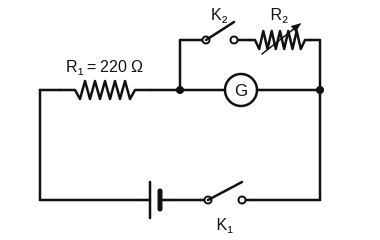
The galvanometer deflection, when key $K_1$ is closed but $K_2$ is open, equals $\theta_0$ (see figure). On closing $K_2$ also and adjusting $R_2$ to $5\ \Omega$, the deflection in galvanometer becomes $\dfrac{\theta_0}{5}$. The resistance of the galvanometer is, then, given by [Neglect the internal resistance of battery]:
Answer: (B) $22\ \Omega$
Concept. With $K_2$ open, the galvanometer is in series with $R_1$. With $K_2$ closed, $R_2$ shunts it: the total current changes, and only the fraction $\dfrac{R_2}{R_2+G}$ goes through G. Here $R_1$ is not large enough to keep the current fixed, so solve exactly.
Step 1. Before. $I_0=\dfrac{E}{220+G}$.
Step 2. After. $I=\dfrac{E}{220+\frac{5G}{5+G}}$ and $I_g=I\dfrac{5}{5+G}=\dfrac{5E}{220(5+G)+5G}$.
Step 3. Condition. $I_g=\dfrac{I_0}{5}$: $25(220+G)=1100+225G\Rightarrow5500-1100=200G\Rightarrow G=22\ \Omega$.
Answer. $22\ \Omega$ (Option B).
 Solution by Sreeraj P, M.Sc Physics


