

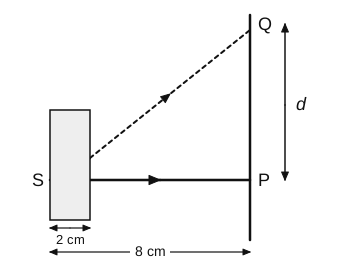
An electron, moving along the $x$-axis with an initial energy of $100$ eV, enters a region of magnetic field $\vec{B} = (1.5\times10^{-3}\ \text{T})\hat{k}$ at S (see figure). The field extends between $x = 0$ and $x = 2$ cm. The electron is detected at the point Q on a screen placed $8$ cm away from the point S. The distance $d$ between P and Q (on the screen) is: (electron's charge $1.6\times10^{-19}$ C, mass of electron $= 9.1\times10^{-31}$ kg)
Answer: (B) $12.87$ cm
Speed: $v = \sqrt{\dfrac{2\times100\times1.6\times10^{-19}}{9.1\times10^{-31}}} \approx 5.93\times10^6$ m/s.
$$r = \frac{mv}{eB} = \frac{9.1\times10^{-31}\times5.93\times10^6}{1.6\times10^{-19}\times1.5\times10^{-3}} \approx 2.25\ \text{cm}$$
In the 2 cm wide field the electron turns through $\theta$ with $\sin\theta = \dfrac{2}{2.25}$, so $\theta \approx 62.7^\circ$ ($\cos\theta \approx 0.459$, $\tan\theta \approx 1.94$). Deflection inside the field:
$$y_1 = r(1 - \cos\theta) \approx 2.25\times0.541 \approx 1.22\ \text{cm}$$
It then moves straight for the remaining $6$ cm: $y_2 = 6\tan\theta \approx 11.6$ cm.
$$d = y_1 + y_2 \approx 12.9\ \text{cm}$$
 Solution by Sreeraj P, M.Sc Physics