

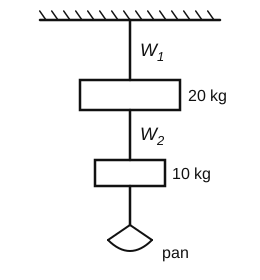
Wires $W_1$ and $W_2$ are made of same material having the breaking stress of $1.25\times10^9$ N m$^{-2}$. $W_1$ and $W_2$ have cross-sectional area of $8\times10^{-7}$ m$^2$ and $4\times10^{-7}$ m$^2$, respectively. Masses of $20$ kg and $10$ kg hang from them as shown in the figure. The maximum mass that can be placed in the pan without breaking the wires is ______ kg (Use $g = 10$ m s$^{-2}$)
Numerical value type. Enter your answer.
Answer: 40
Breaking tensions: $W_1$: $1.25\times10^9\times8\times10^{-7} = 1000$ N; $W_2$: $1.25\times10^9\times4\times10^{-7} = 500$ N.
With mass $M$ in the pan (pan mass neglected):
$W_2$ supports $10 + M$: $(10 + M)10 \le 500 \Rightarrow M \le 40$ kg.
$W_1$ supports $30 + M$: $(30 + M)10 \le 1000 \Rightarrow M \le 70$ kg.
Maximum mass $= 40$ kg.
 Solution by Sreeraj P, M.Sc Physics