

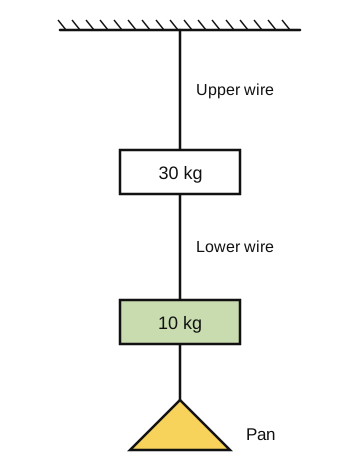
Two wires as shown in the figure below, made of steel and have breaking stress of $12 \times 10^8\ \text{N/m}^2$. Area of cross-section of upper wire is $0.008\ \text{cm}^2$ and of lower wire is $0.004\ \text{cm}^2$. The maximum mass that can be added to pan without breaking any wire is ______ kg.
Answer: (B) $38$
Take $g = 10\ \text{m/s}^2$ and let $M$ be the mass on the pan.
Lower wire holds the $10$ kg block and the pan load: its maximum tension is $12 \times 10^8 \times 0.004 \times 10^{-4} = 480$ N, so $10 + M \le 48$, i.e. $M \le 38$ kg.
Upper wire holds everything: maximum $12 \times 10^8 \times 0.008 \times 10^{-4} = 960$ N, so $40 + M \le 96$, i.e. $M \le 56$ kg.
The lower wire breaks first, so the maximum is $38$ kg.
 Solution by Sreeraj P, M.Sc Physics