

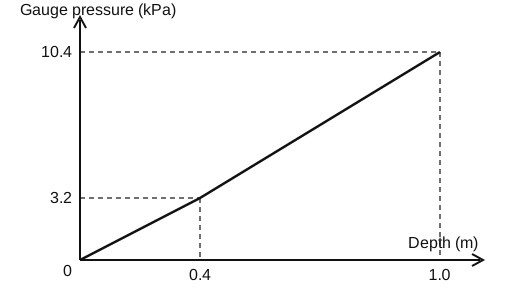
An open tank contains two immiscible liquids, one above the other. The graph shows the gauge pressure in the tank as a function of depth below the free surface. A solid block of density $1000$ kg/m³ floats in equilibrium at the interface of the two liquids, completely submerged. The fraction of its volume that lies in the lower liquid is (Take $g = 10\ \text{m/s}^2$)
Answer: (C) $\dfrac12$
Concept. The slope of the pressure–depth graph in each liquid is $\rho g$. For a block floating at the interface, its weight equals the total buoyant force from both liquids.
Step 1. Upper liquid. From $0$ to $0.4$ m the pressure rises by $3.2$ kPa:
$$\rho_1 = \frac{3200}{0.4 \times 10} = 800\ \text{kg/m}^3$$
Step 2. Lower liquid. From $0.4$ m to $1.0$ m it rises by $10.4 - 3.2 = 7.2$ kPa:
$$\rho_2 = \frac{7200}{0.6 \times 10} = 1200\ \text{kg/m}^3$$
Step 3. Floating condition. Let a fraction $f$ be in the lower liquid:
$$1000V = 800(1 - f)V + 1200fV \;\Rightarrow\; 200 = 400f \;\Rightarrow\; f = \frac12$$
Answer. $\dfrac12$ (Option C).
 Solution by Sreeraj P, M.Sc Physics