
PiTheory

Mechanical Properties of Fluids: NEET and JEE questions with solutions

Class 11 physics, NCERT chapter 9. Attempt each question, check your answer, then open the step-by-step solution.

4 questions4 MCQ0 numericalClass 11 · Chapter 9
Not started yet
Q 11-09-001NEETNEET 2026Top questionMedium

Water flows in a streamline motion through a horizontal pipe of circular cross-section as shown in the figure. The pressure difference of water between $P$ and $Q$ is $15\ \text{N m}^{-2}$. The area of cross-section at $P$ and $Q$ are $40\ \text{cm}^2$ and $20\ \text{cm}^2$, respectively. The rate of flow of water through the pipe, in $\text{cm}^3\text{s}^{-1}$, is :

[Take density of water $= 1000\ \text{kg m}^{-3}$]
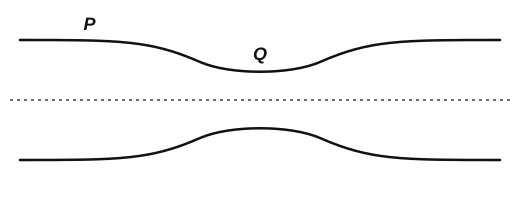
Horizontal pipe that is wide at P and narrows at Q
Open
Q 11-09-002NEETNEET 2026Top questionMedium

In the measurement of viscosity of liquids using terminal velocity experiment, spherical balls of same radius but having different densities are used. The variation of the terminal velocity ($v$) with the ratio of density of spherical ball ($\sigma$) to density of the liquid ($\rho$), is best represented by :

Open
Q 11-09-003NEETNEET 2025Top questionHard

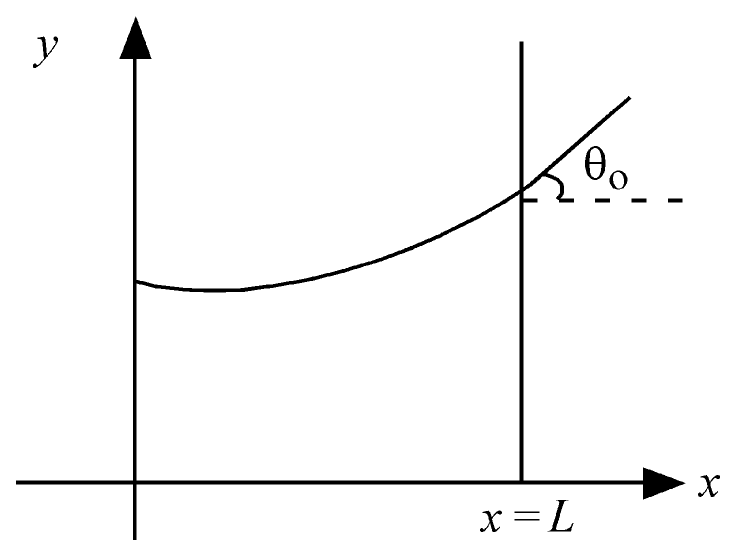
Consider a water tank shown in the figure. It has one wall at $x = L$ and can be taken to be very wide in the $z$ direction. When filled with a liquid of surface tension $S$ and density $\rho$, the liquid surface makes angle $\theta_0$ ($\theta_0 << 1$) with the $x$-axis at $x = L$. If $y(x)$ is the height of the surface then the equation for $y(x)$ is :

(take $\theta(x) = \sin\theta(x) = \tan\theta(x) = \dfrac{dy}{dx}$, $g$ is the acceleration due to gravity)

Liquid surface y(x) rising towards the wall at x = L, where it makes a small angle θ0 with the horizontal
Open
Q 11-09-004NEETNEET 2025Top questionHard

A balloon is made of a material of surface tension $S$ and its inflation outlet (from where gas is filled in it) has small area $A$. It is filled with a gas of density $\rho$ and takes a spherical shape of radius $R$. When the gas is allowed to flow freely out of it, its radius $r$ changes from $R$ to $0$ (zero) in time $T$. If the speed $v(r)$ of gas coming out of the balloon depends on $r$ as $r^a$ and $T \propto S^\alpha A^\beta \rho^\gamma R^\delta$ then

Open