

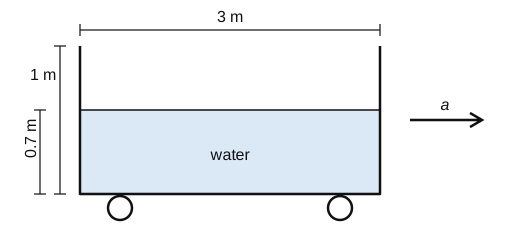
An open rectangular tank $3$ m long and $1$ m deep contains water to a depth of $0.7$ m. It is accelerated horizontally along its length, as shown. The maximum acceleration for which no water spills is (Take $g = 10\ \text{m/s}^2$)
Answer: (D) $2\ \text{m/s}^2$
Concept. In the frame of the tank each fluid element feels $g$ downward and a pseudo acceleration $a$ backward. The free surface becomes a plane perpendicular to the effective gravity, so its slope is $\tan\theta = \dfrac ag$. The volume of water is unchanged, so the surface pivots about the middle of the tank.
Step 1. Allowed rise. The water can rise at the rear wall by $1 - 0.7 = 0.3$ m.
Step 2. Slope. The rise at the wall is half the length times the slope:
$$\frac32\tan\theta = 0.3 \;\Rightarrow\; \tan\theta = 0.2$$
Step 3. Acceleration.
$$a = g\tan\theta = 10 \times 0.2 = 2\ \text{m/s}^2$$
At the front wall the depth falls to $0.7 - 0.3 = 0.4$ m, so the bottom stays covered and the tilted-plane picture holds.
Answer. $2\ \text{m/s}^2$ (Option D).
 Solution by Sreeraj P, M.Sc Physics