

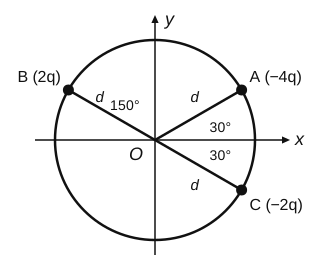
Three charged particles A, B and C with charges $-4q$, $2q$ and $-2q$ are present on the circumference of a circle of radius $d$. The charged particles A, C and the centre O of the circle form an equilateral triangle, as shown in the figure. The electric field at the point O is:
Answer: (A) $\dfrac{\sqrt3q}{\pi\varepsilon_0d^2}$
Let $E_0 = \dfrac{q}{4\pi\varepsilon_0d^2}$. A is at $30^\circ$, B at $150^\circ$ and C at $-30^\circ$, so B and C are at opposite ends of a diameter.
**A** ($-4q$): field $4E_0$ towards A, i.e. along $30^\circ$.
**B** ($+2q$): field $2E_0$ away from B, i.e. along $-30^\circ$.
**C** ($-2q$): field $2E_0$ towards C, i.e. along $-30^\circ$.
So there is $4E_0$ along $30^\circ$ and $4E_0$ along $-30^\circ$. The $y$-components cancel:
$$E = 2\times4E_0\cos30^\circ = 4\sqrt3E_0 = \frac{4\sqrt3q}{4\pi\varepsilon_0d^2} = \frac{\sqrt3q}{\pi\varepsilon_0d^2}$$
along $+x$.
(The official answer key lists $\frac{3\sqrt3q}{4\pi\varepsilon_0d^2}$.)
 Solution by Sreeraj P, M.Sc Physics