

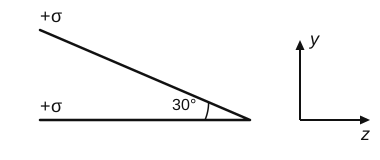
Two infinite planes, each with uniform surface charge density $+\sigma$, are kept in such a way that the angle between them is $30^\circ$. The electric field in the region shown between them is given by:
Answer: (D) $\dfrac{\sigma}{2\varepsilon_0}\left[\left(1 - \dfrac{\sqrt3}{2}\right)\hat y - \dfrac{\hat z}{2}\right]$
Each plane gives a field of magnitude $\dfrac{\sigma}{2\varepsilon_0}$ pointing away from it (positive charge), whatever the distance.
**Horizontal plane:** the region lies above it, so $\vec E_1 = \dfrac{\sigma}{2\varepsilon_0}\hat y$.
**Inclined plane:** it rises at $30^\circ$ towards $-z$ from the line where the planes meet, and the region lies below it. Its unit normal pointing into the region is $-\sin30^\circ\,\hat z - \cos30^\circ\,\hat y$, so
$$\vec E_2 = \frac{\sigma}{2\varepsilon_0}\left(-\frac{\sqrt3}{2}\hat y - \frac12\hat z\right)$$
**Total:**
$$\vec E = \frac{\sigma}{2\varepsilon_0}\left[\left(1 - \frac{\sqrt3}{2}\right)\hat y - \frac{\hat z}{2}\right]$$
(The official answer key lists the first option, whose $\hat y$ coefficient $1 + \sqrt3$ cannot arise from adding two fields of magnitude $\frac{\sigma}{2\varepsilon_0}$.)
 Solution by Sreeraj P, M.Sc Physics