Point charges $+4\ \mu\text{C}$ and $+1\ \mu\text{C}$ are $30\ \text{cm}$ apart. At what distance from the $4\ \mu\text{C}$ charge, on the line joining them, is the electric field zero?
Concept. Between two like charges their fields point in opposite directions, so the null point is where the magnitudes are equal.
Step 1. Equate magnitudes. At distance $x$ from the $4\ \mu$C charge: $$\frac{k(4)}{x^2} = \frac{k(1)}{(30 - x)^2} \;\Rightarrow\; \frac{2}{x} = \frac{1}{30 - x}$$
Step 2. Solve. $60 - 2x = x \Rightarrow x = 20$ cm.
Answer. $20$ cm (Option C).
Solution by Sreeraj P, M.Sc Physics
Q 12-01-002NEETNEET 2026Top questionMedium
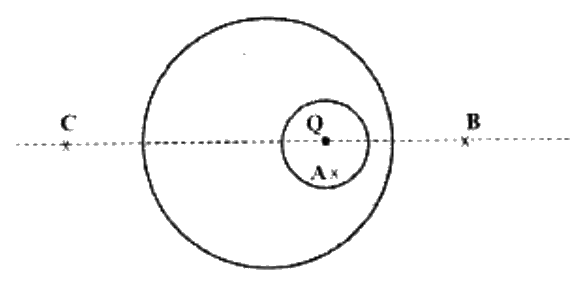
A point charge Q is placed inside a cavity within a solid isolated conducting sphere. Consider points A, B and C as shown in the figure, where the magnitudes of the electric fields are $E_A$, $E_B$ and $E_C$, respectively. The points B and C are at the same distance from the center of the solid sphere. The correct option is :
Concept. Charge $-Q$ is induced on the cavity wall and $+Q$ on the outer surface. The conductor shields the outside, so the outer charge spreads uniformly whatever the position of Q.
Step 1. Point A (in the cavity). The field of Q and the induced charge is not zero: $E_A \neq 0$.
Step 2. Points B and C (outside). The uniform outer charge acts as a point charge $Q$ at the centre, so equal distances give $E_B = E_C$.
Answer. $E_A \neq 0,\ E_B = E_C$ (Option B).
Solution by Sreeraj P, M.Sc Physics
Q 12-01-003NEETNEET 2025Top questionEasy
Two identical charged conducting spheres A and B have their centres separated by a certain distance. Charge on each sphere is q and the force of repulsion between them is F. A third identical uncharged conducting sphere is brought in contact with sphere A first and then with B and finally removed from both. New force of repulsion between spheres A and B (Radii of A and B are negligible compared to the distance of separation so that for calculating force between them they can be considered as point charges) is best given as :
Answer: (A) the number of flux lines entering the surface must be equal to the number of flux lines leaving it.
Concept. Gauss's law: zero net flux means zero enclosed charge; it says nothing about the field being zero or uniform.
Step 1. Interpret. Zero net flux means every field line entering the surface also leaves it. The field need not be constant or uniform, and charges may lie outside.
Answer. The number of flux lines entering the surface must be equal to the number leaving it (Option A).
Solution by Sreeraj P, M.Sc Physics
Q 12-01-005NEETNEET 2023Top questionEasy
An electric dipole is placed at an angle of $30°$ with an electric field of intensity $2 \times 10^5\ \text{N C}^{-1}$. It experiences a torque equal to $4$ N m. Calculate the magnitude of charge on the dipole, if the dipole length is $2$ cm.
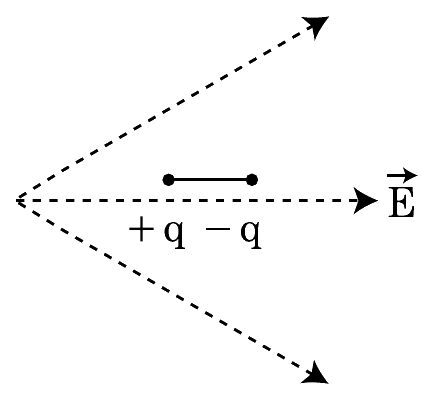
Answer: (C) towards the right as its potential energy will decrease.
Concept. In a non-uniform field the forces on the two charges of a dipole differ; equivalently, the dipole moves to lower its energy $U = -\vec p \cdot \vec E$.
Step 1. Field. The lines spread out to the right, so the field is stronger on the left.
Step 2. Forces. $+q$ (left, stronger field) is pushed right more strongly than $-q$ (right, weaker field) is pulled left: net force to the right.
Step 3. Energy. $\vec p$ points left, opposite to $\vec E$, so $U = +pE$; moving right into weaker field lowers $U$.
Answer. Towards the right as its potential energy will decrease (Option C).
Solution by Sreeraj P, M.Sc Physics
Q 12-01-008NEETNEET 2020Top questionEasy
A spherical conductor of radius $10$ cm has a charge of $3.2 \times 10^{-7}$ C distributed uniformly. What is the magnitude of electric field at a point $15$ cm from the centre of the sphere ? $\left(\dfrac{1}{4\pi\epsilon_0} = 9 \times 10^9\ \text{N m}^2/\text{C}^2\right)$
Two identical point charges repel each other with a force $F$ when $r$ apart. If the charge on each is doubled and the separation is halved, the force becomes
Two point charges $+4\ \mu$C and $+9\ \mu$C are $50$ cm apart. The point on the line joining them where the electric field is zero is at a distance from the $4\ \mu$C charge of
Two small identical balls, each of mass $m$ and charge $q$, hang from a common point by threads of length $l$. In equilibrium each thread makes a small angle $\theta$ with the vertical. The separation $x$ between the balls varies with $q$ as
An electron is placed in a uniform electric field of $2 \times 10^4$ N/C. Its acceleration is ($e = 1.6 \times 10^{-19}$ C, $m_e = 9.1 \times 10^{-31}$ kg)
Concept. Gauss's law with a pillbox through a thin sheet: flux leaves through both faces.
Step 1. Apply. $2EA = \dfrac{\sigma A}{\epsilon_0} \Rightarrow E = \dfrac{\sigma}{2\epsilon_0}$. (Near a conductor's surface it would be $\dfrac{\sigma}{\epsilon_0}$.)
Answer. $\dfrac{\sigma}{2\epsilon_0}$ (Option A).
Solution by Sreeraj P, M.Sc Physics
Q 12-01-018NEETJEE MainMedium
A uniformly charged solid sphere of radius $R$ produces a field $E_0$ at its surface. The field at distance $\dfrac{R}{2}$ from the centre and at distance $2R$ from the centre are
Answer: (D) $\dfrac{E}{2}$, in the opposite direction
Concept. Short dipole: axial field $\dfrac{2kp}{r^3}$ along $\vec p$; equatorial field $\dfrac{kp}{r^3}$ opposite to $\vec p$.
Step 1. Compare. At equal distance the equatorial field is half as large and points the other way.
Answer. $\dfrac{E}{2}$, in the opposite direction (Option D).
Solution by Sreeraj P, M.Sc Physics
Q 12-01-021NEETJEE MainMedium
A charge of $+1\ \mu$C is at the origin and $-1\ \mu$C is at $(0, 2\ \text{mm})$. The electric field at $(10\ \text{cm}, 0)$ is approximately \left(\dfrac{1}{4\pi\epsilon_0} = 9 \times 10^9\ \text{N m}^2\text{C}^{-2}\right)
A small ball of mass $2$ g and charge $+5\ \mu$C hangs from a thread in a uniform horizontal electric field. In equilibrium the thread makes $45°$ with the vertical. Find the field strength in N/C. ($g = 10\ \text{m/s}^2$)
Q 12-01-023JEE MainJEE Main 2026 (8 Apr, Shift 2)Medium
Two point charges $q_1 = 3\,\mu C$ and $q_2 = -4\,\mu C$ are placed at points $(2\hat{i} + 3\hat{j} + 3\hat{k})$ and $(\hat{i} + \hat{j} + \hat{k})$ respectively. Force on charge $q_2$ is ______ N. (Take $\dfrac{1}{4\pi\epsilon_0} = 9 \times 10^9$ SI Units)
Concept. Vector Coulomb's law: the force on $q_2$ is $\vec F_2=\dfrac{kq_1q_2}{r^2}\hat r$, where $\hat r$ points from $q_1$ to $q_2$. The signs of the charges take care of attraction.
Step 1. Separation. $\vec r=\vec r_2-\vec r_1=(1-2)\hat i+(1-3)\hat j+(1-3)\hat k=-\hat i-2\hat j-2\hat k$, so $r=3$ m and $\hat r=\dfrac{-\hat i-2\hat j-2\hat k}{3}$.
Step 2. Size factor. $\dfrac{kq_1q_2}{r^2}=\dfrac{9\times10^9\times3\times10^{-6}\times(-4\times10^{-6})}{9}=-1.2\times10^{-2}$ N.
Step 3. Force. $\vec F_2=-1.2\times10^{-2}\times\dfrac{-\hat i-2\hat j-2\hat k}{3}=(4\hat i+8\hat j+8\hat k)\times10^{-3}$ N (towards $q_1$, as unlike charges attract).
Answer. Option B.
Solution by Sreeraj P, M.Sc Physics
Q 12-01-024JEE MainJEE Main 2026 (6 Apr, Shift 1)Medium
A thin half ring of radius $35$ cm is uniformly charged with a total charge of $Q$ coulomb. If the magnitude of the electric field at centre of the half ring is $100\ \text{V/m}$, then the value of $Q$ is ______ nC. ($\epsilon_0 = 8.85 \times 10^{-12}\ \text{C}^2/\text{Nm}^2$ and $\pi = 3.14$)
Concept. For a uniformly charged arc of angle $2\alpha$ at its centre: $E=\dfrac{2k\lambda\sin\alpha}{R}$. A half ring has $\alpha=90^\circ$, so $E=\dfrac{2k\lambda}{R}$ with $\lambda=\dfrac{Q}{\pi R}$.
Step 2. Solve. $Q=2\pi^2\varepsilon_0R^2E=2\times9.86\times8.85\times10^{-12}\times0.1225\times100=2.14\times10^{-9}$ C.
Answer. $2.14$ nC (Option A).
Solution by Sreeraj P, M.Sc Physics
Q 12-01-025JEE MainJEE Main 2026 (4 Apr, Shift 2)Hard
A rigid dipole undergoes a simple harmonic motion about its centre in the presence of an electric field $\vec{E}_1 = E_0\hat{x}$. If another electric field $\vec{E}_2 = 2E_0(\hat{y} + \hat{z})$ is introduced to the system, what will be the percentage change in the frequency of the oscillation (approximate)?
Concept. A dipole's small oscillation has $\omega=\sqrt{pE/I}$, so frequency $\propto\sqrt{|\vec E|}$. Adding a second field changes the magnitude of the total field.
Step 2. Frequency ratio. $\sqrt3=1.732$: an increase of about $73\%$.
Answer. Option A.
Solution by Sreeraj P, M.Sc Physics
Q 12-01-026JEE MainJEE Main 2026 (2 Apr, Shift 1)Medium
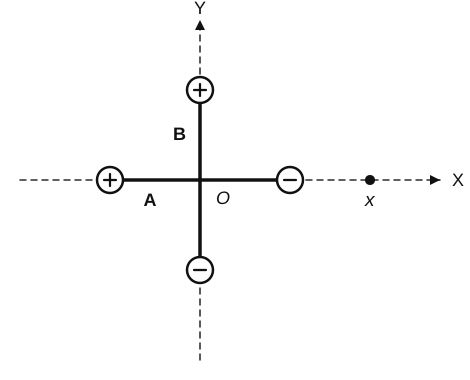
Two short electric dipoles A and B having dipole moment $p_1$ and $p_2$ respectively are placed with their axis mutually perpendicular as shown in the figure. The resultant electric field at a point $x$ is making an angle of $60^\circ$ with the line joining points $O$ and $x$. The ratio of the dipole moments $p_2/p_1$ is ______.
Concept. The point is on the axis of A and on the equatorial line of B, at the same distance $r$. Axial field $\dfrac{2kp_1}{r^3}$ along $\vec p_1$; equatorial field $\dfrac{kp_2}{r^3}$ opposite to $\vec p_2$. They are perpendicular.
Step 1. Angle. The resultant makes $60^\circ$ with the line Ox (the axis of A): $\tan60^\circ=\dfrac{kp_2/r^3}{2kp_1/r^3}=\dfrac{p_2}{2p_1}$.
Step 2. Ratio. $\dfrac{p_2}{p_1}=2\sqrt3$.
Answer. Option B.
Solution by Sreeraj P, M.Sc Physics
Q 12-01-027JEE MainJEE Main 2026 (2 Apr, Shift 2)Easy
Two point charges $8\ \mu C$ and $-2\ \mu C$ are located at $x=2$ cm and $x=4$ cm, respectively on the $x$-axis. The ratio of electric flux due to these charges through two spheres of radii $3$ cm and $5$ cm with their centers at the origin is ______.
Concept. Check each statement against the properties of electrostatic fields.
Step 1. A. Electrostatic field lines start on positive and end on negative charges; they never close: false.
Step 2. B. For a positive point charge the lines point radially outward: true.
Step 3. C. Gauss's law in its usual form depends on the $1/r^2$ law: true.
Step 4. D. The electrostatic field is conservative, so the work round a closed path is zero: true.
Step 5. E. The Coulomb force is central, so angular momentum is conserved and the motion stays in a plane: true.
Answer. B, C, D, E only (Option C).
Solution by Sreeraj P, M.Sc Physics
Q 12-01-029JEE MainJEE Main 2026 (24 Jan, Shift 2)Medium
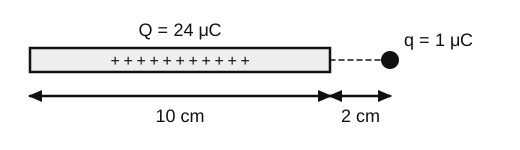
A point charge $q = 1\mu\text{C}$ is located at a distance 2 cm from one end of a thin insulating wire of length 10 cm having a charge $Q = 24\mu\text{C}$, distributed uniformly along its length, as shown in figure. Force between $q$ and wire is ______ N.
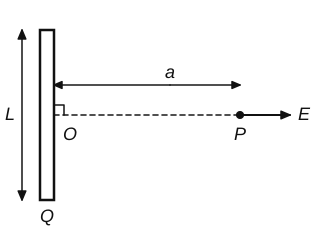
Concept. Each element $dQ=\dfrac QL\,dx$ of the rod pushes $q$ along the same line, so the forces add as numbers: $F=\displaystyle\int_d^{d+L}\dfrac{kq\,(Q/L)\,dx}{x^2}=\dfrac{kqQ}{d(d+L)}$.
Step 1. Values. $d=0.02$ m, $d+L=0.12$ m.
Step 2. Force. $F=\dfrac{9\times10^9\times10^{-6}\times24\times10^{-6}}{0.02\times0.12}=\dfrac{0.216}{0.0024}=90$ N.
Answer. $90$.
Solution by Sreeraj P, M.Sc Physics
Q 12-01-030JEE MainJEE Main 2026 (24 Jan, Shift 1)Easy
Three charges $+2q, +3q$ and $-4q$ are situated at $(0, -3a), (2a, 0)$ and $(-2a, 0)$ respectively in the $xy$ plane. The resultant dipole moment about origin is ______ .
Concept. For a set of charges, $\vec p=\sum q_i\vec r_i$. If the total charge is not zero, the result depends on the origin; the question fixes the origin.
Q 12-01-031JEE MainJEE Main 2025 (22 Jan, Shift 1)Medium
An electron is made to enter symmetrically between two parallel and equally but oppositely charged metal plates, each of $10\ \text{cm}$ length. The electron emerges out of the electric field region with a horizontal component of velocity $10^6\ \text{m/s}$. If the magnitude of the electric field between the plates is $9.1\ \text{V/cm}$, then the vertical component of velocity of electron is (mass of electron $= 9.1\times10^{-31}\ \text{kg}$ and charge of electron $= 1.6\times10^{-19}\ \text{C}$)
Q 12-01-032JEE MainJEE Main 2025 (22 Jan, Shift 1)Medium
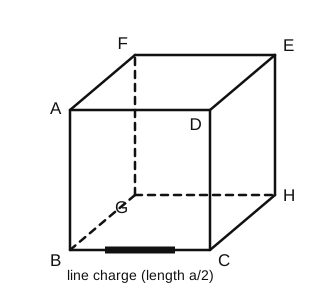
A line charge of length $a/2$ is kept at the centre of an edge $BC$ of a cube $ABCDEFGH$ having edge length $a$, as shown in the figure. If the density of line charge is $\lambda\ \text{C}$ per unit length, then the total electric flux through all the faces of the cube will be (Take $\epsilon_0$ as the free space permittivity)
Concept. A charge on an edge of a cube is shared equally by the four cubes that meet at that edge, so this cube gets a quarter of $\dfrac{q}{\varepsilon_0}$.
Q 12-01-033JEE MainJEE Main 2025 (23 Jan, Shift 1)Easy
A positive ion $A$ and a negative ion $B$ have charges $6.67\times10^{-19}\ \text{C}$ and $9.6\times10^{-10}\ \text{C}$, and masses $19.2\times10^{-27}\ \text{kg}$ and $9\times10^{-27}\ \text{kg}$ respectively. At an instant, the ions are separated by a certain distance $r$. At that instant the ratio of the magnitudes of electrostatic force to gravitational force is $P\times10^{45}$, where the value of $10P$ is ______. (Take $\dfrac{1}{4\pi\varepsilon_0} = 9\times10^9\ \text{N m}^2\text{C}^{-2}$ and universal gravitational constant as $6.67\times10^{-11}\ \text{N m}^2\text{kg}^{-2}$.) Assume that charge may not be an integral multiple of electrons.
Step 2. Simplify. $9$ and $6.67$ cancel and $\dfrac{9.6}{19.2} = \dfrac12$: $$\frac{F_e}{F_g} = \frac12 \times \frac{10^{-20}}{10^{-65}} = 0.5 \times 10^{45}$$
Step 3. Read off. $P = 0.5$, so $10P = 5$.
Answer. $5$.
Solution by Sreeraj P, M.Sc Physics
Q 12-01-034JEE MainJEE Main 2025 (23 Jan, Shift 2)Easy
Two point charges $-4\ \mu\text{C}$ and $4\ \mu\text{C}$, constituting an electric dipole, are placed at $(-9, 0, 0)\ \text{cm}$ and $(9, 0, 0)\ \text{cm}$ in a uniform electric field of strength $10^4\ \text{N C}^{-1}$. The work done on the dipole in rotating it from the equilibrium through $180^\circ$ is
Concept. Work to turn a dipole from $\theta_1$ to $\theta_2$: $W=pE(\cos\theta_1-\cos\theta_2)$. From $0^\circ$ to $180^\circ$ this is $2pE$.
Step 1. Moment. $p=4\times10^{-6}\times0.18=7.2\times10^{-7}$ C m.
Step 2. Work. $2\times7.2\times10^{-7}\times10^4=14.4\times10^{-3}$ J.
Answer. $14.4$ mJ (Option B).
Solution by Sreeraj P, M.Sc Physics
Q 12-01-035JEE MainJEE Main 2025 (24 Jan, Shift 1)Hard
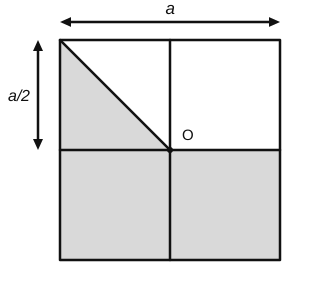
A square loop of sides $a = 1\ \text{m}$ is held normally in front of a point charge $q = 1\ \text{C}$, the charge lying on the axis of the loop at a distance $a/2$ from its centre. The flux of the electric field through the shaded region is $\dfrac{5}{p}\times\dfrac{1}{\varepsilon_0}\ \dfrac{\text{N m}^2}{\text{C}}$, where the value of $p$ is ______.
Concept. A charge at $\dfrac a2$ from the centre of a square of side $a$ sits at the centre of a cube made of six such squares, so the whole square gets $\dfrac16\cdot\dfrac{q}{\varepsilon_0}$. By symmetry each quarter gets a quarter of that, and the triangle that is half a quarter gets an eighth.
Step 1. Shaded fraction. Two quarters plus half a quarter: $\dfrac14+\dfrac14+\dfrac18=\dfrac58$ of the square.
Q 12-01-036JEE MainJEE Main 2025 (24 Jan, Shift 2)Easy
A small uncharged conducting sphere is placed in contact with an identical sphere but having $4\times10^{-8}\ \text{C}$ charge and then removed to a distance such that the force of repulsion between them is $9\times10^{-3}\ \text{N}$. The distance between them is (Take $\dfrac{1}{4\pi\epsilon_0}$ as $9\times10^9$ in SI units)
Concept. Identical conductors in contact share charge equally. Then Coulomb's law $F=\dfrac{kq_1q_2}{r^2}$ gives the distance.
Step 1. Charges after contact. $2\times10^{-8}$ C each.
Step 2. Distance. $9\times10^{-3}=\dfrac{9\times10^9\times(2\times10^{-8})^2}{r^2}=\dfrac{3.6\times10^{-6}}{r^2}\Rightarrow r^2=4\times10^{-4}$, $r=0.02$ m.
Answer. $2$ cm (Option B).
Solution by Sreeraj P, M.Sc Physics
Q 12-01-037JEE MainJEE Main 2025 (28 Jan, Shift 1)Medium
A particle of mass $m$ and charge $q$ is fastened to one end $A$ of a massless string having equilibrium length $l$, whose other end is fixed at point $O$. The whole system is placed on a frictionless horizontal plane and is initially at rest. If a uniform electric field is switched on along the direction shown in the figure, then the speed of the particle when it crosses the $x$-axis is
Concept. The string tension does no work (it is perpendicular to the motion of a particle going round O), so the kinetic energy gained equals the work of $q\vec E$, which depends only on the displacement along $\vec E$.
Step 1. Displacement along $x$. A starts at $x=l\cos60^\circ=\dfrac l2$ and crosses the $x$-axis at $x=l$: $\Delta x=\dfrac l2$.
Q 12-01-038JEE MainJEE Main 2025 (28 Jan, Shift 2)Easy
An electric dipole of dipole moment $6\times10^{-6}\ \text{C m}$ is placed in a uniform electric field of magnitude $10^6\ \text{V/m}$. Initially, the dipole moment is parallel to the electric field. The work that needs to be done on the dipole to make its dipole moment opposite to the field will be ______ J.
Q 12-01-039JEE MainJEE Main 2025 (29 Jan, Shift 1)Medium
An electric dipole of mass $m$, charge $q$, and length $l$ is placed in a uniform electric field $\vec E = E_0\hat i$. When the dipole is rotated slightly from its equilibrium position and released, the time period of its oscillations will be (treat each of the two charges as a point mass $m$)
Step 1. A. Inside a shell: no enclosed charge, $E=0$ (III).
Step 2. B. Infinite sheet: $\dfrac{\sigma}{2\varepsilon_0}$ (II).
Step 3. C. Outside a shell: $\dfrac{Q}{4\pi\varepsilon_0r^2}$ with $Q=4\pi R^2\sigma$: $\dfrac{\sigma R^2}{\varepsilon_0r^2}$ (IV).
Step 4. D. Between oppositely charged sheets the two fields add: $\dfrac{\sigma}{\varepsilon_0}$ (I).
Answer. Option A.
Solution by Sreeraj P, M.Sc Physics
Q 12-01-041JEE MainJEE Main 2025 (29 Jan, Shift 2)Easy
A point charge causes an electric flux of $-2\times10^4\ \text{N m}^2\text{C}^{-1}$ to pass through a spherical Gaussian surface of $8.0\ \text{cm}$ radius, centred on the charge. The value of the point charge is (Given $\epsilon_0 = 8.85\times10^{-12}\ \text{C}^2\text{N}^{-1}\text{m}^{-2}$)
Q 12-01-042JEE MainJEE Main 2024 (1 Feb, Shift 1)Medium
Two identical charged spheres are suspended by strings of equal lengths. The strings make an angle $\theta$ with each other. When suspended in water the angle remains the same. If the density of the material of the spheres is $1.5\ \text{g/cc}$, the dielectric constant of water will be ______. (Take density of water $= 1\ \text{g/cc}$)
Concept. For a hanging charged sphere, $\tan\theta=\dfrac{F}{mg}$. In a liquid the electric force falls to $\dfrac FK$ and the effective weight falls to $mg\left(1-\dfrac{\sigma}{\rho}\right)$ (buoyancy). The angle is unchanged if both fall by the same factor.
Q 12-01-043JEE MainJEE Main 2024 (1 Feb, Shift 2)Easy
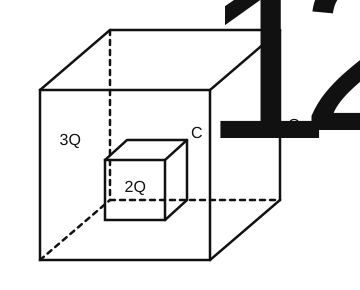
$C_1$ and $C_2$ are two hollow concentric cubes enclosing charges $2Q$ and $3Q$ respectively as shown in the figure. The ratio of electric flux passing through $C_1$ and $C_2$ is
Q 12-01-044JEE MainJEE Main 2024 (1 Feb, Shift 2)Medium
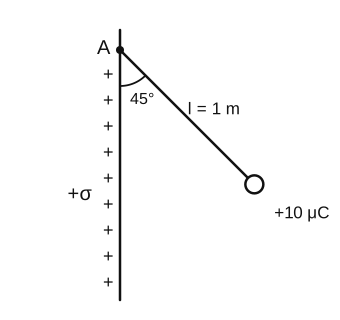
Suppose a uniformly charged wall provides a uniform electric field of $2\times10^4\ \text{N C}^{-1}$ normal to it. A charged particle of mass $2\ \text{g}$ suspended through a silk thread of length $20\ \text{cm}$ remains at rest at a distance of $10\ \text{cm}$ from the wall. Then the charge on the particle will be $\dfrac{1}{\sqrt x}\ \mu\text{C}$, where $x = $ ______. [use $g = 10\ \text{m s}^{-2}$]
Concept. The thread hangs from the wall. The bob is $10$ cm from the wall on a $20$ cm thread, so $\sin\theta=\tfrac12$ and $\theta=30^\circ$. Equilibrium gives $\tan\theta=\dfrac{qE}{mg}$.
Step 1. Solve. $q=\dfrac{mg\tan30^\circ}{E}=\dfrac{2\times10^{-3}\times10}{\sqrt3\times2\times10^4}=\dfrac{1}{\sqrt3}\times10^{-6}$ C.
Answer. $x=3$.
Solution by Sreeraj P, M.Sc Physics
Q 12-01-045JEE MainJEE Main 2024 (4 Apr, Shift 1)Medium
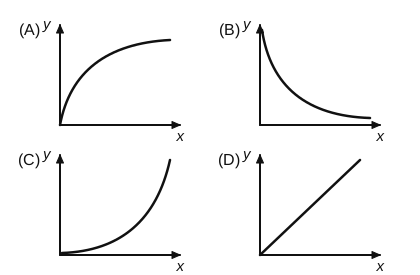
An infinitely long positively charged straight thread has a linear charge density $\lambda\ \text{C m}^{-1}$. An electron revolves along a circular path having its axis along the length of the wire. The graph that correctly represents the variation of the kinetic energy of the electron as a function of the radius of the circular path from the wire is
Concept. The attraction of the line charge supplies the centripetal force: $\dfrac{mv^2}{r}=\dfrac{e\lambda}{2\pi\varepsilon_0r}$.
Step 1. Kinetic energy. $\dfrac12mv^2=\dfrac{e\lambda}{4\pi\varepsilon_0}$: the same for every radius.
Step 2. Graph. A horizontal line.
Answer. Option C.
Solution by Sreeraj P, M.Sc Physics
Q 12-01-046JEE MainJEE Main 2024 (4 Apr, Shift 1)Medium
An infinite plane sheet of charge having uniform surface charge density $+\sigma_s\ \text{C/m}^2$ is placed on the $x$-$y$ plane. Another infinitely long line charge having uniform linear charge density $+\lambda_e\ \text{C/m}$ is placed in the $z = 4\ \text{m}$ plane and parallel to the $y$-axis. If the magnitudes $|\sigma_s| = 2|\lambda_e|$, then at the point $(0, 0, 2)$ the ratio of the magnitudes of the electric field due to the sheet charge to that due to the line charge is $\pi\sqrt n : 1$. The value of $n$ is ______.
Answer: (D) to conduct excess charge due to air friction to the ground and prevent sparking
Concept. Friction between the moving tanker and the air (and the sloshing fuel) builds up charge on the metal body. A spark from that charge could ignite the fuel.
Step 1. Purpose of the chain. A metal chain touching the road gives the charge a conducting path to earth, so it cannot build up.
Answer. Option D.
Solution by Sreeraj P, M.Sc Physics
Q 12-01-050JEE MainJEE Main 2024 (5 Apr, Shift 2)Medium
The electric field at a point P on the axis of a short electric dipole, at a distance $r$ from its centre O, is $E$. The electric field at a point R on the equatorial line, at a distance $2r$ from O, will be $\dfrac{E}{x}$. The value of $x$ is ______.
Q 12-01-051JEE MainJEE Main 2024 (6 Apr, Shift 1)Easy
$\sigma$ is the uniform surface charge density of a thin spherical shell of radius $R$. The electric field at any point on the surface of the spherical shell is
Q 12-01-052JEE MainJEE Main 2024 (6 Apr, Shift 1)Medium
Three infinitely long, thin charged sheets are placed parallel to the $y$-$z$ plane at $x = -a$ (surface charge density $-\sigma$), $x = a$ (density $-2\sigma$) and $x = 3a$ (density $+\sigma$). The magnitude of the electric field at a point $P$ lying between $x = a$ and $x = 3a$ is $\dfrac{x\sigma}{\varepsilon_0}$. The value of $x$ is ______ (all quantities are measured in SI units).
Concept. Each infinite sheet gives $\dfrac{\sigma}{2\varepsilon_0}$, away from a positive sheet and towards a negative one, the same at every distance.
Step 1. Sheet at $-a$ ($-\sigma$). P is to its right; field towards the sheet: $-\dfrac{\sigma}{2\varepsilon_0}$.
Step 2. Sheet at $a$ ($-2\sigma$). P to its right; towards it: $-\dfrac{\sigma}{\varepsilon_0}$.
Step 3. Sheet at $3a$ ($+\sigma$). P to its left; away from it: $-\dfrac{\sigma}{2\varepsilon_0}$.
Step 4. Total. $-\dfrac{2\sigma}{\varepsilon_0}$.
Answer. $x=2$.
Solution by Sreeraj P, M.Sc Physics
Q 12-01-053JEE MainJEE Main 2024 (6 Apr, Shift 2)Medium
Two identical conducting spheres $P$ and $S$ with charge $Q$ on each repel each other with a force of $16\ \text{N}$. A third identical uncharged conducting sphere $R$ is successively brought in contact with the two spheres. The new force of repulsion between $P$ and $S$ is
Concept. Each touch between identical spheres averages the two charges. Force $\propto q_Pq_S$ at fixed distance.
Step 1. R touches P. $P$ and $R$ each get $\dfrac Q2$.
Step 2. R touches S. $\dfrac{Q/2+Q}{2}=\dfrac{3Q}{4}$ each.
Step 3. New force. $16\times\dfrac{(Q/2)(3Q/4)}{Q^2}=16\times\dfrac38=6$ N.
Answer. Option B.
Solution by Sreeraj P, M.Sc Physics
Q 12-01-054JEE MainJEE Main 2024 (27 Jan, Shift 1)Hard
A thin metallic wire having cross sectional area of $10^{-4}\ \text{m}^2$ is used to make a ring of radius $30\ \text{cm}$. A positive charge of $2\pi\ \text{C}$ is uniformly distributed over the ring, while another positive charge of $30\ \text{pC}$ is kept at the centre of the ring. The tension in the ring is ______ N; provided that the ring does not get deformed (neglect the influence of gravity). (Given, $\dfrac{1}{4\pi\epsilon_0} = 9\times10^9$ SI units)
Concept. Each small piece of the ring is pushed outward by the central charge. Take half the ring: the total outward force on it is balanced by the tension $T$ at its two ends, $2T$.
Step 1. Outward force on a half ring. The element at angle $\theta$ has charge $\lambda R\,d\theta$ and feels $\dfrac{kq\lambda R\,d\theta}{R^2}$ outward; the components along the symmetry axis add to $\dfrac{kq\lambda}{R}\displaystyle\int_{-\pi/2}^{\pi/2}\cos\theta\,d\theta=\dfrac{2kq\lambda}{R}$.
Step 3. Value. $T=\dfrac{9\times10^9\times30\times10^{-12}\times2\pi}{2\pi\times0.09}=\dfrac{0.27}{0.09}=3$ N.
Answer. $3$.
Solution by Sreeraj P, M.Sc Physics
Q 12-01-055JEE MainJEE Main 2024 (27 Jan, Shift 2)Medium
Two charges of $-4\ \mu\text{C}$ and $+4\ \mu\text{C}$ are placed at the points $A(1, 0, 4)\ \text{m}$ and $B(2, -1, 5)\ \text{m}$ located in an electric field $\vec E = 0.20\,\hat i\ \text{V cm}^{-1}$. The magnitude of the torque acting on the dipole is $8\sqrt\alpha\times10^{-5}\ \text{N m}$, where $\alpha =$ ______.
Concept. $\vec p$ points from $-q$ to $+q$; torque $\vec\tau=\vec p\times\vec E$.
Step 1. Dipole moment. $\vec p=4\times10^{-6}\,(\hat i-\hat j+\hat k)$ C m.
Step 2. Field. $0.20$ V/cm $=20$ V/m along $\hat i$.
Step 3. Torque. $(\hat i-\hat j+\hat k)\times\hat i=\hat j+\hat k$, so $|\vec\tau|=8\times10^{-5}\sqrt2$ N m.
Answer. $\alpha=2$.
Solution by Sreeraj P, M.Sc Physics
Q 12-01-056JEE MainJEE Main 2024 (29 Jan, Shift 1)Easy
Two charges of $5Q$ and $-2Q$ are situated at the points $(3a, 0)$ and $(-5a, 0)$ respectively. The electric flux through a sphere of radius $4a$ having centre at origin is:
Step 1. Inside. $5Q$ at $3a$ is inside the radius $4a$; $-2Q$ at $5a$ is outside.
Answer. $\dfrac{5Q}{\varepsilon_0}$ (Option B).
Solution by Sreeraj P, M.Sc Physics
Q 12-01-057JEE MainJEE Main 2024 (29 Jan, Shift 1)Hard
An electron is moving under the influence of the electric field of a uniformly charged infinite plane sheet $S$ having surface charge density $+\sigma$. The electron at $t = 0$ is at a distance of $1\ \text{m}$ from $S$ and has a speed of $1\ \text{m s}^{-1}$. The maximum value of $\sigma$, if the electron strikes $S$ at $t = 1\ \text{s}$, is $\alpha\left[\dfrac{m\epsilon_0}{e}\right]\dfrac{\text{C}}{\text{m}^2}$. The value of $\alpha$ is ______.
Concept. The $+\sigma$ sheet attracts the electron with a constant acceleration $a=\dfrac{e\sigma}{2\varepsilon_0m}$ towards the sheet. The largest $\sigma$ corresponds to the electron first moving away from the sheet and being pulled back.
Step 1. Kinematics. Taking distance from the sheet, $s(t)=1+ut-\dfrac12at^2$ with $u=\pm1$ m/s. At $t=1$ s, $s=0$: $a=2(1+u)$.
Step 2. Largest $a$. With $u=+1$ (moving away): $a=4$ m s$^{-2}$.
Q 12-01-058JEE MainJEE Main 2024 (29 Jan, Shift 2)Easy
An electric field is given by $(6\hat i + 5\hat j + 3\hat k)\ \text{N C}^{-1}$. The electric flux through a surface area $30\hat i\ \text{m}^2$ lying in the YZ-plane (in SI unit) is:
Q 12-01-059JEE MainJEE Main 2024 (8 Apr, Shift 1)Easy
An electric field $\vec E = \dfrac{2\hat i + 6\hat j + 8\hat k}{\sqrt6}$ passes through the surface of $4\ \text{m}^2$ area having unit vector $\hat n = \left(\dfrac{2\hat i + \hat j + \hat k}{\sqrt6}\right)$. The electric flux for that surface is ______ V m.
Q 12-01-060JEE MainJEE Main 2024 (8 Apr, Shift 2)Medium
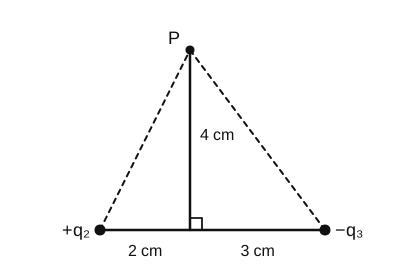
If the net electric field at point P along the Y axis is zero, then the ratio of $\left|\dfrac{q_2}{q_3}\right|$ is $\dfrac{8}{5\sqrt x}$, where $x =$ ______.
Concept. "Net field along the $Y$ axis is zero" means the vertical components of the two fields cancel at P.
Step 1. Distances. $q_2$ is at $(-2,0)$ and $q_3$ at $(3,0)$, P at $(0,4)$ (cm): $r_2=\sqrt{20}$, $r_3=5$.
Step 2. Vertical components. $+q_2$ pushes P away: upward part $\dfrac{kq_2}{20}\cdot\dfrac{4}{\sqrt{20}}$. $-q_3$ pulls P towards it: downward part $\dfrac{kq_3}{25}\cdot\dfrac45$.
Q 12-01-061JEE MainJEE Main 2024 (9 Apr, Shift 2)Easy
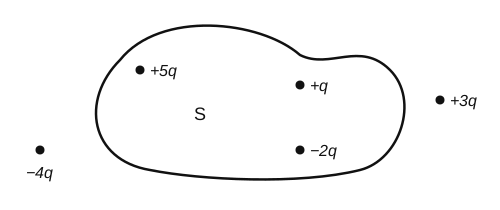
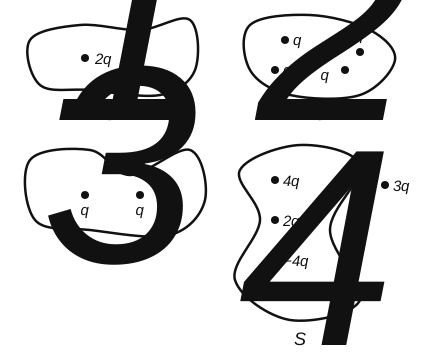
Five charges $+q$, $+5q$, $-2q$, $+3q$ and $-4q$ are situated as shown in the figure. The electric flux due to this configuration through the surface $S$ is:
Concept. Gauss's law: only charges inside S count.
Step 1. Enclosed charge. $+5q + q - 2q = 4q$.
Step 2. Flux. $\dfrac{4q}{\epsilon_0}$.
Answer. $\dfrac{4q}{\epsilon_0}$ (Option A).
Solution by Sreeraj P, M.Sc Physics
Q 12-01-062JEE MainJEE Main 2024 (9 Apr, Shift 2)Medium
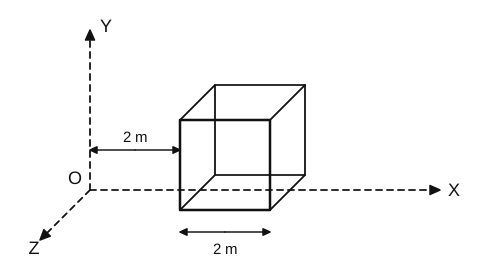
An electric field $\vec E = (2x\hat i)\ \text{N C}^{-1}$ exists in space. A cube of side $2\ \text{m}$ is placed in the space as shown in the figure. The electric flux through the cube is ______ $\text{N m}^2/\text{C}$.
Concept. $\vec E$ is along $x$, so only the two faces perpendicular to $x$ have flux: $\phi=[E(x_2)-E(x_1)]A$.
Step 1. Faces. $x_1=2$ m, $x_2=4$ m, $A=4$ m$^2$.
Step 2. Flux. $\phi=(2\times4-2\times2)\times4=16$ N m$^2$/C.
Answer. $16$.
Solution by Sreeraj P, M.Sc Physics
Q 12-01-063JEE MainJEE Main 2024 (30 Jan, Shift 2)Medium
A particle of charge $-q$ and mass $m$ moves in a circle of radius $r$ around an infinitely long line charge of linear density $+\lambda$. Then the time period will be given as: (Consider $k$ as Coulomb's constant)
Concept. A line charge gives $E=\dfrac{2k\lambda}{r}$. Attraction supplies the centripetal force: $\dfrac{2k\lambda q}{r}=\dfrac{mv^2}{r}$, so $v$ is the same at every radius.
Answer. Option B. ($T\propto r$; kinetic energy is the same at all radii.)
Solution by Sreeraj P, M.Sc Physics
Q 12-01-064JEE MainJEE Main 2024 (30 Jan, Shift 2)Medium
Two identical charged spheres are suspended by strings of equal lengths. The strings make an angle of $37^\circ$ with each other. When suspended in a liquid of density $0.7\ \text{g cm}^{-3}$, the angle remains the same. If the density of the material of the sphere is $1.4\ \text{g cm}^{-3}$, the dielectric constant of the liquid is ______. $\left(\tan37^\circ = \frac34\right)$
Concept. Same angle in air and liquid means the ratio (electric force)/(effective weight) is unchanged; in the liquid $F \to \dfrac{F}{K}$ and $W \to W\left(1 - \dfrac{\sigma}{\rho}\right)$.
Q 12-01-065JEE MainJEE Main 2024 (31 Jan, Shift 1)Easy
Two charges $q$ and $3q$ are separated by a distance $r$ in air. At a distance $x$ from charge $q$, the resultant electric field is zero. The value of $x$ is:
Q 12-01-066JEE MainJEE Main 2024 (31 Jan, Shift 2)Easy
The force between two point charges $q_1$ and $q_2$ placed in vacuum at $r$ cm apart is $F$. The force between them when placed in a medium having dielectric constant $K = 5$ at $\dfrac r5$ cm apart will be:
Q 12-01-067JEE MainJEE Main 2023 (29 Jan, Shift 1)Hard
In a cuboid of dimension $2L\times2L\times L$, a charge $q$ is placed at the centre of the surface $S$ having area of $4L^2$. The flux through the opposite surface to $S$ is given by
Concept. Same symmetry: the face opposite $S$ is a $2L\times2L$ square at distance $L$ from the charge, exactly a face of a cube of side $2L$ centred on the charge.
Step 1. Flux. $\dfrac{q}{6\varepsilon_0}$.
Answer. Option D.
Solution by Sreeraj P, M.Sc Physics
Q 12-01-068JEE MainJEE Main 2023 (29 Jan, Shift 1)Medium
A point charge $q_1=4q_0$ is placed at origin. Another point charge $q_2=-q_0$ is placed at $x=12\ \text{cm}$. Charge of proton is $q_0$. The proton is placed on $x$-axis so that the electrostatic force on the proton is zero. In this situation, the position of the proton from the origin is ______ cm.
Concept. A charge feels zero force where the two forces are equal and opposite. For unlike charges, that point lies outside, on the side of the smaller charge.
Step 1. Region. Beyond $x=12$ cm (near $-q_0$).
Step 2. Equate. $\dfrac{4q_0}{x^2}=\dfrac{q_0}{(x-12)^2}\Rightarrow2(x-12)=x\Rightarrow x=24$ cm.
Answer. $24$.
Solution by Sreeraj P, M.Sc Physics
Q 12-01-069JEE MainJEE Main 2023 (29 Jan, Shift 2)Medium
For a charged spherical ball, electrostatic potential inside the ball varies with $r$ as $V=2ar^2+b$. Here, $a$ and $b$ are constant and $r$ is the distance from the center. The volume charge density inside the ball is $-\lambda a\varepsilon$. The value of $\lambda$ is ______. ($\varepsilon=$ permittivity of medium)
Concept. $\vec E=-\dfrac{dV}{dr}\hat r$, and Gauss's law in point form $\rho=\varepsilon\nabla\cdot\vec E=\dfrac{\varepsilon}{r^2}\dfrac{d}{dr}(r^2E)$.
Concept. Each term of $\vec E$ must have the unit of field, N C$^{-1}$.
Step 1. $A$. $\dfrac{A}{x^2}$ in N C$^{-1}$: $A$ in N m$^2$ C$^{-1}$.
Step 2. $B$. $\dfrac{B}{y^3}$ in N C$^{-1}$: $B$ in N m$^3$ C$^{-1}$.
Answer. Option B.
Solution by Sreeraj P, M.Sc Physics
Q 12-01-071JEE MainJEE Main 2023 (30 Jan, Shift 2)Easy
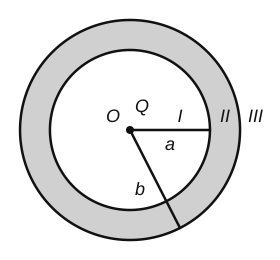
As shown in the figure, a point charge $Q$ is placed at the centre of conducting spherical shell of inner radius $a$ and outer radius $b$. The electric field due to charge $Q$ in three different regions $I$, $II$ and $III$ is given by ($I: r<a$, $II: a<r<b$, $III: r>b$)
Concept. Gauss's law with spheres centred on $Q$. The charge $Q$ induces $-Q$ on the inner surface and $+Q$ on the outer surface of the shell.
Step 1. Region I ($r\lt a$): encloses $Q$, $E\ne0$.
Step 2. Region II (inside the metal): $E=0$ in a conductor in equilibrium.
Step 3. Region III ($r\gt b$): encloses $Q-Q+Q=Q$, $E\ne0$.
Answer. Option B.
Solution by Sreeraj P, M.Sc Physics
Q 12-01-072JEE MainJEE Main 2023 (30 Jan, Shift 2)Medium
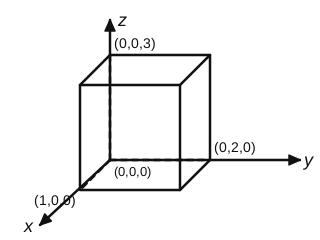
As shown in figure, a cuboid lies in a region with electric field $\vec E=2x^2\hat i-4y\hat j+6\hat k\ \text{N C}^{-1}$. The magnitude of charge within the cuboid is $n\varepsilon_0$ C. The value of $n$ is ______ (if dimension of cuboid is $1\times2\times3\ \text{m}^3$).
Concept. For a cuboid aligned with the axes, each field component gives flux only through its pair of faces: $\phi_x=[E_x(x_2)-E_x(x_1)]A_x$, and so on. Then $q=\varepsilon_0\phi$.
Step 1. $x$ faces ($x=0,1$; area $2\times3=6$): $(2\times1-0)\times6=12$.
Step 2. $y$ faces ($y=0,2$; area $1\times3=3$): $(-4\times2-0)\times3=-24$.
Step 3. $z$ faces. $E_z=6$ is the same on both: $0$.
Step 4. Charge. $\phi=12-24=-12$, so $q=-12\varepsilon_0$: magnitude $12\varepsilon_0$.
Answer. $n=12$.
Solution by Sreeraj P, M.Sc Physics
Q 12-01-073JEE MainJEE Main 2023 (31 Jan, Shift 1)Medium
Expression for an electric field is given by $\vec E=4000x^2\hat i\ \text{V m}^{-1}$. The electric flux through the cube of side $20\ \text{cm}$ when placed in electric field (as shown in the figure) is ______ V cm.
Step 2. Flux. $160 \times (0.2)^2 = 6.4$ V m $= 640$ V cm.
Answer. $640$.
Solution by Sreeraj P, M.Sc Physics
Q 12-01-074JEE MainJEE Main 2023 (24 Jan, Shift 1)Easy
If two charges $q_1$ and $q_2$ are separated with distance $d$ and placed in a medium of dielectric constant $k$, what will be the equivalent distance between charges in air for the same electrostatic force?
Concept. In a medium of dielectric constant $k$ the force is $\dfrac{1}{k}$ times the force in air at the same distance: $F=\dfrac{q_1q_2}{4\pi\varepsilon_0kd^2}$.
Q 12-01-075JEE MainJEE Main 2023 (24 Jan, Shift 1)Medium
A stream of positively charged particles having $\dfrac qm=2\times10^{11}\ \text{C kg}^{-1}$ and velocity $\vec v_0=3\times10^7\hat i\ \text{m s}^{-1}$ is deflected by an electric field $1.8\hat j\ \text{kV m}^{-1}$. The electric field exists in a region of $10\ \text{cm}$ along $x$ direction. Due to the electric field, the deflection of the charged particles in the $y$ direction is ______ mm.
Concept. Across the field the particle has constant acceleration $a=\dfrac qmE$; along $x$ its speed stays $v_0$. Deflection $y=\dfrac12a\left(\dfrac{L}{v_0}\right)^2$.
Step 1. Acceleration. $a=2\times10^{11}\times1.8\times10^3=3.6\times10^{14}$ m s$^{-2}$.
Step 2. Time. $t=\dfrac{0.1}{3\times10^7}=\dfrac13\times10^{-8}$ s.
Step 3. Deflection. $y=\dfrac12\times3.6\times10^{14}\times\dfrac19\times10^{-16}=2\times10^{-3}$ m.
Answer. $2$ mm.
Solution by Sreeraj P, M.Sc Physics
Q 12-01-076JEE MainJEE Main 2023 (25 Jan, Shift 1)Medium
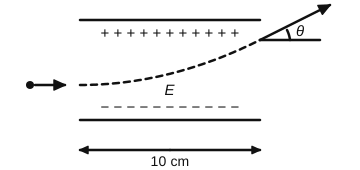
A uniform electric field of $10\ \text{N C}^{-1}$ is created between two parallel charged plates (as shown in figure). An electron enters the field symmetrically between the plates with a kinetic energy $0.5\ \text{eV}$. The length of each plate is $10\ \text{cm}$. The angle ($\theta$) of deviation of the path of electron as it comes out of the field is ______ (in degree).
Q 12-01-077JEE MainJEE Main 2023 (25 Jan, Shift 2)Easy
A point charge of $10\ \mu\text{C}$ is placed at the origin. At what location on the $X$-axis should a point charge of $40\ \mu\text{C}$ be placed so that the net electric field is zero at $x=2\ \text{cm}$ on the $X$-axis?
Q 12-01-078JEE MainJEE Main 2023 (13 Apr, Shift 2)Easy
A $10\ \mu\text{C}$ charge is divided into two parts and placed at $1\ \text{cm}$ distance so that the repulsive force between them is maximum. The charges of the two parts are
Concept. $F \propto q(Q - q)$, which is maximum at $q = \dfrac{Q}{2}$.
Step 1. Split. $5\ \mu$C and $5\ \mu$C.
Answer. $5\ \mu$C, $5\ \mu$C (Option C).
Solution by Sreeraj P, M.Sc Physics
Q 12-01-079JEE MainJEE Main 2023 (13 Apr, Shift 2)Medium
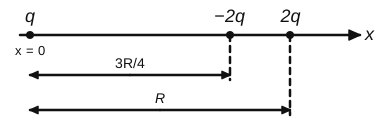
Three point charges $q$, $-2q$ and $2q$ are placed on $x$ axis at a distance $x=0$, $x=\dfrac34R$ and $x=R$ respectively from origin as shown. If $q=2\times10^{-6}\ \text{C}$ and $R=2\ \text{cm}$, the magnitude of net force experienced by the charge $-2q$ is ______ N.
Concept. On the equatorial line of a short dipole $E=\dfrac{kp}{r^3}$.
Answer. $E\propto\dfrac1{r^3}$ (Option C).
Solution by Sreeraj P, M.Sc Physics
Q 12-01-081JEE MainJEE Main 2023 (10 Apr, Shift 2)Medium
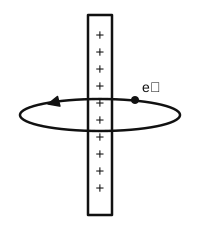
An electron revolves around an infinite cylindrical wire having uniform linear charge density $2\times10^{-8}\ \text{C m}^{-1}$ in circular path under the influence of attractive electrostatic field as shown in the figure. The velocity of electron with which it is revolving is ______ $\times10^6\ \text{m s}^{-1}$. Given mass of electron $=9\times10^{-31}\ \text{kg}$.
Q 12-01-082JEE MainJEE Main 2023 (11 Apr, Shift 1)Medium
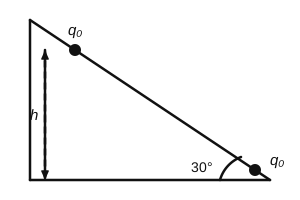
As shown in the figure, a configuration of two equal point charges ($q_0=+2\ \mu\text{C}$) is placed on an inclined plane. Mass of each point charge is $20\ \text{g}$. Assume that there is no friction between charge and plane. For the system of two point charges to be in equilibrium (at rest) the height $h=x\times10^{-3}$ m. The value of $x$ is ______. (Take $\dfrac1{4\pi\epsilon_0}=9\times10^9\ \text{N m}^2\,\text{C}^{-2}$, $g=10\ \text{m s}^{-2}$)
Concept. The upper charge rests on the smooth incline when the repulsion along the incline balances the component of its weight down the incline: $\dfrac{kq_0^2}{s^2}=mg\sin30^\circ$, where $s$ is the distance along the incline.
Step 1. Distance. The charge is at height $h$ on a $30^\circ$ incline, so $s=\dfrac{h}{\sin30^\circ}=2h$.
Q 12-01-083JEE MainJEE Main 2023 (11 Apr, Shift 2)Easy
A capacitor of capacitance $C$ is charged to a potential $V$. The flux of the electric field through a closed surface enclosing the positive plate of the capacitor is
Q 12-01-084JEE MainJEE Main 2023 (12 Apr, Shift 1)Easy
Given below are two statements: one is labelled as Assertion A and the other is labelled as Reason R.
Assertion A: If an electric dipole of dipole moment $30\times10^{-5}$ C m is enclosed by a closed surface, the net flux coming out of the surface will be zero.
Reason R: Electric dipole consists of two equal and opposite charges.
In the light of above statements, choose the correct answer from the options given below.
Answer: (A) Both A and R are true and R is the correct explanation of A
Concept. Gauss's law: net flux $=\dfrac{q_{enc}}{\varepsilon_0}$.
Step 1. Reason. A dipole is two equal and opposite charges: true.
Step 2. Assertion. A surface enclosing the dipole encloses $+q-q=0$, so the net flux is zero: true, and it follows from the reason.
Answer. Option A.
Solution by Sreeraj P, M.Sc Physics
Q 12-01-085JEE MainJEE Main 2023 (13 Apr, Shift 1)Easy
Two charges of each magnitude $0.01\ \text{C}$ and separated by a distance of $0.4\ \text{mm}$ constitute an electric dipole. If the dipole is placed in an uniform electric field $\vec E$ of $10\ \text{dyne C}^{-1}$ making $30^\circ$ angle with $\vec E$, the magnitude of torque acting on dipole is
Concept. $\tau = pE\sin\theta$, with all quantities in SI units.
Step 1. Dipole moment. $p = 0.01 \times 4 \times 10^{-4} = 4 \times 10^{-6}$ C m.
Step 2. Field. $10$ dyne/C $= 10^{-4}$ N/C.
Step 3. Torque. $\tau = 4 \times 10^{-6} \times 10^{-4} \times 0.5 = 2 \times 10^{-10}$ N m.
Answer. $2.0 \times 10^{-10}$ N m (Option D).
Solution by Sreeraj P, M.Sc Physics
Q 12-01-086JEE MainJEE Main 2023 (13 Apr, Shift 1)Hard
A thin infinite sheet charge and an infinite line charge of respective charge densities $+\sigma$ and $+\lambda$ are placed parallel at $5\ \text{m}$ distance from each other. Points $P$ and $Q$ are at $\dfrac3\pi$ m and $\dfrac4\pi$ m perpendicular distances from line charge towards sheet charge, respectively. $E_P$ and $E_Q$ are the magnitudes of resultant electric field intensities at point $P$ and $Q$ respectively. If $\dfrac{E_P}{E_Q}=\dfrac4a$ for $2|\sigma|=|\lambda|$, then the value of $a$ is ______.
Concept. Between the sheet and the line, the two fields are opposite: the line pushes away from itself (towards the sheet), the sheet pushes away from itself (towards the line).
Step 1. Fields at P ($r=3/\pi$): line $\dfrac{\lambda}{2\pi\varepsilon_0r}=\dfrac{\lambda}{6\varepsilon_0}$; sheet $\dfrac{\sigma}{2\varepsilon_0}=\dfrac{\lambda}{4\varepsilon_0}$. Net $\dfrac{\lambda}{12\varepsilon_0}$.
Step 2. Fields at Q ($r=4/\pi$): line $\dfrac{\lambda}{8\varepsilon_0}$; net $\dfrac{\lambda}{8\varepsilon_0}$.
Q 12-01-087JEE MainJEE Main 2023 (6 Apr, Shift 2)Hard
A dipole comprises of two charged particles of identical magnitude $q$ and opposite in nature. The mass $m$ of the positive charged particle is half of the mass of the negative charged particle. The two charges are separated by a distance $l$. If the dipole is placed in a uniform electric field $\vec E$ in such a way that dipole axis makes a very small angle with the electric field $\vec E$, the angular frequency of the oscillations of the dipole when released is given by
Q 12-01-088JEE MainJEE Main 2023 (8 Apr, Shift 1)Easy
Graphical variation of electric field due to a uniformly charged insulating solid sphere of radius $R$, with distance $r$ from the centre $O$ is represented by
Concept. Uniformly charged insulating sphere: inside $E=\dfrac{\rho r}{3\varepsilon_0}$ (rises linearly from zero); outside $E=\dfrac{Q}{4\pi\varepsilon_0r^2}$ (falls as $1/r^2$). The two agree at $r=R$, where $E$ is largest.
Step 1. Shape. A straight line from the origin to a peak at $R$, then a $1/r^2$ fall.
Answer. Option A.
Solution by Sreeraj P, M.Sc Physics
Q 12-01-089JEE MainJEE Main 2023 (8 Apr, Shift 1)Easy
An electric dipole of dipole moment $6.0\times10^{-6}$ C m is placed in a uniform electric field of $1.5\times10^3\ \text{N C}^{-1}$ in such a way that dipole moment is along electric field. The work done in rotating dipole by $180^\circ$ in this field will be ______ mJ.
Q 12-01-090JEE MainJEE Main 2023 (1 Feb, Shift 1)Easy
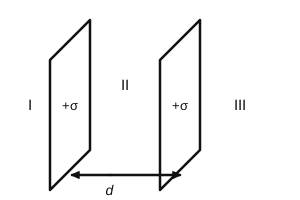
Let $\sigma$ be the uniform surface charge density of two infinite thin plane sheets shown in figure. Then the electric fields in three different regions $E_I$, $E_{II}$ and $E_{III}$ are
Concept. Each sheet gives $\dfrac{\sigma}{2\varepsilon_0}$ pointing away from itself on both sides; add the two sheets region by region ($\hat n$ points from I towards III).
Step 1. Region I (left of both): both fields point left: $-\dfrac{\sigma}{\varepsilon_0}\hat n$.
Step 2. Region II (between): equal and opposite: $0$.
Step 3. Region III (right of both): both point right: $+\dfrac{\sigma}{\varepsilon_0}\hat n$.
Answer. Option D.
Solution by Sreeraj P, M.Sc Physics
Q 12-01-091JEE MainJEE Main 2023 (1 Feb, Shift 1)Medium
Two equal positive point charges are separated by a distance $2a$. The distance of a point from the centre of the line joining two charges on the equatorial line (perpendicular bisector) at which force experienced by a test charge $q_0$ becomes maximum is $\dfrac{a}{\sqrt x}$. The value of $x$ is ______.
Concept. On the perpendicular bisector at distance $y$, the two fields' components along the line cancel and the perpendicular components add: $E=\dfrac{2kqy}{(a^2+y^2)^{3/2}}$. Maximise it.
Q 12-01-092JEE MainJEE Main 2023 (1 Feb, Shift 2)Medium
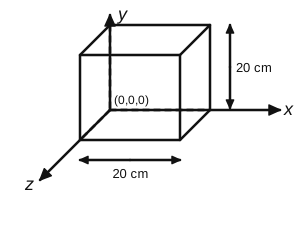
A cubical volume is bounded by the surfaces $x=0$, $x=a$, $y=0$, $y=a$, $z=0$, $z=a$. The electric field in the region is given by $\vec E=E_0x\hat i$, where $E_0=4\times10^4\ \text{N C}^{-1}\text{m}^{-1}$. If $a=2$ cm, the charge contained in the cubical volume is $Q\times10^{-14}$ C. The value of $Q$ is ______. (Take $\epsilon_0=9\times10^{-12}\ \text{C}^2\text{N}^{-1}\text{m}^{-2}$)
Concept. Only the faces $x=0$ and $x=a$ have flux: $\phi=E_0a\cdot a^2-0=E_0a^3$. Then $q=\varepsilon_0\phi$.
Step 1. Flux. $E_0a^3=4\times10^4\times(0.02)^3=0.32$ N m$^2$/C.
Step 2. Charge. $q=9\times10^{-12}\times0.32=2.88\times10^{-12}$ C $=288\times10^{-14}$ C.
Answer. $288$.
Solution by Sreeraj P, M.Sc Physics
Q 12-01-093JEE MainJEE Main 2022 (24 Jun, Shift 1)Easy
A vertical electric field of magnitude $4.9\times10^5\ \text{N C}^{-1}$ just prevents a water droplet of mass $0.1\ \text{g}$ from falling. The value of charge on the droplet will be: (Given $g = 9.8\ \text{m s}^{-2}$)
Concept. "Just prevents from falling": the electric force balances the weight, $qE=mg$.
Step 1. Solve. $q=\dfrac{10^{-4}\times9.8}{4.9\times10^5}=2\times10^{-9}$ C.
Answer. Option B.
Solution by Sreeraj P, M.Sc Physics
Q 12-01-094JEE MainJEE Main 2022 (24 Jun, Shift 2)Medium
Two identical charged particles each having a mass $10\ \text{g}$ and charge $2.0\times10^{-7}\ \text{C}$ are placed on a horizontal table with a separation of $L$ between them such that they stay in limiting equilibrium. If the coefficient of friction between each particle and the table is $0.25$, find the value of $L$. [Use $g = 10\ \text{m s}^{-2}$]
Concept. In limiting equilibrium the repulsion on each particle equals the maximum friction $\mu mg$.
Step 1. Equation. $\dfrac{kq^2}{L^2}=\mu mg=0.25\times0.01\times10=0.025$ N.
Step 2. Solve. $L^2=\dfrac{9\times10^9\times4\times10^{-14}}{0.025}=\dfrac{3.6\times10^{-4}}{0.025}=0.0144\Rightarrow L=0.12$ m.
Answer. $12$ cm (Option A).
Solution by Sreeraj P, M.Sc Physics
Q 12-01-095JEE MainJEE Main 2022 (24 Jun, Shift 2)Medium
A long cylindrical volume contains a uniformly distributed charge of density $\rho$. The radius of the cylindrical volume is $R$. A charged particle $(q)$ revolves around the cylinder in a circular path. The kinetic energy of the particle is:
Concept. Gauss's law with a cylinder: outside a long charged cylinder, $E=\dfrac{\rho R^2}{2\varepsilon_0r}$. The electric force provides the centripetal force.
Step 1. Force balance. $qE=\dfrac{mv^2}{r}\Rightarrow mv^2=\dfrac{q\rho R^2}{2\varepsilon_0}$.
Q 12-01-096JEE MainJEE Main 2022 (25 Jun, Shift 1)Easy
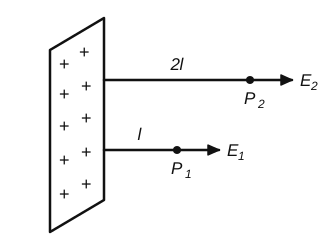
In the figure, a very large plane sheet of positive charge is shown. $P_1$ and $P_2$ are two points at distance $l$ and $2l$ from the charge distribution. If $\sigma$ is the surface charge density, then the magnitudes of electric fields $E_1$ and $E_2$ at $P_1$ and $P_2$ respectively are
Concept. The field of an infinite sheet is $\dfrac{\sigma}{2\varepsilon_0}$ and does not depend on the distance from it.
Step 1. Both points. $E_1=E_2=\dfrac{\sigma}{2\varepsilon_0}$.
Answer. Option C.
Solution by Sreeraj P, M.Sc Physics
Q 12-01-097JEE MainJEE Main 2022 (26 Jun, Shift 2)Easy
Sixty four conducting drops each of radius $0.02\ \text{m}$ and each carrying a charge of $5\ \mu\text{C}$ are combined to form a bigger drop. The ratio of surface density of the bigger drop to the smaller drop will be
Q 12-01-098JEE MainJEE Main 2022 (25 Jul, Shift 1)Medium
The volume charge density of a sphere of radius $6\ \text{m}$ is $2\ \mu\text{C cm}^{-3}$. The number of lines of force per unit surface area coming out from the surface of the sphere is ______ $\times10^{10}\ \text{N C}^{-1}$. [Given: permittivity of vacuum $\varepsilon_0 = 8.85\times10^{-12}\ \text{C}^2\text{N}^{-1}\text{m}^{-2}$]
Q 12-01-099JEE MainJEE Main 2022 (26 Jul, Shift 2)Medium
Three point charges of magnitude $5\ \mu\text{C}$, $0.16\ \mu\text{C}$ and $0.3\ \mu\text{C}$ are located at the vertices $A$, $B$, $C$ of a right angled triangle whose sides are $AB = 3\ \text{cm}$, $BC = 3\sqrt2\ \text{cm}$ and $CA = 3\ \text{cm}$, and point $A$ is the right angle corner. The charge at point $A$ experiences ______ N of electrostatic force due to the other two charges.
Concept. At the right-angle corner the two forces are perpendicular, so the net force is $\sqrt{F_1^2+F_2^2}$.
Step 1. Force from B. $\dfrac{9\times10^9\times5\times10^{-6}\times0.16\times10^{-6}}{(0.03)^2}=8$ N.
Step 2. Force from C. $\dfrac{9\times10^9\times5\times10^{-6}\times0.3\times10^{-6}}{(0.03)^2}=15$ N.
Step 3. Resultant. $\sqrt{64+225}=17$ N.
Answer. $17$.
Solution by Sreeraj P, M.Sc Physics
Q 12-01-101JEE MainJEE Main 2022 (27 Jun, Shift 2)Medium
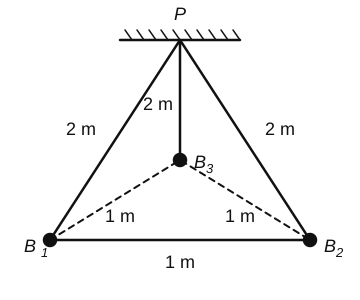
Three identical charged balls each of charge $2$ C are suspended from a common point $P$ by silk threads of $2$ m each (as shown in figure). They form an equilateral triangle of side $1$ m.
The ratio of net force on a charged ball to the force between any two charged balls will be
Concept. Each ball is repelled by the other two with equal forces $F$, and the two forces make $60^\circ$ with each other (the angle of the equilateral triangle).
Q 12-01-102JEE MainJEE Main 2022 (27 Jul, Shift 1)Hard
Two identical positive charges $Q$ each are fixed at a distance of $2a$ apart from each other. Another point charge $q_0$ with mass $m$ is placed at midpoint between two fixed charges. For a small displacement along the line joining the fixed charges, the charge $q_0$ executes SHM. The time period of oscillation of charge $q_0$ will be
Concept. Displace $q_0$ by $x$ along the line. The nearer charge pushes harder, so the net force points back to the centre. For small $x$ this force is proportional to $x$, which gives SHM.
Step 1. Net force. $kQq_0\left[\dfrac{1}{(a-x)^2}-\dfrac{1}{(a+x)^2}\right]\approx kQq_0\dfrac{4x}{a^3}$.
Q 12-01-103JEE MainJEE Main 2022 (27 Jul, Shift 1)Easy
A long cylindrical volume contains a uniformly distributed charge of density $\rho\ \text{C m}^{-3}$. The electric field inside the cylindrical volume at a distance $x = \dfrac{2\varepsilon_0}{\rho}$ m from its axis is ______ $\text{V m}^{-1}$.
Concept. Gauss's law with a coaxial cylinder of radius $x$ inside a uniformly charged long cylinder: $E\cdot2\pi xl=\dfrac{\rho\pi x^2l}{\varepsilon_0}$, so $E=\dfrac{\rho x}{2\varepsilon_0}$.
Q 12-01-104JEE MainJEE Main 2022 (27 Jul, Shift 2)Easy
A charge of $4\ \mu$C is to be divided into two. The distance between the two divided charges is constant. The magnitude of the divided charges so that the force between them is maximum, will be:
Answer. Option B. Equal halves always give the largest force.
Solution by Sreeraj P, M.Sc Physics
Q 12-01-105JEE MainJEE Main 2022 (28 Jul, Shift 1)Easy
Two electric dipoles of dipole moments $1.2\times10^{-30}$ C m and $2.4\times10^{-30}$ C m are placed in two different uniform electric fields of strengths $5\times10^4\ \text{N C}^{-1}$ and $15\times10^4\ \text{N C}^{-1}$ respectively. The ratio of maximum torque experienced by the electric dipoles will be $\dfrac1x$. The value of $x$ is ______ .
Q 12-01-106JEE MainJEE Main 2021 (27 Jul, Shift 1)Medium
Two identical tennis balls each having mass $m$ and charge $q$ are suspended from a fixed point by threads of length $l$. What is the equilibrium separation when each thread makes a small angle $\theta$ with the vertical?
Concept. Each ball is in equilibrium under weight, tension and the electric force: $\tan\theta=\dfrac{F}{mg}$. For a small angle $\tan\theta\approx\sin\theta=\dfrac{x/2}{l}$.
Q 12-01-107JEE MainJEE Main 2021 (31 Aug, Shift 1)Easy
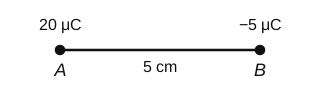
Two particles $A$ and $B$ having charges $20\ \mu\text{C}$ and $-5\ \mu\text{C}$ respectively are held fixed with a separation of $5$ cm. At what position should a third charged particle be placed so that it does not experience a net electric force?
Answer: (A) At $5$ cm from $-5\ \mu\text{C}$ on the right side
Concept. For unlike charges the force on a third charge can be zero only outside the pair, on the side of the smaller charge, where the two inverse-square forces are equal.
Step 1. Position. Let it be $x$ beyond B ($-5\ \mu$C): $\dfrac{20}{(5+x)^2}=\dfrac{5}{x^2}\Rightarrow\dfrac{2}{5+x}=\dfrac1x\Rightarrow x=5$ cm.
Answer. At $5$ cm from $-5\ \mu$C, on the right (Option A).
Solution by Sreeraj P, M.Sc Physics
Q 12-01-108JEE MainJEE Main 2021 (31 Aug, Shift 2)Easy
Choose the incorrect statement:
(a) The electric lines of force entering into a Gaussian surface provide negative flux.
(b) A charge $q$ is placed at the centre of a cube. The flux through all the faces will be the same.
(c) In a uniform electric field net flux through a closed Gaussian surface containing no net charge, is zero.
(d) When an electric field is parallel to a Gaussian surface, it provides a finite non-zero flux.
Choose the most appropriate answer from the options given below:
Step 2. (b) By symmetry each face gets $\dfrac{q}{6\varepsilon_0}$. Correct.
Step 3. (c) No net charge enclosed means zero net flux. Correct.
Step 4. (d) A field parallel to the surface has no normal component: zero flux. Incorrect.
Answer. (d) only (Option D).
Solution by Sreeraj P, M.Sc Physics
Q 12-01-109JEE MainJEE Main 2021 (24 Feb, Shift 1)Medium
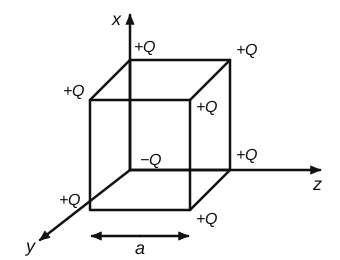
A cube of side $a$ has point charges $+Q$ located at each of its vertices except at the origin where the charge is $-Q$. The electric field at the centre of cube is:
Concept. Superposition trick: $-Q$ at the origin equals $+Q$ plus $-2Q$. Eight equal $+Q$ charges at the corners give zero field at the centre (symmetry), so only $-2Q$ at the origin remains.
Step 1. Distance. Centre to corner: $\dfrac{\sqrt3a}{2}$, so $r^2=\dfrac{3a^2}{4}$.
Q 12-01-110JEE MainJEE Main 2021 (24 Feb, Shift 2)Medium
Two electrons each are fixed at a distance $2d$. A third charge proton placed at the midpoint is displaced slightly by a distance $x\ (x \ll d)$ perpendicular to the line joining the two fixed charges. Proton will execute simple harmonic motion having angular frequency:
Concept. Displaced a distance $x$ perpendicular to the line, the proton is pulled towards both electrons. Along the line the pulls cancel; across it they add and point back to the midpoint.
Step 1. Restoring force. Each pull is $\dfrac{kq^2}{d^2+x^2}$, with component $\dfrac{x}{\sqrt{d^2+x^2}}$ back towards the line: $F=\dfrac{2kq^2x}{(d^2+x^2)^{3/2}}\approx\dfrac{2kq^2}{d^3}x$.
Q 12-01-111JEE MainJEE Main 2021 (24 Feb, Shift 2)Medium
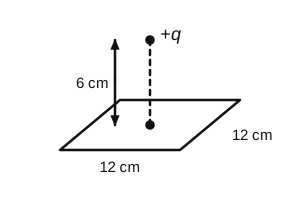
A point charge of $+12\ \mu\text{C}$ is at a distance 6 cm vertically above the centre of a square of side 12 cm as shown in figure. The magnitude of the electric flux through the square will be ______ $\times10^3\ \text{N m}^2\text{ C}^{-1}$.
Q 12-01-112JEE MainJEE Main 2021 (25 Feb, Shift 1)Easy
The electric field in a region is given by $\vec E = \left(\frac35E_0\hat i + \frac45E_0\hat j\right)\ \text{N C}^{-1}$. The ratio of flux of reported field through the rectangular surface of area $0.2\ \text{m}^2$ (parallel to $y$-$z$ plane) to that of the surface of area $0.3\ \text{m}^2$ (parallel to $x$-$z$ plane) is $a : b = a : 2$, where $a = $ ? [Here $\hat i$, $\hat j$ and $\hat k$ are unit vectors along $x$, $y$ and $z$-axes respectively]
Concept. All forces point the same way (along $-y$ on the charge at the origin), so the magnitudes add. The distances double each time, so the forces form a geometric series.
Step 2. Value. $\dfrac43\times9\times10^9\times10^{-6}=12\times10^3$ N.
Answer. $12$.
Solution by Sreeraj P, M.Sc Physics
Q 12-01-114JEE MainJEE Main 2021 (20 Jul, Shift 1)Easy
A certain charge $Q$ is divided into two parts $q$ and $(Q - q)$. How should the charges $Q$ and $q$ be divided so that $q$ and $(Q - q)$ placed at a certain distance apart experience maximum electrostatic repulsion?
Q 12-01-115JEE MainJEE Main 2021 (20 Jul, Shift 1)Medium
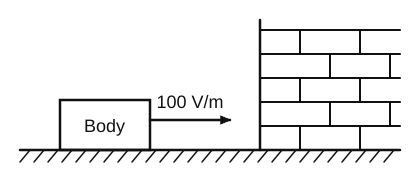
A body having specific charge $8\ \mu\text{C g}^{-1}$ is resting on a frictionless plane at a distance 10 cm from the wall (as shown in the figure). It starts moving towards the wall when a uniform electric field of $100\ \text{V m}^{-1}$ is applied horizontally towards the wall. If the collision of the body with the wall is perfectly elastic, then the time period of the motion will be ______ s.
Concept. The body accelerates uniformly to the wall, bounces elastically with the same speed, and decelerates uniformly back to rest at the start: one period is twice the time to reach the wall.
Step 1. Acceleration. $\dfrac qm=8\ \mu\text{C/g}=8\times10^{-3}$ C/kg: $a=8\times10^{-3}\times100=0.8$ m s$^{-2}$.
Step 2. Time to the wall. $0.1=\dfrac12(0.8)t^2\Rightarrow t=0.5$ s.
Step 3. Period. $2\times0.5=1$ s.
Answer. $1$.
Solution by Sreeraj P, M.Sc Physics
Q 12-01-116JEE MainJEE Main 2021 (22 Jul, Shift 1)Medium
An electric dipole is placed on $x$-axis in proximity to a line charge of linear charge density $3.0\times10^{-6}\ \text{C m}^{-1}$. Line charge is placed on $z$-axis and positive and negative charge of dipole is at a distance of 10 mm and 12 mm from the origin respectively. If total force of 4 N is exerted on the dipole, find out the amount of positive or negative charge of the dipole.
Step 3. Solve. $q=\dfrac{4}{9\times10^5}=4.44\times10^{-6}$ C.
Answer. Option D.
Solution by Sreeraj P, M.Sc Physics
Q 12-01-117JEE MainJEE Main 2021 (22 Jul, Shift 1)Medium
The total charge enclosed in an incremental volume of $2\times10^{-9}\ \text{m}^3$ located at the origin is ______ nC, if electric flux density of its field is found as $\vec D = e^{-x}\sin y\,\hat i - e^{-x}\cos y\,\hat j + 2z\,\hat k\ \text{C m}^{-2}$.
Step 2. Charge. $q=2\times2\times10^{-9}=4\times10^{-9}$ C.
Answer. $4$ nC.
Solution by Sreeraj P, M.Sc Physics
Q 12-01-118JEE MainJEE Main 2021 (26 Feb, Shift 1)Medium
Find the electric field at point $P$ (as shown in figure) on the perpendicular bisector of a uniformly charged thin wire of length $L$ carrying a charge $Q$. The distance of the point $P$ from the centre of the rod is $a = \frac{\sqrt{3}}{2}L$
Concept. For a finite line charge, at perpendicular distance $a$ from its middle: $E=\dfrac{2k\lambda\sin\alpha}{a}$, where $\alpha$ is the half-angle the rod subtends at P.
Q 12-01-119JEE MainJEE Main 2021 (26 Feb, Shift 2)Hard
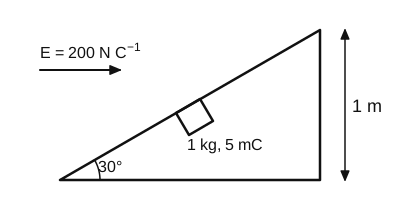
An inclined plane making an angle of $30^\circ$ with the horizontal is placed in a uniform horizontal electric field $200\ \frac{\text{N}}{\text{C}}$ as shown in the figure. A body of mass $1$ kg and charge $5$ mC is allowed to slide down from rest at a height of $1$ m. If the coefficient of friction is $0.2$, find the time taken by the body to reach the bottom. $\left[g = 9.8\ \text{m s}^{-2};\ \sin30^\circ = \frac{1}{2};\ \cos30^\circ = \frac{\sqrt{3}}{2}\right]$
Concept. Resolve the horizontal electric force $qE$ along and perpendicular to the incline, together with gravity and friction, then use constant-acceleration kinematics over the slope length.
Step 1. Forces. $qE=5\times10^{-3}\times200=1$ N, pointing towards the high side. Along the slope it opposes the slide: $qE\cos30^\circ=0.87$ N. Into the slope it adds to the normal force: $qE\sin30^\circ=0.5$ N.
Step 2. Normal force and friction. $N=mg\cos30^\circ+0.5=8.49+0.5=8.99$ N; $f=0.2\times8.99=1.80$ N.
Step 3. Acceleration. $a=mg\sin30^\circ-0.87-1.80=4.9-2.67=2.23$ m s$^{-2}$.
Step 4. Time. Slope length $\dfrac{1}{\sin30^\circ}=2$ m: $t=\sqrt{\dfrac{2\times2}{2.23}}\approx1.3$ s.
Answer. Option B.
Solution by Sreeraj P, M.Sc Physics
Q 12-01-120JEE MainJEE Main 2021 (26 Feb, Shift 2)Easy
Given below are two statements
Statement I: An electric dipole is placed at the centre of a hollow sphere. The flux of electric field through the sphere is zero, but the electric field is not zero anywhere in the sphere.
Statement II: If $R$ is the radius of a solid metallic sphere and $Q$ be the total charge on it. The electric field at any point on the spherical surface of radius $r\,(< R)$ is zero but the electric flux passing through this closed spherical surface of radius $r$ is not
In the light of the above statements, choose the correct answer from the options given below:
Answer: (C) Statement I is true but Statement II is false
Concept. Flux depends only on the enclosed charge; the field at a point depends on all charges.
Step 1. Statement I. The dipole's net charge is zero, so the flux is zero; but the dipole's field is non-zero at every point of the sphere. True.
Step 2. Statement II. Inside a charged metal sphere the charge sits on the outer surface: a surface of radius $r\lt R$ encloses no charge, so both $E$ and the flux are zero. The statement says the flux is not zero: false.
Answer. Option C.
Solution by Sreeraj P, M.Sc Physics
Q 12-01-121JEE MainJEE Main 2021 (25 Jul, Shift 2)Medium
Two ideal electric dipoles $A$ and $B$, having their dipole moment $p_1$ and $p_2$ respectively are placed on a plane with their centres at $O$ as shown in the figure. At point $C$ on the axis of dipole $A$, the resultant electric field is making an angle of $37^\circ$ with the axis. The ratio of the dipole moment of $A$ and $B$, $\frac{p_1}{p_2}$ is: (take $\sin37^\circ = \frac{3}{5}$)
Q 12-01-122JEE MainJEE Main 2021 (26 Aug, Shift 1)Medium
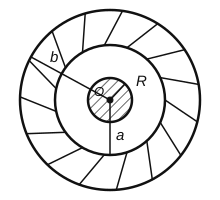
A solid metal sphere of radius $R$ having charge $q$ is enclosed inside the concentric spherical shell of inner radius $a$ and outer radius $b$ as shown in the figure. The approximate variation of electric field $\vec{E}$, as a function of distance $r$, from centre $O$, is given by:
Concept. Use Gauss's law region by region. The metal sphere's charge sits on its surface; the neutral shell gets $-q$ on its inner surface and $+q$ on its outer surface.
Step 3. $a\lt r\lt b$: inside the shell's metal, $E=0$.
Step 4. $r\gt b$: $E=\dfrac{kq}{r^2}$ again, continuing the same $1/r^2$ curve.
Step 5. Graph. Zero, a falling curve from $R$ to $a$, zero from $a$ to $b$, then the falling curve again: (C).
Answer. Option C.
Solution by Sreeraj P, M.Sc Physics
Q 12-01-123JEE MainJEE Main 2021 (27 Aug, Shift 1)Medium
A uniformly charged disc of radius $R$ having surface charge density $\sigma$ is placed in the $xy$ plane with its center at the origin. Find the electric field intensity along the $z$-axis at a distance $Z$ from origin:
Concept. Split the disc into rings of radius $r$ and width $dr$. A ring of charge $dq=\sigma2\pi r\,dr$ gives $\dfrac{k\,dq\,Z}{(r^2+Z^2)^{3/2}}$ along the axis.
Q 12-01-124JEE MainJEE Main 2021 (27 Aug, Shift 2)Medium
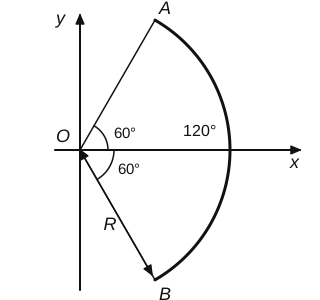
Figure shows a rod $AB$, which is bent in a $120^\circ$ circular arc of radius $R$. A charge $(-Q)$ is uniformly distributed over rod $AB$. What is the electric field $\vec{E}$ at the centre of curvature $O$?
Concept. For an arc of radius $R$, angle $2\alpha$ and linear density $\lambda$, the field at the centre is $\dfrac{2k\lambda\sin\alpha}{R}$ along the bisector. A positive arc pushes away from itself; a negative arc pulls towards itself.
Step 3. Direction. The charge is $-Q$ on an arc centred on $+x$, so the field at O points towards the arc: $+\hat i$.
Answer. Option A.
Solution by Sreeraj P, M.Sc Physics
Q 12-01-125JEE MainJEE Main 2020 (8 Jan, Shift 2)Easy
A particle of mass $m$ and charge $q$ is released from rest in a uniform electric field. If there is no other force on the particle, the dependence of its speed $v$ on the distance $x$ travelled by it is correctly given by (graphs are schematic and not drawn to scale)
Concept. From rest with constant acceleration $a=\dfrac{qE}{m}$: $v^2=2ax$, so $v\propto\sqrt x$.
Step 1. Shape. A curve starting at the origin with a vertical tangent and bending over (a parabola on its side).
Answer. Option B.
Solution by Sreeraj P, M.Sc Physics
Q 12-01-129JEE MainJEE Main 2020 (5 Sep, Shift 2)Medium
Ten charges are placed on the circumference of a circle of radius $R$ with constant angular separation between successive charges. Alternate charges $1, 3, 5, 7, 9$ have charge $(+q)$ each, while $2, 4, 6, 8, 10$ have charge $(-q)$ each. The potential $V$ and the electric field $E$ at the centre of the circle are respectively: (Take $V = 0$ at infinity)
Concept. Potential is a scalar sum; field is a vector sum. With 10 equally spaced charges, charge $k$ and charge $k+5$ are at opposite ends of a diameter.
Step 1. Potential. Five $+q$ and five $-q$ at the same distance $R$: $V=\dfrac{k(5q-5q)}{R}=0$.
Step 2. Field of one diametric pair. An odd charge ($+q$) and the even charge opposite it ($-q$): both fields at O point the same way, away from the $+q$. Each pair gives $\dfrac{2kq}{R^2}$ along the diameter, away from its $+q$.
Step 3. Sum of pairs. The five $+q$ charges are $72^\circ$ apart, so the five pair-fields are equal vectors $72^\circ$ apart: they add to zero.
Answer. $V=0$, $E=0$ (Option C).
Solution by Sreeraj P, M.Sc Physics
Q 12-01-130JEE MainJEE Main 2020 (6 Sep, Shift 1)Medium
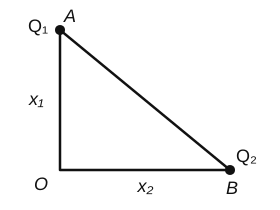
Charges $Q_1$ and $Q_2$ are at points A and B of a right-angled triangle OAB (right angle at O). The resultant electric field at point O is perpendicular to the hypotenuse; then $Q_1/Q_2$ is proportional to:
Concept. At O, $Q_1$ (at distance $x_1$ along one leg) gives $E_1=\dfrac{kQ_1}{x_1^2}$ along that leg, and $Q_2$ gives $E_2=\dfrac{kQ_2}{x_2^2}$ along the other. The resultant is perpendicular to AB when its dot product with the vector along AB is zero.
Step 1. Vectors. With O at the origin, A at $(0,x_1)$, B at $(x_2,0)$: $\vec E=(-E_2,-E_1)$ and $\vec{AB}=(x_2,-x_1)$.
Q 12-01-131JEE MainJEE Main 2020 (6 Sep, Shift 2)Easy
Consider the force $F$ on a charge $q$ due to a uniformly charged spherical shell of radius $R$ carrying charge $Q$ distributed uniformly over it. Which one of the following statements is true for $F$, if $q$ is placed at distance $r$ from the centre of the shell?
Q 12-01-132JEE MainJEE Main 2020 (7 Jan, Shift 1)Hard
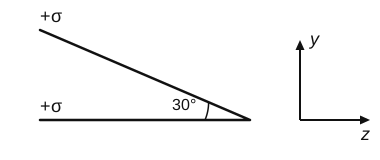
Two infinite planes, each with uniform surface charge density $+\sigma$, are kept in such a way that the angle between them is $30^\circ$. The electric field in the region shown between them is given by:
Answer: (D) $\dfrac{\sigma}{2\varepsilon_0}\left[\left(1 - \dfrac{\sqrt3}{2}\right)\hat y - \dfrac{\hat z}{2}\right]$
Concept. Each plane gives $\dfrac{\sigma}{2\varepsilon_0}$ perpendicular to itself, pointing away from it. Add the two fields as vectors in the region between the planes.
Step 1. Horizontal plane. The region is above it: $\dfrac{\sigma}{2\varepsilon_0}\hat y$.
Step 2. Inclined plane. It falls at $30^\circ$ towards $+z$, and the region is below it. Its normal on that side is $-\sin30^\circ\hat z-\cos30^\circ\hat y$: field $\dfrac{\sigma}{2\varepsilon_0}\left(-\dfrac{\sqrt3}{2}\hat y-\dfrac12\hat z\right)$.
Q 12-01-133JEE MainJEE Main 2020 (8 Jan, Shift 1)Medium
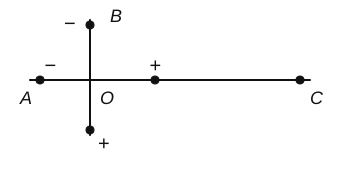
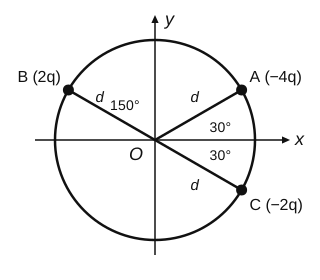
Three charged particles A, B and C with charges $-4q$, $2q$ and $-2q$ are present on the circumference of a circle of radius $d$. The charged particles A, C and the centre O of the circle form an equilateral triangle, as shown in the figure. The electric field at the point O is:
Concept. At the centre, each charge contributes $\dfrac{k|q|}{d^2}$: away from a positive charge, towards a negative one. Write each as a direction and add.
Step 1. A ($-4q$ at $30^\circ$). Towards A: $\dfrac{4kq}{d^2}$ at $30^\circ$.
Step 2. B ($+2q$ at $150^\circ$). Away from B, i.e. at $-30^\circ$: $\dfrac{2kq}{d^2}$.
Step 3. C ($-2q$ at $-30^\circ$). Towards C, also at $-30^\circ$: $\dfrac{2kq}{d^2}$.
Step 4. Add. $\dfrac{4kq}{d^2}$ at $30^\circ$ and $\dfrac{4kq}{d^2}$ at $-30^\circ$: the $y$ parts cancel and $E=2\times\dfrac{4kq}{d^2}\cos30^\circ=\dfrac{4\sqrt3kq}{d^2}=\dfrac{\sqrt3q}{\pi\varepsilon_0d^2}$.
Answer. Option A.
Solution by Sreeraj P, M.Sc Physics
Q 12-01-134JEE MainJEE Main 2020 (8 Jan, Shift 1)Medium
In finding the electric field using Gauss's law, the formula $|\vec E| = \dfrac{q_{\text{enc}}}{\varepsilon_0|A|}$ is applicable. In the formula $\varepsilon_0$ is the permittivity of free space, $A$ is the area of the Gaussian surface and $q_{\text{enc}}$ is the charge enclosed by the Gaussian surface. This equation can be used in which of the following situations?
Answer: (B) Only when the Gaussian surface is an equipotential surface and $|\vec E|$ is constant on the surface
Concept. $\oint\vec E\cdot d\vec A=\dfrac{q_{enc}}{\varepsilon_0}$ always. It becomes $EA=\dfrac{q_{enc}}{\varepsilon_0}$ only if $\vec E$ is everywhere normal to the surface and has the same size all over it.
Step 1. Conditions. "Normal everywhere" means the surface is an equipotential; "same size" means $|\vec E|$ is constant on it.
Answer. Option B.
Solution by Sreeraj P, M.Sc Physics
Q 12-01-135JEE MainJEE Main 2020 (2 Sep, Shift 1)Medium
A charged particle (mass $m$ and charge $q$) moves along the $x$-axis with velocity $V_0$. When it passes through the origin it enters a region having uniform electric field $\vec{E} = -E\hat{j}$ which extends up to $x = d$. Equation of path of the particle in the region $x > d$ is:
Q 12-01-136JEE MainJEE Main 2020 (2 Sep, Shift 2)Medium
A small point mass carrying some positive charge on it, is released from the edge of a table. There is a uniform electric field in this region in the horizontal direction. Which of the graphs shown then correctly describes the trajectory of the mass? (Curves are drawn schematically and are not to scale)
Concept. Released from rest, the mass has two constant accelerations: $g$ down and $\dfrac{qE}{m}$ sideways. Starting from rest under a constant total acceleration, it moves in a straight line along that acceleration.
Step 1. Path. $x=\dfrac12\dfrac{qE}{m}t^2$, $y=\dfrac12gt^2$: $\dfrac yx=\dfrac{mg}{qE}$, a constant.
Answer. A straight line, graph (D) (Option D).
Solution by Sreeraj P, M.Sc Physics
Q 12-01-137JEE MainJEE Main 2020 (4 Sep, Shift 1)Medium
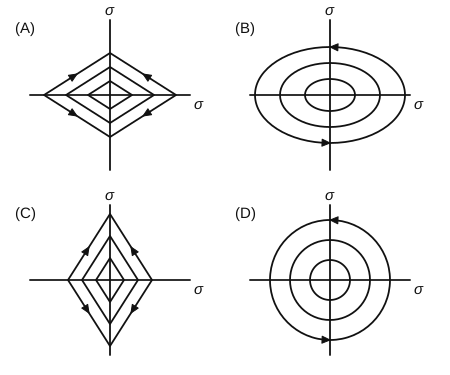
Two charged thin infinite plane sheets of uniform charge density $\sigma_+$ and $\sigma_-$, where $|\sigma_+| > |\sigma_-|$, intersect at right angle. Which of the following best represents the electric field lines for the system?
Concept. In each quadrant the field is uniform: the horizontal $\sigma_+$ sheet gives a vertical part $\dfrac{\sigma_+}{2\varepsilon_0}$ (away from it) and the vertical $\sigma_-$ sheet a horizontal part $\dfrac{|\sigma_-|}{2\varepsilon_0}$ (towards it). Uniform fields have straight field lines.
Step 1. Shape. Straight lines in each quadrant, forming rhombi round the crossing; curved shapes (B, D) are ruled out.
Step 2. Slope. $|\sigma_+|\gt|\sigma_-|$: the vertical part is larger, so the lines are steeper than $45^\circ$ and the rhombi are taller than wide.
Answer. Option C.
Solution by Sreeraj P, M.Sc Physics
Q 12-01-138JEE MainJEE Main 2019 (9 Jan, Shift 2)Medium
Charge is distributed within a sphere of radius $R$ with a volume charge density $\rho(r) = \dfrac{A}{r^2}e^{-2r/a}$, where $A$ and $a$ are constants. If $Q$ is the total charge of this charge distribution, the radius $R$ is:
Step 3. Solve for $R$. $e^{-2R/a}=1-\dfrac{Q}{2\pi aA}\Rightarrow R=\dfrac a2\log\left(\dfrac{1}{1-\frac{Q}{2\pi aA}}\right)$.
Answer. Option A.
Solution by Sreeraj P, M.Sc Physics
Q 12-01-139JEE MainJEE Main 2019 (9 Jan, Shift 2)Medium
Two point charges $q_1\,(\sqrt{10}\ \mu\text{C})$ and $q_2\,(-25\ \mu\text{C})$ are placed on the $x$-axis at $x = 1\ \text{m}$ and $x = 4\ \text{m}$ respectively. The electric field (in V/m) at a point $y = 3\ \text{m}$ on the $y$-axis is $\left[\text{Take } \dfrac{1}{4\pi\epsilon_0} = 9\times10^9\ \text{N m}^2\text{C}^{-2}\right]$
Q 12-01-140JEE MainJEE Main 2019 (10 Jan, Shift 2)Easy
Charges $-q$ and $+q$, located at $A$ and $B$, respectively, constitute an electric dipole. Distance $AB = 2a$, $O$ is the mid point of the dipole and $OP$ is perpendicular to $AB$. A charge $Q$ is placed at $P$ where $OP = y$ and $y \gg 2a$. The charge $Q$ experiences an electrostatic force $F$. If $Q$ is now moved along the equatorial line to $P'$ such that $OP' = \dfrac y3$, the force on $Q$ will be close to $\left(\dfrac y3 \gg 2a\right)$
Q 12-01-141JEE MainJEE Main 2019 (9 Jan, Shift 1)Easy
Three charges $+Q$, $q$, $+Q$ are placed respectively, at distance, $0$, $d/2$ and $d$ from the origin, on the $x$-axis. If the net force experienced by $+Q$, placed at $x = 0$, is zero, then value of $q$ is
Q 12-01-142JEE MainJEE Main 2019 (9 Jan, Shift 1)Easy
For a uniformly charged ring of radius $R$, the electric field on its axis has the largest magnitude at a distance $h$ from its centre. Then value of $h$ is
Q 12-01-144JEE MainJEE Main 2019 (8 Apr, Shift 2)Medium
An electric dipole is formed by two equal and opposite charges $q$ with separation $d$. The charges have same mass $m$. It is kept in a uniform electric field $E$. If it is slightly rotated from its equilibrium orientation, then its angular frequency $\omega$ is
Q 12-01-145JEE MainJEE Main 2019 (9 Apr, Shift 2)Hard
Four point charges $-q$, $+q$, $+q$ and $-q$ are placed on $y$-axis at $y = -2d$, $y = -d$, $y = +d$ and $y = +2d$, respectively. The magnitude of the electric field $E$ at a point on the $x$-axis at $x = D$, with $D \gg d$, will behave as
Step 3. Conclusion. It is two opposite dipoles back to back (a linear quadrupole): $E\propto\dfrac{1}{D^4}$.
Answer. Option A.
Solution by Sreeraj P, M.Sc Physics
Q 12-01-146JEE MainJEE Main 2019 (11 Jan, Shift 2)Easy
An electric field of $1000$ V/m is applied to an electric dipole at angle of $45^\circ$. The value of electric dipole moment is $10^{-29}$ C m. What is the potential energy of the electric dipole?
Q 12-01-148JEE MainJEE Main 2019 (12 Apr, Shift 1)Medium
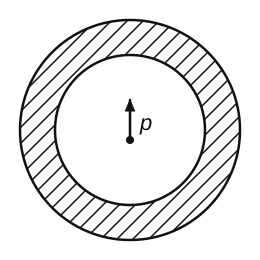
Shown in the figure is a shell made of a conductor. It has inner radius $a$ and outer radius $b$, and carries charge $Q$. At its centre a dipole $\vec{p}$ is placed as shown, then:
Answer: (B) Electric field outside the shell is the same as that of a point charge at the centre of the shell.
Concept. The field inside the metal of the shell is zero. A Gaussian surface inside the metal encloses the dipole (net charge 0), so the inner surface carries net charge 0, arranged non-uniformly to cancel the dipole's field in the metal. The outer surface carries all of $Q$ and, being shielded from the inside, spreads it uniformly.
Step 1. Check the options. A: the inner density is not zero everywhere (it varies to cancel $\vec p$). C: it is not uniform. D: the outer density does not depend on $\vec p$.
Step 2. Outside. A uniform charge $Q$ on the outer sphere gives the field of a point charge $Q$ at the centre.
Answer. Option B.
Solution by Sreeraj P, M.Sc Physics
Q 12-01-149JEE MainJEE Main 2019 (12 Apr, Shift 1)Easy
A point dipole $\vec{p} = -p_0\hat{x}$ is kept at the origin. The potential and electric field due to this dipole on the $y$-axis at a distance $d$ are, respectively: (Take $V = 0$ at infinity)
Concept. Points on the $y$-axis are on the equatorial line of a dipole along $x$. There the potential is zero and the field is $\dfrac{k|\vec p|}{d^3}$, opposite to $\vec p$.
Q 12-01-150JEE MainJEE Main 2019 (12 Apr, Shift 2)Hard
Let a total charge $2Q$ be distributed in a sphere of radius $R$, with the charge density given by $\rho(r) = kr$, where $r$ is the distance from the centre. Two charges A and B, of $-Q$ each, are placed on diametrically opposite points, at equal distance, $a$, from the centre. If A and B do not experience any force, then:
Concept. Each outer charge feels repulsion from the other $-Q$ and attraction from the sphere's charge inside radius $a$ (Gauss: the charge outside $a$ exerts no net force).
Step 1. Enclosed charge. $\rho=kr$: $q(a)=\pi ka^4$, and $\pi kR^4=2Q$, so $q(a)=2Q\dfrac{a^4}{R^4}$.
Q 12-01-151JEE MainJEE Main 2018 (15 Apr, Shift 1)Easy
A charge $Q$ is placed at a distance $\dfrac a2$ above the centre of a square surface of side length $a$. The electric flux through the square surface due to the charge would be?
Concept. Symmetry: put the charge at the centre of a cube of side $a$; the square is one face. Each of the six faces gets $\dfrac16$ of the total flux.
Step 1. Apply. $\dfrac{Q}{6\varepsilon_0}$.
Answer. Option A.
Solution by Sreeraj P, M.Sc Physics
Q 12-01-152JEE MainJEE Main 2018 (15 Apr, Shift 2)Medium
A solid ball of radius $R$ has a charge density $\rho$ given by $\rho = \rho_0\left(1 - \dfrac rR\right)$ for $0 \le r \le R$. The electric field outside the ball is:
Q 12-01-153JEE MainJEE Main 2018 (16 Apr, Shift 1)Easy
Two identical conducting spheres $A$ and $B$ carry an equal charges. They are separated by a distance much larger than their diameters, and the force between them is $F$. A third identical conducting sphere, $C$, is uncharged. Sphere $C$ is first touched to $A$, then to $B$, and then removed. As a result, the force between $A$ and $B$ would be equal to:
Concept. Identical spheres in contact share their total charge equally; $F \propto q_Aq_B$.
Step 1. C touches A. $q_A = q_C = \dfrac{q}{2}$.
Step 2. C touches B. $q_B = q_C = \dfrac{q + q/2}{2} = \dfrac{3q}{4}$.
Step 3. New force. $F' \propto \dfrac{q}{2} \cdot \dfrac{3q}{4} = \dfrac38q^2$, so $F' = \dfrac{3F}{8}$.
Answer. $\dfrac{3F}{8}$ (Option C).
Solution by Sreeraj P, M.Sc Physics
Q 12-01-154JEE MainJEE Main 2017 (2 Apr)Medium
An electric dipole has fixed dipole moment $\vec p$, which makes angle $\theta$ with respect to $x$-axis. When subjected to an electric field $\vec E_1 = E\hat i$, it experiences a torque $\vec T_1 = \tau\hat k$. When subjected to another electric field $\vec E_2 = \sqrt3 E_1\hat j$, it experiences a torque $\vec T_2 = -\vec T_1$. The angle $\theta$ is:
Four closed surfaces and corresponding charge distributions are shown below. Let the respective electric fluxes through the surfaces be $\phi_1$, $\phi_2$, $\phi_3$ and $\phi_4$. Then:
Concept. Each flux is $\dfrac{q_{enc}}{\varepsilon_0}$; a charge just outside a surface contributes nothing.
Step 1. Enclosed charges. $S_1$: $2q$. $S_2$: $q+q+q-q=2q$. $S_3$: $q+q=2q$. $S_4$: $4q+2q-4q=2q$ (the $3q$ is outside).
Step 2. Compare. All four enclose $2q$.
Answer. $\phi_1=\phi_2=\phi_3=\phi_4$ (Option D).
Solution by Sreeraj P, M.Sc Physics
Q 12-01-156NEETNEET 2022Top questionEasy
Two point charges $-q$ and $+q$ are placed at a distance of $L$, as shown in the figure. The magnitude of electric field intensity at a distance $R$ ($R \gg L$) varies as:
Q 12-01-157JEE MainJEE Main 2025 (2 Apr, Shift 1)Medium
Consider two infinitely large plane parallel conducting plates as shown below. The plates are uniformly charged with a surface charge density $+\sigma$ and $-2\sigma$. The force experienced by a point charge $+q$ placed at the mid point between the two plates will be:
Concept. Treat the plates as sheets: each gives $\dfrac{|\sigma|}{2\varepsilon_0}$, away from a positive plate and towards a negative one. Between them both point from the $+\sigma$ plate to the $-2\sigma$ plate.
Step 1. Field. $E=\dfrac{\sigma}{2\varepsilon_0}+\dfrac{2\sigma}{2\varepsilon_0}=\dfrac{3\sigma}{2\varepsilon_0}$ (the midpoint does not matter).
Q 12-01-158JEE MainJEE Main 2025 (2 Apr, Shift 1)Easy
A point charge $+q$ is placed at the origin. A second point charge $+9q$ is placed at $(d, 0, 0)$ in the Cartesian coordinate system. The point in between them where the electric field vanishes is:
Q 12-01-159JEE MainJEE Main 2025 (2 Apr, Shift 1)Medium
A small bob of mass $100\ \text{mg}$ and charge $+10\ \mu\text{C}$ is connected to an insulating string of length $1\ \text{m}$. It is brought near an infinitely long non-conducting sheet of charge density $\sigma$ as shown in the figure. If the string subtends an angle of $45^\circ$ with the sheet at equilibrium, the charge density of the sheet will be:
(Given $\varepsilon_0 = 8.85\times10^{-12}\ \text{F/m}$ and $g = 10\ \text{m/s}^2$)
Concept. A large sheet gives a uniform field $\dfrac{\sigma}{2\varepsilon_0}$, perpendicular to it (horizontal here). With the string at $45^\circ$ to the vertical sheet, $qE=mg$.
Q 12-01-160JEE MainJEE Main 2025 (2 Apr, Shift 2)Medium
Consider a circular loop that is uniformly charged and has a radius $a\sqrt2$. Find the position along the positive $z$-axis of the Cartesian coordinate system where the electric field is maximum if the ring was assumed to be placed in the $xy$-plane at the origin:
Q 12-01-161JEE MainJEE Main 2025 (4 Apr, Shift 1)Medium
Two infinite identical charged sheets (each $+\sigma$) and a charged spherical body of charge density $\rho$ are arranged as shown in the figure. Then the correct relation between the electric fields at A, B, C and D is:
Concept. Two equal $+\sigma$ sheets give zero field between them and $\dfrac{\sigma}{\varepsilon_0}$ outside, pointing away on each side. The charged sphere adds its own field, which depends on the distance from it.
Step 1. A and B (between the sheets): only the sphere acts, and A is nearer to it: $E_A\gt E_B$.
Step 2. C and D (outside): the sheets' fields point in opposite directions (left at C, right at D), and the sphere adds different amounts at the two points, so $\vec E_C\ne\vec E_D$.
Answer. Option C.
Solution by Sreeraj P, M.Sc Physics
Q 12-01-162JEE MainJEE Main 2025 (4 Apr, Shift 1)Medium
Two small spherical balls of mass $10\ \text{g}$ each with charges $-2\ \mu\text{C}$ and $2\ \mu\text{C}$ are attached to the two ends of a very light rigid rod of length $20\ \text{cm}$. The arrangement is now placed near an infinite non-conducting charge sheet with uniform charge density of $100\ \mu\text{C/m}^2$ such that the length of the rod makes an angle of $30^\circ$ with the electric field generated by the charge sheet. The net torque acting on the rod is: (Take $\varepsilon_0 = 8.85\times10^{-12}\ \text{C}^2/\text{N m}^2$)
Step 2. Moment. $p=2\times10^{-6}\times0.20=4\times10^{-7}$ C m.
Step 3. Torque. $\tau=4\times10^{-7}\times5.65\times10^6\times\sin30^\circ=1.13$ N m.
Answer. Option B.
Solution by Sreeraj P, M.Sc Physics
Q 12-01-163JEE MainJEE Main 2025 (4 Apr, Shift 2)Medium
A metallic ring is uniformly charged as shown in the figure. AC and BD are two mutually perpendicular diameters. The electric field due to arc AB at O is $E$ in magnitude. What would be the magnitude of the electric field at O due to arc ABC?
Concept. Each quarter arc gives a field $E$ along its own bisector. Arc ABC is two quarter arcs, AB and BC, whose bisectors are $90^\circ$ apart.
Step 1. Add. $\sqrt{E^2+E^2}=\sqrt2E$.
Answer. Option B. (A full ring gives zero.)
Solution by Sreeraj P, M.Sc Physics
Q 12-01-164JEE MainJEE Main 2025 (7 Apr, Shift 2)Easy
A dipole with two electric charges of $2\ \mu\text{C}$ magnitude each, with separation distance $0.5\ \mu\text{m}$, is placed between the plates of a capacitor such that its axis is parallel to the electric field established between the plates when a potential difference of $5\ \text{V}$ is applied. The separation between the plates is $0.5\ \text{mm}$. If the dipole is rotated by $30^\circ$ from the axis, it tends to realign in the direction due to a torque. The value of the torque is:
Step 2. Moment. $p=2\times10^{-6}\times0.5\times10^{-6}=10^{-12}$ C m.
Step 3. Torque. $\tau=10^{-12}\times10^4\times\sin30^\circ=5\times10^{-9}$ N m.
Answer. Option A.
Solution by Sreeraj P, M.Sc Physics
Q 12-01-165JEE MainJEE Main 2025 (7 Apr, Shift 2)Easy
The electric field in a region is given by $\vec E = (2\hat i + 4\hat j + 6\hat k)\times10^3\ \text{N/C}$. The flux of the field through a rectangular surface parallel to the $x$–$z$ plane is $6.0\ \text{N m}^2\text{C}^{-1}$. The area of the surface is ______ $\text{cm}^2$.
Q 12-01-166JEE MainJEE Main 2025 (8 Apr, Shift 2)Medium
An infinitely long wire has uniform linear charge density $\lambda = 2\ \text{nC/m}$. The net flux through a Gaussian cube of side length $\sqrt3\ \text{cm}$, if the wire passes through two corners of the cube that are maximally displaced from each other, would be $x\ \text{N m}^2\text{C}^{-1}$, where $x$ is: (Neglect any edge effects and use $\dfrac1{4\pi\varepsilon_0} = 9\times10^9$ SI units)
Concept. Gauss's law counts the charge inside the cube. A wire through opposite corners runs along the body diagonal, of length $\sqrt3$ times the side.
Step 1. Length inside. $\sqrt3\times\sqrt3$ cm $=3$ cm.
Step 2. Charge. $2\times10^{-9}\times0.03=6\times10^{-11}$ C.


 Solution by Sreeraj P, M.Sc Physics