

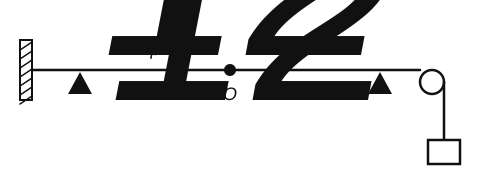
Two wires $W_1$ and $W_2$ have the same radius $r$ and respective densities $\rho_1$ and $\rho_2$, such that $\rho_2 = 4\rho_1$. They are joined together at the point $O$, as shown in the figure. The combination is used as a sonometer wire and kept under tension $T$. The point $O$ is midway between the two bridges. When a stationary wave is set up in the composite wire, the joint is found to be a node. The ratio of the number of antinodes formed in $W_1$ to $W_2$ is:
Answer: (B) $1:2$
Both parts have the same length $L$ and tension $T$. Same radius means $\mu \propto \rho$, so $\mu_2 = 4\mu_1$ and
$$v = \sqrt{T/\mu} \;\Rightarrow\; v_2 = \frac{v_1}{2}$$
The joint is a node, so each part vibrates in a whole number of loops at the same frequency $f$:
$$f = \frac{p_1v_1}{2L} = \frac{p_2v_2}{2L} \;\Rightarrow\; \frac{p_1}{p_2} = \frac{v_2}{v_1} = \frac12$$
Each loop has one antinode, so the ratio of antinodes is $1:2$.
 Solution by Sreeraj P, M.Sc Physics