

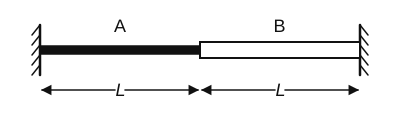
A wire of length $2L$, is made by joining two wires A and B of same length but different radii $r$ and $2r$ and made of the same material. It is vibrating at a frequency such that the joint of the two wires forms a node. If the number of antinodes in wire A is $p$ and that in B is $q$ then ratio $p:q$ is
Answer: (D) $1:2$
The tension $T$ is the same in both wires. Mass per unit length $\mu \propto r^2$, so $\mu_B = 4\mu_A$ and
$$v = \sqrt{T/\mu} \Rightarrow v_A = 2v_B \Rightarrow \lambda_A = 2\lambda_B\ (\text{same frequency})$$
Both segments have nodes at their ends, so each holds a whole number of loops:
$$L = p\frac{\lambda_A}{2} = q\frac{\lambda_B}{2} \Rightarrow \frac pq = \frac{\lambda_B}{\lambda_A} = \frac12$$
 Solution by Sreeraj P, M.Sc Physics