

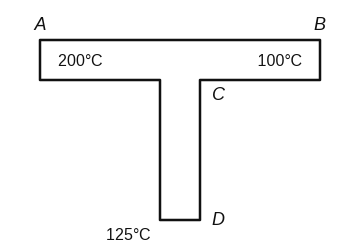
A rod $CD$ of thermal resistance $10.0$ K W$^{-1}$ is joined at the middle of an identical rod $AB$ as shown in figure. The ends $A$, $B$ and $D$ are maintained at $200^\circ$C, $100^\circ$C and $125^\circ$C respectively. The heat current in $CD$ is $P$ W. The value of $P$ is
Numerical value type. Enter your answer.
Answer: 2
Concept. Treat it like a circuit: temperatures are potentials, thermal resistances are resistors. At the junction $C$ heat in $=$ heat out. Each half of $AB$ has resistance $5$ K W$^{-1}$; $CD$ has $10$.
Step 1. Junction equation (temperature $T$ at $C$):
$$\frac{200-T}{5}=\frac{T-100}{5}+\frac{T-125}{10}$$
Step 2. Solve. $2(200-T)=2(T-100)+(T-125)\Rightarrow 400+200+125=5T\Rightarrow T=145^\circ$C.
Step 3. Current in $CD$. $P=\dfrac{145-125}{10}=2$ W.
Answer. $2$.
 Solution by Sreeraj P, M.Sc Physics


