

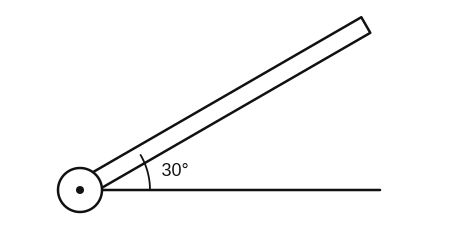
A rod of length $50\ \text{cm}$ is pivoted at one end. It is raised such that it makes an angle of $30^\circ$ from the horizontal as shown and released from rest. Its angular speed when it passes through the horizontal (in $\text{rad s}^{-1}$) will be $(g = 10\ \text{m s}^{-2})$
Answer: (B) $\sqrt{30}$
Concept. The pivot does no work, so energy is conserved. The rod's potential energy depends on how far its centre of mass drops; its kinetic energy is $\tfrac12I\omega^2$ about the pivot.
Step 1. Drop of the centre of mass. The centre is $\dfrac l2$ from the pivot. At $30^\circ$ it is $\dfrac l2\sin30^\circ=\dfrac l4$ above the horizontal position.
Step 2. Energy conservation.
$$Mg\frac l4=\frac12\cdot\frac{Ml^2}{3}\omega^2\ \Rightarrow\ \omega^2=\frac{3g}{2l}$$
Step 3. Numbers ($l=0.5$ m): $\omega^2=\dfrac{3\times10}{2\times0.5}=30$, so $\omega=\sqrt{30}$ rad s$^{-1}$.
Answer. Option B.
 Solution by Sreeraj P, M.Sc Physics


