

A thin rod of mass $0.9$ kg and length $1$ m is suspended, at rest, from one end so that it can freely oscillate in the vertical plane. A particle of mass $0.1$ kg moving in a straight line with velocity $80\ \text{m s}^{-1}$ hits the rod at its bottom most point and sticks to it (see figure). The angular speed (in rad s$^{-1}$) of the rod immediately after the collision will be ______.
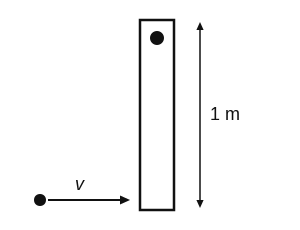
Numerical value type. Enter your answer.
Answer: 20
Concept. At the pivot there is a large impulsive force during the impact, so linear momentum is not conserved. But that force passes through the pivot, so angular momentum about the pivot is conserved.
Step 1. Angular momentum before (about the pivot; the particle moves horizontally at $1$ m below it):
$$L=mvd=0.1\times80\times1=8\ \text{kg m}^2\text{s}^{-1}$$
Step 2. Moment of inertia after (rod about its end plus the particle stuck at the bottom):
$$I=\frac{0.9\times1^2}{3}+0.1\times1^2=0.3+0.1=0.4\ \text{kg m}^2$$
Step 3. Conserve. $\omega=\dfrac LI=\dfrac{8}{0.4}=20$ rad s$^{-1}$.
Answer. $20$.
 Solution by Sreeraj P, M.Sc Physics


