

Two blocks of masses $m$ and $M$ ($M > m$) are placed on a frictionless table as shown in the figure. A massless spring with spring constant $k$ is attached to the lower block. If the system is slightly displaced and released, then ($\mu$ = coefficient of friction between the two blocks):
(A) The time period of small oscillation of the two blocks is $T = 2\pi\sqrt{\dfrac{m + M}{k}}$
(B) The acceleration of the blocks is $a = \dfrac{kx}{M + m}$ ($x$ = displacement of the blocks from the mean position)
(C) The magnitude of the frictional force on the upper block is $\dfrac{m\mu|x|}{M + m}$
(D) The maximum amplitude of the upper block, if it does not slip, is $\dfrac{\mu(M + m)g}{k}$
(E) The maximum frictional force can be $\mu(M + m)g$.
Choose the correct answer from the options given below:
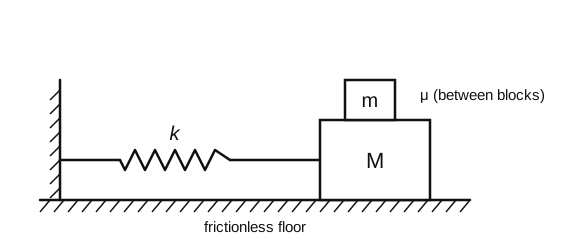
Answer: (A) A, B, D only
While the blocks move together, the spring acts on total mass $M + m$:
- (A) $T = 2\pi\sqrt{\dfrac{M + m}{k}}$ ✔
- (B) $(M + m)a = -kx$, so $|a| = \dfrac{kx}{M + m}$ ✔
- (C) Friction is the only horizontal force on the upper block: $f = ma = \dfrac{mk|x|}{M + m}$. The statement has $\mu$ in place of $k$. ✘
- (D) No slipping needs $f \le \mu mg$ at the extreme position: $\dfrac{mkA}{M + m} \le \mu mg \Rightarrow A_{\max} = \dfrac{\mu(M + m)g}{k}$ ✔
- (E) The normal force between the blocks is $mg$, so the friction can be at most $\mu mg$. ✘
Correct: A, B and D only.
 Solution by Sreeraj P, M.Sc Physics