

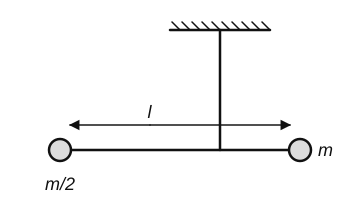
Two masses $m$ and $\frac{m}{2}$ are connected at the two ends of a massless rigid rod of length $l$. The rod is suspended by a thin wire of torsional constant $k$ at the centre of mass of the rod-mass system (see figure). Because of torsional constant $k$, the restoring torque is $\tau = k\theta$ for angular displacement $\theta$. If the rod is rotated by $\theta_0$ and released, the tension in it when it passes through its mean position will be
Answer: (D) $\dfrac{k\theta_0^2}{l}$
The centre of mass is at $l/3$ from $m$ and $2l/3$ from $m/2$. Moment of inertia about the wire:
$$I = m\left(\frac l3\right)^2 + \frac m2\left(\frac{2l}{3}\right)^2 = \frac{ml^2}{9} + \frac{2ml^2}{9} = \frac{ml^2}{3}$$
The rod performs angular SHM with $\Omega = \sqrt{k/I}$, so at the mean position its angular speed is
$$\omega_{\max} = \theta_0\sqrt{\frac kI} \Rightarrow \omega_{\max}^2 = \frac{3k\theta_0^2}{ml^2}$$
The tension in the rod provides the centripetal force on each mass. For mass $m$:
$$T = m\,\omega_{\max}^2\,\frac l3 = m\cdot\frac{3k\theta_0^2}{ml^2}\cdot\frac l3 = \frac{k\theta_0^2}{l}$$
(The same value is obtained for $m/2$ at $2l/3$.)
 Solution by Sreeraj P, M.Sc Physics