

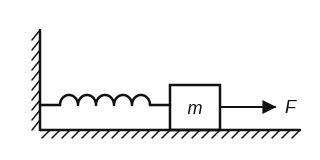
A block of mass $m$, lying on a smooth horizontal surface, is attached to a spring (of negligible mass) of spring constant $k$. The other end of the spring is fixed, as shown in the figure. The block is initially at rest in its equilibrium position. If now the block is pulled with a constant force $F$, the maximum speed of the block is
Answer: (A) $\dfrac{F}{\sqrt{mk}}$
Concept. A constant force only shifts the equilibrium: the new mean is at $x_0=\dfrac Fk$. The block starts at rest at $x=0$, which is an extreme, so the amplitude is $\dfrac Fk$.
Step 1. Amplitude. $A=\dfrac Fk$.
Step 2. Maximum speed. $v_{\max}=A\omega=\dfrac Fk\sqrt{\dfrac km}=\dfrac{F}{\sqrt{mk}}$.
Answer. Option A. Check by energy: at $x=F/k$, $Fx-\tfrac12kx^2=\tfrac12mv^2$ gives the same.
 Solution by Sreeraj P, M.Sc Physics


