

An infinitely long current carrying wire and a small current carrying loop are in the plane of the paper as shown. The radius of the loop is $a$ and distance of its centre from the wire is $d$ ($d \gg a$). If the loop applies a force $F$ on the wire then
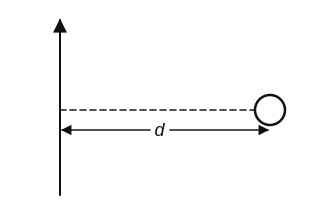
Answer: (A) $F \propto \left(\dfrac{a}{d}\right)^2$
Concept. By Newton's third law, the force of the loop on the wire equals the force of the wire on the loop. A uniform field gives a loop no net force; the force comes from the change of the wire's field across the loop. For a small loop, $F=m\left|\dfrac{dB}{dx}\right|$ with $m=I'\pi a^2$ and $B=\dfrac{\mu_0I}{2\pi x}$.
Step 1. Gradient. $\left|\dfrac{dB}{dx}\right|=\dfrac{\mu_0I}{2\pi d^2}$ at the loop.
Step 2. Force. $F=I'\pi a^2\cdot\dfrac{\mu_0I}{2\pi d^2}=\dfrac{\mu_0II'}{2}\left(\dfrac ad\right)^2$.
Answer. $F\propto\left(\dfrac ad\right)^2$ (Option A).
 Solution by Sreeraj P, M.Sc Physics


