

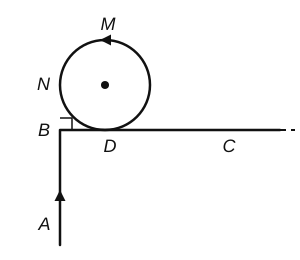
A very long wire ABDMNDC is shown in figure carrying current $I$. AB and BC parts are straight, long and at right angle. At D the wire forms a circular turn DMND of radius $R$. AB, BC parts are tangential to the circular turn at N and D. Magnetic field at the centre of the circle is:
Answer: (A) $\dfrac{\mu_0 I}{2\pi R}\left(\pi + \dfrac{1}{\sqrt{2}}\right)$
Let the centre be $P$. It is at perpendicular distance $R$ from both straight lines; the feet of the perpendiculars are N (on AB) and D (on BC), each a distance $R$ from the corner B. For a straight segment, $B = \dfrac{\mu_0 I}{4\pi R}(\sin\theta_2 - \sin\theta_1)$ with angles measured from the perpendicular.
Wire AB (from far below up to B): angles from $-90^\circ$ to $-45^\circ$, so $B_{AB} = \dfrac{\mu_0 I}{4\pi R}\left(1 - \dfrac{1}{\sqrt{2}}\right)$, into the page.
Wire BC (from B to far right): angles from $-45^\circ$ to $90^\circ$, so $B_{BC} = \dfrac{\mu_0 I}{4\pi R}\left(1 + \dfrac{1}{\sqrt{2}}\right)$, out of the page.
Net from the straight parts: $\dfrac{\mu_0 I}{4\pi R}\cdot\sqrt{2} = \dfrac{\mu_0 I}{2\sqrt{2}\,\pi R}$, out of the page.
The loop is traversed anticlockwise, giving $\dfrac{\mu_0 I}{2R}$, also out of the page. Total:
$$B = \frac{\mu_0 I}{2R} + \frac{\mu_0 I}{2\sqrt{2}\pi R} = \frac{\mu_0 I}{2\pi R}\left(\pi + \frac{1}{\sqrt{2}}\right)$$
 Solution by Sreeraj P, M.Sc Physics