

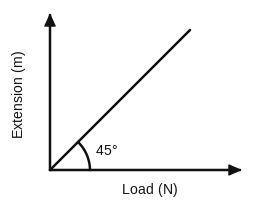
As shown in the figure, in an experiment to determine Young's modulus of a wire, the extension–load curve is plotted. The curve is a straight line passing through the origin and makes an angle of $45^\circ$ with the load axis. The length of wire is $62.8\ \text{cm}$ and its diameter is $4\ \text{mm}$. The Young's modulus is found to be $x\times10^4\ \text{N m}^{-2}$. The value of $x$ is ______.
Numerical value type. Enter your answer.
Answer: 5
Concept. $Y=\dfrac{FL}{A\,\Delta l}=\dfrac LA\cdot\dfrac{F}{\Delta l}$. On an extension–load graph the slope is $\dfrac{\Delta l}{F}$, so $Y=\dfrac{L}{A\times\text{slope}}$.
Step 1. Slope. The line makes $45^\circ$ with the load axis: $\dfrac{\Delta l}{F}=\tan45^\circ=1$ m N$^{-1}$.
Step 2. Area. Diameter $4$ mm: $A=\pi(2\times10^{-3})^2=1.256\times10^{-5}$ m$^2$.
Step 3. Young's modulus.
$$Y=\frac{0.628}{1.256\times10^{-5}\times1}=5\times10^4\ \text{N m}^{-2}$$
Answer. $x=5$.
 Solution by Sreeraj P, M.Sc Physics


