

In a uniform magnetic field of $0.049$ T, a magnetic needle performs $20$ complete oscillations in $5$ seconds as shown. The moment of inertia of the needle is $9.8 \times 10^{-6}\ \text{kg m}^2$. If the magnitude of magnetic moment of the needle is $x \times 10^{-5}\ \text{A m}^2$; then the value of '$x$' is :
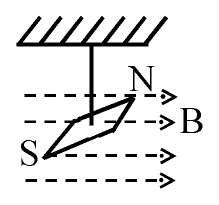
Answer: (B) $1280\pi^2$
Concept. A needle of moment $m$ in a field $B$ oscillates like a torsional pendulum with $T = 2\pi\sqrt{\dfrac{I}{mB}}$, so $m$ follows from the measured period.
Step 1. Find the period. $20$ oscillations take $5$ s:
$$T = \frac{5}{20} = 0.25\ \text{s}$$
Step 2. Solve for the moment. Squaring the period formula:
$$m = \frac{4\pi^2 I}{T^2 B} = \frac{4\pi^2 \times 9.8 \times 10^{-6}}{(0.25)^2 \times 0.049} = \frac{4\pi^2 \times 9.8 \times 10^{-6}}{3.0625 \times 10^{-3}} = 12.8\pi^2 \times 10^{-3}\ \text{A m}^2$$
Step 3. Compare with the given form. $12.8\pi^2 \times 10^{-3} = 1280\pi^2 \times 10^{-5}$, so $x = 1280\pi^2$.
Answer. $x = 1280\pi^2$ (Option B).
 Solution by Sreeraj P, M.Sc Physics