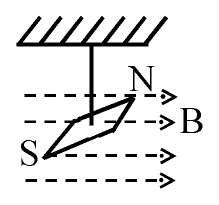
In a uniform magnetic field of $0.049$ T, a magnetic needle performs $20$ complete oscillations in $5$ seconds as shown. The moment of inertia of the needle is $9.8 \times 10^{-6}\ \text{kg m}^2$. If the magnitude of magnetic moment of the needle is $x \times 10^{-5}\ \text{A m}^2$; then the value of '$x$' is :
Concept. A needle of moment $m$ in a field $B$ oscillates like a torsional pendulum with $T = 2\pi\sqrt{\dfrac{I}{mB}}$, so $m$ follows from the measured period.
Step 1. Find the period. $20$ oscillations take $5$ s: $$T = \frac{5}{20} = 0.25\ \text{s}$$
Step 2. Solve for the moment. Squaring the period formula: $$m = \frac{4\pi^2 I}{T^2 B} = \frac{4\pi^2 \times 9.8 \times 10^{-6}}{(0.25)^2 \times 0.049} = \frac{4\pi^2 \times 9.8 \times 10^{-6}}{3.0625 \times 10^{-3}} = 12.8\pi^2 \times 10^{-3}\ \text{A m}^2$$
Step 3. Compare with the given form. $12.8\pi^2 \times 10^{-3} = 1280\pi^2 \times 10^{-5}$, so $x = 1280\pi^2$.
Answer. $x = 1280\pi^2$ (Option B).
Solution by Sreeraj P, M.Sc Physics
Q 12-05-002NEETNEET 2024Top questionEasy
Match List-I with List-II.
List-I (Material): A. Diamagnetic B. Ferromagnetic C. Paramagnetic D. Non-magnetic
List-II (Susceptibility ($\chi$)): I. $\chi = 0$ II. $0 > \chi \geq -1$ III. $\chi >> 1$ IV. $0 < \chi < \varepsilon$ (a small positive number)
Choose the correct answer from the options given below:
Concept. Materials are classified by the sign and size of their susceptibility $\chi$.
Step 1. Match each class.
Diamagnetic: small negative $\chi$, with $-1 \leq \chi < 0$ → II.
Ferromagnetic: very large positive $\chi$, $\chi >> 1$ → III.
Paramagnetic: small positive $\chi$ → IV.
Non-magnetic: $\chi = 0$ → I.
Answer. A-II, B-III, C-IV, D-I (Option C).
Solution by Sreeraj P, M.Sc Physics
Q 12-05-003NEETNEET 2024Top questionMedium
An iron bar of length L has magnetic moment M. It is bent at the middle of its length such that the two arms make an angle $60°$ with each other. The magnetic moment of this new magnet is:
Concept. Bending a magnet keeps the pole strength $m$; only the straight-line distance between the poles changes, and $M = m \times$ (pole separation).
Step 1. Original magnet. $M = mL$.
Step 2. Geometry after bending. Each arm is $\dfrac{L}{2}$ long and the arms meet at $60°$. The two arms and the line joining the ends form an equilateral triangle, so the poles are now $\dfrac{L}{2}$ apart.
Step 3. New moment. $$M' = m \cdot \frac{L}{2} = \frac{M}{2}$$
Answer. $\dfrac{M}{2}$ (Option D).
Solution by Sreeraj P, M.Sc Physics
Q 12-05-004NEETNEET 2023Top questionEasy
The net magnetic flux through any closed surface is :
Concept. Gauss's law for magnetism: $\displaystyle\oint\vec{B}\cdot d\vec{S} = 0$.
Step 1. Reason. Magnetic monopoles do not exist and field lines form closed loops, so every line that enters a closed surface also leaves it. The inward and outward flux cancel exactly.
Answer. Zero (Option A).
Solution by Sreeraj P, M.Sc Physics
Q 12-05-005NEETNEET 2020Top questionEasy
An iron rod of susceptibility $599$ is subjected to a magnetising field of $1200\ \text{A m}^{-1}$. The permeability of the material of the rod is : ($\mu_0 = 4\pi \times 10^{-7}\ \text{T m A}^{-1}$)
Answer. $2.4\pi \times 10^{-4}\ \text{T m A}^{-1}$ (Option A).
Solution by Sreeraj P, M.Sc Physics
Q 12-05-006NEETEAMCET 2007 (Medical)Medium
A bar magnet of magnetic moment $M_1$ is axially cut into two equal parts. If these two pieces are arranged perpendicular to each other, the resultant magnetic moment is $M_2$. Then the value of $\dfrac{M_1}{M_2}$ is
A bar magnet has moment of inertia $49 \times 10^{-2}\ \text{kg m}^2$ and vibrates in a magnetic field of induction $0.5 \times 10^{-4}$ T. The time period of vibration is $8.8$ s. The magnetic moment of the bar magnet is
Two bar magnets are placed in a vibration magnetometer and allowed to vibrate. They make $20$ oscillations per minute when their similar poles are on the same side, while they make $15$ oscillations per minute when their opposite poles lie on the same side. The ratio of their magnetic moments is
Concept. In a vibration magnetometer $f = \dfrac{1}{2\pi}\sqrt{\dfrac{MB}{I}}$. The combination has the same moment of inertia in both arrangements, so $f^2 \propto M$.
Step 1. Net moments. Similar poles on the same side: $M_1 + M_2$. Opposite poles on the same side: $M_1 - M_2$.
Step 2. Ratio of frequencies. $$\frac{M_1 + M_2}{M_1 - M_2} = \frac{20^2}{15^2} = \frac{16}{9}$$
With a standard rectangular bar magnet, the time period of a vibration magnetometer is $4$ s. The bar magnet is cut parallel to its length into four equal pieces. The time period of the vibration magnetometer when one piece is used (in seconds) is (bar magnet breadth is small)
Concept. $T = 2\pi\sqrt{\dfrac{I}{MB}}$. Cutting parallel to the length changes both $I$ and $M$.
Step 1. Moment of inertia of a piece. Each piece has $\dfrac{1}{4}$ of the mass and the same length; with small breadth $I \approx \dfrac{mL^2}{12}$, so $I' = \dfrac{I}{4}$.
Step 2. Magnetic moment of a piece. The pole strength is shared among the four pieces and the length is unchanged, so $M' = \dfrac{M}{4}$.
Step 3. New period. $\dfrac{I'}{M'} = \dfrac{I}{M}$, so the period is unchanged: $T' = 4$ s.
Answer. $4$ s (Option C).
Solution by Sreeraj P, M.Sc Physics
Q 12-05-010NEETJEE MainEasy
A bar magnet of length $10$ cm and pole strength $2$ A m is cut into two equal halves perpendicular to its length. The magnetic moment of each half is
Concept. Cutting perpendicular to the length keeps the pole strength and halves the length; $M = m \times$ length.
Step 1. Length of each half. $\dfrac{10}{2} = 5$ cm $= 0.05$ m.
Step 2. Moment. $M = 2 \times 0.05 = 0.1\ \text{A m}^2$ (half of the original $0.2\ \text{A m}^2$).
Answer. $0.1\ \text{A m}^2$ (Option A).
Solution by Sreeraj P, M.Sc Physics
Q 12-05-011NEETJEE MainMedium
The magnetic field of a short bar magnet at a point $10$ cm from its centre on the axial line is $2 \times 10^{-4}$ T. The field at a point $20$ cm from its centre on the equatorial line is
Concept. The angle of dip is the angle the Earth's total field makes with the horizontal.
Step 1. At the magnetic equator. The field there is horizontal ($B_V = 0$), so a dip needle rests horizontally: $\delta = 0°$. (At the magnetic poles it is $90°$.)
Answer. $0°$ (Option C).
Solution by Sreeraj P, M.Sc Physics
Q 12-05-017NEETJEE MainMedium
A dip circle is placed in a vertical plane at $30°$ to the magnetic meridian. The apparent dip is $45°$. The true dip $\delta$ satisfies
Concept. In a vertical plane at angle $\theta$ to the magnetic meridian, the dip needle feels only the component $B_H\cos\theta$ of the horizontal field, while the vertical component $B_V$ is unchanged.
A solenoid of $1000$ turns per metre carries $2$ A. An iron core of relative permeability $400$ is inserted. The magnetic field inside is ($\mu_0 = 4\pi \times 10^{-7}$ T m/A)
Answer: (B) the energy lost as heat per unit volume per cycle
Concept. In one cycle of magnetisation the work done per unit volume on the material is $\oint H\,dB$, which is the area enclosed by the $B$-$H$ loop.
Step 1. Interpret. This energy is not recovered; it appears as heat. So the loop area measures the hysteresis loss per unit volume per cycle. Soft iron has a thin loop, which is why it is used in transformer cores.
Answer. The energy lost as heat per unit volume per cycle (Option B).
Solution by Sreeraj P, M.Sc Physics
Q 12-05-024NEETJEE MainEasy
A diamagnetic substance placed in a non-uniform magnetic field
Answer: (C) moves from the stronger to the weaker region
Concept. A diamagnetic material acquires a weak magnetisation opposite to the applied field, so its energy is lower where the field is weaker.
Step 1. Direction of the force. The force pushes the sample from the stronger towards the weaker field region. (Paramagnets and ferromagnets are pulled the other way.)
Answer. It moves from the stronger to the weaker region (Option C).
Solution by Sreeraj P, M.Sc Physics
Q 12-05-025JEE MainMedium
A short bar magnet placed with its axis at $30°$ to a uniform field of $0.25$ T experiences a torque of $4.5 \times 10^{-2}$ N m. Find its magnetic moment in $\text{A m}^2$.
Q 12-05-026JEE MainJEE Main 2026 (4 Apr, Shift 2)Easy
A solenoid has a core made of material with relative permeability $400$. The magnetic field produced in the interior of solenoid is $1.0$ T. The magnetic intensity in SI units is $\alpha \times 10^5$. The value of $\alpha$ is ______.
(Free space permeability $\mu_0 = 4\pi \times 10^{-7}$ SI units.)
Q 12-05-027JEE MainJEE Main 2026 (4 Apr, Shift 2)Hard
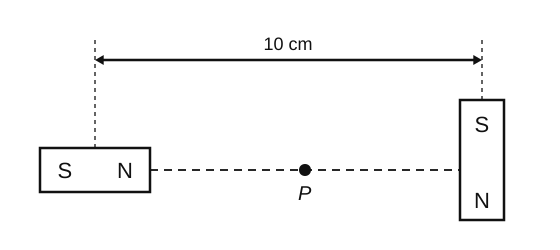
Two identical small bar magnets each of dipole moment $3\sqrt{5}$ J/T are placed at a center to center separation of $10$ cm, with their axes perpendicular to each other as shown in figure. The value of magnetic field at the point P midway between the magnets is $\alpha \times 10^{-3}$ T. The value of $\alpha$ is ______
Concept. P is on the axis of the left magnet and on the equatorial line of the right one, $5$ cm from each. Axial field $\dfrac{\mu_0}{4\pi}\dfrac{2m}{r^3}$ points along $\vec m$; equatorial field $\dfrac{\mu_0}{4\pi}\dfrac{m}{r^3}$ points opposite to $\vec m$. The two are perpendicular, so add them as vectors.
Step 1. Axial field. $B_1=10^{-7}\times\dfrac{2\times3\sqrt5}{(0.05)^3}=10^{-7}\times6\sqrt5\times8000=4.8\sqrt5\times10^{-3}$ T, to the right.
Step 2. Equatorial field. Half as large: $B_2=2.4\sqrt5\times10^{-3}$ T, upward (the right magnet's moment points down, S to N).
Step 3. Resultant. $B=\sqrt{B_1^2+B_2^2}=2.4\sqrt5\times10^{-3}\sqrt{4+1}=2.4\times5\times10^{-3}=12\times10^{-3}$ T.
Answer. $\alpha=12$.
Solution by Sreeraj P, M.Sc Physics
Q 12-05-028JEE MainJEE Main 2026 (24 Jan, Shift 1)Easy
A short bar magnet placed with its axis at $30^\circ$ with an external field of 800 Gauss, experiences a torque of $0.016$ N.m. The work done in moving it from most stable to most unstable position is $\alpha\times10^{-3}$ J. The value of $\alpha$ is ______ .
Concept. The torque gives the moment ($\tau=mB\sin\theta$); then the work from stable to unstable is $2mB$.
Step 1. Moment. $m=\dfrac{0.016}{0.08\times0.5}=0.4$ A m$^2$ (800 G $=0.08$ T).
Step 2. Work. $2\times0.4\times0.08=0.064$ J.
Answer. $\alpha=64$.
Solution by Sreeraj P, M.Sc Physics
Q 12-05-029JEE MainJEE Main 2025 (28 Jan, Shift 2)Hard
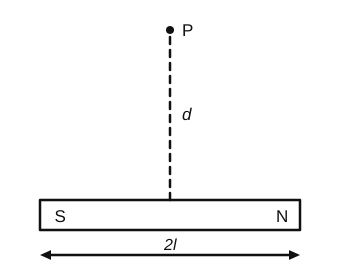
A bar magnet has total length $2l = 20$ units and the field point $P$ is at a distance $d = 10$ units from the centre of the magnet, as shown in the figure. If the relative uncertainty of length measurement is $1\%$, then the uncertainty of the magnetic field at point $P$ is
Concept. On the perpendicular bisector of a magnet of length $2l$ (pole strength $q_m$), $B=\dfrac{\mu_0}{4\pi}\dfrac{q_m(2l)}{(d^2+l^2)^{3/2}}\propto\dfrac{l}{(d^2+l^2)^{3/2}}$. Both $l$ and $d$ are lengths measured with $1\%$ uncertainty; maximum errors add.
Step 1. Error in $d^2+l^2$. $\Delta(d^2+l^2)=2d^2\dfrac{\Delta d}{d}+2l^2\dfrac{\Delta l}{l}=2(d^2+l^2)\times1\%$, so its relative error is $2\%$.
Step 2. Error in $B$. $\dfrac{\Delta B}{B}=\dfrac{\Delta l}{l}+\dfrac32\times2\%=1\%+3\%=4\%$.
Answer. $4\%$ (Option A).
Solution by Sreeraj P, M.Sc Physics
Q 12-05-030JEE MainJEE Main 2025 (29 Jan, Shift 2)Easy
Match List-I with List-II.
List-I
(A) Magnetic induction
(B) Magnetic intensity
(C) Magnetic flux
(D) Magnetic moment
List-II
(I) Ampere metre$^2$
(II) Weber
(III) Gauss
(IV) Ampere/metre
Choose the correct answer from the options given below:
Step 1. Units. Magnetic induction $B$: tesla or gauss (III). Magnetic intensity $H$: A/m (IV). Magnetic flux: weber (II). Magnetic moment: A m$^2$ (I).
Q 12-05-031JEE MainJEE Main 2024 (4 Apr, Shift 2)Easy
The magnetic moment of a bar magnet is $0.5\ \text{A m}^2$. It is suspended in a uniform magnetic field of $8\times10^{-2}\ \text{T}$. The work done in rotating it from its most stable to its most unstable position is
Concept. Energy of a dipole $U=-mB\cos\theta$. Most stable: $\theta=0$ ($U=-mB$); most unstable: $\theta=180^\circ$ ($U=+mB$). Work needed $=2mB$.
Step 1. Apply. $2\times0.5\times8\times10^{-2}=8\times10^{-2}$ J.
Answer. Option A.
Solution by Sreeraj P, M.Sc Physics
Q 12-05-032JEE MainJEE Main 2024 (29 Jan, Shift 1)Easy
The magnetic potential due to a magnetic dipole at a point on its axis situated at a distance of $20\ \text{cm}$ from its centre is $1.5\times10^{-5}\ \text{T m}$. The magnetic moment of the dipole is ______ $\text{A m}^2$. (Given: $\dfrac{\mu_0}{4\pi} = 10^{-7}\ \text{T m A}^{-1}$)
Concept. A paramagnet has a small positive susceptibility: it is magnetised weakly along the field and pulled weakly towards stronger field.
Step 1. Check. A: aligns along the field, true. B: "strongly" attracted is ferromagnetic behaviour, false. C: $\chi$ slightly above zero, true. D: moving from strong to weak field is diamagnetic behaviour, false.
Answer. A, C only (Option C).
Solution by Sreeraj P, M.Sc Physics
Q 12-05-034JEE MainJEE Main 2024 (8 Apr, Shift 2)Easy
The coercivity of a magnet is $5\times10^3\ \text{A/m}$. The amount of current required to be passed in a solenoid of length $30\ \text{cm}$ and number of turns 150, so that the magnet gets demagnetised when inside the solenoid, is ______ A.
Concept. A magnet is demagnetised when the reverse $H=nI$ reaches its coercivity.
Step 1. Solve. $I=\dfrac{H}{n}=\dfrac{5\times10^3}{150/0.3}=10$ A.
Answer. $10$.
Solution by Sreeraj P, M.Sc Physics
Q 12-05-035JEE MainJEE Main 2024 (9 Apr, Shift 2)Easy
A straight magnetic strip has a magnetic moment of $44\ \text{A m}^2$. If the strip is bent in a semicircular shape, its magnetic moment will be ______ $\text{A m}^2$. (given $\pi = \dfrac{22}{7}$)
Concept. Magnetic moment $=$ pole strength $\times$ straight distance between the poles. Bending into a semicircle of arc length $l$: radius $\dfrac l\pi$, poles a diameter $\dfrac{2l}{\pi}$ apart.
Step 1. New moment. $m'=\dfrac{2}{\pi}m=\dfrac{2\times44\times7}{22}=28$ A m$^2$.
Answer. $28$.
Solution by Sreeraj P, M.Sc Physics
Q 12-05-036JEE MainJEE Main 2023 (31 Jan, Shift 1)Easy
A bar magnet with a magnetic moment $5.0\ \text{A m}^2$ is placed in parallel position relative to a magnetic field of $0.4\ \text{T}$. The amount of required work done in turning the magnet from parallel to antiparallel position relative to the field direction is ______.
Q 12-05-038JEE MainJEE Main 2023 (25 Jan, Shift 1)Easy
A solenoid of $1200$ turns is wound uniformly in a single layer on a glass tube $2\ \text{m}$ long and $0.2\ \text{m}$ in diameter. The magnetic intensity at the center of the solenoid when a current of $2\ \text{A}$ flows through it is
Answer: (D) Both Statement I and Statement II are true
Concept. Diamagnets have small negative $\chi$ (down to $-1$ for a perfect diamagnet) and move towards weaker field.
Answer. Both statements true (Option D).
Solution by Sreeraj P, M.Sc Physics
Q 12-05-040JEE MainJEE Main 2023 (11 Apr, Shift 1)Easy
The free space inside a current carrying toroid is filled with a material of susceptibility $2\times10^{-2}$. The percentage increase in the value of magnetic field inside the toroid will be
Answer: (B) Statement I is incorrect but Statement II is true
Concept. Diamagnetism comes from the orbital motion of electrons reacting to the applied field (like Lenz's law); it does not depend on thermal alignment of permanent moments.
Step 1. Statement I. Diamagnetic susceptibility is (almost) independent of temperature: false.
Step 2. Statement II. The induced moment always opposes the magnetising field, which is why $\chi\lt0$: true.
Answer. Option B.
Solution by Sreeraj P, M.Sc Physics
Q 12-05-042JEE MainJEE Main 2023 (12 Apr, Shift 1)Medium
A compass needle oscillates $20$ times per minute at a place where the dip is $30^\circ$ and $30$ times per minute where the dip is $60^\circ$. The ratio of total magnetic field due to the earth at two places respectively is $\dfrac4{\sqrt x}$. The value of $x$ is ______.
Q 12-05-043JEE MainJEE Main 2023 (8 Apr, Shift 1)Easy
The magnetic intensity at the centre of a long current carrying solenoid is found to be $1.6\times10^3\ \text{A m}^{-1}$. If the number of turns is $8$ per cm, then the current flowing through the solenoid is ______ A.
Answer: (C) Both A and R are correct and R is the correct explanation of A
Concept. An electromagnet must become strongly magnetised when current flows (high permeability) and lose its magnetism when the current is switched off (low retentivity, low coercivity).
Step 1. Assertion. Electromagnets use soft iron: true.
Step 2. Reason. Soft iron has high permeability and low retentivity: true, and these are exactly the properties that make it suitable.
Answer. Option C.
Solution by Sreeraj P, M.Sc Physics
Q 12-05-045JEE MainJEE Main 2023 (10 Apr, Shift 1)Easy
The current required to be passed through a solenoid of $15$ cm length and $60$ turns in order to demagnetise a bar magnet of magnetic intensity $2.4\times10^3\ \text{A m}^{-1}$ is ______ A.
Answer: (A) Both Statement I and Statement II are true.
Concept. Para- and ferromagnetic susceptibilities fall as temperature rises (Curie law, Curie–Weiss law). Diamagnetism arises from induced orbital moments opposing the field (Lenz's law).
Answer. Both true (Option A).
Solution by Sreeraj P, M.Sc Physics
Q 12-05-048JEE MainJEE Main 2022 (26 Jun, Shift 2)Easy
A bar magnet having a magnetic moment of $2.0\times10^5\ \text{J T}^{-1}$ is placed along the direction of a uniform magnetic field of magnitude $B = 14\times10^{-5}\ \text{T}$. The work done in rotating the magnet slowly through $60^\circ$ from the direction of field is
Step 1. Apply. $2\times10^5\times14\times10^{-5}\times(1-\tfrac12)=14$ J.
Answer. Option A.
Solution by Sreeraj P, M.Sc Physics
Q 12-05-049JEE MainJEE Main 2022 (27 Jun, Shift 1)Easy
The susceptibility of a paramagnetic material is $99$. The permeability of the material in Wb/A-m, is [Permeability of free space $\mu_0 = 4\pi\times10^{-7}$ Wb/A-m]
Concept. In a vertical plane at angle $\beta$ to the meridian, only $B_H\cos\beta$ acts horizontally, so the apparent dip satisfies $\tan\delta'=\dfrac{\tan\delta}{\cos\beta}$.
Q 12-05-051JEE MainJEE Main 2022 (27 Jul, Shift 1)Easy
Two bar magnets oscillate in a horizontal plane in earth's magnetic field with time periods of $3$ s and $4$ s respectively. If their moments of inertia are in the ratio of $3 : 2$ then the ratio of their magnetic moments will be
Q 12-05-052JEE MainJEE Main 2022 (27 Jul, Shift 2)Medium
A compass needle of oscillation magnetometer oscillates $20$ times per minute at a place $P$ of dip $30^\circ$. The number of oscillations per minute become $10$ at another place $Q$ of $60^\circ$ dip. The ratio of the total magnetic field at the two places $(B_Q : B_P)$ is:
Q 12-05-053JEE MainJEE Main 2021 (27 Jul, Shift 1)Medium
In a uniform magnetic field, the magnetic needle has a magnetic moment $9.85\times10^{-2}\ \text{A m}^2$ and moment of inertia $5\times10^{-6}\ \text{kg m}^2$. If it performs $10$ complete oscillations in $5$ seconds then the magnitude of the magnetic field is ______ mT. [Take $\pi^2$ as $9.85$]
Concept. Same formula, solved for $B$: $B=\dfrac{4\pi^2I}{mT^2}$.
Step 1. Period. $T=\dfrac5{10}=0.5$ s.
Step 2. Field. $B=\dfrac{4\times9.85\times5\times10^{-6}}{9.85\times10^{-2}\times0.25}=8\times10^{-3}$ T.
Answer. $8$ mT.
Solution by Sreeraj P, M.Sc Physics
Q 12-05-054JEE MainJEE Main 2021 (31 Aug, Shift 2)Medium
A long solenoid with $1000$ turns $\text{m}^{-1}$ has a core material with relative permeability $500$ and volume $10^3\ \text{cm}^3$. If the core material is replaced by another material having relative permeability of $750$ with same volume maintaining same current of $0.75$ A in the solenoid, the fractional change in the magnetic moment of the core would be approximately $\dfrac{x}{499}$. Find the value of $x$.
Answer: (D) may increase or decrease in size and change its orientation.
Concept. In a ferromagnet, an applied field makes the domains aligned with it grow at the expense of the others, and also turns the moments of domains towards the field.
Step 1. Apply. So some domains grow and others shrink, and orientations change.
Answer. Option D.
Solution by Sreeraj P, M.Sc Physics
Q 12-05-057JEE MainJEE Main 2021 (20 Jul, Shift 2)Easy
At an angle of $30^\circ$ to the magnetic meridian, the apparent dip is $45^\circ$. Find the true dip:
Q 12-05-058JEE MainJEE Main 2021 (20 Jul, Shift 2)Easy
The magnetic susceptibility of a material of a rod is 499. Permeability in vacuum is $4\pi\times10^{-7}\ \text{H m}^{-1}$. Absolute permeability of the material of the rod is
Concept. $\tan\delta'=\dfrac{\tan\delta}{\cos\beta}\ge\tan\delta$ since $\cos\beta\le1$.
Answer. The true dip is less than (or equal to) the apparent dip (Option B).
Solution by Sreeraj P, M.Sc Physics
Q 12-05-061JEE MainJEE Main 2021 (26 Aug, Shift 1)Medium
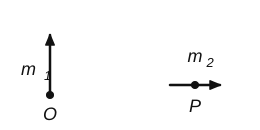
Two short magnetic dipoles $m_1$ and $m_2$ each having magnetic moment of $1$ A m$^2$ are placed at point $O$ and $P$ respectively. The distance between $OP$ is $1$ m. The torque experienced by the magnetic dipole $m_2$ due to the presence of $m_1$ is ______ $\times10^{-7}$ N m
Concept. Find the field of $m_1$ at the position of $m_2$, then $\tau=m_2B\sin\theta$.
Step 1. Field at P. P lies on the equatorial line of $m_1$ (which points up), at $r=1$ m: $B=\dfrac{\mu_0}{4\pi}\dfrac{m_1}{r^3}=10^{-7}$ T, pointing down (opposite to $\vec m_1$).
Step 2. Torque. $\vec m_2$ is horizontal, perpendicular to $\vec B$: $\tau=1\times10^{-7}\times\sin90^\circ=1\times10^{-7}$ N m.
Answer. $1$.
Solution by Sreeraj P, M.Sc Physics
Q 12-05-062JEE MainJEE Main 2021 (26 Aug, Shift 2)Medium
Q 12-05-063JEE MainJEE Main 2020 (5 Sep, Shift 2)Medium
An iron rod of volume $10^{-3}\ \text{m}^3$ and relative permeability $1000$ is placed as core in a solenoid with $10$ turns cm$^{-1}$. If a current of $0.5$ A is passed through the solenoid, then the magnetic moment of the rod will be:
Step 2. Moment. $5\times10^5\times10^{-3}=5\times10^2$ A m$^2$.
Answer. Option B.
Solution by Sreeraj P, M.Sc Physics
Q 12-05-064JEE MainJEE Main 2020 (7 Jan, Shift 1)Medium
Consider a circular coil of wire carrying constant current $I$, forming a magnetic dipole. The magnetic flux through an infinite plane that contains the circular coil and excludes the circular coil area is given by $\phi_i$. The magnetic flux through the area of the circular coil is given by $\phi_0$. Which of the following options is correct?
Concept. Magnetic field lines form closed loops: every line going up through the coil comes back down through the rest of the plane. Net flux through the whole infinite plane is zero.
Step 1. Balance. $\phi_i+\phi_0=0$.
Answer. $\phi_i=-\phi_0$ (Option D).
Solution by Sreeraj P, M.Sc Physics
Q 12-05-065JEE MainJEE Main 2020 (2 Sep, Shift 1)Easy
Magnetic materials used for making permanent magnets $(P)$ and magnets in a transformer $(T)$ have different properties. Which of the following properties best matches the type of magnet required?
Answer: (D) $P$: Large retentivity, large coercivity
Concept. A permanent magnet must keep its magnetism (large retentivity) and resist demagnetisation (large coercivity). A transformer core needs the opposite (small hysteresis loss).
Answer. Option D.
Solution by Sreeraj P, M.Sc Physics
Q 12-05-066JEE MainJEE Main 2020 (3 Sep, Shift 2)Easy
A perfectly diamagnetic sphere has a small spherical cavity at its centre, which is filled with a paramagnetic substance. The whole system is placed in a uniform magnetic field $\vec B$. Then the field inside the paramagnetic substance is:
Concept. A perfect diamagnet ($\chi=-1$) expels the field completely (like a superconductor), so no field reaches the cavity, whatever fills it.
Answer. Zero (Option B).
Solution by Sreeraj P, M.Sc Physics
Q 12-05-067JEE MainJEE Main 2020 (4 Sep, Shift 1)Medium
A small bar magnet placed with its axis at $30^\circ$ with an external magnetic field of $0.06\ \text{T}$ experiences a torque of $0.018\ \text{N m}$. The minimum work required to rotate it from its stable to unstable equilibrium position is:
Concept. The torque reading gives $m$: $\tau=mB\sin\theta$. Turning from stable ($\theta=0$) to unstable ($\theta=180^\circ$) needs $W=mB(\cos0-\cos180^\circ)=2mB$.
Step 1. Moment. $m=\dfrac{0.018}{0.06\times\sin30^\circ}=0.6$ A m$^2$.
Step 2. Work. $W=2\times0.6\times0.06=7.2\times10^{-2}$ J.
Answer. Option C.
Solution by Sreeraj P, M.Sc Physics
Q 12-05-068JEE MainJEE Main 2020 (4 Sep, Shift 2)Medium
A paramagnetic sample shows a net magnetisation of $6\ \text{A/m}$ when it is placed in an external magnetic field of $0.4\ \text{T}$ at a temperature of $4\ \text{K}$. When the sample is placed in an external magnetic field of $0.3\ \text{T}$ at a temperature of $24\ \text{K}$, then the magnetisation will be:
Q 12-05-070JEE MainJEE Main 2019 (10 Jan, Shift 1)Medium
A magnet of total magnetic moment $10^{-2}\,\hat i\ \text{A m}^2$ is placed in a time varying magnetic field, $B\,\hat i\,(\cos\omega t)$ where $B = 1\ \text{T}$ and $\omega = 0.125\ \text{rad s}^{-1}$. The work done for reversing the direction of the magnetic moment at $t = 1$ second, is:
Concept. Reversing the moment (from along $\vec B$ to against it) needs $W=2mB$, with $B$ at that instant.
Step 1. Field at $t=1$ s. $B=\cos(0.125)=0.992$ T.
Step 2. Work. $2\times10^{-2}\times0.992\approx0.02$ J.
Answer. Option B.
Solution by Sreeraj P, M.Sc Physics
Q 12-05-071JEE MainJEE Main 2019 (10 Jan, Shift 2)Medium
A hoop and a solid cylinder of same mass and radius are made of a permanent magnetic material with their magnetic moments along their respective axes. But the magnetic moment of the hoop is twice that of the solid cylinder. They are placed in a uniform magnetic field in such a manner that their magnetic moments make a small angle with the field. If the oscillation periods of hoop and cylinder are $T_h$ and $T_c$ respectively, then:
Q 12-05-072JEE MainJEE Main 2019 (10 Jan, Shift 2)Medium
At some location the horizontal component of earth's magnetic field is $18\times10^{-6}\ \text{T}$. At this location, a magnetic needle of length $0.12\ \text{m}$ and pole strength $1.8\ \text{A m}$ is suspended from its mid-point using a thread; it makes $45^\circ$ angle with the horizontal in equilibrium. To keep this needle horizontal, the vertical force that should be applied at one of its ends is:
Concept. Hanging freely, the needle lies along the total field, so dip $=45^\circ$ and $B_V=B_H$. Held horizontal, the vertical component exerts a torque $mB_V$, which the applied force must balance at a lever arm of half the length.
Step 1. Moment. $m=1.8\times0.12=0.216$ A m$^2$.
Step 2. Torque. $0.216\times18\times10^{-6}=3.89\times10^{-6}$ N m.
Step 3. Force. $\dfrac{3.89\times10^{-6}}{0.06}=6.5\times10^{-5}$ N.
Answer. Option C.
Solution by Sreeraj P, M.Sc Physics
Q 12-05-073JEE MainJEE Main 2019 (9 Jan, Shift 1)Easy
A bar magnet is demagnetized by inserting it inside a solenoid of length $0.2\ \text{m}$, 100 turns, and carrying a current of $5.2\ \text{A}$. The coercivity of the bar magnet is
Q 12-05-075JEE MainJEE Main 2019 (11 Jan, Shift 2)Easy
A paramagnetic substance in the form of a cube with sides $1$ cm has a magnetic dipole moment of $20\times10^{-6}$ J/T when a magnetic intensity of $60\times10^{3}$ A/m is applied. Its magnetic susceptibility is:
Q 12-05-076JEE MainJEE Main 2019 (12 Jan, Shift 2)Easy
A paramagnetic material has $10^{28}$ atoms m$^{-3}$. Its magnetic susceptibility at temperature $350$ K is $2.8\times10^{-4}$. Its susceptibility at $300$ K is
Q 12-05-077JEE MainJEE Main 2019 (12 Apr, Shift 1)Medium
A magnetic compass needle oscillates $30$ times per minute at a place where the dip is $45^\circ$ and $40$ times per minute where the dip is $30^\circ$. If $B_1$ and $B_2$ are the net magnetic fields due to the earth at the two places respectively, then the ratio $B_1/B_2$ is approximately equal to
Q 12-05-078JEE MainJEE Main 2018 (15 Apr, Shift 1)Medium
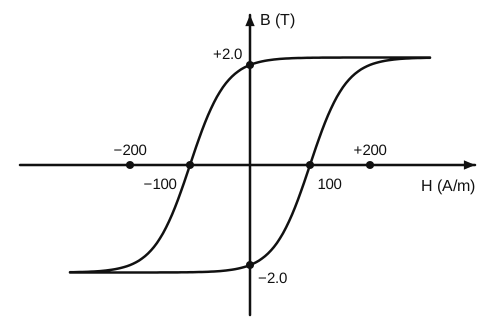
The $B-H$ curve for a ferromagnet is shown in the figure. The ferromagnet is placed inside a long solenoid with $1000\ \text{turns cm}^{-1}$. The current that should be passed in the solenoid to demagnetize the ferromagnet completely is,
Concept. To demagnetise the ferromagnet the solenoid must supply a reverse $H$ equal to the coercivity, the value of $H$ where the loop crosses $B=0$. In a solenoid $H=nI$.
Step 1. Coercivity. From the graph, $B=0$ at $H=\pm100$ A/m.
Step 2. Current. $n=1000$ per cm $=10^5$ per m: $I=\dfrac{100}{10^5}=10^{-3}$ A.
Answer. $1$ mA (Option C).
Solution by Sreeraj P, M.Sc Physics
Q 12-05-079JEE MainJEE Main 2017 (2 Apr)Easy
A magnetic needle of magnetic moment $6.7\times10^{-2}\ \text{A m}^2$ and moment of inertia $7.5\times10^{-6}\ \text{kg m}^2$ is performing simple harmonic oscillations in a magnetic field of $0.01$ T. Time taken for $10$ complete oscillations is:
Answer: (B) Zero potential energy when the torque is maximum
Concept. $U=-mB\cos\theta$ and $\tau=mB\sin\theta$. At $\theta=90^\circ$, $U=0$ and $\tau$ is maximum.
Answer. Option B.
Solution by Sreeraj P, M.Sc Physics
Q 12-05-081JEE MainJEE Main 2025 (2 Apr, Shift 1)Easy
The relationship between the magnetic susceptibility ($\chi$) and the magnetic permeability ($\mu$) is given by: ($\mu_0$ is the permeability of free space and $\mu_r$ is relative permeability)
Concept. $B=\mu H=\mu_0(1+\chi)H$, so $\mu_r=\dfrac{\mu}{\mu_0}=1+\chi$.
Answer. $\chi=\dfrac{\mu}{\mu_0}-1$ (Option A).
Solution by Sreeraj P, M.Sc Physics
Q 12-05-082JEE MainJEE Main 2025 (3 Apr, Shift 2)Easy
A magnetic dipole experiences a torque of $80\sqrt3\ \text{N m}$ when placed in a uniform magnetic field in such a way that the dipole moment makes an angle of $60^\circ$ with the magnetic field. The potential energy of the dipole is:
Concept. $\tau=mB\sin\theta$ gives $mB$; then $U=-mB\cos\theta$.
Step 1. $mB$. $\dfrac{80\sqrt3}{\sqrt3/2}=160$.
Step 2. Energy. $-160\times\tfrac12=-80$ J.
Answer. Option D.
Solution by Sreeraj P, M.Sc Physics
Q 12-05-083JEE MainJEE Main 2025 (7 Apr, Shift 1)Easy
The percentage increase in magnetic field ($B$) when the space within a current carrying solenoid is filled with magnesium (magnetic susceptibility $\chi_{mg} = 1.2\times10^{-5}$) is:
Answer: (C) Both (A) and (R) are correct and (R) is the correct explanation of (A)
Concept. A magnetic monopole would be a point where field lines begin or end.
Step 1. Reason. Magnetic field lines have no beginning or end: they form closed loops (Gauss's law for magnetism, net flux through any closed surface is zero). True.
Step 2. Assertion. Since no line starts or stops anywhere, there is no isolated pole: true, and it follows from the reason.


 Solution by Sreeraj P, M.Sc Physics