

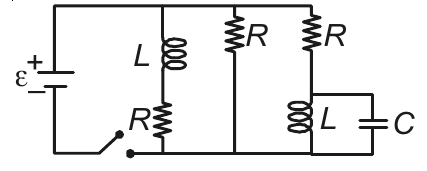
Figure shows a circuit contains three identical resistors with resistance $R = 9.0\ \Omega$ each, two identical inductors with inductance $L = 2.0$ mH each, and an ideal battery with emf $\varepsilon = 18$ V. The current '$i$' through the battery just after the switch closed is
Answer: (C) $2$ A
Concept. Just after the switch is closed, an inductor carries no current (it acts as an open circuit), because current through it cannot change suddenly.
Step 1. Branch with $L$ and $R$ in series. The inductor blocks current: $0$.
Step 2. Branch with $R$ alone.
$$i = \frac{\varepsilon}{R} = \frac{18}{9} = 2\ \text{A}$$
Step 3. Third branch. It contains an inductor; treating it as open at $t = 0$, it carries no current. So the battery current is $2$ A.
Note: the figure also shows a capacitor $C$ across the second inductor. An uncharged capacitor would let $2$ A flow in that branch as well, giving $4$ A, which is not an option. The question was framed with this flaw; the official answer is $2$ A, obtained by treating both inductor branches as open.
Answer. $2$ A (Option C).
 Solution by Sreeraj P, M.Sc Physics