

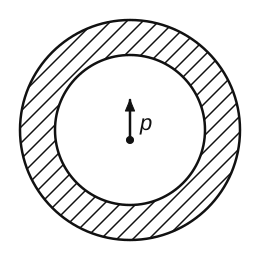
Shown in the figure is a shell made of a conductor. It has inner radius $a$ and outer radius $b$, and carries charge $Q$. At its centre a dipole $\vec{p}$ is placed as shown, then:
Answer: (B) Electric field outside the shell is the same as that of a point charge at the centre of the shell.
The dipole's field induces a non-uniform charge on the inner surface (net zero), which cancels the dipole's field inside the conductor. So (1) and (3) are wrong.
The total charge $Q$ goes to the outer surface. The cavity's contents (dipole plus induced charge) produce no field in the conductor or outside, so the outer charge spreads uniformly, independent of $\vec{p}$; (4) is wrong.
Outside, the field is that of a uniform spherical charge $Q$, i.e. the same as a point charge $Q$ at the centre.
 Solution by Sreeraj P, M.Sc Physics