

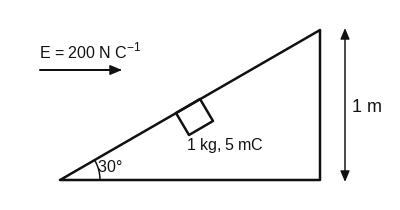
An inclined plane making an angle of $30^\circ$ with the horizontal is placed in a uniform horizontal electric field $200\ \frac{\text{N}}{\text{C}}$ as shown in the figure. A body of mass $1$ kg and charge $5$ mC is allowed to slide down from rest at a height of $1$ m. If the coefficient of friction is $0.2$, find the time taken by the body to reach the bottom. $\left[g = 9.8\ \text{m s}^{-2};\ \sin30^\circ = \frac{1}{2};\ \cos30^\circ = \frac{\sqrt{3}}{2}\right]$
Answer: (B) $1.3$ s
Concept. Resolve the horizontal electric force $qE$ along and perpendicular to the incline, together with gravity and friction, then use constant-acceleration kinematics over the slope length.
Step 1. Forces. $qE=5\times10^{-3}\times200=1$ N, pointing towards the high side. Along the slope it opposes the slide: $qE\cos30^\circ=0.87$ N. Into the slope it adds to the normal force: $qE\sin30^\circ=0.5$ N.
Step 2. Normal force and friction. $N=mg\cos30^\circ+0.5=8.49+0.5=8.99$ N; $f=0.2\times8.99=1.80$ N.
Step 3. Acceleration. $a=mg\sin30^\circ-0.87-1.80=4.9-2.67=2.23$ m s$^{-2}$.
Step 4. Time. Slope length $\dfrac{1}{\sin30^\circ}=2$ m: $t=\sqrt{\dfrac{2\times2}{2.23}}\approx1.3$ s.
Answer. Option B.
 Solution by Sreeraj P, M.Sc Physics


