

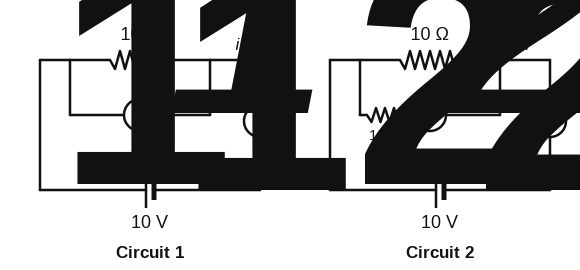
In the circuits shown below, the readings of voltmeters and the ammeters will be
Answer: (C) $V_1 = V_2$ and $i_1 = i_2$
Concept. Treat the meters as ideal: an ideal voltmeter draws no current and an ideal ammeter has no resistance.
Step 1. Circuit 1. No current goes through $V_1$, so the whole current flows through $10\ \Omega$:
$$i_1 = \frac{10}{10} = 1\ \text{A}, \qquad V_1 = 1 \times 10 = 10\ \text{V}$$
Step 2. Circuit 2. Again no current flows in the voltmeter branch, so $i_2 = 1$ A. The $10\ \Omega$ in series with $V_2$ carries no current and drops no voltage, so $V_2$ reads the full $10$ V across the main resistor.
Step 3. Compare. $V_1 = V_2 = 10$ V and $i_1 = i_2 = 1$ A.
Answer. $V_1 = V_2$ and $i_1 = i_2$ (Option C).
 Solution by Sreeraj P, M.Sc Physics