

The radius of circle, the period of revolution, initial position and sense of revolution are indicated in the fig. $y$-projection of the radius vector of rotating particle P is :
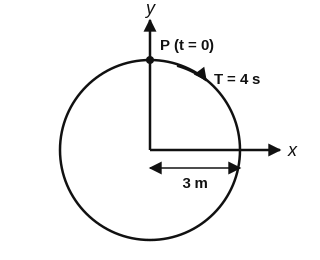
Answer: (D) $y(t) = 3\cos\left(\dfrac{\pi t}{2}\right)$, where $y$ in m
Concept. The projection of uniform circular motion on a diameter is SHM with amplitude equal to the radius and $\omega = 2\pi/T$. The starting point fixes the phase.
Step 1. Amplitude and $\omega$. $A = 3$ m, $\omega = \dfrac{2\pi}{4} = \dfrac{\pi}{2}$ rad/s.
Step 2. Phase. At $t = 0$, P is at the top of the circle, so $y(0) = +3$ m, the maximum. A cosine starts at its maximum:
$$y(t) = 3\cos\left(\frac{\pi t}{2}\right)$$
(Moving clockwise, P goes towards $+x$ and $y$ starts to fall, as a cosine does.)
Answer. $y(t) = 3\cos\left(\dfrac{\pi t}{2}\right)$ (Option D).
 Solution by Sreeraj P, M.Sc Physics